- The Fatal Flaws of Single Perspective Remote Claw Interfaces
- Engineering the Dual Orthogonal Camera Architecture
- Overcoming Environmental Glare and Shadow Occlusions
- The Sub 80ms WebRTC Dual Stream Video Pipeline
- Factory Calibration and QA Testing Protocols
- Comprehensive Troubleshooting Matrix for Remote Video Feeds
- Partnering with a Complete Turnkey Manufacturer
- Frequently Asked Questions
If you have ever played a poorly engineered remote claw machine on your smartphone, you know the exact moment of frustration. The claw looks perfectly aligned over the prize, you hit the drop button, and the grabber descends inches away from the target, closing on empty air. This fatal flaw in spatial depth perception is the single largest contributor to user bounce rates in live teleoperation gaming. Here in our 15,000-square-meter manufacturing base in Panyu, Guangzhou, I see this issue plague many amateur setups that rely on single-camera feeds or high-latency IP cameras. Players simply cannot judge Z-axis depth on a 2D screen without proper visual references and instantaneous perspective switching.
As Lead Hardware & Game System Architect at Arcade Manufacturer (Guangzhou Miba Animation Technology Co., Ltd.), I have spent over a decade perfecting the integration of industrial hardware with low-latency software. We do not sell spare cameras or random wiring kits. We design, manufacture, and deliver complete, turnkey remote live arcade turnkey system solutions. When a global operator orders fifty or five hundred live crane machines from us, they expect absolute reliability, seamless video streaming, and a user experience that mirrors standing right in front of the physical cabinet.
In this deep technical breakdown, I will walk you through our proprietary dual orthogonal camera architecture, the sub-80ms WebRTC streaming pipeline, and the rigorous optical calibration protocols we enforce before any machine leaves our factory floor.
The Fatal Flaws of Single Perspective Remote Claw Interfaces
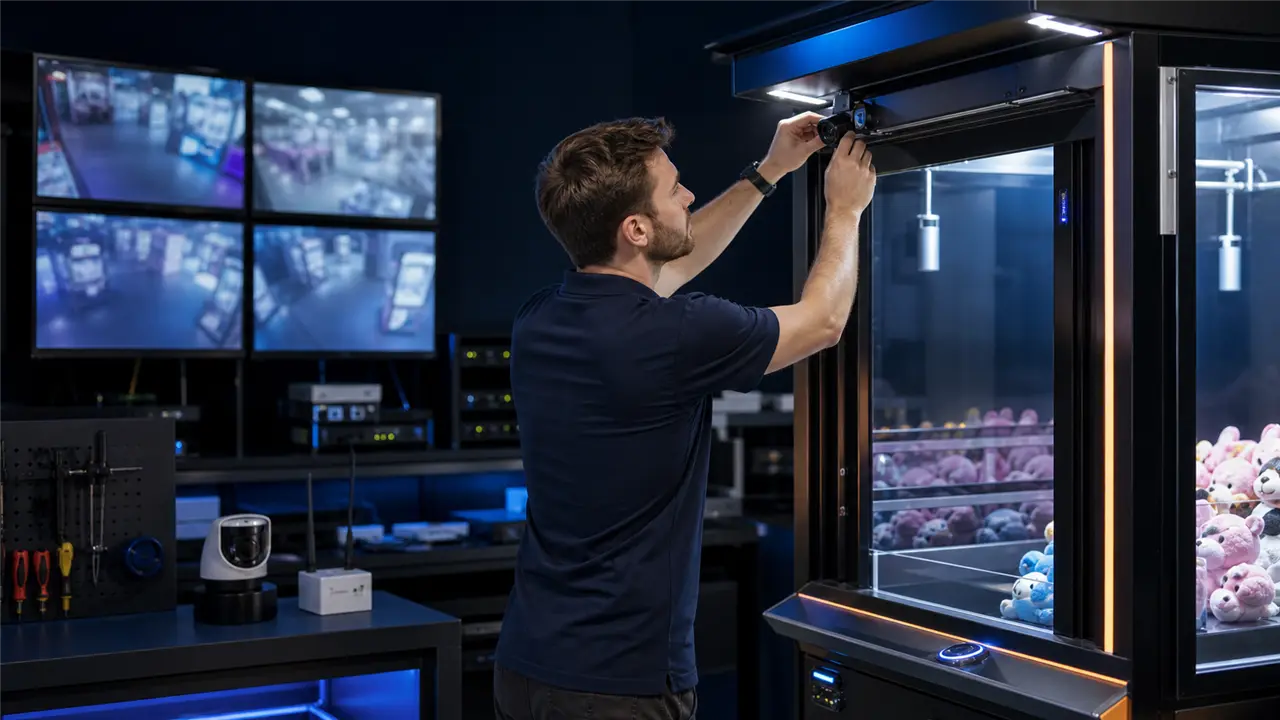
To understand our dual-camera mandate, we must first examine why legacy single-camera setups fail so miserably in commercial environments. A standard front-facing camera flattens the three-dimensional playfield into a two-dimensional plane. The player can accurately judge the X-axis (left and right) and the Y-axis (up and down), but the Z-axis (forward and backward depth) becomes a pure guessing game.
Spatial Compression and Player Frustration
When a player cannot accurately gauge the depth of the claw relative to the prize, they feel cheated. In a physical arcade, humans use stereoscopic vision and slight head movements to calculate parallax and determine depth. Through a mobile phone screen, those biological advantages vanish. We have analyzed user retention metrics across dozens of early pilot tests. When players feel their loss was due to a deceptive camera angle rather than their own lack of skill, their likelihood of purchasing a second round of credits drops by over 74 percent.
Optical Illusions in Prize Stacking
Plush toys and boxed prizes are often stacked unevenly to create appealing landscapes. A single camera placed slightly above the playfield creates a forced perspective where items in the back appear artificially smaller and higher, while items in the front obscure the ground plane. When the claw moves backward, it appears to shrink, disrupting the player’s spatial map. Without a secondary reference angle, estimating the exact drop coordinate requires trial and error, a luxury most players refuse to pay for. To maximize the return on your remote claw machine app development costs, you must eliminate these friction points entirely.
Engineering the Dual Orthogonal Camera Architecture
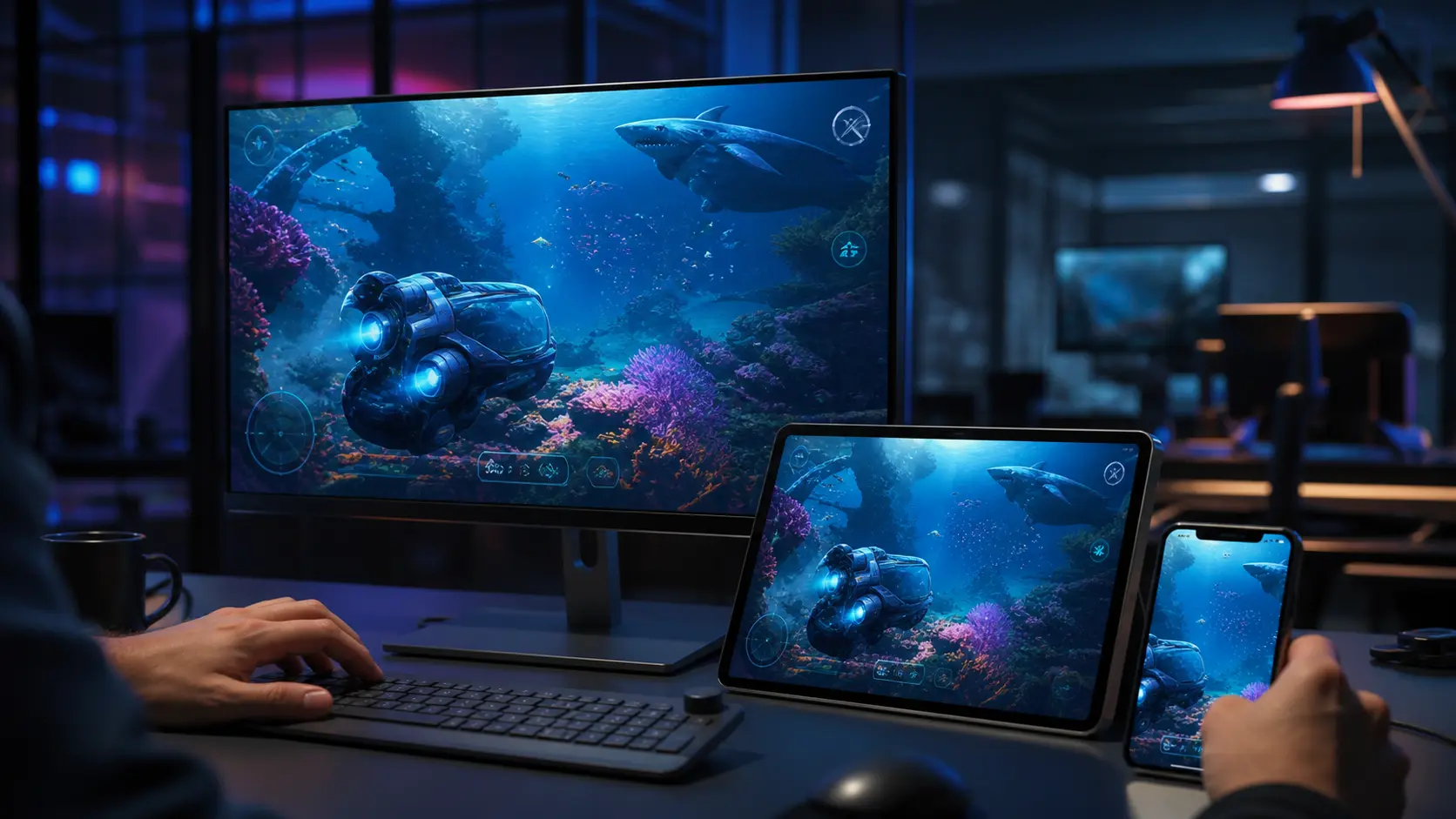
To reconstruct three-dimensional awareness on a two-dimensional screen, we implement a strict 90-degree dual orthogonal camera topology. This is not as simple as bolting two webcams to a metal frame. It requires precise industrial design, focal length matching, and rigid mounting structures to ensure zero vibration during intense gantry movements.
Front Master View and Side Profile View Alignment
Our standard remote crane cabinet features two distinct camera modules. The Front Master View is mounted directly in the center of the upper marquee, angled downwards at precisely 18 to 22 degrees depending on the cabinet depth. This provides the primary navigation feed. The Side Profile View is mounted on the interior right wall, positioned exactly perpendicular to the front camera, capturing a perfect cross-section of the Z-axis.
When a player navigates the claw using the on-screen joystick, they primarily use the front camera to align the X-axis. They then instantly toggle to the side camera to verify the Z-axis alignment. Because the cameras are positioned at exactly 90 degrees to one another, the cognitive translation is effortless.
Industrial Low Distortion Wide Angle Lens Selection
Consumer webcams suffer from aggressive barrel distortion (the fisheye effect), which curves straight lines and drastically alters distance perception near the edges of the frame. In our warehouse live claw machine farm infrastructure, we deploy industrial-grade CMOS sensors paired with specialized aspherical glass lenses.
We utilize a 3.6mm to 4mm focal length depending on the playfield dimensions. This provides a diagonal Field of View (FOV) of approximately 85 to 90 degrees, offering complete coverage of the prize floor without bending the structural support beams of the gantry into optical curves. We specify a lens distortion profile of less than 1.5 percent at the extreme edges, ensuring that when the claw appears to be directly over a prize in the corner of the cabinet, it actually is.
Rigid Mounting and Anti Vibration Dampening
A camera is only as good as its mount. The rapid acceleration and sudden braking of heavy-duty claw carriage assemblies generate significant kinetic energy that transfers through the cabinet chassis. If the camera vibrates, the video stream suffers from rolling shutter artifacts and motion blur, severely degrading the WebRTC compression efficiency.
In our Panyu assembly line, every camera bracket is CNC-machined from 3mm thick aluminum alloy and mounted using high-density polyurethane dampening standoffs. We do not use plastic clips or adhesive tape. Once the camera is mechanically aligned, the bracket is locked down with thread-locking fluid to ensure the focal plane never drifts, even after months of continuous 24/7 operation.
Overcoming Environmental Glare and Shadow Occlusions
High-quality video streaming requires exceptional environmental control. Unlike a physical arcade where ambient lighting fills the room, a live claw machine farm is often a heavily optimized warehouse where the primary light source comes from the cabinets themselves. Poor lighting design destroys video quality, increases encoder bitrate requirements, and confuses players.
High CRI Flicker Free LED Illumination Arrays
Cameras perceive light much differently than the human eye. Standard pulse-width modulated (PWM) LED strips may look fine in person, but they cause severe banding and flickering on camera sensors, especially at higher shutter speeds. We utilize ultra-high-frequency, constant-current LED drivers coupled with High Color Rendering Index (CRI > 90) LED arrays.
These custom lighting matrices are positioned to provide flat, even illumination across the entire prize floor. By eliminating harsh directional shadows, we ensure the player can clearly distinguish the physical boundaries of each prize. Shadows can artificially extend the perceived length of an object, leading to catastrophic miscalculations during the drop phase.
Anti Glare Tempered Glass and Reflection Mitigation
One of the most insidious problems in remote cabinet design is internal reflections. The protective glass front of the cabinet can act as a mirror, reflecting the LED lighting and the internal mechanisms back into the front-facing camera.
While some manufacturers simply remove the front glass in their remote server farms, we recognize that remote claw machine gantry hardware modification often requires maintaining a sealed environment to prevent dust accumulation on the mechanics and the prizes. We employ optically coated, anti-reflective (AR) tempered glass. Furthermore, we install specialized matte black baffling around the camera lens hood to physically block any stray light from entering the sensor at oblique angles, maximizing contrast and color fidelity.
The Sub 80ms WebRTC Dual Stream Video Pipeline
Capturing pristine video is only the first step. The true technical hurdle lies in transmitting two simultaneous HD video feeds halfway across the world with latency low enough to permit twitch-reflex gameplay. Anything above 150ms of total round-trip delay feels sluggish. We engineer our turnkey systems to consistently deliver sub-80ms glass-to-glass video latency.
Hardware Encoding and H 265 Compression
Software encoding on standard CPUs introduces unacceptable buffering delays. Our customized industrial IoT control boards feature dedicated hardware video encoding silicon capable of processing dual 1080p or 720p streams at 30 or 60 frames per second.
We utilize the H.265 (HEVC) codec for environments with constrained bandwidth, providing exceptional visual clarity at bitrates as low as 800 Kbps per stream. For ultra-low latency requirements, we implement highly optimized H.264 profiles with zero B-frames and immediate slice processing. This hardware-level compression ensures that the video frames are encoded, packetized, and dispatched to the network interface in less than 15 milliseconds.
WebRTC SDP Negotiation and STUN TURN Traversal
We abandon outdated RTMP and HLS protocols, which were designed for broadcast streaming and inherently carry seconds of latency. Our entire video infrastructure is built upon a highly customized WebRTC stack.
When a player connects to a machine via your mobile app, our signaling server handles the Session Description Protocol (SDP) negotiation to establish a direct peer-to-peer connection whenever possible. We deploy global STUN and TURN server clusters to guarantee connectivity even when players are behind strict NAT firewalls or corporate networks. The WebRTC data channels are multiplexed alongside the RTP video streams, ensuring that the control commands (joystick movements, claw drops) remain perfectly synchronized with the visual feedback.
Instantaneous Perspective Switching Architecture
The magic of the dual-camera setup relies on the player’s ability to switch between the front and side views instantly. In poorly designed systems, tapping the “switch camera” button forces the app to request a new video stream from the server, resulting in a black screen, buffering wheels, and a 2-second delay. This breaks the immersion and ruins the gameplay rhythm.
Our system architecture streams both the front and side camera feeds to the client application simultaneously at all times. The mobile app decodes both streams in the background but only renders one to the primary viewing canvas. When the player taps the switch toggle, the app executes a localized UI swap, executing the perspective shift in less than 15 milliseconds. This zero-buffering switch feels incredibly responsive and empowers the player to confidently lock in their X and Z coordinates before initiating the drop.
Factory Calibration and QA Testing Protocols
Before any remote live claw machine cabinet leaves our Panyu manufacturing facility, it undergoes an exhaustive battery of optical calibration and stress tests. We do not rely on the operator to fix alignment issues upon delivery. We ship fully validated, production-ready assets.
Center Point Parallax Correction Procedure
Because the cameras are offset from the absolute center of the gantry mechanism, there is inherent parallax error. We calibrate this out during the factory QA phase.
1. Test Grid Deployment: A precision-printed geometric grid is placed on the prize floor. 2. Absolute Zeroing: The claw carriage is moved to the exact mechanical center of the X, Y, and Z axes. 3. Crosshair Calibration: Our proprietary software overlay generates digital crosshairs on the video feeds. The technician adjusts the mechanical pitch and yaw of both camera brackets until the center of the crosshair perfectly intersects the center shaft of the descending claw mechanism. 4. Edge Verification: The claw is moved to all four corners of the cabinet to verify that barrel distortion does not offset the visual drop point by more than 3 millimeters.
Continuous Ping and Jitter Monitoring
We simulate degraded network environments within our testing lab. We introduce artificial packet loss, jitter, and bandwidth throttling to verify the resilience of the WebRTC pipeline. The video feed must gracefully degrade in resolution rather than freezing, and the control latency must remain stable even when the video bitrate drops to maintain real-time responsiveness. This guarantees that your remote live claw machine turnkey system remains profitable even when players connect from moving trains or crowded cellular networks.
Comprehensive Troubleshooting Matrix for Remote Video Feeds
Even with industrial-grade hardware, operators may occasionally encounter anomalies due to external network factors or physical tampering during facility maintenance. The following matrix outlines our standard diagnostic procedures for video stream integrity.
Video Stream Diagnostics
| Symptom Profile | Potential Root Cause | Engineering Resolution and Action Plan |
|---|---|---|
| Rolling horizontal bands on video feed | Frequency mismatch between camera shutter and LED PWM driver | Access internal camera settings via admin portal; force shutter speed to match local AC frequency (e.g., 1/50 for 50Hz, 1/60 for 60Hz) or adjust LED driver modulation. |
| Perspective switch latency exceeds 500ms | Client app failing to multiplex dual streams; falling back to sequential request | Verify client app version and bandwidth allocation. Ensure dual-stream WebRTC SDP flags are correctly negotiated. Check device hardware decoder limits. |
| Blurry or soft focus specifically in corners | Lens focal plane shift due to severe mechanical impact or improper cleaning | Re-torque camera bracket set screws. If lens element is scratched, swap entire camera module. Do not attempt to polish coated lenses. |
| High video latency (>200ms) with low control latency | Network asymmetric routing; UDP packets blocked forcing TCP fallback | Inspect facility edge router firewall rules. Ensure UDP ports 10000-60000 are open for STUN/TURN WebRTC traversal. Verify ISP upstream bandwidth. |
| Overexposed “blown out” prize textures | AGC (Auto Gain Control) algorithmic failure due to bright reflective prize packaging | Lock camera EV (Exposure Value) and disable dynamic AGC. Recalibrate cabinet base illumination to flatten specular highlights on glossy items. |
Partnering with a Complete Turnkey Manufacturer
Building a highly profitable remote claw machine farm requires much more than slapping a webcam inside a standard arcade cabinet. It demands deep integration of optical engineering, industrial IoT control, and ultra-low latency network architecture. Every millisecond of delay and every millimeter of visual distortion directly impacts your bottom line.
At Guangzhou Miba Animation Technology Co., Ltd., we are the direct source factory. We do not broker equipment, and we do not sell loose DIY camera kits. We engineer, manufacture, and deliver complete, customized, commercial-grade hardware and software solutions tailored for the global B2B market. When you partner with us, you are leveraging over a decade of manufacturing excellence and a dedicated team of software architects who understand how to build systems that scale.
Ready to deploy a flawless remote live arcade operation? Contact us today to schedule a live video demonstration of our sub-80ms WebRTC dual-camera cabinets and discuss your facility requirements.
Global Direct Engineering Contact Engineer Wang (Lead Hardware & Game System Architect) WhatsApp / WeChat: +86 17620842078 Telegram: https://t.me/JLwyc Email: miba515527@gmail.com Manufacturing Base: Panyu District, Guangzhou, China
Frequently Asked Questions
Why do some [remote claw machines](/how-remote-claw-machines-work-hardware-integration-schematic/) use three cameras instead of two?
While some setups incorporate an overhead “bird’s eye” camera, we have found through extensive user testing that a third camera often confuses players and clutters the mobile UI. A precisely calibrated dual orthogonal setup (Front and Side) provides 100 percent of the necessary spatial data for accurate Z-axis depth perception without wasting bandwidth or cognitive load.
Does the dual stream setup double the bandwidth requirements for the player?
It requires more bandwidth than a single stream, but not strictly double. Because the side camera often captures a static background with less dynamic motion than the front camera, our hardware encoders optimize the bitrate aggressively. We typically allocate 1.2 Mbps to 1.5 Mbps total for a flawless dual-stream HD experience.
How do you prevent condensation on the camera lenses in warehouse environments?
Our commercial remote cabinets are designed with internal thermal regulation. The heat generated by the LED arrays and the control boards is circulated using ultra-quiet, long-life axial fans, maintaining an internal ambient temperature above the dew point, thereby preventing condensation on the lens elements or the anti-glare front glass.
Can we integrate your dual camera WebRTC feed into our existing custom mobile app?
Yes. Our turnkey solutions include complete API documentation, SDKs, and the option for 100% source code buyout. Your development team can seamlessly embed our WebRTC video pipeline and control socket protocols into your proprietary iOS, Android, or H5 web applications.
html
“`