- Mechanical Coin Recirculation and High-Speed Dispenser Engineering
- Dual-Camera WebRTC Macro Streaming and Depth Perception
- Low Latency Teleoperation Hardware and WebRTC Pipeline Engineering
- Venue Fleet Management and Remote Maintenance Workflows
- Turnkey OEM Factory Sourcing in Panyu
- Microcontroller Firmware Architecture and Real-Time Telemetry Processing
- Cloud Telemetry Infrastructure and Multi-Region Server Scalability
- Frequently Asked Questions
Physical coin pusher machines remain among the most popular and profitable attractions in family entertainment centers. By transforming these traditional mechanical games into cloud-connected teleoperated units, operators can reach a worldwide audience of mobile players 24 hours a day. Sourcing machines directly from an experienced cloud play coin pusher factory ensures that cabinet chassis, automated coin recirculation hoppers, and low-latency camera telemetry are engineered specifically for continuous remote operation.
Unlike traditional coin pushers that rely on manual coin insertion by on-site patrons, remote live coin pushers require sophisticated electromechanical coin feeding mechanisms, optical card/chip detection sensors, and automated jackpot collection chutes.
| Engineering Subsystem | Traditional Arcade Coin Pusher | Cloud Play Teleoperated Pusher |
|---|---|---|
| Coin Insertion Mechanism | Physical mechanical coin entry slot | High-speed optical solenoid coin dispenser (< 50ms) |
| Coin Recirculation | Manual hopper refilling by venue staff | Internal automated belt / spiral elevator lift |
| Video Telemetry | None | Dual 1080p 60FPS WebRTC macro-focus cameras |
| Prize / Card Detection | Manual retrieval from prize tray | RFID sensor + Optical infrared drop validation |
| Motor Drive System | Standard AC shaded-pole gear motor | High-torque DC brushless motor with PWM speed control |
| Telemetry & Anti-Jamming | Basic mechanical micro-switches | Multi-point optical jam sensors with auto-reverse clearing |
Mechanical Coin Recirculation and High-Speed Dispenser Engineering
In a high-traffic cloud coin pusher environment, machines process thousands of coin drops daily without physical staff intervention. This demands a closed-loop mechanical recirculation system:
1. Precision Solenoid Coin Dropper: High-frequency electromagnetic solenoids fire metal tokens with millisecond accuracy upon receiving cloud command packets. Adjustable directional wipers allow players to aim coin trajectories left, center, or right across the moving wiper blade. 2. Automated Spiral Coin Lift: Pushed coins falling off the side edges are routed through internal sorting baffles into a lower reservoir. An automated vertical spiral elevator or heavy-duty polyurethane belt lift continuously transports coins back to the top dispensing hopper. 3. Coin Level Telemetry: Infrared optical sensors monitor coin levels in the upper dispensing magazine. If coin levels fall below threshold, the spiral elevator automatically engages to replenish stock, ensuring zero game downtime. 4. Anti-Jamming Reversing Logic: If a bent token or foreign object causes a mechanical jam in the dispensing chute, current-sensing circuitry detects motor stall and triggers an automated 3-cycle reverse-clear sequence before alerting route technicians.
Dual-Camera WebRTC Macro Streaming and Depth Perception
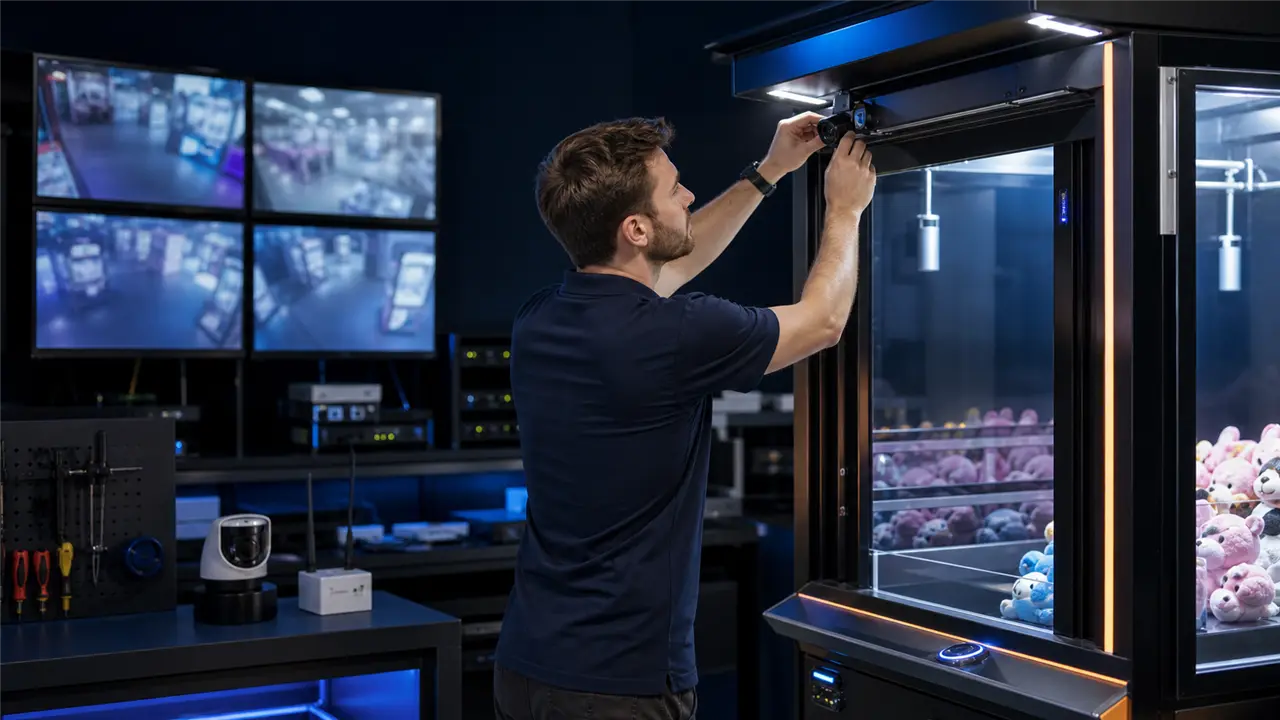
Delivering an authentic coin pusher experience over mobile screens requires precise visual feedback:
- Top Down Alignment Camera: Positioned directly above the coin dispensing chute with wide-angle distortion-corrected optics, allowing the player to line up coin drops with moving target slots.
- Side Edge Macro Depth Camera: Positioned at shelf level with dedicated LED ring illumination to highlight coin stacks, card overhangs, and edge pressure points.
- Hardware-Accelerated Encoding: Edge encoding servers convert raw RTSP camera streams into low-latency WebRTC streams, maintaining sub-80ms glass-to-glass latency across global CDNs.
Low Latency Teleoperation Hardware and WebRTC Pipeline Engineering
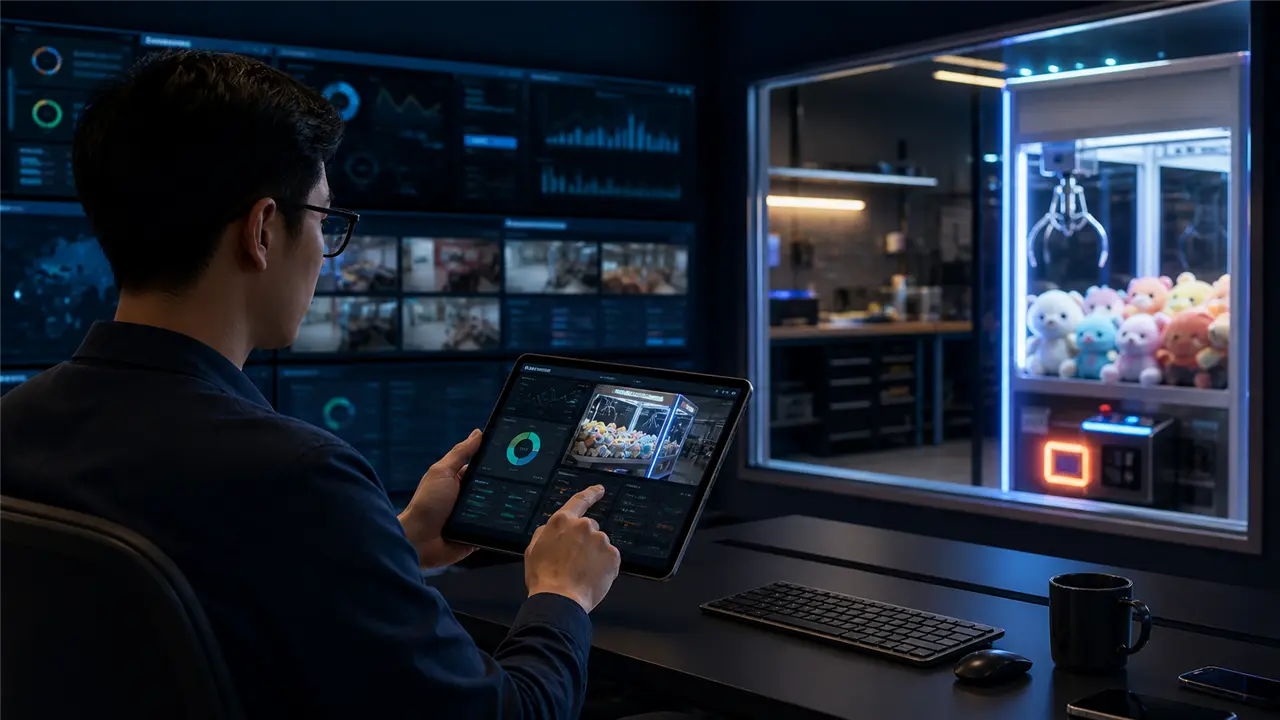
Operating real physical arcade machines over the public internet requires overcoming severe latency, packet jitter, and mechanical response delays. To achieve a seamless real-time player experience where control inputs feel instantaneous (<80ms glass-to-glass latency), the system architecture integrates edge IoT hardware with optimized streaming pipelines:
1. Sub-80ms WebRTC Streaming Infrastructure: Video feeds captured by dual wide-angle 1080p 60FPS industrial IP cameras are encoded using hardware-accelerated H.264 pipelines directly at the local venue edge server. Video frames are streamed over WebRTC using dynamic jitter buffering, ensuring adaptive bitrate streaming across mobile 4G/5G networks. 2. Industrial Edge IoT Gateway Boards: Each bank of coin pushers is controlled by an industrial STM32 microcontroller board equipped with isolated GPIO relays, optical encoder counters, and RS-485 serial communication. 3. Mechanical Gantry and Stepper Motor Precision: High-precision NEMA 23 stepper motors and optocoupled limit switches replace standard AC motors. This allows fine-grained micro-stepping positioning, enabling precise claw hovering, dynamic claw grip voltage adjustments (3-stage voltage control: grab, lift, transport), and optical prize drop detection with zero false drops. 4. Cloud Queue and Session Failover Architecture: When multiple concurrent players enter a machine’s live room, the cloud backend maintains a strict FIFO queue with automated spectator view synchronization. If a player experiences network disconnection during an active round, the edge gateway executes an automated safe-return sequence, resetting the claw gantry to home position and safely refunding tokens to the player’s account.
| System Subsystem | Hardware / Protocol Specifications | Operational Target Metric | Business Benefit |
|---|---|---|---|
| Edge Video Encoding | H.264 Hardware Encoder, RTSP to WebRTC | < 60 ms glass-to-glass delay | Real-time visual feedback for precise claw drops |
| Teleoperation Gateway | STM32 ARM Cortex-M4 + Optoisolated Relays | < 5 ms GPIO execution latency | Instantaneous joystick response without input lag |
| Stepper Motor Control | NEMA 23 Stepper, 1/16 Microstepping Driver | ±0.5 mm positioning accuracy | Professional claw control and smooth camera telemetry |
| Prize Detection Sensor | Dual-Beam Infrared Optical Barrier | 99.99% detection accuracy | Automated prize payout verification and inventory sync |
| Network Failover | Dual-WAN Edge Router with 4G/5G Auto-Failover | 99.95% venue uptime SLA | Uninterrupted 24/7 route operation without onsite staff |
Venue Fleet Management and Remote Maintenance Workflows
Managing an unattended remote live arcade facility with dozens of physical machines requires centralized telemetry and automated self-healing mechanisms:
- Automated Mechanical Health Diagnostics: Daily self-test routines run automatically during low-traffic hours, testing X/Y/Z gantry travel boundaries, claw grip solenoids, and camera autofocus clarity.
- Smart PDU Remote Power Cycling: Every machine is connected to a cloud-managed PDU, allowing route operators to remotely reboot frozen motherboards or reset gantry controllers directly from their mobile smartphone dashboard.
- Real-Time Prize Inventory and Dispenser Tracking: Optical weight sensors and RFID tags track prize compartment levels, sending automated restocking notifications to local fulfillment teams when plush toy or prize box levels drop below 15%.
Turnkey OEM Factory Sourcing in Panyu
Sourcing cloud play coin pusher machines from certified factory lines in Panyu, Guangzhou provides significant advantages in cabinet customization, component durability, and unit economics. Factory-direct engineering ensures full electrical compatibility with local voltages (110V/220V), custom laser-cut chassis branding, and pre-wired industrial IoT control harnesses ready for immediate plug-and-play cloud deployment.
Microcontroller Firmware Architecture and Real-Time Telemetry Processing
Operating unattended live arcade teleoperation gateways requires deterministic real-time processing to handle high-frequency pulse inputs, optical encoder readouts, and network communications simultaneously:
1. FreeRTOS Task Scheduling and Priority Queuing: The embedded STM32 firmware utilizes FreeRTOS multitasking to isolate time-critical motor control from network communication. The motor step-generator task runs at highest real-time priority (sub-100 microsecond interrupt service routine), while background tasks handle MQTT JSON telemetry serialization, watchdog petting, and ambient temperature sensor polling. 2. Optically Isolated GPIO Driving Stages: Every digital output driving mechanical relays, solenoids, or gantry motors is buffered through optocouplers with 5kV surge isolation. Reverse EMF diodes (such as 1N4007 or fast Schottky arrays) clamp inductive kickback spikes when claw coils de-energize, preventing microcontroller latch-up or reset loops. 3. Over-The-Air (OTA) Dual-Bank Firmware Updates: Remote gateways feature dual-bank Flash memory architecture. New firmware updates are downloaded, verified via SHA-256 checksums, and written to the inactive flash bank. Upon successful verification, the bootloader switches execution banks seamlessly, enabling zero-downtime fleet updates with automatic rollback upon boot failure. 4. Adaptive Gantry Travel Calibration: During daily self-test cycles, optical endstop microswitches calibrate zero-point reference positions across X, Y, and Z axes. The system automatically measures mechanical travel time and detects belt slippage or mechanical friction increases before physical failure occurs.
| Microcontroller Feature | Specification / Standard | Operational Advantage |
|---|---|---|
| Core Processing Unit | STM32F407 ARM Cortex-M4 @ 168 MHz | High-speed trajectory calculation with zero latency |
| Isolation Barrier | 5000 Vrms Optical Isolation on all I/O | Eliminates ground loop noise from high-current motors |
| Telemetry Interface | RS-485 Modbus RTU / CAN Bus 2.0B | Reliable multi-drop cabinet chaining up to 1200 meters |
| Storage & Logging | 32MB SPI NOR Flash + Ferroelectric RAM (FRAM) | Instantaneous non-volatile transaction logging with infinite write cycles |
| Power Management | 9-36V Wide Input DC-DC Buck Converter | Resilient against venue AC voltage dips and brownouts |
Cloud Telemetry Infrastructure and Multi-Region Server Scalability
When managing multi-venue operations spanning multiple physical warehouses across North America, Europe, and Asia, cloud infrastructure must provide low-latency regional routing: (for full technical specifications, explore our engineering review on turnkey live streaming claw machine business hardware)
- Geo-DNS and Edge Ingress Points: Player connection requests are routed to the nearest cloud edge POP via Anycast DNS, minimizing handshake latency and WebRTC ICE negotiation times.
- Distributed Redis Session Caching: Active player queues, coin wallet balances, and game leases are managed in high-availability Redis clusters with automated Sentinel failover.
- Centralized Video Archive for Dispute Resolution: Every played round’s dual-camera WebRTC video stream is automatically recorded, compressed into H.265 MP4 format, and stored on cloud object storage for 30 days, enabling instant customer support review in case of prize claim disputes. (for full technical specifications, explore our engineering review on reducing remote arcade video latency below 80ms using WebRTC)
Frequently Asked Questions
How are collectible cards and collectible chips detected when pushed off the edge?
Collectible cards and chips contain passive RFID tags or high-contrast optical QR codes. When a card falls through the prize chute, high-speed RFID reader coils and optical barcode scanners validate the item’s identity in under 50 milliseconds, immediately crediting the player’s collection in the app database.
What happens if the coin pusher experiences a mechanical jam?
The motor driver circuit monitors real-time current consumption. If a coin jam causes motor resistance, the controller board detects the current spike, automatically executes an alternating reverse-forward clearance cycle, and logs a service event in the telemetry dashboard.
Can existing land-based coin pushers be retrofitted for cloud live play?
Yes, factory retrofit kits include pre-assembled solenoid drop units, dual-camera mounting arms, internal coin recirculators, and industrial IoT control boards designed for universal cabinet installation.
json
For customized cloud play coin pusher cabinet manufacturing, automated mechanical recirculators, and complete teleoperation IoT packages, contact Engineer Wang at Guangzhou Miba Animation Technology Co., Ltd. (Panyu Manufacturing Base, Guangzhou, China) via WhatsApp/WeChat at +86 17620842078, Telegram at https://t.me/JLwyc, or email miba515527@gmail.com.