- Embedded Hardware Evaluation and Gateway Comparison Matrix
- Microcontroller Architecture and Hardware Watchdog Self-Healing Circuits
- Optically Isolated GPIO Relays and Digital Signal Debouncing
- RS485 and Modbus RTU Multi-Drop Machine Bus Topologies
- Physical Coin-In Pulse Simulation and Coin-Out Hopper Sensing
- High-Frequency Directional Joystick Pulse Mapping and Motor Drivers
- Firmware Over-The-Air FOTA Deployment and Real-Time Telemetry Logging
- Frequently Asked Questions
The rapid convergence of physical arcade gaming and cloud-based digital teleoperation presents a fascinating challenge for electrical and software engineers. Building robust, latency-sensitive remote machine control systems requires far more than rudimentary hobbyist microcontrollers. When you are engineering commercial-grade teleoperation setups that bridge global cloud APIs with legacy arcade electrical switches, mechanical coin acceptors, and high-frequency joysticks, the foundational hardware must be bulletproof. This is where an advanced industrial iot gateway architecture becomes absolutely essential.
Modern arcade machine teleoperation relies on industrial-grade IoT gateway boards to translate digital commands into physical actions instantaneously, all while operating in electrically noisy environments filled with high-voltage motors, mechanical relays, and switching power supplies. Without proper electrical noise isolation, ground loop protection, and industrial electromagnetic compatibility (EMC) shielding, control signals can degrade, leading to ghost inputs, missed coin pulses, or catastrophic machine freezing. This comprehensive technical engineering guide explores the depths of arcade iot relay controller board design, remote gpio physical machine control methodologies, rs485 modbus arcade telemetry, and the critical importance of utilizing an optical isolation relay module in your deployment infrastructure. For a comprehensive architectural overview and turnkey procurement frameworks, review our master guide on turnkey remote claw machine platform. For further architectural integration standards, refer to How Operators Reduce Remote Arcade Video. For factory-direct procurement and comprehensive engineering specs, consult our master guide on cloud arcade machine teleoperation and turnkey engineering.
Embedded Hardware Evaluation and Gateway Comparison Matrix
Before diving into the architectural subsystems, it is crucial to understand why standard consumer-grade development boards are insufficient for commercial arcade teleoperation. When designing a system that must operate without human intervention for months at a time, every component must be rigorously evaluated. Consumer electronics simply lack the durability, thermal tolerance, and electrical noise immunity required. The table below outlines the critical technical specifications comparing an Industrial Embedded ARM Gateway against consumer alternatives. To explore detailed technical specifications and deployment considerations, see our operational guide on How Operators Start a Remote Claw.
| Technical Specification | Industrial Embedded ARM Gateway | Consumer Raspberry Pi/Arduino | Direct Cloud-Connected Wi-Fi Relays |
|---|---|---|---|
| **Industrial EMC Rating** | IEC 61000-4-2/3/4 Compliant | None (Unshielded) | Basic consumer FCC/CE only |
| **Optocoupler Isolation Voltage** | 2500V to 3000V RMS Isolation | No native optical isolation | 1000V RMS (Variable) |
| **Hardware Watchdog Recovery** | Dedicated silicon watchdog timer | Software-based or missing | Basic firmware watchdog |
| **Multi-Machine Topology** | Native RS485 multi-drop daisy chaining | Requires external HATs/shields | None (Point-to-point only) |
| **Operating Temperature** | -40°C to +85°C (Extended Range) | 0°C to 50°C (Thermal throttling) | -10°C to +60°C |
| **Power Supply Tolerance** | 9V-36V DC Wide Input, Reverse Polarity | Strictly 5V DC (Highly sensitive) | 5V-12V DC Narrow Input |
As demonstrated, the industrial iot gateway architecture provides the necessary electrical resilience and hardware stability required for continuous 24/7/365 teleoperation in demanding commercial environments. Relying on consumer-grade boards invariably leads to catastrophic system failures when exposed to the harsh electrical realities of an active arcade floor.
Microcontroller Architecture and Hardware Watchdog Self-Healing Circuits

At the heart of any enterprise-grade arcade iot relay controller board lies a robust microcontroller architecture designed specifically for deterministic real-time operations. Unlike general-purpose operating systems like Linux running on consumer single-board computers, bare-metal or Real-Time Operating System (RTOS) driven microcontrollers ensure that critical tasks—such as capturing a high-speed joystick input or simulating a coin-in pulse—execute with absolute microsecond precision. The architecture typically leverages powerful ARM Cortex-M4 or Cortex-M7 processors, which provide sufficient compute overhead for SSL/TLS encrypted WebSocket communication to the cloud while simultaneously handling localized GPIO polling and multi-threaded sensor acquisition.
A primary concern in remote machine control is system lockups caused by memory leaks, sudden voltage spikes, or cosmic radiation-induced bit flips. In a remote teleoperation facility, dispatching a technician to manually reboot a frozen controller board is economically unviable. This necessitates the implementation of autonomous self-healing circuits, primarily driven by a dedicated hardware watchdog timer (WDT). An independent silicon WDT operates on a completely separate internal clock oscillator from the main CPU. The primary application firmware must continuously “kick” or reset the watchdog timer within a predefined millisecond window (e.g., every 500ms). If the main processor enters an infinite loop, hangs due to a network stack crash, or becomes unresponsive for any reason, the watchdog timer overflows and instantly pulls the microcontroller’s hardware reset pin low. This triggers a clean power cycle of the logic circuits, restoring the gateway to a known operational state within milliseconds.
Furthermore, industrial gateways utilize dual-bank flash memory architectures. This allows the system to maintain a verified, known-good firmware image in bank A while executing from bank B. If the primary execution bank becomes corrupted during a power fluctuation or an interrupted over-the-air update, the cryptographic bootloader automatically detects the failed checksum and safely falls back to the pristine backup image, ensuring zero-downtime remote gpio physical machine control and maintaining revenue continuity.
Optically Isolated GPIO Relays and Digital Signal Debouncing

When interfacing modern 3.3V logic microcontrollers with legacy arcade machine circuitry, electrical isolation is not merely a recommendation; it is an absolute necessity. Arcade cabinets utilize highly inductive loads such as solenoid pushers, heavy-duty mechanical counters, high-torque crane claw motors, and 12V/24V halogen lamps. Switching these inductive loads on and off generates massive reverse electromotive force (back EMF) and transient voltage spikes that can easily destroy unisolated logic circuits or inject severe electrical noise into the signal ground plane, causing erratic behavior across the entire control board.
To mitigate these catastrophic electrical phenomena, an optical isolation relay module is deployed as a strict barrier between the logic control domain (the IoT gateway) and the arcade machine’s high-voltage execution domain. Optocouplers utilize an internal LED and a phototransistor to transmit digital signals across a physical microscopic air gap via light. This achieves complete galvanic isolation, typically rated for 2500V to 3000V RMS. When the industrial iot gateway architecture commands a relay to actuate a physical arcade button, the microcontroller simply illuminates the internal LED of the optocoupler. The phototransistor on the high-voltage side detects this light and triggers a larger mechanical relay or a solid-state MOSFET, which then completes the electrical circuit on the arcade machine’s mainboard. No electrical current ever passes between the two domains.
Equally important is the fundamental concept of digital signal debouncing. Physical mechanical switches in arcade joysticks, microswitches, and buttons do not close cleanly; their metal contacts bounce against each other microscopically for several milliseconds, creating a jagged, high-frequency square wave before settling into a solid logic state. If left unhandled, a single button press could be interpreted by the gateway as dozens of rapid, erratic inputs. Industrial gateways utilize a combination of hardware RC (Resistor-Capacitor) low-pass filters to physically smooth the voltage curve, combined with sophisticated software debouncing algorithms. The software state machine samples the optically isolated input at an extremely high frequency (e.g., 1000 Hz) and requires the signal state to remain stable for a configurable contiguous duration (typically 5 to 20 milliseconds) before registering a valid state change. This guarantees absolute accuracy and prevents ghost inputs in remote gpio physical machine control.
RS485 and Modbus RTU Multi-Drop Machine Bus Topologies
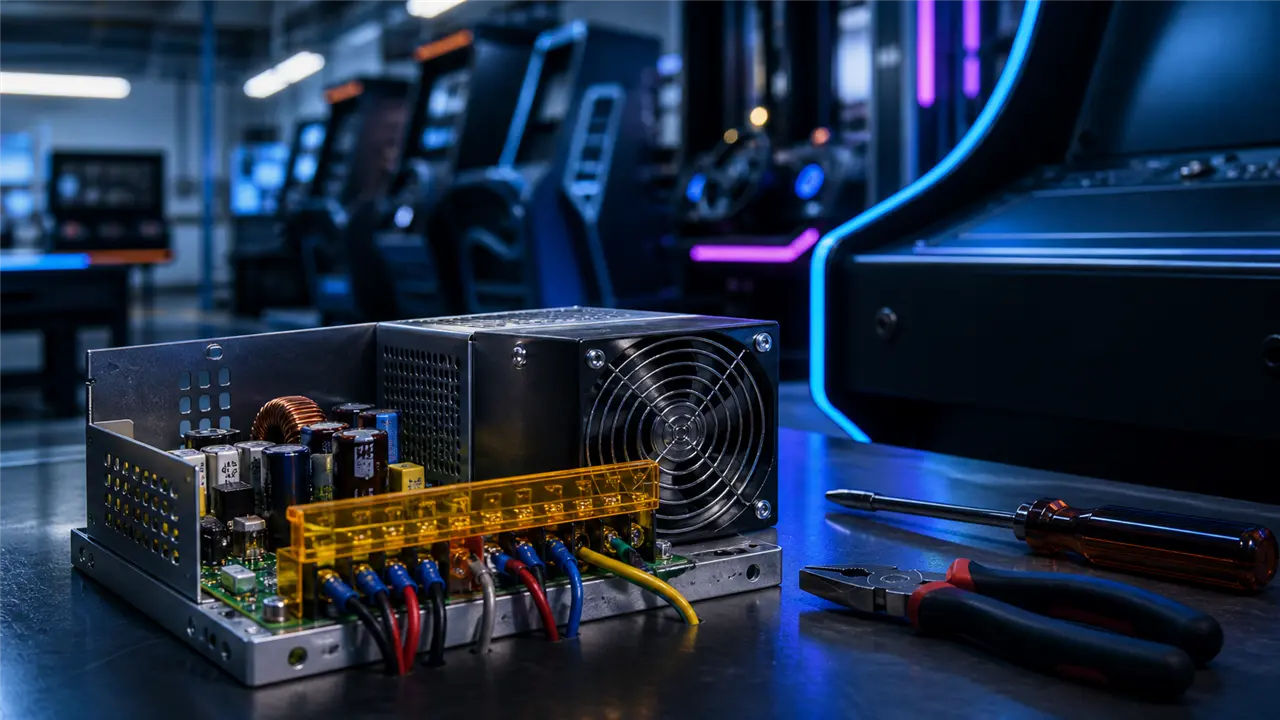
Scaling a teleoperation facility from a single prototype machine to a vast, multi-level warehouse containing hundreds of arcade units requires a networking topology engineered for long-distance, noise-immune communication. While Ethernet and Wi-Fi are standard for cloud connectivity, relying on them for intra-machine local communication on the arcade floor introduces unnecessary network latency, drastically increases hardware costs per unit, and creates severe IP address management overhead. The definitive enterprise solution is utilizing rs485 modbus arcade telemetry networks.
RS485 is a robust differential serial communication standard explicitly designed for harsh, electrically noisy industrial environments. Instead of representing binary logic states with an absolute voltage relative to a common ground—which is highly susceptible to interference—RS485 transmits data by varying the voltage difference between two twisted copper wires (typically labeled Data+ and Data-). If an electromagnetic interference (EMI) pulse from a nearby high-voltage compressor or heavy motor induces a voltage spike on the cable, it affects both twisted wires equally. The differential receiver on the gateway analyzes only the voltage difference between the two wires, perfectly canceling out the induced noise (a concept known as common-mode rejection). This allows RS485 networks to reliably transmit data at high speeds or over vast distances exceeding 1200 meters without signal degradation.
By structuring the arcade floor using a multi-drop daisy-chain bus topology, a single powerful master industrial iot gateway architecture can securely orchestrate up to 255 slave controller boards located within individual arcade cabinets. The system utilizes Modbus RTU, an incredibly robust, deterministic polling protocol that has been the backbone of industrial automation for decades. The master gateway sequentially requests vital telemetry data (such as coin counter metrics, motor current draw anomalies, hardware error codes, and cabinet temperature readings) from each slave unit while simultaneously dispatching instantaneous control commands. This centralized hub-and-spoke architecture drastically simplifies network security and infrastructure management. Only the central master gateway maintains an active outbound TCP/IP WebSocket or MQTT connection to the cloud, shielding the individual arcade machines entirely from direct external network exposure and potential cyber threats.
Physical Coin-In Pulse Simulation and Coin-Out Hopper Sensing
Monetization and strict credit management form the financial backbone of any commercial arcade operation. In a modern teleoperation paradigm, the physical dropping of a metal coin or token by a human is replaced by a digital micro-transaction initiated by the remote user’s mobile application or web browser. To facilitate this seamlessly, the arcade iot relay controller board must flawlessly simulate the precise electrical signature of a mechanical coin acceptor to fool the arcade machine’s mainboard into registering a valid, legitimate credit without any software modifications to the legacy arcade game itself.
Traditional coin acceptors output a highly specific electrical pulse train when a valid coin passes successfully through their internal optical and magnetic validation sensors. A standard coin pulse might consist of a precisely timed 50-millisecond pull to an active-low ground state, followed by a mandatory 100-millisecond high resting state before the next pulse can be accepted. To execute this flawlessly, the gateway utilizes its highly accurate internal hardware timers and interrupt service routines. When the cloud server dispatches a “credit insert” command via the encrypted WebSocket stream, the gateway schedules an interrupt-driven GPIO sequence. The optical isolation relay module engages, pulling the arcade machine’s coin-in signal wire low for the exact microsecond duration required, perfectly mimicking the physical hardware.
Conversely, for redemption games, coin pushers, or ticket dispensers, meticulously tracking the outgoing physical payload is equally critical to prevent inventory shrinkage or operational discrepancies. Coin-out hoppers and ticket mechanisms utilize fast optical sensors to detect physical items ejecting into the prize chute. The gateway must perform continuous, high-speed edge detection on these optical sensor lines to maintain an accurate internal ledger of dispersed items. Every passing coin generates a rising and falling edge interrupt on the microcontroller’s GPIO pin. These high-priority hardware interrupts preempt all other non-critical processing to instantly increment the localized secure memory counter. This decentralized rs485 modbus arcade telemetry data is then periodically bulk-transmitted to the cloud backend, ensuring absolute financial reconciliation and operational auditing, even if the primary internet connection experiences a temporary outage.
High-Frequency Directional Joystick Pulse Mapping and Motor Drivers
Translating digital directional commands from a distant web-based client interface into the physical, immediate movement of a crane claw, racing steering wheel, or game character requires highly sophisticated high-frequency joystick pulse mapping algorithms. Unlike the relatively simple binary on/off states used for coin insertion, active joystick teleoperation demands variable-duration actuation that precisely and instantaneously matches the user’s intent, minimizing perceived latency and providing a smooth, responsive user experience.
When a remote user taps or holds a directional arrow on their smartphone screen, the client application streams a continuous barrage of UDP packets or rapid WebSocket frames containing precise movement vector data. The industrial iot gateway architecture ingests these high-velocity network packets, decrypts and parses the payload, extracts the movement vectors, and mathematically maps them to the appropriate GPIO channels connected to the arcade machine’s legacy directional logic inputs. The optical isolation relay module is rapidly cycled, sometimes hundreds of times per second, to accurately simulate the physical opening and closing of traditional joystick microswitches.
In more advanced teleoperation setups, such as proportional joystick control or direct DC motor manipulation in high-end crane games, the gateway bypasses the arcade machine’s legacy control mainboard entirely. Instead, it interfaces directly with robust H-bridge motor drivers or servo controllers. The gateway utilizes precision hardware Pulse Width Modulation (PWM) to dynamically regulate the voltage and current flowing into the direct current (DC) motors. By intelligently adjusting the duty cycle and frequency of the PWM signal based on the remote user’s analog input, the gateway can precisely control the velocity, torque, and acceleration profiles of the crane gantry. This offers buttery-smooth remote gpio physical machine control that feels completely indistinguishable from standing directly in front of the physical cabinet, dramatically enhancing player satisfaction and retention.
Firmware Over-The-Air FOTA Deployment and Real-Time Telemetry Logging
Maintaining, optimizing, and securing a massive fleet of hundreds of highly specialized arcade iot relay controller boards necessitates a sophisticated fleet management strategy, primarily centered around robust Firmware Over-The-Air (FOTA) deployment capabilities. As new arcade machine types are integrated into the facility, as control algorithms are refined, or as critical security patches are released, engineering teams must seamlessly push compiled binary updates to the entire global fleet without requiring any manual, on-site human intervention.
The FOTA process within an enterprise-grade industrial iot gateway architecture utilizes a highly secure, cryptographic bootloader mechanism. When an update campaign is initiated from the cloud dashboard, the updated firmware image is silently downloaded in the background over a secure, mutually authenticated HTTPS connection. It is temporarily stored in the secondary flash memory bank or an external SPI flash chip. Once the complete download is rigorously verified via SHA-256 cryptographic hashing and ECDSA digital signature validation, the gateway signals the bootloader to swap the active execution memory bank upon the next scheduled system reboot. If the newly deployed firmware fails to boot properly, crashes repeatedly within the first few minutes, or fails to establish a cloud connection, the hardware watchdog timer forces a critical reset. The intelligent bootloader then autonomously rolls back the system to the previous, known-good firmware version, completely preventing bricked devices and ensuring maximum operational uptime.
Simultaneously, the gateway system continuously aggregates vast amounts of real-time telemetry logging. Every single state change, button press, network latency metric, internal CPU temperature reading, power supply voltage fluctuation, and Modbus communication error is precisely timestamped and temporarily buffered in local SRAM. This incredibly valuable rs485 modbus arcade telemetry data is meticulously serialized into compact Protocol Buffers or JSON payloads and continuously streamed to a cloud-based time-series database. Engineering and operations teams utilize advanced visualization tools like Grafana or Kibana to monitor this telemetry in real-time. This deep data visibility enables sophisticated predictive maintenance models; machine learning algorithms can analyze current draw spikes on a motor driver and identify a failing mechanical bearing or an unstable power supply weeks before they result in a catastrophic hardware failure on the live arcade floor, allowing for preemptive, scheduled maintenance.
Frequently Asked Questions
Question: Why is an optical isolation relay module preferred over standard mechanical relays for joystick control?
An optical isolation relay module using high-speed solid-state MOSFETs or opto-triacs is vastly superior for high-frequency joystick control because it contains absolutely no moving mechanical parts. Standard electromechanical relays have a finite, physical lifespan of switching cycles (typically failing around 100,000 to 500,000 actuations) and suffer from severe mechanical latency (contact bounce) when physically closing the metal contacts. Opto-isolated solid-state components can switch logic states in microseconds, have a virtually infinite operational lifespan under normal conditions, and provide the critical high-voltage galvanic isolation needed for reliable remote gpio physical machine control without generating any destructive inductive electrical noise.
Question: How does RS485 Modbus arcade telemetry differ from standard Wi-Fi communication in an arcade environment?
RS485 Modbus arcade telemetry utilizes a differential wired bus topology that is inherently immune to the massive electromagnetic interference (EMI) typically generated by arcade cabinets and industrial equipment. Wi-Fi operates in the heavily congested 2.4GHz or 5GHz radio spectrums, making it highly prone to packet loss, severe latency spikes, and catastrophic signal degradation caused by large metal arcade cabinet enclosures acting as Faraday cages. RS485 provides predictable, deterministic, low-latency, and highly reliable wired multi-drop communication, allowing a single master gateway to poll hundreds of slave machines flawlessly, a feat which is practically impossible to guarantee with standard wireless technologies in a dense warehouse.
Question: What critical role does a hardware watchdog play in an industrial IoT gateway architecture?
In an industrial iot gateway architecture, the dedicated hardware watchdog timer acts as the ultimate, uncompromisable fail-safe recovery mechanism. It is a completely independent silicon circuit with its own clock source that continually monitors the main processor’s health. If the primary firmware crashes, enters a deadlocked state, or fails to programmatically “kick” the watchdog within a specific, strict millisecond window, the watchdog physically pulls the reset pin and reboots the power logic to the microcontroller. This autonomous self-healing process ensures that remote teleoperation machines remain online and accessible to users globally 24/7, completely eliminating the need for a human technician to perform a manual, costly power cycle.
Question: Can the arcade IoT relay controller board simulate complex analog inputs like steering wheels or accelerator pedals?
Yes, an advanced arcade iot relay controller board can effortlessly handle complex analog inputs by utilizing dedicated Digital-to-Analog Converters (DAC) or precisely calculated Pulse Width Modulation (PWM) filtered through an active RC network. While basic digital arcade joysticks use simple binary on/off microswitches, racing steering wheels, analog flight yokes, or accelerator pedals rely on variable potentiometers. The gateway mathematically generates a precise analog voltage level corresponding exactly to the remote user’s steering angle input, simulating the variable voltage output of a physical potentiometer perfectly. This allows for comprehensive, highly realistic remote control of sophisticated racing or shooting arcade cabinets.
Question: How do you definitively prevent ghost inputs or false coin drops in highly electrically noisy environments?
Preventing ghost inputs requires a rigorous, multifaceted engineering approach deeply integrated into the core industrial iot gateway architecture. First, a high-grade optical isolation relay module completely and physically separates the logic control grounds from the noisy, high-voltage machine grounds. Second, dedicated hardware low-pass RC filters are implemented on every single input line to absorb and dissipate high-frequency transient voltage spikes before they reach the microcontroller. Finally, aggressive, highly tuned software debouncing algorithms ensure that only sustained, stable, and continuous signal state changes are recognized as valid inputs, effectively filtering out any residual electromagnetic noise that might induce a disastrous false coin drop or erratic, unintended joystick movement.
Contact the Engineering Team:
For specialized technical consultation on enterprise teleoperation infrastructure, custom circuit board design, and high-performance gateway integration, please contact our principal systems architect:
- Engineer Wang
- WhatsApp/WeChat: +86 17620842078
- Telegram: https://t.me/JLwyc
- Email: miba515527@gmail.com
- Guangzhou Miba Animation Technology Co., Ltd.