- Technical Comparison Table Heavy-Duty Laser-Cut Metal Fish Table vs Traditional MDF Wood Fish Table vs Hybrid Plastic Composite Frame
- 55-Inch to 85-Inch 4K Display Mounting and Tempered Explosion-Proof Glass
- Heavy-Gauge Cold-Rolled Steel Framing and Anti-Crowbar Lockbar Design
- 8-Station Ergonomic Joystick, Pushbutton, and Weapon Switch Wiring Looms
- Multi-Bill Acceptor Pulse and RS232 Harness Interfacing (ICT, MEI, Pyramid)
- High-Power LED Marquee Edge Lighting and Under-Glow Illumination
- Assembly Tolerances, Modular Flat-Pack Packaging, and On-Site Setup
- Frequently Asked Questions
Route operators and arcade room owners understand the harsh realities of deploying gaming equipment in high-traffic commercial environments. Unsupervised arcades, bustling entertainment centers, and demanding operator routes constantly subject hardware to extreme stress. The typical industry standard has long relied on medium-density fiberboard and standard particleboard construction. While inexpensive and easy to mass-produce, wooden fish table cabinets invariably suffer catastrophic failures under real-world pressures. Operators routinely report damaged wooden enclosures resulting from spilled beverages, which cause the fiberboard to swell, warp, and ultimately disintegrate. Furthermore, standard wooden cabinets are highly vulnerable to blunt force trauma and malicious vandalism.
Perhaps the most critical failure point of traditional wooden cabinets lies in their security vulnerabilities. Cash box break-ins are a constant threat to any route operator. Wooden doors and frames offer minimal resistance against determined individuals armed with crowbars or drilling tools. Once the integrity of the cabinet is compromised, the operator loses not only the hardware investment but also the revenue generated inside the machine. Additionally, joystick wear and control panel degradation accelerate quickly when the structural foundation lacks rigidity. When excited players forcefully manipulate joysticks and aggressively strike pushbuttons during intense fish hunting sessions, a wooden control deck will flex, eventually leading to stripped mounting screws, fractured control panels, and disconnected wiring harnesses. For a comprehensive architectural overview and turnkey procurement frameworks, review our master guide on turnkey arcade cabinet manufacturing. For further architectural integration standards, refer to How B2B Operators Source Custom Aristocrat. For factory-direct procurement and comprehensive engineering specs, consult our master guide on turnkey arcade cabinet manufacturing and B2B procurement.
To permanently eradicate these costly maintenance and security issues, forward-thinking operators are shifting their investments toward a reputable custom 8 player fish table metal chassis builder. Modern heavy-gauge metal chassis manufacturing completely redefines the lifecycle expectations of commercial arcade hardware. By utilizing industrial-grade cold-rolled steel and precision laser-cutting fabrication methodologies, engineers can construct a fortress-like enclosure that delivers a guaranteed ten-year durability profile. These premium metal cabinets are impervious to liquid spills, highly resistant to environmental humidity, and engineered to withstand extreme physical abuse. For further architectural integration standards, refer to How Casino Machine Manufacturers Engineer Dual.
As a leading commercial fish table cabinet manufacturer china relies on for premium export quality, we understand that structural integrity directly correlates with long-term profitability. By upgrading to a custom 8 player fish table enclosure manufactured entirely from heavy-duty steel, operators instantly achieve maximum security. Anti-crowbar lockbars, concealed hinges, and multi-point locking mechanisms ensure that the internal cash vault remains completely impenetrable to opportunistic thieves. Furthermore, a rigid metal control panel guarantees that joysticks and action buttons remain perfectly anchored, eliminating the micro-flexing that causes premature microswitch failures and harness disconnections.
The transition to a metal chassis is not merely a structural upgrade; it is a comprehensive overhaul of the entire mechanical and electrical ecosystem of the machine. The rigidity of the frame allows for tighter tolerances, better thermal management for the internal electronics, and a vastly superior aesthetic presentation. Players are naturally drawn to the sleek, modern appearance of a powder-coated metal cabinet adorned with brilliant edge lighting, while operators benefit from the peace of mind that their asset and revenue are thoroughly protected. This guide details the exact engineering specifications and fabrication techniques utilized to build the ultimate eight-player arcade fortress.
Technical Comparison Table Heavy-Duty Laser-Cut Metal Fish Table vs Traditional MDF Wood Fish Table vs Hybrid Plastic Composite Frame
| Engineering Metric | Heavy-Duty Laser-Cut Metal Fish Table | Traditional MDF Wood Fish Table | Hybrid Plastic Composite Frame |
|---|---|---|---|
| **Vandalism Resistance** | Extreme (Impervious to heavy blunt force and puncture attempts) | Low (Easily splintered, cracked, or punctured) | Moderate (Resists light impacts but shatters under heavy force) |
| **Cash Vault Security** | Maximum (Concealed steel locking bars, drill-resistant plates) | Poor (Standard cam locks easily pried from soft wood) | Moderate (Plastic exterior often conceals weak internal metal brackets) |
| **Display Heat Dissipation** | Excellent (Metal chassis acts as a massive passive thermal heatsink) | Poor (Wood acts as an insulator, trapping heat and reducing panel life) | Fair (Requires aggressive active cooling fans to prevent overheating) |
| **Joystick Mounting Rigidity** | Absolute (Zero flex during intense gameplay, welded mounting studs) | Weak (Screws strip out of MDF under repeated heavy lateral torque) | Fair (Plastic control panels flex, leading to switch misalignment) |
| **Assembly Time and Logistics** | Fast (Precision tolerances allow for rapid flat-pack assembly) | Slow (Requires glue, wood screws, and careful alignment) | Variable (Often relies on proprietary snap-fit clips that break easily) |
55-Inch to 85-Inch 4K Display Mounting and Tempered Explosion-Proof Glass
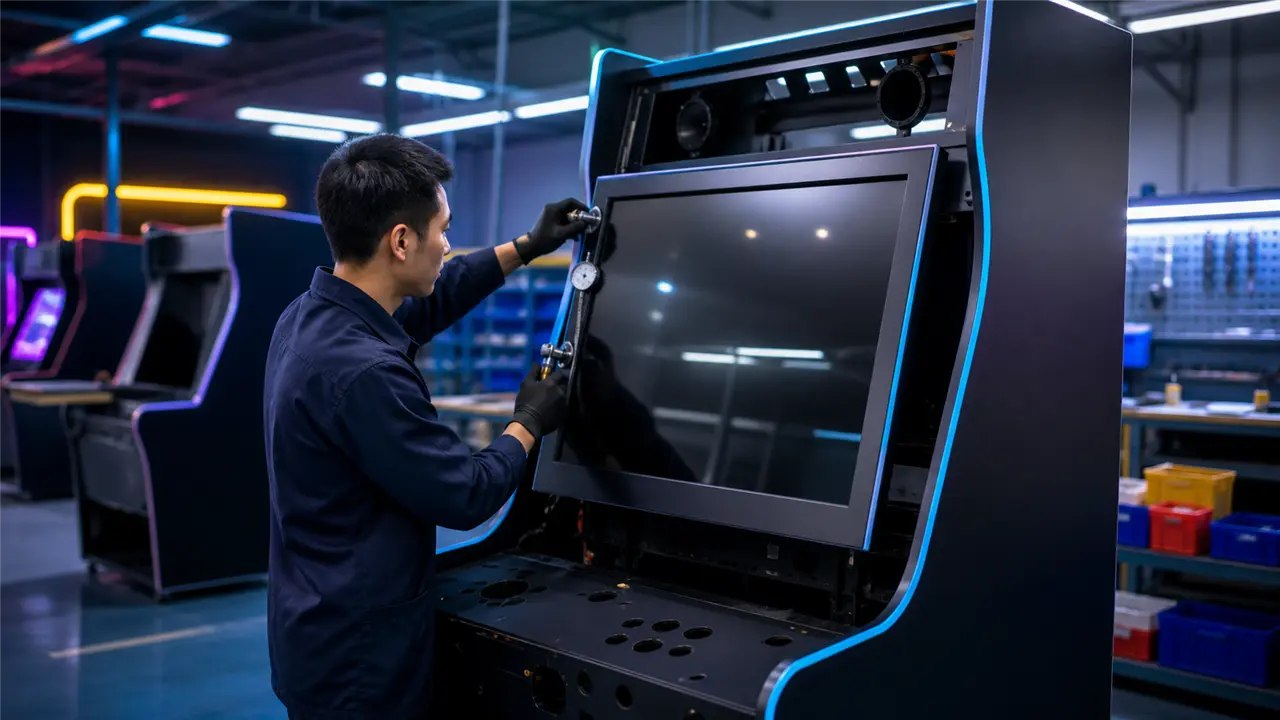
The visual centerpiece of any premium fish hunting game is the massive horizontal display panel. Accommodating screens ranging from standard 55-inch formats up to massive 85-inch 4K resolution monitors requires an extraordinary level of structural support. A custom 8 player fish table metal chassis builder must design a monitor mounting superstructure that prevents any microscopic sagging or warping of the display chassis over time. When an 85-inch commercial monitor is mounted horizontally, the gravitational stress on the center of the panel is immense. Standard wooden cabinets often fail to support this weight evenly, leading to backlight bleeding, panel distortion, and eventual catastrophic failure of the liquid crystal display.
To combat this, the main display tub is fabricated from heavily reinforced steel cross-members. These structural ribs are strategically welded beneath the primary VESA mounting brackets to distribute the static load of the monitor across the entire perimeter of the cabinet frame. The mounting brackets themselves feature micro-adjustment threading, allowing assembly technicians to perfectly level the display panel regardless of the underlying floor conditions. This precision leveling ensures that the gap between the monitor bezel and the protective glass remains perfectly uniform, eliminating any pressure points that could crack the screen during temperature fluctuations.
Protecting this expensive visual asset requires uncompromising top-surface shielding. We utilize specialized 8mm to 10mm thick tempered explosion-proof glass. Unlike standard tempered glass, which can still shatter into dangerous cubes upon extreme impact, our explosion-proof specification incorporates a multi-layer laminated polycarbonate film sandwiched between the glass strata. If a malicious user strikes the table surface with a heavy blunt instrument, the glass may fracture, but the polycarbonate matrix will hold all shards perfectly in place, maintaining a safe surface and completely preventing the weapon from penetrating through to the delicate 4K monitor below.
Furthermore, the glass surface undergoes a specialized chemical etching process to provide anti-glare properties. In brightly lit arcade environments, overhead fluorescent lights and neon signs can create severe reflections on the horizontal screen, ruining the immersive player experience. The anti-glare treatment diffuses these ambient light sources while maintaining 99 percent optical clarity and color transmission from the monitor beneath. The glass perimeter is subsequently sealed with heavy-duty industrial rubber gaskets that prevent spilled liquids from seeping into the monitor chassis, fully waterproofing the most vulnerable section of the cabinet.
Heavy-Gauge Cold-Rolled Steel Framing and Anti-Crowbar Lockbar Design
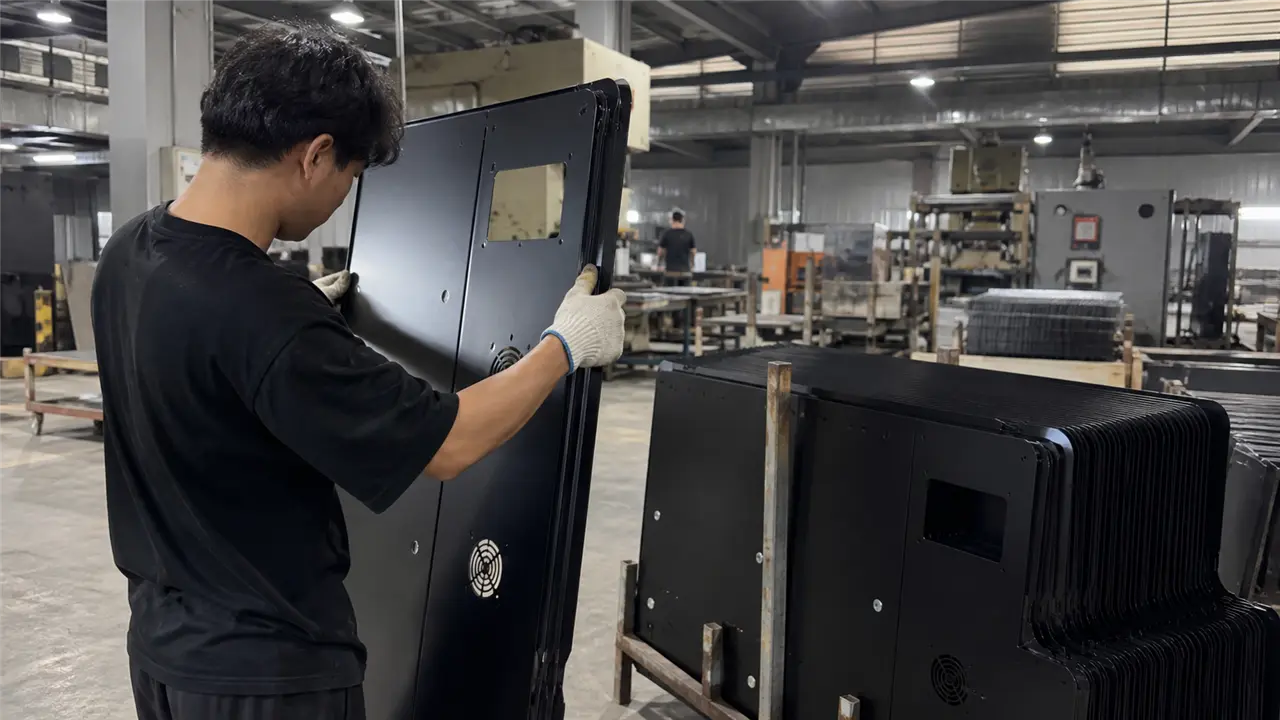
The foundational architecture of the cabinet relies exclusively on SPCC cold-rolled steel, specifically chosen for its superior tensile strength and excellent forming characteristics. Unlike hot-rolled steel, which can exhibit microscopic surface imperfections and dimensional variances, cold-rolled steel provides a flawlessly smooth finish essential for high-end powder coating. The primary structural pillars and load-bearing walls are fabricated from 14-gauge and 16-gauge steel sheets. These heavy thicknesses guarantee that the cabinet will absolutely never bend, twist, or rack under the weight of eight leaning adults during aggressive gameplay scenarios.
Fabrication begins on advanced CNC laser cutting tables. These machines slice through the heavy-gauge steel with micrometer precision, ensuring that all tabs, slots, and mounting holes align perfectly during the welding and assembly phases. Following the laser cutting, precision CNC press brakes fold the steel along calculated bend radiuses. By utilizing continuous folds rather than multiple welded plates where possible, the structural integrity of the corner geometries is vastly increased. Where welding is required, robotic TIG welding cells create flawless, continuous beads that fuse the seams into a unified monolithic structure.
Security is paramount in the design of the lower chassis, which houses the critical cash boxes and the main motherboard vault. Traditional cabinets utilize simple cam locks on flat wooden doors, which can be easily defeated by wedging a prybar into the gap. Our metal chassis entirely eliminates this vulnerability through an integrated anti-crowbar lockbar design. The doors are recessed deeply into the surrounding frame, featuring overlapping steel flanges that completely block any prybar access to the door seams. The hinge mechanisms are fully concealed internal piano hinges, meaning there are no exposed pins for a thief to punch out.
The locking mechanism itself upgrades from a standard single-point cam to a robust three-point vault locking system. When the operator turns the high-security tubular key, heavy steel rods deploy vertically into reinforced steel strike plates located at the top and bottom of the frame, while a central deadbolt engages the side wall. This turns the entire access door into a structural sheer wall that can resist thousands of pounds of prying force. For route operators seeking to buy fish game pcb board wholesale components and deploy them in high-risk zones, this level of physical security is the ultimate guarantee of revenue protection.
8-Station Ergonomic Joystick, Pushbutton, and Weapon Switch Wiring Looms
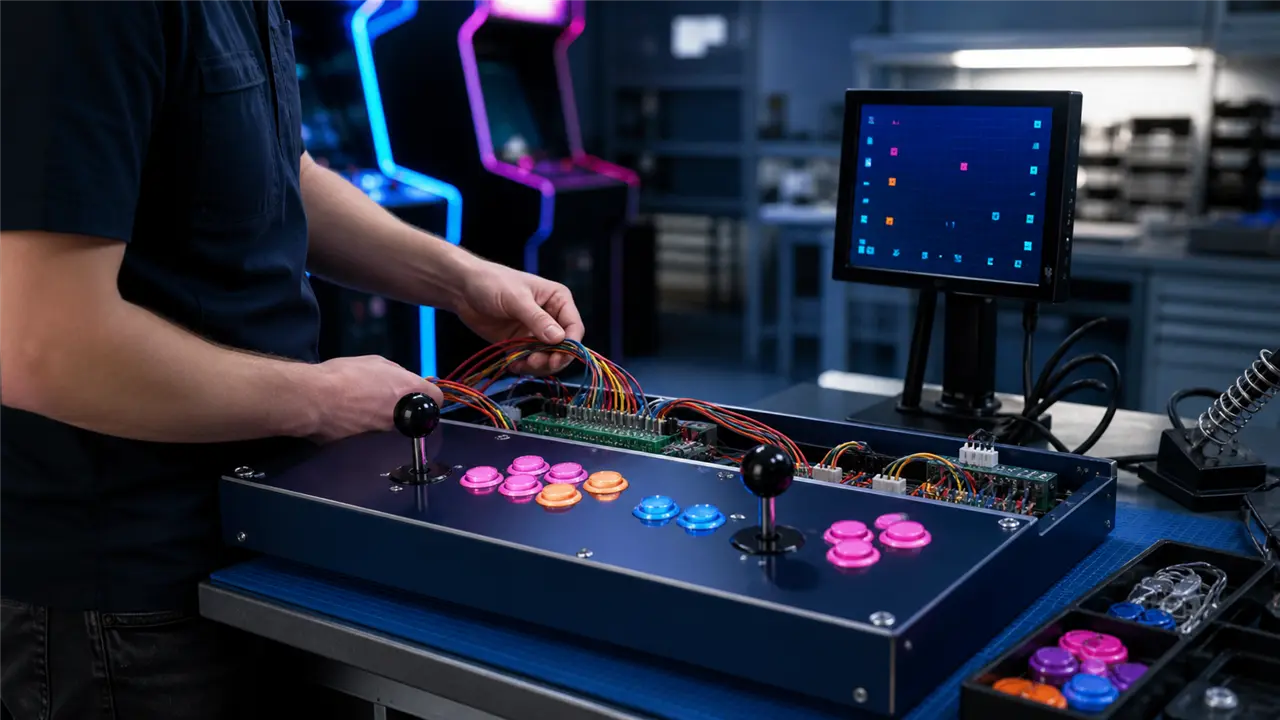
The player interface is the physical connection point between the customer and the software revenue engine. In an eight-player configuration, the sheer density of hardware required on the control deck demands meticulous engineering. Each of the eight stations features an authentic arcade joystick, a primary weapon fire button, a weapon toggle switch, and various auxiliary function buttons. When multiplied by eight players, the control deck must accommodate over forty individual mechanical switches, all of which must withstand millions of actuation cycles without failure.
The control deck itself is formed from a continuous sheet of thick steel, angled precisely at a 15-degree ergonomic slope. This angle is specifically calculated to reduce wrist fatigue during extended gaming sessions, encouraging players to remain at the machine and continue feeding credits. The joystick mounting points feature internally welded threaded standoffs. This allows the joystick body to be bolted directly into the metal from below without any exposed screw heads on the top control surface. This method absolutely prevents players from unscrewing the joysticks, while providing a rock-solid anchor that will never strip out or loosen over time.
Beneath the control panel lies the intricate circulatory system of the machine the wiring looms. A custom 8 player fish table metal chassis builder cannot rely on generic, thin-gauge wiring. We utilize dedicated, color-coded 18 AWG copper stranded wiring harnesses for all control inputs and 16 AWG wiring for power distribution. The thicker gauge completely eliminates voltage drop across the long runs required to reach the stations furthest from the central PCB. All wire terminations utilize high-quality, insulated spade crimp connectors that grip the microswitch terminals tightly, preventing accidental disconnection from cabinet vibration.
To manage the massive bundle of wires routing from the eight individual stations down to the central I/O board, we employ industrial-grade expandable braided sleeving and heavy-duty nylon zip-tie anchors spot-welded directly to the interior chassis walls. This strict cable management protocol provides exceptional strain relief, ensuring that no single wire is ever subjected to tension. It also dramatically speeds up maintenance and troubleshooting for operators on site. If a specific player station requires a button replacement, the operator can instantly trace the beautifully organized loom back to the origin point, completely avoiding the tangled wire nests notoriously found in cheap wooden cabinets.
Multi-Bill Acceptor Pulse and RS232 Harness Interfacing (ICT, MEI, Pyramid)
Revenue collection is the lifeblood of any arcade machine, and the integration of the bill validators must be flawless, secure, and technologically advanced. Our premium metal chassis are designed to accommodate a diverse array of global currency validators, supporting industry-standard units from manufacturers such as ICT, MEI, and Pyramid Technologies. The cabinet features precisely cut mounting bezels that allow these validators to sit flush against the exterior metal, with heavy internal security brackets that bolt the validator chassis directly to the main steel frame, preventing thieves from simply ripping the unit out of the cabinet.
The electrical interfacing of these bill validators requires highly specialized fish table bill validator wiring protocols. While older systems relied exclusively on simple pulse outputs, modern sophisticated operators demand complex data integration. Our custom harnesses are engineered to support both traditional 12-volt pulse communication and advanced RS232 serial data interfacing. The RS232 protocol allows the bill validator to communicate highly detailed telemetry back to the main motherboard, including real-time error reporting, full cash box alerts, and detailed accounting of specific bill denominations accepted.
Security against electronic manipulation is a critical component of our harness engineering. Thieves frequently attempt to use stringing techniques or electromagnetic interference (EMI) generators to trick the bill validator into registering false credits. To combat this, our wiring harnesses incorporate heavy EMI shielding braided mesh, completely isolating the sensitive pulse and data lines from external electromagnetic pulses. Furthermore, the harnesses feature integrated optical isolation circuits on the logic boards that physically separate the validator voltage lines from the motherboard logic lines, preventing power spikes from destroying the primary PCB.
The power distribution to the bill validators is also highly regulated. Multi-validator setups on an eight-player machine draw significant current during the mechanical validation cycle. We deploy dedicated, isolated switching power supplies exclusively for the currency handling equipment. This prevents voltage dips during simultaneous bill insertions across multiple player stations, which could otherwise cause the main game board to reset or glitch. The wiring harnesses utilize robust MOLEX connectors with positive locking latches, ensuring that thermal expansion and mechanical vibration can never cause an accidental power loss to the revenue collection hardware.
High-Power LED Marquee Edge Lighting and Under-Glow Illumination
Attracting players in a crowded arcade or bustling bar environment requires an aggressive and captivating visual presence. The metal chassis design allows for the integration of sophisticated high-power LED lighting systems that are simply impossible to safely mount in combustible wooden cabinets. We utilize addressable RGB LED strips (WS2812B or similar protocols) heavily integrated into the perimeter edges, the leg structures, and the control panel under-glow channels. These addressable LEDs allow the game board to control the lighting dynamically, synchronizing the exterior illumination with in-game events, such as massive boss defeats or jackpot payouts.
The thermal properties of the cold-rolled steel chassis play a crucial role in the lifespan of these high-power LED systems. LEDs generate substantial localized heat, and when mounted inside wooden grooves, they rapidly degrade and burn out due to thermal trapping. Our chassis features precision-milled aluminum diffusion channels bolted directly to the steel frame. The steel acts as a massive thermal sink, drawing heat away from the LED diodes and extending their operational lifespan beyond 50,000 hours. The diffusion channels are capped with frosted polycarbonate strips that perfectly blend the individual LED point lights into a smooth, continuous neon-like glow.
Powering these massive lighting arrays requires careful electrical load balancing. An eight-player cabinet fully decked in addressable LEDs can draw upward of 30 to 40 amps on the 5-volt rail. We utilize multiple synchronized high-efficiency power supplies, distributing the LED load across dedicated copper busbars routed through the chassis. This ensures that the voltage remains stable at exactly 5.0V even at the absolute furthest corners of the lighting matrix, preventing the infamous color-shifting (where white turns to yellow or pink) commonly seen in poorly wired arcade machines. The lighting control harnesses are heavily shielded to prevent the high-frequency PWM dimming signals from inducing audible noise into the cabinet’s audio amplifier lines.
Assembly Tolerances, Modular Flat-Pack Packaging, and On-Site Setup
One of the greatest logistical challenges for operators and distributors is the astronomical cost of shipping fully assembled arcade equipment internationally. Our advanced engineering processes solve this issue through an innovative modular flat-pack design architecture. By designing the metal chassis as a series of interlocking structural sub-assemblies, we can collapse the immense footprint of an eight-player fish table into highly dense shipping crates. This maximizes container utilization, allowing distributors to import commercial fish table cabinet manufacturer china shipments with vastly reduced freight costs per unit.
The success of a modular flat-pack design relies entirely on microscopic assembly tolerances. Because we utilize laser cutting and CNC bending, every bolt hole and mounting flange aligns with a tolerance of less than 0.5 millimeters. There is no drilling, filing, or brute-force adjustment required on-site. The structural components interlock using heavily reinforced steel gussets and M8 machine bolts tapped into hardened steel rivet nuts. This fastening methodology ensures that once the cabinet is bolted together, the joints are mathematically as strong as a continuous weld, completely eliminating the structural wobble associated with cheap flat-pack furniture.
On-site setup is dramatically streamlined for the operator’s technical staff. The internal wiring harnesses are pre-routed through the sub-assemblies at the factory and terminated in massive, automotive-grade multi-pin quick disconnects. When the operator bolts the legs and control panels to the main display tub, they simply snap these color-coded harness blocks together to instantly complete the complex electrical circulatory system. A skilled two-person technician crew can fully assemble, wire, and boot up an eight-player metal chassis in less than forty-five minutes, drastically reducing deployment labor costs and accelerating the time to profitability on the route.
Frequently Asked Questions
Question What thickness of steel is optimal for commercial fish table cabinets to prevent crowbar attacks?
We strictly utilize 14-gauge and 16-gauge SPCC cold-rolled steel for our primary structural panels and security doors. This thickness provides immense tensile strength and absolute rigidity. When combined with our recessed door designs and multi-point locking bars, it makes the cabinet effectively impervious to standard crowbars, prybars, and aggressive blunt force trauma typically encountered in unattended route operations.
Question How does the wiring harness design prevent joystick and button failures in an 8-player setup?
We engineer our wiring looms using robust 18 AWG copper stranded wire terminated with high-tension insulated spade connectors. Furthermore, we employ strict cable management utilizing braided sleeving and heavy-duty chassis anchors. This completely eliminates strain on the microswitch terminals. The joysticks themselves are bolted directly into threaded metal standoffs, preventing mechanical flex that traditionally shears wires and misaligns microswitches.
Question Can the metal chassis support different brands of bill validators and accounting systems?
Absolutely. Our custom 8 player fish table enclosure is designed with universal mounting bezels and heavy-duty internal security brackets compatible with all major hardware, including ICT, MEI, and Pyramid. Our advanced wiring harnesses support both standard 12V pulse interfaces and highly complex RS232 serial data protocols, ensuring seamless integration with your preferred auditing and accounting management systems.
Question Why is tempered explosion-proof glass necessary instead of standard arcade glass?
Standard glass, even when tempered, can shatter into thousands of pieces upon severe impact, creating a massive liability and allowing the vandal to destroy the expensive 4K monitor below. Our explosion-proof glass utilizes an internal laminated polycarbonate film layer. Upon catastrophic impact, the glass may crack, but the polycarbonate matrix holds all shards securely in place, maintaining a safe surface and perfectly shielding the display hardware.
Question Do metal cabinets cause the internal PCB and power supplies to overheat?
The exact opposite is true. Traditional wooden cabinets act as severe thermal insulators, trapping heat and requiring loud, aggressive exhaust fans. Our cold-rolled steel chassis acts as a massive passive thermal heatsink. Heat generated by the fish game pcb board wholesale components, power supplies, and massive LED arrays is efficiently transferred to the metal frame and dissipated into the surrounding ambient air, drastically extending the lifespan of all electronic components.
For Enterprise Hardware Manufacturing Inquiries: Engineer Wang WhatsApp/WeChat: +86 17620842078 Telegram: https://t.me/JLwyc Email: miba515527@gmail.com Guangzhou Miba Animation Technology Co., Ltd.