- Acquisition Strategy and Financial Blueprint
- Cost Drivers in Commercial Arcade and Casino Software Engineering
- High-Concurrency Backend Microservices and Database Architecture
- Source Code Due Diligence and Anti-Reverse Engineering Protections
- Delivery Milestones and Production Deployment Roadmap
- Frequently Asked Questions
Developing commercial-grade arcade and casino games demands strategic capital allocation. Venue operators and route managers must decide whether to fund in-house engineering from scratch or acquire established white-label source code to accelerate market entry.
Acquiring complete source code drastically reduces time-to-market compared to a ground-up build. While custom scratch development requires extensive CapEx for full-stack engineering teams, RNG certification, and prolonged QA testing, a white-label source code acquisition provides a proven foundation. Operators bypass the initial heavy lifting of core engine mechanics and backend scaffolding, moving straight to reskinning, custom mechanic adjustments, and regional localization. This immediate deployment capability maximizes ROI window while maintaining full intellectual property independence, avoiding the perpetual profit drain associated with SaaS revenue-share models. For tailored deployment architectures and source code licensing frameworks, connect with our principal engineering team for a dedicated consultation. For a comprehensive architectural overview and turnkey procurement frameworks, review our master guide on custom game development and mathematical modeling. For factory-direct procurement and comprehensive engineering specs, consult our master guide on white label casino game engine and source code ownership.
Acquisition Strategy and Financial Blueprint
Understanding the financial and operational trade-offs between different acquisition paths is critical for route operators aiming to scale their hardware fleets globally.
| Acquisition Model | Initial CapEx | Ongoing OpEx | Time-to-Market | Customization Freedom | IP Ownership |
|---|---|---|---|---|---|
| **In-House Scratch Development** | Extreme ($150k – $500k+) | High (Dev team payroll) | 9 – 18 Months | Unrestricted | 100% Retained |
| **White-Label Source Code Purchase** | Moderate ($30k – $100k) | Low (Maintenance only) | 1 – 3 Months | High (Full codebase access) | Perpetual License / Full Ownership |
| **SaaS Revenue-Share Licensing** | Minimal ($5k – $15k) | Extreme (10-30% gross profit) | 2 – 4 Weeks | Highly Restricted | Vendor Retained |
Cost Drivers in Commercial Arcade and Casino Software Engineering
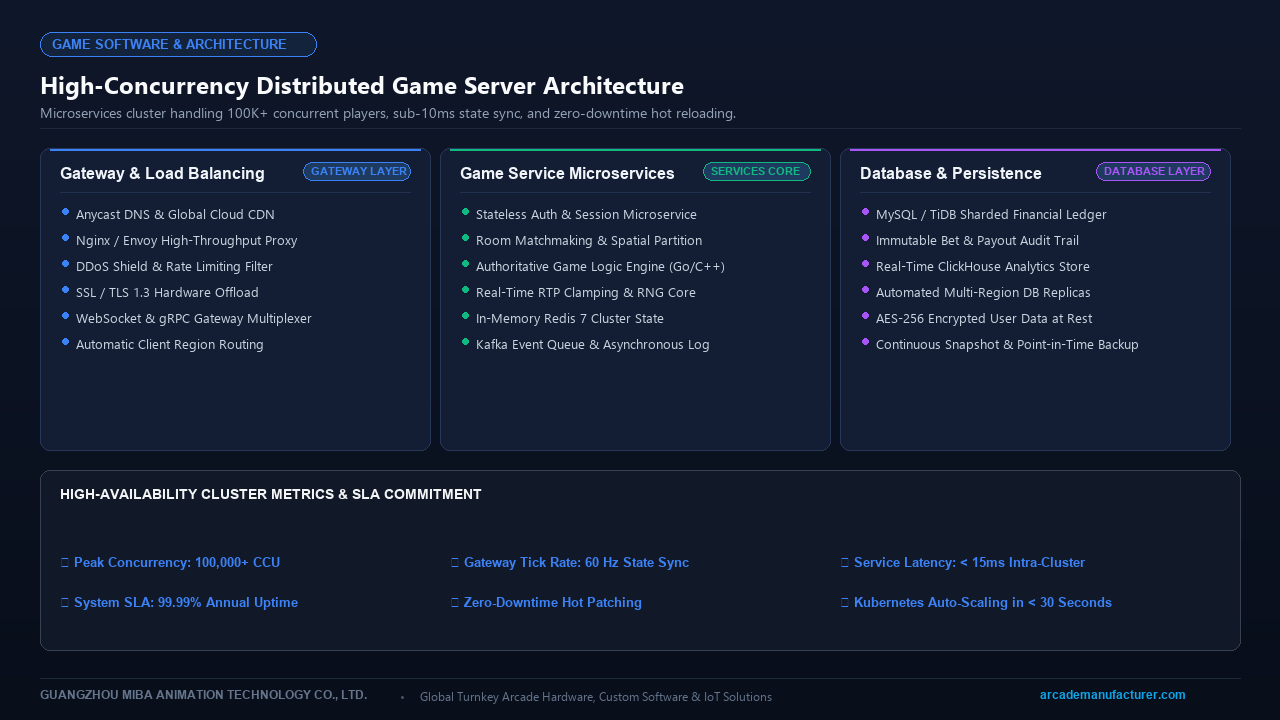
Estimating the actual capital required to develop a commercial game requires a forensic breakdown of engineering disciplines. Building a robust digital asset is not merely about writing functional code; it requires rigorous mathematical modeling, high-fidelity asset pipelines, and enterprise-grade backend infrastructure.
The largest variable in the development budget is the 2D and 3D art pipeline. High-resolution graphics, dynamic particle effects, and fluid skeleton animations demand hundreds of specialized man-hours. A typical casino slot or fish shooting game requires extensive skeletal animations built in Spine 2D or Unity 3D particle systems. Every symbol, environment asset, and UI element must be optimized for diverse hardware configurations without compromising visual fidelity. Operators should allocate roughly forty percent of the initial budget solely to visual and auditory asset creation to ensure the title meets modern player expectations.
Equally demanding is the mathematical model and RNG certification process. The core engine driving payout percentages, volatility indexes, and hit frequencies requires precision engineering by experienced game mathematicians. This logic must then pass rigorous third-party auditing to achieve certification for regulated markets. The cost of iterative mathematical simulations—running billions of simulated spins to guarantee the Return to Player (RTP) aligns with theoretical models—represents a significant upfront investment. Any flaw in the mathematical architecture exposes the operator to severe financial liability on the floor.
Furthermore, deploying a robust backend distributed cluster setup dramatically influences overall costs. Modern arcade games rely on real-time telemetry, continuous state saving, and distributed ledger mechanics. Building a highly available backend capable of handling millions of concurrent transactions necessitates senior DevOps expertise. The infrastructure must handle peak load scaling dynamically while ensuring absolute transaction integrity. Designing this architecture from scratch requires specialized engineers who understand the unique latency and reliability constraints of the arcade gaming industry.
High-Concurrency Backend Microservices and Database Architecture
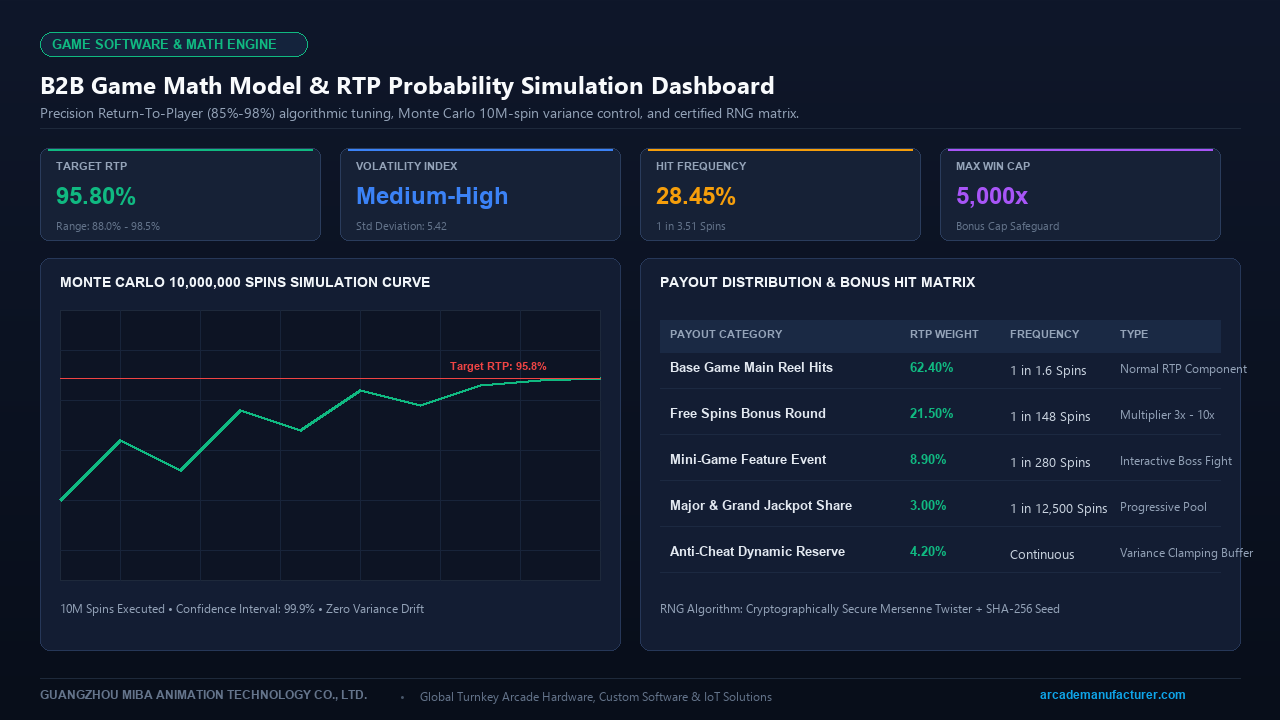
Commercial arcade operations require enterprise-grade backend infrastructure to process immense transactional loads without latency. An optimized architecture leverages distributed microservices, ensuring independent scaling and fault tolerance across the entire network cluster.
A modern deployment typically utilizes Golang or Node.js for microservices due to their exceptional asynchronous I/O capabilities and low memory footprints. The gaming logic service handles real-time player interactions, while a separate wallet service manages financial transactions with atomic precision. To prevent race conditions during high-volume betting, the architecture employs Redis distributed locks, ensuring that concurrent requests cannot mutate the same player balance simultaneously. This caching layer is vital for maintaining real-time arcade machine security when thousands of terminals connect concurrently.
For persistent data storage, PostgreSQL sharding provides the horizontal scalability required by global operators. Player profiles, transaction ledgers, and game state snapshots are partitioned across multiple database nodes based on geographic routing or tenant IDs. This ensures query speeds remain instantaneous regardless of database size, preventing bottlenecking during peak operational hours across diverse service arcade locations.
- [ Arcade Client Terminals / Hardware Cabinets ]
- v v v
- L4 / L7 Load Balancers
- v v v
- API Gateway Cluster
- (Authentication, Rate Limiting, SSL Termination)
- v v v
- Game State Service | | Wallet Service
- (Golang/WebSockets) | | (Node.js/gRPC)
- v v
- Redis Cluster | | PostgreSQL Sharded DB
- (Distributed Lock)| | (Persistent Ledger)
This microservices blueprint allows route operators to push live updates to the presentation layer without disrupting the underlying financial services, guaranteeing zero downtime.
Source Code Due Diligence and Anti-Reverse Engineering Protections
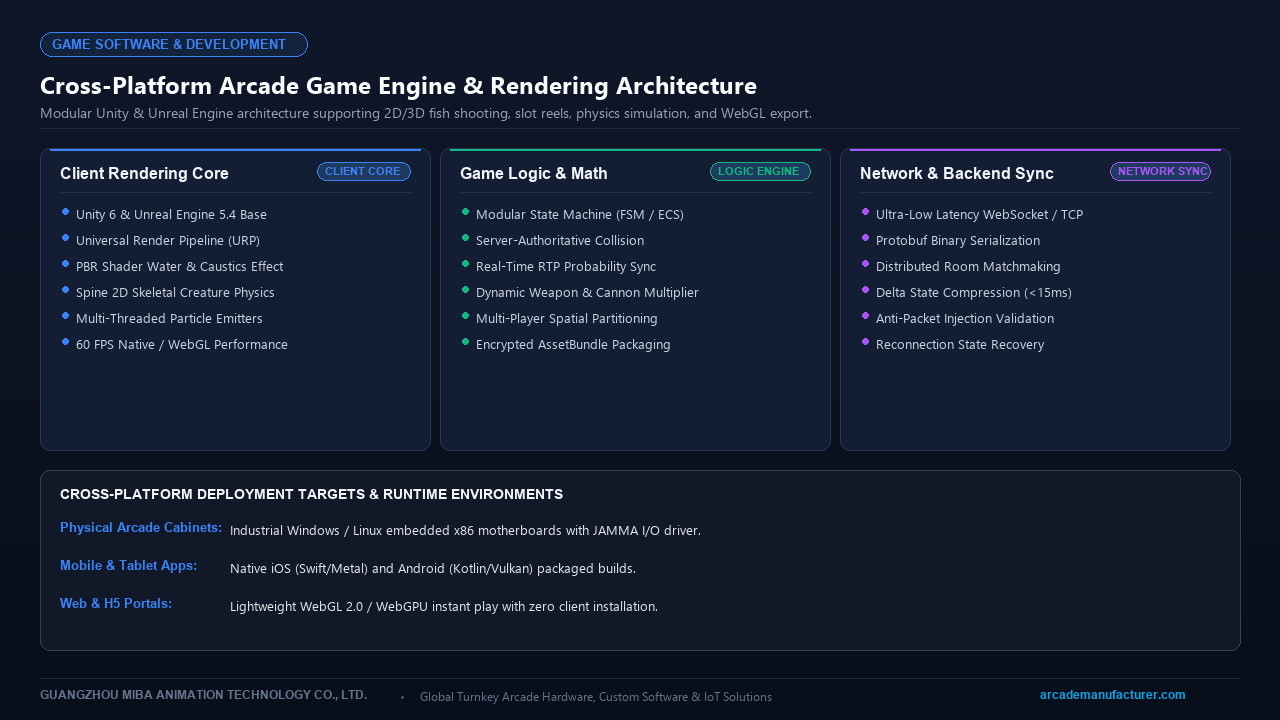
When purchasing white-label source code or deploying proprietary builds, safeguarding the intellectual property and ensuring operational integrity is paramount. Operators must implement comprehensive security protocols to prevent malicious exploitation and unauthorized code cloning.
Source code due diligence begins with comprehensive code obfuscation. Before any binary is compiled and distributed to the hardware floor, the entire codebase must be systematically obfuscated. This process strips human-readable symbols, encrypts critical mathematical logic, and flattens control flows, rendering reverse engineering attempts via decompilers mathematically impractical. Obfuscation ensures that proprietary RNG algorithms and hit frequency calculations remain concealed from malicious actors attempting to analyze the client-side binary.
Beyond obfuscation, robust memory integrity verification is essential for maintaining a secure operational environment. Sophisticated attackers may attempt to modify process memory at runtime to alter game state variables or inject counterfeit credits. Implementing continuous memory scanning and checksum validations guarantees that the executable remains untampered throughout its runtime. These software checks work in tandem with hardware defense systems, creating a multi-layered barrier against physical and digital intrusion attempts on the casino floor.
Furthermore, restricting unauthorized distribution of the software requires advanced license key dongle mechanisms. The game binary should be cryptographically tethered to a physical USB security dongle or a unique hardware identifier on the motherboard. This ensures that the purchased source code cannot be arbitrarily duplicated and deployed onto unauthorized cabinets. Integrating a reliable anti cheat device validation check directly into the boot sequence prevents cloned boards from connecting to the legitimate backend network, securing the operator’s fleet investment.
Delivery Milestones and Production Deployment Roadmap
Executing a game development or white-label customization project requires a disciplined, phase-gate approach to ensure the final product meets commercial viability standards and technical specifications.
The process begins with the initial prototype review. During this phase, the core gameplay loop, mathematical volatility, and foundational UI wireframes are evaluated. For a white-label acquisition, this milestone focuses on defining reskin parameters and custom feature integration. Stakeholders must sign off on the exact mathematical models and art direction before heavy asset production commences. This ensures alignment between the engineering team and the operator’s target demographic expectations.
Subsequent development sprints focus on implementing the approved art assets and wiring the frontend client to the backend infrastructure. This leads to the critical staging QA phase. The fully assembled build is deployed to an isolated staging environment that mirrors production hardware. Quality assurance engineers execute automated load testing, boundary condition validation, and comprehensive edge-case exploitation attempts. Every transaction path is audited to ensure zero discrepancies in the financial ledger, and memory profiling is conducted to eliminate memory leaks during extended uptime scenarios.
The final phase involves containerized global server deployment. Utilizing Docker and Kubernetes orchestration, the backend services are containerized and deployed across geographically distributed data centers. This infrastructure-as-code approach ensures perfect environment parity and allows for zero-downtime rolling updates. Simultaneously, the compiled, encrypted client binaries are securely flashed onto the physical arcade hardware. Upon successful deployment, operators gain access to real-time analytics dashboards, marking the transition from development to live commercial operation.
Frequently Asked Questions
How long does it take to deploy a white-label game source code
Deploying a white-label source code typically requires one to three months, depending on the extent of customization. If operators require extensive 3D asset reskinning or significant adjustments to the underlying mathematical volatility, the timeline extends. Standard cosmetic re-theming and API integrations can be completed rapidly for immediate market entry.
Are white-label game mathematics certified for regulated markets
Most premium white-label source codes are developed using certified mathematical models as a foundation. However, whenever operators modify payout structures or re-theme symbols, the new iteration must be submitted to independent testing laboratories like GLI or BMM for recertification to ensure compliance with local gaming jurisdictions.
Do I receive full ownership when buying game source code
Purchasing a white-label full source code generally grants operators a perpetual, non-exclusive commercial license, allowing unlimited deployments without revenue-sharing. Depending on the contract, operators may secure exclusive regional rights or outright intellectual property transfer, granting total control over the codebase and future derivatives.
How do we handle backend server maintenance after launch
Post-launch backend maintenance requires monitoring telemetry, applying security patches, and scaling database instances. Operators can manage this internally utilizing the provided containerized deployment scripts, or they can establish a Service Level Agreement with the original engineering team for continuous 24/7 DevOps support and infrastructure optimization.Contact our principal engineers to architect your commercial gaming fleet. Reach out to Engineer Wang at +86 17620842078 or visit the Guangzhou Miba Animation Technology Co., Ltd. Panyu facility to review our enterprise software solutions and hardware manufacturing capabilities.