- Evaluating Microcontroller Architectures for Teleoperation
- Optocoupled Isolation and High Voltage Protection
- Bridging Logic with WebRTC Video Pipelines
- Cloud Queue Server Integration and Telemetry Logging
- Redundancy and Power Distribution Systems
- Technical Specifications for IoT Controllers
- Low Latency Teleoperation Hardware and WebRTC Pipeline Engineering
- Venue Fleet Management and Remote Maintenance Workflows
- Low Latency Teleoperation Hardware and WebRTC Pipeline Engineering
- Venue Fleet Management and Remote Maintenance Workflows
- Frequently Asked Questions
Building a durable remote teleoperation arcade requires moving past generic consumer electronics and adopting industrial-grade logic controllers. Operators frequently struggle with machine downtime caused by logic board failures, signal interference, or inadequate processing power when bridging physical hardware to the cloud.
Selecting the optimal IoT architecture involves evaluating the specific demands of teleoperated gameplay. The ideal microcontroller gateway—typically built upon the STM32 or ESP32-S3 architectures—must flawlessly handle persistent cloud queue server connections while simultaneously executing microsecond-precise PWM signals for stepper motor drivers. This requires robust failover architecture, optocoupled motor relays to shield the logic gates from high-voltage inductive spikes, and seamless integration with independent WebRTC sub-80ms pipelines. Furthermore, dual-camera telemetry must operate synchronously without bottlenecking the primary control logic. Implementing the correct industrial control board ensures your remote coin dispensers and gantry mechanics run 24/7 in an unattended environment without requiring constant technician intervention.
To engineer custom IoT solutions for your remote amusement route, consult directly with Engineer Wang at Guangzhou Miba Animation Technology Co., Ltd. (Panyu Manufacturing Base) via WhatsApp at +86 17620842078, Telegram at https://t.me/JLwyc, or email at miba515527@gmail.com.
Evaluating Microcontroller Architectures for Teleoperation
When designing the brain of a remote claw machine, engineers must choose between various microcontroller architectures. Standard Arduino-level AVR chips lack the processing speed and memory required for secure IoT cryptography (TLS/SSL) and real-time networking. The industry standard has shifted to 32-bit ARM Cortex-M microcontrollers, specifically the STM32 family, or the highly integrated dual-core ESP32 series. These chips provide the necessary clock speeds (up to 240MHz or higher) to run a Real-Time Operating System (RTOS). An RTOS is critical for prioritizing tasks; it ensures that the thread managing the WebSocket connection to the cloud queue server never interrupts the high-priority thread generating the exact pulse sequences required by the industrial stepper motors.
Optocoupled Isolation and High Voltage Protection
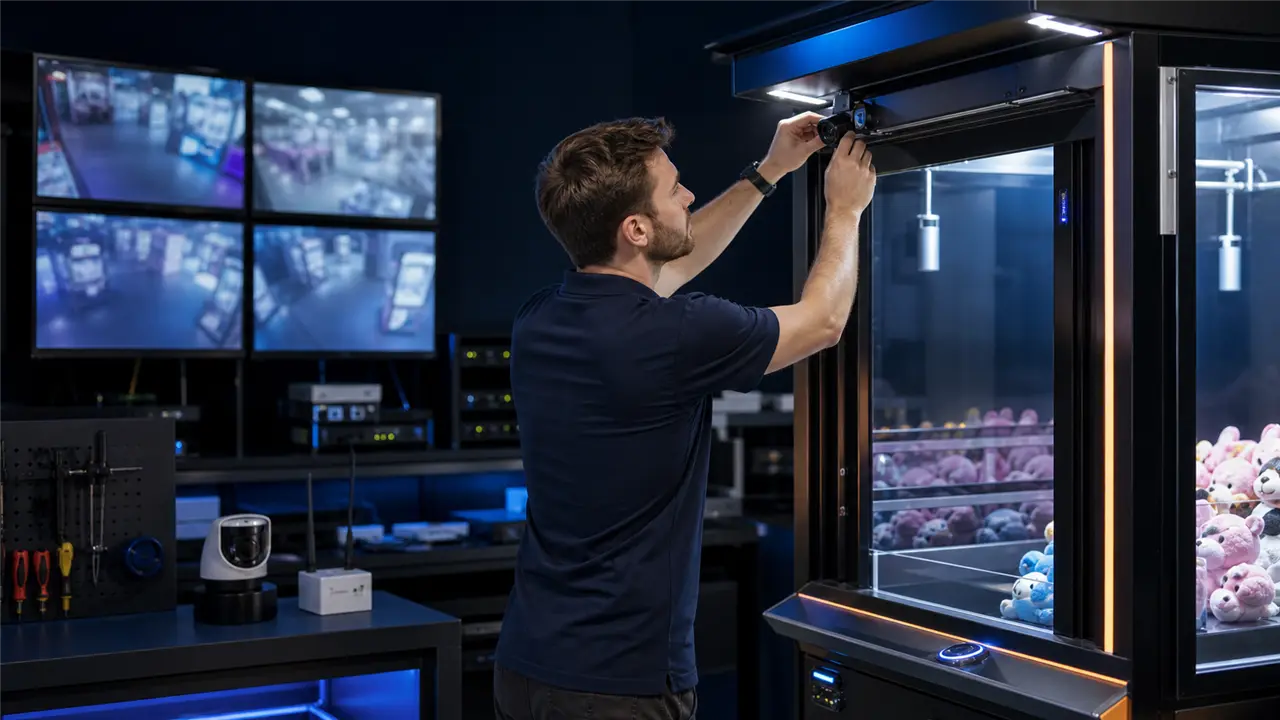
Claw machines are inherently noisy electrical environments. The rapid switching of high-torque motors, solenoids, and coin dispensers generates massive electromagnetic interference (EMI) and high-voltage back-EMF spikes. A consumer-grade logic board will quickly suffer from random resets or permanent silicon damage in this environment. Industrial IoT control boards utilize extensive optical isolation. Optocoupled relays transmit digital control signals using light across a physical gap, ensuring zero electrical continuity between the delicate 3.3V microcontroller logic and the 24V/48V actuator circuits. This isolation is a non-negotiable requirement for hardware deployed in unattended B2B routes, drastically reducing maintenance overhead.
Bridging Logic with WebRTC Video Pipelines

A common mistake in amateur teleoperation design is attempting to route video telemetry through the primary IoT microcontroller. Video encoding requires massive computational throughput that will inevitably starve the motor control routines, causing physical gantry stutter. Industrial implementations entirely separate these systems. The microcontroller gateway focuses solely on command and control via MQTT or WebSockets, while dedicated hardware ASICs (Application-Specific Integrated Circuits) handle the H.264/H.265 compression of the dual-camera feeds. These separate pipelines meet in the cloud, where the signaling server and the SFU synchronize the sub-80ms video stream with the millisecond-accurate control telemetry.
Cloud Queue Server Integration and Telemetry Logging
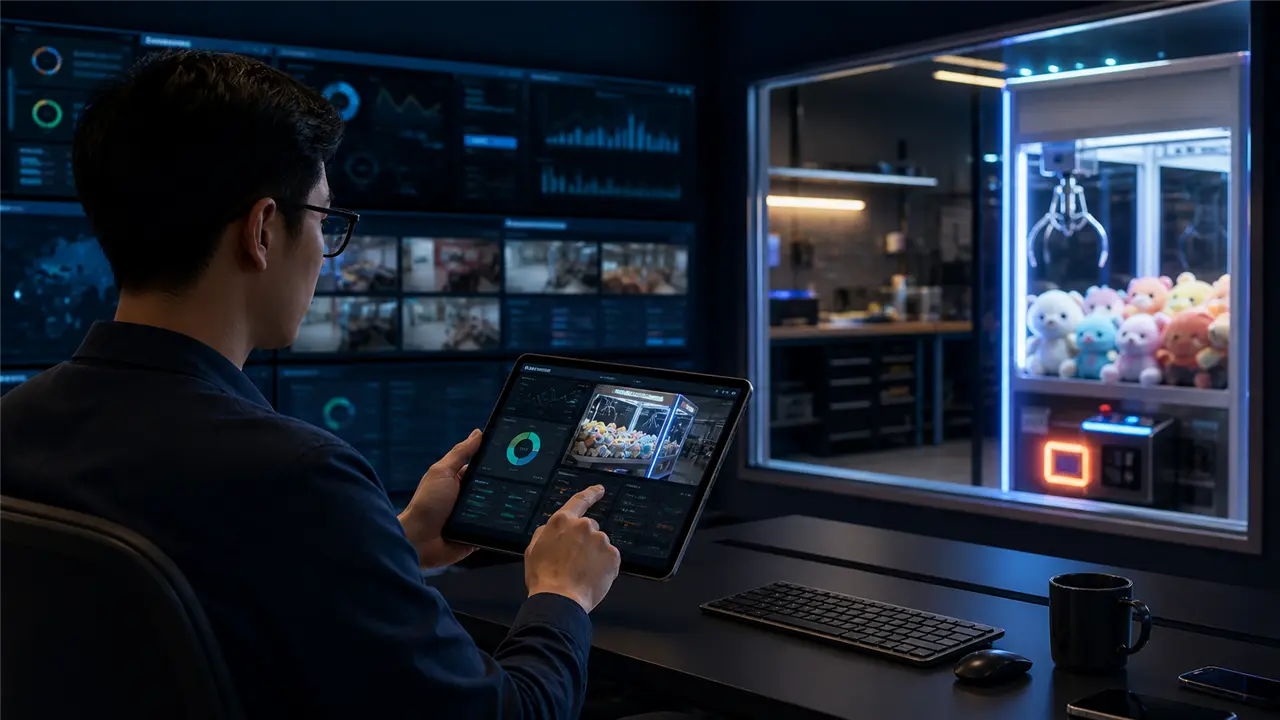
The microcontroller gateway acts as the physical endpoint for the central cloud queue server. It must maintain a persistent, heartbeat-monitored connection. If the board stops receiving the heartbeat ping from the server, its failover architecture must dictate an immediate safe-stop of all moving parts. Beyond executing movement commands, the IoT board serves as a diagnostic hub. It constantly polls a network of internal sensors via I2C or SPI buses, monitoring stepper motor temperatures, chassis ambient temperature, current draw anomalies, and prize drop sensor state. This rich telemetry is packaged into JSON payloads and pushed to the operator’s dashboard, allowing for predictive maintenance before a hardware failure occurs.
Redundancy and Power Distribution Systems
Industrial IoT control boards for remote arcades are designed with redundant power architecture. A power supply fluctuation should never cause the logic controller to crash mid-game. These boards are equipped with multi-stage voltage regulators, smoothing capacitors, and often dual-input power terminals. If the primary 24V supply sags during a heavy claw lift, the logic board’s dedicated power rail remains stable. Furthermore, many advanced gateways include hardware watchdog timers—a dedicated silicon circuit that requires the microcontroller to constantly “pet” it. If the software hangs and fails to ping the watchdog, it automatically triggers a hard reset of the board, allowing the machine to recover autonomously without dispatching a human technician.
Technical Specifications for IoT Controllers
| Feature | Standard Parameter | Industrial Application Context |
|---|---|---|
| Core Architecture | STM32 / ESP32-S3 (Dual Core) | Handles concurrent RTOS threads for networking and high-frequency PWM generation. |
| Circuit Protection | Multi-Channel Optocouplers | Provides 5kV optical isolation between 3.3V logic and 24V/48V motor systems. |
| Communication Interface | RS485 / CAN bus / Dual Ethernet | Robust internal module communication and redundant external network connectivity. |
| Diagnostic Telemetry | I2C / SPI Sensor Arrays | Real-time monitoring of motor temps, current draw, and internal cabinet climate. |
| System Recovery | Hardware Watchdog Timer | Autonomous hard-reset capability to recover from software freezes without human intervention. |
| Actuator Control | Precision PWM Generation | Drives closed-loop stepper motors without jitter or missed steps. |
Low Latency Teleoperation Hardware and WebRTC Pipeline Engineering
Operating real physical arcade machines over the public internet requires overcoming severe latency, packet jitter, and mechanical response delays. To achieve a seamless real-time player experience where control inputs feel instantaneous (<80ms glass-to-glass latency), the system architecture integrates edge IoT hardware with optimized streaming pipelines:
1. Sub-80ms WebRTC Streaming Infrastructure: Video feeds captured by dual wide-angle 1080p 60FPS industrial IP cameras (front view and side depth view) are encoded using hardware-accelerated H.264 / NVENC pipelines directly at the local venue edge server. Video frames are streamed over WebSockets/WebRTC using dynamic jitter buffering, ensuring adaptive bitrate streaming across mobile 4G/5G networks without buffering stutters. 2. Industrial Edge IoT Gateway Boards: Each bank of claw machines or coin pushers is controlled by an industrial STM32F4/ESP32-S3 microcontroller board equipped with isolated GPIO relays, optical encoder counters, and RS-485 serial communication. The gateway parses player control packets (joystick directional vectors, drop buttons) and triggers stepper motor drivers within 5 milliseconds of network packet reception. 3. Mechanical Gantry and Stepper Motor Precision: High-precision NEMA 23 stepper motors and optocoupled limit switches replace standard AC motors. This allows fine-grained micro-stepping positioning, enabling precise claw hovering, dynamic claw grip voltage adjustments (3-stage voltage control: grab, lift, transport), and optical prize drop detection with zero false drops. 4. Cloud Queue and Session Failover Architecture: When multiple concurrent players enter a machine’s live room, the cloud backend maintains a strict FIFO queue with automated spectator view synchronization. If a player experiences network disconnection during an active round, the edge gateway executes an automated safe-return sequence, resetting the claw gantry to home position and safely refunding tokens to the player’s account.
| System Subsystem | Hardware / Protocol Specifications | Operational Target Metric | Business Benefit |
|---|---|---|---|
| Edge Video Encoding | H.264 / HEVC Hardware Encoder, RTSP to WebRTC | < 60 ms glass-to-glass delay | Real-time visual feedback for precise claw drops |
| Teleoperation Gateway | STM32 ARM Cortex-M4 + Optoisolated Relays | < 5 ms GPIO execution latency | Instantaneous joystick response without input lag |
| Stepper Motor Control | NEMA 23 Stepper, 1/16 Microstepping Driver | ±0.5 mm positioning accuracy | Professional claw control and smooth camera telemetry |
| Prize Detection Sensor | Dual-Beam Infrared Optical Barrier | 99.99% detection accuracy | Automated prize payout verification and inventory sync |
| Network Failover | Dual-WAN Edge Router with 4G/5G Auto-Failover | 99.95% venue uptime SLA | Uninterrupted 24/7 route operation without onsite staff |
Venue Fleet Management and Remote Maintenance Workflows
Managing an unattended remote live arcade facility with dozens of physical machines requires centralized telemetry and automated self-healing mechanisms:
- Automated Mechanical Health Diagnostics: Daily self-test routines run automatically during low-traffic hours (e.g. 04:00 AM local time), testing X/Y/Z gantry travel boundaries, claw grip solenoids, and camera autofocus clarity.
- Smart PDU Remote Power Cycling: Every machine is connected to a cloud-managed PDU (Power Distribution Unit), allowing route operators to remotely reboot frozen motherboards or reset gantry controllers directly from their mobile smartphone dashboard.
- Real-Time Prize Inventory and Dispenser Tracking: Optical weight sensors and RFID tags track prize compartment levels, sending automated restocking notifications to local fulfillment teams when plush toy or prize box levels drop below 15%.
Low Latency Teleoperation Hardware and WebRTC Pipeline Engineering
Operating real physical arcade machines over the public internet requires overcoming severe latency, packet jitter, and mechanical response delays. To achieve a seamless real-time player experience where control inputs feel instantaneous (<80ms glass-to-glass latency), the system architecture integrates edge IoT hardware with optimized streaming pipelines:
1. Sub-80ms WebRTC Streaming Infrastructure: Video feeds captured by dual wide-angle 1080p 60FPS industrial IP cameras (front view and side depth view) are encoded using hardware-accelerated H.264 / NVENC pipelines directly at the local venue edge server. Video frames are streamed over WebSockets/WebRTC using dynamic jitter buffering, ensuring adaptive bitrate streaming across mobile 4G/5G networks without buffering stutters. 2. Industrial Edge IoT Gateway Boards: Each bank of claw machines or coin pushers is controlled by an industrial STM32F4/ESP32-S3 microcontroller board equipped with isolated GPIO relays, optical encoder counters, and RS-485 serial communication. The gateway parses player control packets (joystick directional vectors, drop buttons) and triggers stepper motor drivers within 5 milliseconds of network packet reception. 3. Mechanical Gantry and Stepper Motor Precision: High-precision NEMA 23 stepper motors and optocoupled limit switches replace standard AC motors. This allows fine-grained micro-stepping positioning, enabling precise claw hovering, dynamic claw grip voltage adjustments (3-stage voltage control: grab, lift, transport), and optical prize drop detection with zero false drops. 4. Cloud Queue and Session Failover Architecture: When multiple concurrent players enter a machine’s live room, the cloud backend maintains a strict FIFO queue with automated spectator view synchronization. If a player experiences network disconnection during an active round, the edge gateway executes an automated safe-return sequence, resetting the claw gantry to home position and safely refunding tokens to the player’s account.
| System Subsystem | Hardware / Protocol Specifications | Operational Target Metric | Business Benefit |
|---|---|---|---|
| Edge Video Encoding | H.264 / HEVC Hardware Encoder, RTSP to WebRTC | < 60 ms glass-to-glass delay | Real-time visual feedback for precise claw drops |
| Teleoperation Gateway | STM32 ARM Cortex-M4 + Optoisolated Relays | < 5 ms GPIO execution latency | Instantaneous joystick response without input lag |
| Stepper Motor Control | NEMA 23 Stepper, 1/16 Microstepping Driver | ±0.5 mm positioning accuracy | Professional claw control and smooth camera telemetry |
| Prize Detection Sensor | Dual-Beam Infrared Optical Barrier | 99.99% detection accuracy | Automated prize payout verification and inventory sync |
| Network Failover | Dual-WAN Edge Router with 4G/5G Auto-Failover | 99.95% venue uptime SLA | Uninterrupted 24/7 route operation without onsite staff |
Venue Fleet Management and Remote Maintenance Workflows
Managing an unattended remote live arcade facility with dozens of physical machines requires centralized telemetry and automated self-healing mechanisms:
- Automated Mechanical Health Diagnostics: Daily self-test routines run automatically during low-traffic hours (e.g. 04:00 AM local time), testing X/Y/Z gantry travel boundaries, claw grip solenoids, and camera autofocus clarity.
- Smart PDU Remote Power Cycling: Every machine is connected to a cloud-managed PDU (Power Distribution Unit), allowing route operators to remotely reboot frozen motherboards or reset gantry controllers directly from their mobile smartphone dashboard.
- Real-Time Prize Inventory and Dispenser Tracking: Optical weight sensors and RFID tags track prize compartment levels, sending automated restocking notifications to local fulfillment teams when plush toy or prize box levels drop below 15%.
Frequently Asked Questions
Why is an RTOS necessary for claw machine microcontrollers?
A Real-Time Operating System (RTOS) allows the microcontroller to strictly prioritize tasks. It ensures that critical functions, like pulsing a stepper motor precisely on time, are never delayed by background tasks like encrypting a network packet, ensuring smooth physical movement.
How do optocouplers prevent control board failures?
Optocouplers use an internal LED and photoreceptor to pass signals as light. This completely separates the high-voltage electrical circuits of the motors from the low-voltage logic circuits, blocking harmful voltage spikes and electrical noise from frying the microcontroller.
Can the IoT gateway operate if the cloud connection is lost?
If the connection to the cloud queue server drops, the hardware’s failover architecture takes over. The IoT gateway immediately halts all motor movement, releases the claw to drop any held item safely, and returns the gantry to its home position while attempting to reconnect.
For enterprise-level IoT hardware and custom arcade PCB design, contact Engineer Wang at Guangzhou Miba Animation Technology Co., Ltd. (Panyu Manufacturing Base). WhatsApp: +86 17620842078, Telegram: https://t.me/JLwyc, Email: miba515527@gmail.com.