The physical amusement sector is undergoing a monumental shift toward hybrid revenue models, but traditional video streaming protocols fall hopelessly short. Operators demand sub-100ms latency to make remote coin-op gameplay commercially viable and technically sound.
To overcome severe latency bottlenecks and enable precise physical I/O control, arcade manufacturers and route operators must migrate from legacy HLS or RTMP streaming stacks to specialized WebRTC topologies coupled with industrial IoT integrations. By establishing a direct UDP DataChannel for instantaneous input commands alongside edge-encoded IP cameras, arcade venues can convert dormant floor inventory into 24/7 global revenue engines without compromising the tactile responsiveness players expect. This technical transformation guarantees robust arcade machine security while maximizing utilization rates across various time zones. For a comprehensive architectural overview and turnkey procurement frameworks, review our master guide on turnkey remote claw machine platform. For factory-direct procurement and comprehensive engineering specs, consult our master guide on cloud arcade machine teleoperation and turnkey engineering.
Ready to test true sub-80ms tele-operation for your operations? Reach out to our systems integration team to request a soft interactive app demo and experience real-time mechanical control on our factory floor cabinets.
Streaming Protocol Architecture Comparison for Mechanical Control
Achieving commercial-grade remote arcade operation requires a fundamental departure from broadcast-oriented streaming. The table below illustrates the critical delta between legacy protocols, generic video conferencing, and purpose-built arcade tele-operation stacks.
| Parameter | Legacy RTMP and HLS | Generic WebRTC Implementations | Industrial Arcade Hybrid Tele-Operation |
|---|---|---|---|
| End-to-End Latency | 3000ms to 15000ms | 200ms to 500ms | Under 80ms (Glass-to-Glass) |
| Protocol Foundation | TCP (Reliable, high latency) | UDP (Lossy, variable buffering) | Tuned UDP with custom Jitter Buffers |
| Input Command Path | HTTP REST (Polling) | WebSockets (TCP) | WebRTC UDP DataChannel (<20ms) |
| Hardware Interfacing | Software API only | USB/HID emulation | PC817 Optocoupler and MOSFET relay |
| Frame Rate Stability | Variable, buffers heavily | Drops frames to maintain sync | Constant 60fps locked, Edge Encoded |
| Error Correction | TCP Retransmission | Standard NACK/PLI | Dynamic Forward Error Correction (FEC) |
| Bandwidth Adaptation | Adaptive Bitrate (ABR) via playlists | Basic WebRTC congestion control | Aggressive SFU-driven Simulcast |
Dual Angle IP Camera Topology and Edge Video Encoding
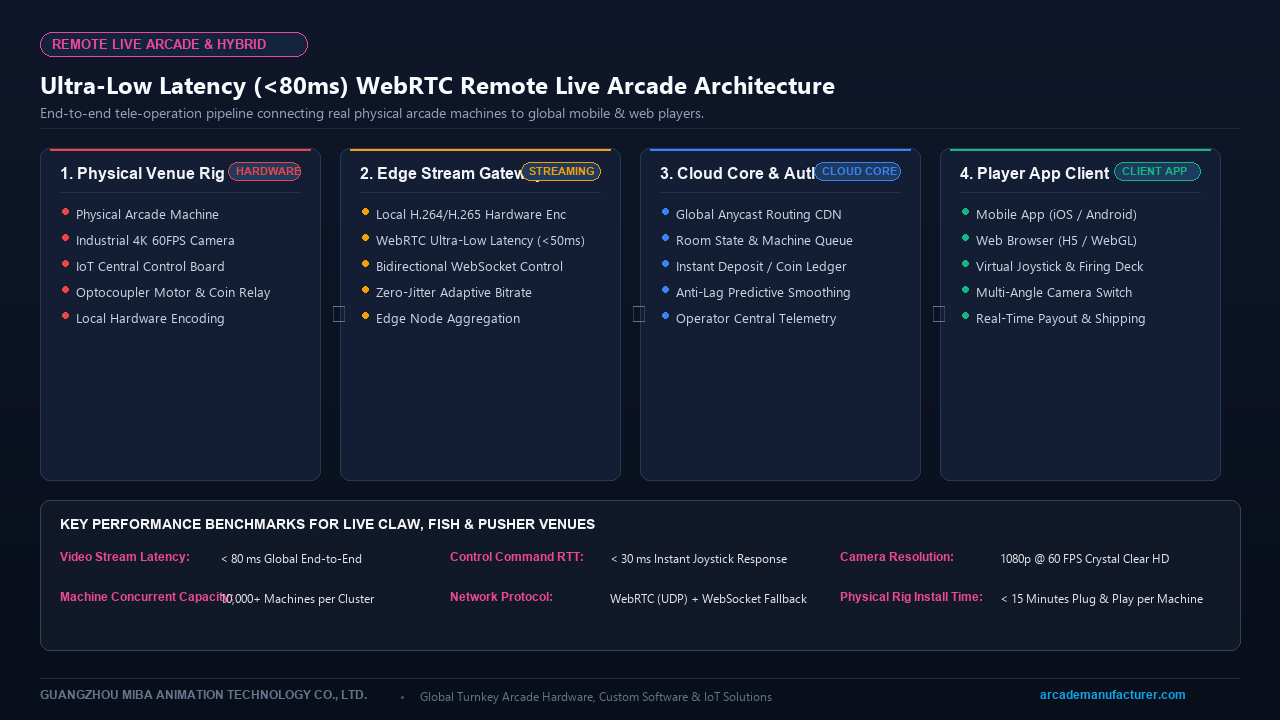
The visual feedback loop is the lifeblood of remote live arcade gaming. A single, static camera is insufficient for games relying on depth perception, timing, and spatial awareness, such as claw machines, coin pushers, and precision redemption cabinets. Implementing a dual-angle IP camera topology ensures players possess the necessary visual data to execute complex mechanical maneuvers with confidence.
The standard industrial deployment requires two distinct optical perspectives. The primary feed relies on an overhead 1080p60 wide-angle lens (typically 120-degree FOV) positioned to capture the entire playfield, providing the macro context of the cabinet’s current state. The secondary feed utilizes a narrower FOV, high-framerate camera focused strictly on the critical action zone—such as the prize chute, the drop zone, or the precise alignment of the claw mechanism.
To maintain the stringent sub-80ms glass-to-glass latency requirement, raw sensor data must not be sent to generic cloud encoders. Instead, video must be compressed at the absolute edge using dedicated hardware encoders. Modern deployments utilize specialized ASICs capable of low-latency H.264 or H.265 (HEVC) encoding directly adjacent to the camera sensor. This edge-encoding paradigm minimizes the processing time before packets hit the network interface.
Furthermore, integrating robust hardware defense systems at the camera level prevents unauthorized video injection or spoofing, a crucial consideration for high-value prize redemption scenarios.
- [ Arcade Cabinet Chassis ]
- [ Camera A: Overhead Wide Angle ] —> [ H.265 Hardware Encoder SoC ]
- [ Camera B: Chute Target View ] —–> [ H.265 Hardware Encoder SoC ]
- [ Edge Gateway Router ]
- [ WebRTC SFU Cloud ]
- These edge encoders must be configured with aggressive intra-refresh cycles rather than relying on traditional long Group of Pictures (GOP) structures. A long GOP introduces unacceptable decoding latency on the client side when packet loss occurs, as the decoder must wait for the next keyframe. By utilizing intra-refresh or very short GOP lengths alongside CBR (Constant Bitrate) tuning, the video pipeline remains resilient to network jitter while delivering the crisp, 60fps fluid motion required for skill-based gaming.
- ## Industrial IoT Microcontrollers and Cabinet JAMMA Signal Interfacing
- While ultra-low latency video provides the visual context, the physical execution of player commands relies entirely on the bridging logic between the digital network and the analog cabinet electronics. Standard software APIs cannot actuate mechanical relays; this transition requires specialized Industrial IoT microcontrollers interfacing directly with the cabinet’s internal wiring harness, typically following JAMMA standards or proprietary I/O boards.
- The processing core of this integration is typically an STM32 or advanced ESP32 microcontroller operating as an edge node. This MCU runs an optimized RTOS (Real-Time Operating System) designed specifically to parse incoming UDP DataChannel payloads from the WebRTC stream and translate them into physical voltage states with microsecond precision.
- Directly coupling a modern 3.3V microcontroller to a legacy 12V or 5V arcade machine harness is a recipe for catastrophic electrical failure and erratic behavior. To ensure commercial longevity and impeccable arcade machine security, the interface board must utilize strict galvanic isolation. We employ high-speed PC817 optocouplers to physically separate the MCU logic domain from the noisy, high-current mechanical domain of the arcade cabinet.
- [ WebRTC Cloud ] -> [ UDP DataChannel ] -> [ STM32/ESP32 Edge MCU ]
- (3.3V Logic Signals)
- [ PC817 Optocoupler Bank ] <-- (Galvanic Isolation Barrier)
- (Isolated Drive Signals)
- [ 4-Way/8-Way MOSFET ] [ Coin Pulse Generator ]
- [ Relay Emulation ] [ Simulation Circuit ]
- (Directional I/O) (Credit Pulses)
- [ JAMMA Harness / Cabinet Control Board ]
- [ Mechanical Actuators / Motors ]
When a player taps the digital joystick on their mobile device, the WebRTC DataChannel fires a UDP packet to the edge MCU. The MCU instantly drives the LED inside the corresponding PC817 optocoupler. The phototransistor on the opposite side of the barrier detects this light and triggers a high-power MOSFET, which cleanly sinks the voltage on the arcade cabinet’s input pin, emulating a physical microswitch closure. This entire process, from network receipt to mechanical relay actuation, occurs in under 2 milliseconds.
Crucially, this hardware layer also acts as an anti cheat device. The MCU firmware enforces strict timing constraints, debouncing rules, and simultaneous input limitations (e.g., preventing impossible left+right simultaneous commands) before the signals ever reach the cabinet’s native game board. This ensures that network anomalies or malicious client-side scripting cannot force the physical hardware into an undefined or damaging state. Additionally, credit insertion is handled via precise coin pulse simulation, mimicking the exact waveform of a legitimate coin mechanism to maintain flawless daily accounting.
WebRTC Selective Forwarding Units and Global Edge Relays
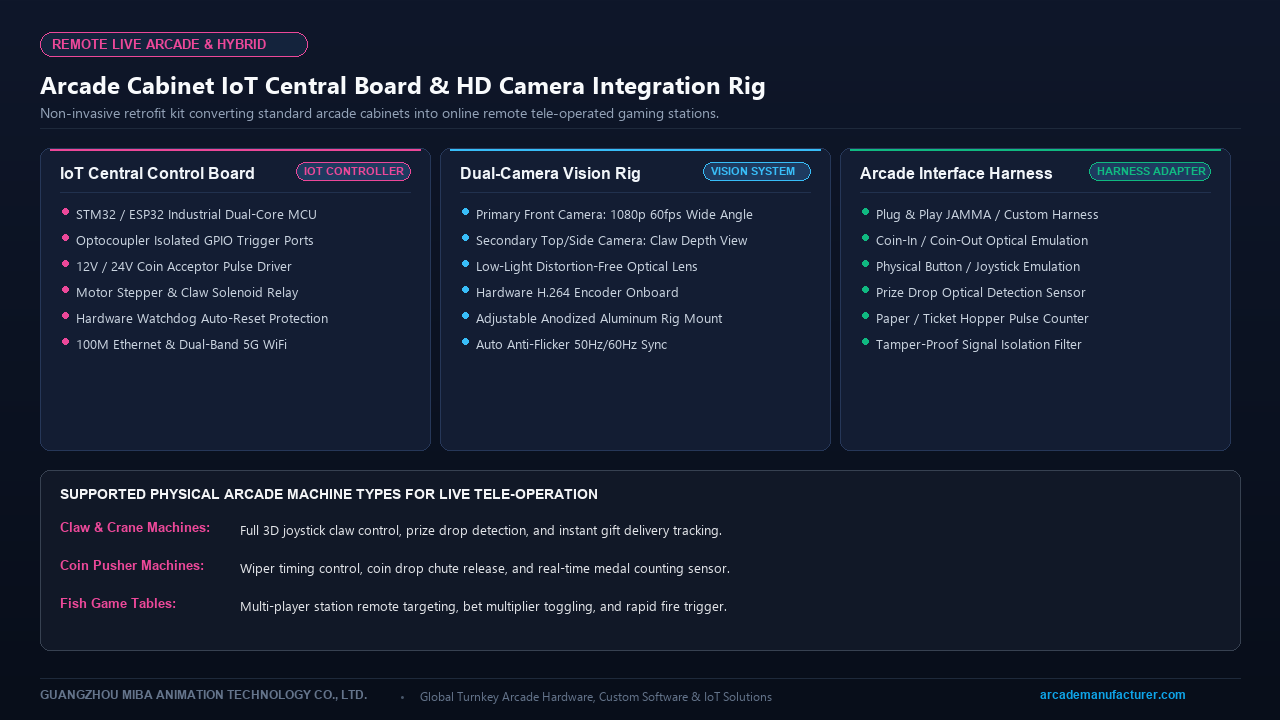
Deploying a single remote arcade cabinet is trivial; scaling that deployment to serve thousands of concurrent players and spectators globally requires a sophisticated server-side routing architecture. Peer-to-Peer (P2P) WebRTC topologies are fundamentally incompatible with commercial arcade operations due to asymmetric bandwidth constraints and the necessity for multi-viewer spectator modes.
The industry standard solution is the deployment of WebRTC Selective Forwarding Units (SFU) clustered at the network edge. An SFU acts as an intelligent media router. Rather than decoding and re-encoding the video streams (which a Multipoint Control Unit or MCU would do, adding massive latency), the SFU receives the encoded H.264/H.265 streams from the arcade cabinet and selectively forwards those raw packets to connected clients based on their current network conditions.
To support global audiences, these SFUs are deployed in edge clustering configurations, placing the media relay as physically close to the end-user as possible. This minimizes the number of public internet hops and significantly reduces the total round-trip time (RTT).
A critical feature of the SFU architecture is its handling of adaptive bitrate and network congestion. By utilizing WebRTC’s native RTCP (RTP Control Protocol) feedback mechanisms, the SFU continuously monitors player bandwidth. If a player’s connection degrades, the SFU leverages aggressive simulcast (where the cabinet sends multiple resolutions simultaneously) to seamlessly drop the player to a lower-bitrate stream without interrupting the gameplay or affecting other spectators.
Furthermore, generic UDP transmission is susceptible to packet loss, which visually manifests as macroblocking or frozen frames. To mitigate this without the latency penalty of TCP retransmission, the SFU employs Dynamic Forward Error Correction (FEC). The server injects redundant parity packets into the stream stream based on real-time packet loss metrics, allowing the client decoder to reconstruct missing frames mathematically on the fly.
Simultaneously, the SFU manages the critical sub-20ms UDP DataChannel. This channel bypasses the video encoding pipeline entirely, providing a dedicated, ultra-low latency pathway exclusively for joystick movements, button presses, and mechanical actuation commands, ensuring the player feels physically connected to the distant machine.
Hardware Retrofit Workflow for Route Operators
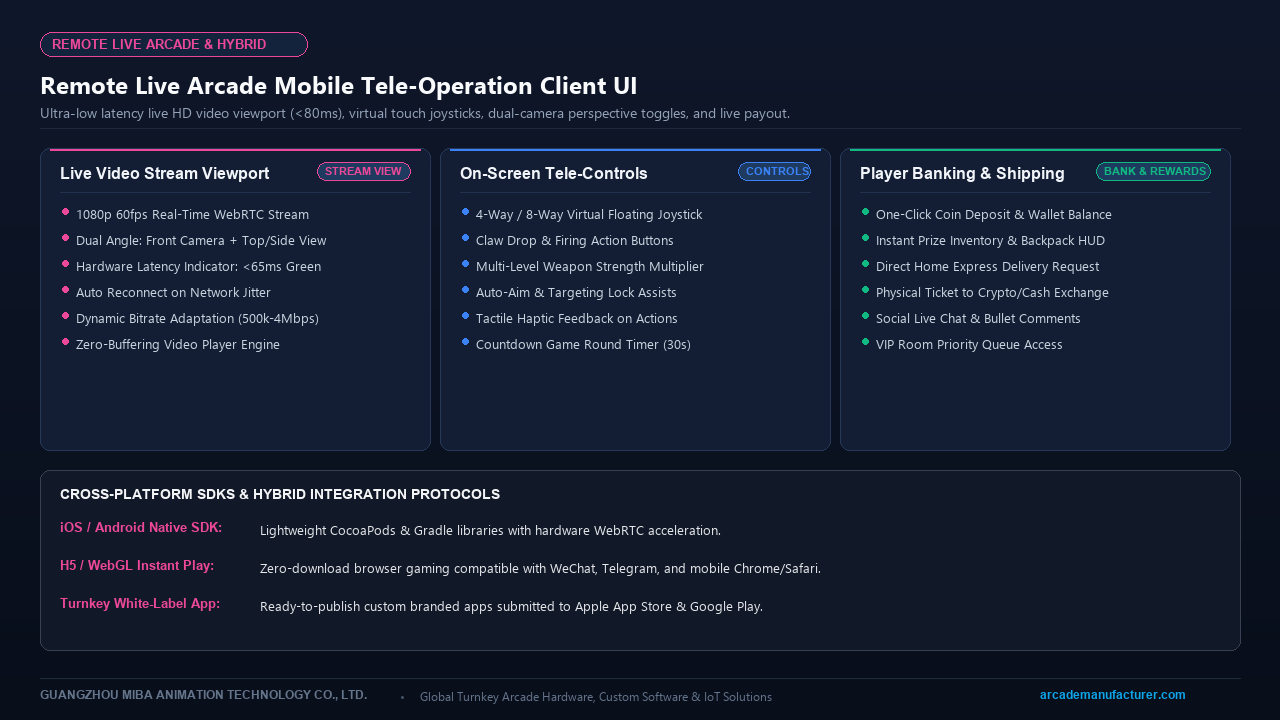
Transitioning existing physical inventory into the remote live ecosystem requires a systematic hardware retrofit workflow. Route operators and venue technicians must follow a rigorous process to ensure maximum uptime, safety, and operational consistency. When you service arcade locations, adhering to this standardized five-step procedure minimizes deployment friction and prevents costly electrical errors.
Step 1: Cabinet Power Tapping and Grounding Assessment. Before integrating any external logic, technicians must verify the integrity of the cabinet’s primary switching power supply (SMPS). The IoT gateway and camera encoders require stable, isolated power to prevent ground loops that cause video interference or false logic triggers. Install a dedicated, medically isolated 12V/5V DC-DC converter tapped directly from the primary AC mains, bypassing the game board’s heavily loaded DC rails entirely.
Step 2: Optical Sensor and Limit Switch Intercepts. For redemption games, remote systems must know exactly when a prize is won or when a mechanism returns to its home position. Technicians must splice into the existing optical sensors and limit switches using non-invasive high-impedance parallel taps. This data is fed back into the ESP32/STM32 MCU to provide real-time game state telemetry to the cloud backend, ensuring accurate prize inventory management.
Step 3: Optocoupler Board Installation and Harness Splicing. Mount the custom JAMMA interfacing board securely within the chassis, ensuring adequate airflow. Disconnect the physical control panel harness and route the inputs through the MOSFET relay emulation blocks. Ensure that the coin/bill validator pulse lines are routed through the secure coin simulation circuit to allow remote crediting while maintaining physical coin drop capabilities if the cabinet operates in a hybrid on-site/remote capacity.
Step 4: Dual Camera Alignment and Illumination Calibration. Mount the overhead 1080p60 camera using rigid, vibration-dampened brackets to prevent motion blur during aggressive mechanical movements. Position the secondary camera to eliminate glare from internal cabinet lighting. Often, existing fluorescent tubes must be replaced with high-CRI LED arrays operating at high PWM frequencies to prevent banding or flickering on the H.265 encoded video stream.
Step 5: Edge Network Configuration and Cloud Calibration. Connect the local edge router to the facility’s dedicated fiber line. Configure strict QoS (Quality of Service) rules prioritizing UDP WebRTC traffic over all other venue data. Finally, utilize the cloud dashboard to calibrate mechanical latency offsets, test the full range of motion for all actuators, and verify the multi-angle video synchronization before marking the cabinet as active for global players.
Frequently Asked Questions
What makes WebRTC better than RTMP for arcade games? RTMP relies on TCP, which prioritizes packet delivery over speed, resulting in latencies of 3 to 15 seconds. WebRTC utilizes tuned UDP transmission and dedicated DataChannels, bypassing generic buffering to achieve the sub-80ms glass-to-glass latency required for real-time mechanical control and viable skill-based gameplay.
How do you prevent electrical damage to the arcade machine? We utilize industrial-grade PC817 optocouplers to create a strict galvanic isolation barrier between the internet-connected IoT microcontroller and the legacy arcade wiring. This physical separation ensures that power surges, ground loops, or logic errors cannot cross into the cabinet’s sensitive native electronics or motor controllers.
Can existing arcade cabinets be retrofitted for remote play? Yes. Almost any cabinet utilizing standard JAMMA wiring or accessible microswitch inputs can be converted. The retrofit process involves installing a dual-camera mounting system, a localized edge encoder, and an opto-isolated bridging board to intercept and emulate mechanical inputs without altering the original game board logic.
What internet speed is required per arcade machine? For a stable dual-angle 1080p60 configuration utilizing H.265 hardware encoding, we recommend a dedicated, symmetric connection providing at least 8 Mbps of consistent upstream bandwidth per cabinet. Critically, network jitter and routing efficiency (low ping to the nearest SFU) are more important than raw maximum throughput.
—
To explore customized hybrid arcade solutions, architectural schematics, or bulk hardware procurement for your global operations, consult directly with our principal engineers.
Contact Engineer Wang at +86 17620842078. Guangzhou Miba Animation Technology Co., Ltd. Advanced Manufacturing & R&D Facility, Panyu District, Guangzhou, China.