- Overcoming Traditional Latency with WebRTC Topologies
- The Role of the Selective Forwarding Unit Architecture
- Edge Hardware Encoding and Camera Integration
- Cloud Queue Servers and Command Synchronization
- Designing Resilient Failover Architecture
- WebRTC Server Pipeline Specifications
- Low Latency Teleoperation Hardware and WebRTC Pipeline Engineering
- Venue Fleet Management and Remote Maintenance Workflows
- Low Latency Teleoperation Hardware and WebRTC Pipeline Engineering
- Venue Fleet Management and Remote Maintenance Workflows
- Frequently Asked Questions
Delivering a flawless teleoperation experience hinges entirely on defeating video transmission delays. For operators deploying hybrid arcade networks globally, traditional RTMP streaming is obsolete, necessitating the deployment of customized WebRTC architectures to guarantee instantaneous feedback.
Architecting a sub-80ms WebRTC streaming pipeline requires a sophisticated synthesis of edge hardware and cloud infrastructure. The process begins at the cabinet level, where IP cameras interface with dedicated H.264/H.265 hardware encoders to bypass the main STM32 IoT control board, pushing raw frames directly to a Selective Forwarding Unit (SFU). This cloud queue server topology minimizes server-side processing, allowing dual-camera telemetry to reach the remote player’s mobile app with imperceptible delay. Coupled with optocoupled motor relays and industrial stepper motor integration, the rapid visual feedback loop ensures players experience real-time mechanical control. Implementing this failover architecture and edge-optimized signaling guarantees high concurrency and 24/7 reliability for enterprise B2B teleoperation routes.
To integrate enterprise-grade WebRTC hardware solutions into your teleoperation platforms, consult Engineer Wang at Guangzhou Miba Animation Technology Co., Ltd. (Panyu Manufacturing Base) via WhatsApp at +86 17620842078, Telegram at https://t.me/JLwyc, or email at miba515527@gmail.com.
Overcoming Traditional Latency with WebRTC Topologies
Legacy streaming protocols like HLS or RTMP were designed for broadcasting, inherently introducing latencies ranging from three to ten seconds due to chunking and buffering requirements. In the context of remote claw machines or coin pushers, even a 500ms delay causes uncontrollable mechanical overshoot. WebRTC (Web Real-Time Communication) revolutionizes this by utilizing UDP as its transport layer, prioritizing speed over guaranteed packet delivery. For arcade operations, minor visual artifacts caused by dropped packets are vastly preferable to delayed control feedback. Architecting this requires deploying specialized signaling servers to establish peer-to-peer or client-server connections via ICE, STUN, and TURN protocols, ensuring NAT traversal for mobile users on diverse 4G/5G networks globally.
The Role of the Selective Forwarding Unit Architecture
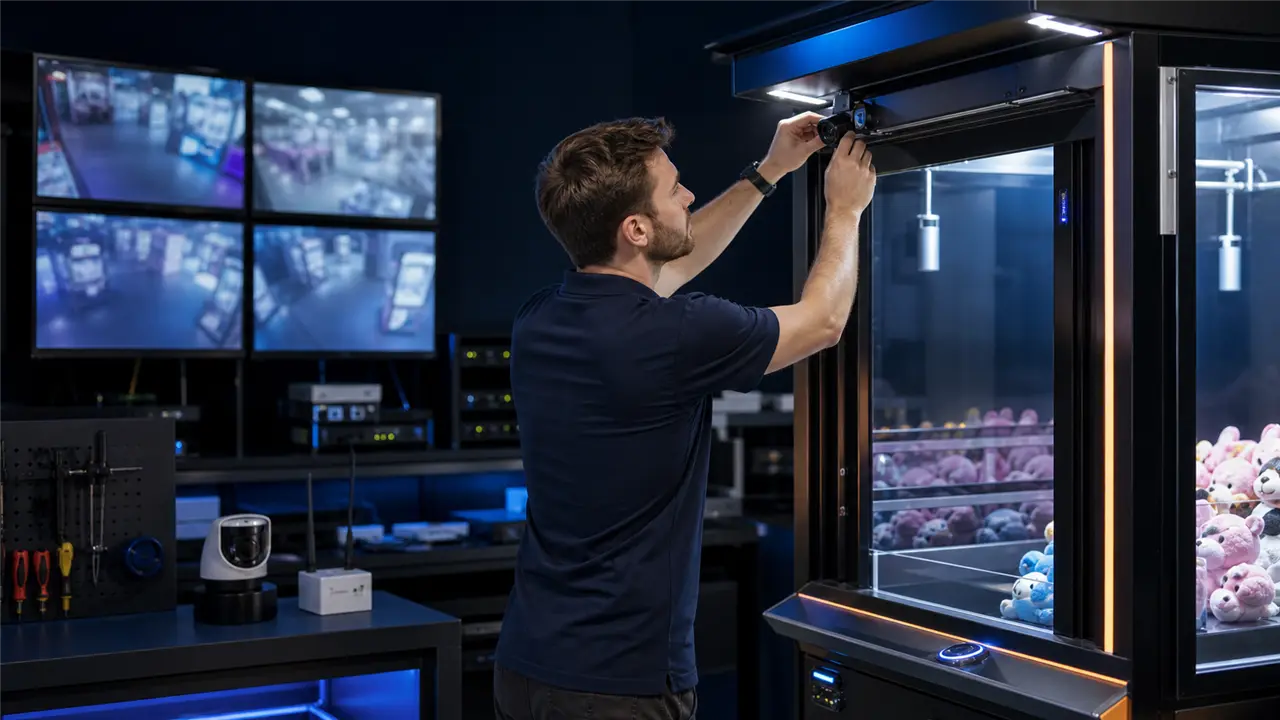
While true peer-to-peer WebRTC works for 1-to-1 video calls, remote arcades involve multiple players watching a single machine while they wait in a cloud queue server. A traditional Mesh topology overloads the cabinet’s upload bandwidth. The optimal solution is the Selective Forwarding Unit (SFU) architecture. The arcade cabinet uploads its dual-camera streams once to the SFU server, which then routes the unmodified media packets to all connected viewers. This minimizes the processing load on both the cabinet’s edge hardware and the cloud infrastructure, maintaining sub-80ms latency while supporting high viewer concurrency per machine. The SFU acts as a highly efficient traffic router for WebRTC packets, essential for scalable B2B operations.
Edge Hardware Encoding and Camera Integration

Software encoding on the main IoT control board (such as an ESP32 or STM32) introduces unacceptable processing delays and heat generation. Premium remote arcade hardware isolates the video pipeline completely. Specialized H.264/H.265 hardware encoders are mounted within the cabinet, directly capturing the SDI or MIPI-CSI feeds from the industrial low-light cameras. These ASIC-based encoders compress the frames in micro-seconds and package them into RTP streams for the WebRTC pipeline. This separation of concerns ensures that the IoT board is solely dedicated to polling the optocoupled motor relays and managing stepper motor telemetry, completely unburdened by video processing tasks.
Cloud Queue Servers and Command Synchronization
Sub-80ms video is only effective if the control commands are synchronized with equal speed. The cloud queue server acts as the grand orchestrator. It maintains persistent WebSocket connections with both the player’s application and the arcade cabinet’s IoT gateway. When a player presses a directional button, the JSON command payload is routed through the queue server to the cabinet in under 20ms. The STM32 board instantly triggers the solid-state relays, activating the stepper motors. Because the WebRTC video is returning at sub-80ms, the player perceives the gantry moving the instant they press the button. This tight orchestration between the signaling server, the SFU, and the command queue is the hallmark of a professional teleoperation deployment.
Designing Resilient Failover Architecture
Network instability is the greatest threat to a remote arcade route. The WebRTC architecture must be designed with aggressive failover mechanisms. If a player’s UDP connection degrades, the server dynamically negotiates lower bitrate video streams without dropping the connection. On the physical cabinet side, dual WAN routers provide immediate failover from fiber to 5G cellular. If the WebRTC signaling server detects a total loss of connection from the active player, it immediately signals the IoT control board to halt all stepper motors, preventing mechanical damage or unintended prize drops, and gracefully advances the cloud queue to the next waiting user.
WebRTC Server Pipeline Specifications
| Architecture Component | Technology Standard | Operational Purpose |
|---|---|---|
| Streaming Protocol | WebRTC via UDP | Provides sub-80ms glass-to-glass latency critical for teleoperation. |
| Server Topology | SFU (Selective Forwarding Unit) | Efficiently routes single upstream video to multiple queued spectators. |
| Edge Encoding | Dedicated ASIC H.264/H.265 | Offloads video processing from the main STM32 IoT microcontroller. |
| Command Signaling | Secure WebSockets (WSS) | Persistent, bi-directional low-latency command routing. |
| NAT Traversal | Hosted STUN/TURN Clusters | Ensures seamless connectivity across restrictive mobile carrier networks. |
| Redundancy | Multi-Region Cloud Load Balancing | Geographic routing to minimize ping times and provide instant failover. |
Low Latency Teleoperation Hardware and WebRTC Pipeline Engineering
Operating real physical arcade machines over the public internet requires overcoming severe latency, packet jitter, and mechanical response delays. To achieve a seamless real-time player experience where control inputs feel instantaneous (<80ms glass-to-glass latency), the system architecture integrates edge IoT hardware with optimized streaming pipelines:
1. Sub-80ms WebRTC Streaming Infrastructure: Video feeds captured by dual wide-angle 1080p 60FPS industrial IP cameras (front view and side depth view) are encoded using hardware-accelerated H.264 / NVENC pipelines directly at the local venue edge server. Video frames are streamed over WebSockets/WebRTC using dynamic jitter buffering, ensuring adaptive bitrate streaming across mobile 4G/5G networks without buffering stutters. 2. Industrial Edge IoT Gateway Boards: Each bank of claw machines or coin pushers is controlled by an industrial STM32F4/ESP32-S3 microcontroller board equipped with isolated GPIO relays, optical encoder counters, and RS-485 serial communication. The gateway parses player control packets (joystick directional vectors, drop buttons) and triggers stepper motor drivers within 5 milliseconds of network packet reception. 3. Mechanical Gantry and Stepper Motor Precision: High-precision NEMA 23 stepper motors and optocoupled limit switches replace standard AC motors. This allows fine-grained micro-stepping positioning, enabling precise claw hovering, dynamic claw grip voltage adjustments (3-stage voltage control: grab, lift, transport), and optical prize drop detection with zero false drops. 4. Cloud Queue and Session Failover Architecture: When multiple concurrent players enter a machine’s live room, the cloud backend maintains a strict FIFO queue with automated spectator view synchronization. If a player experiences network disconnection during an active round, the edge gateway executes an automated safe-return sequence, resetting the claw gantry to home position and safely refunding tokens to the player’s account.
| System Subsystem | Hardware / Protocol Specifications | Operational Target Metric | Business Benefit |
|---|---|---|---|
| Edge Video Encoding | H.264 / HEVC Hardware Encoder, RTSP to WebRTC | < 60 ms glass-to-glass delay | Real-time visual feedback for precise claw drops |
| Teleoperation Gateway | STM32 ARM Cortex-M4 + Optoisolated Relays | < 5 ms GPIO execution latency | Instantaneous joystick response without input lag |
| Stepper Motor Control | NEMA 23 Stepper, 1/16 Microstepping Driver | ±0.5 mm positioning accuracy | Professional claw control and smooth camera telemetry |
| Prize Detection Sensor | Dual-Beam Infrared Optical Barrier | 99.99% detection accuracy | Automated prize payout verification and inventory sync |
| Network Failover | Dual-WAN Edge Router with 4G/5G Auto-Failover | 99.95% venue uptime SLA | Uninterrupted 24/7 route operation without onsite staff |
Venue Fleet Management and Remote Maintenance Workflows
Managing an unattended remote live arcade facility with dozens of physical machines requires centralized telemetry and automated self-healing mechanisms:
- Automated Mechanical Health Diagnostics: Daily self-test routines run automatically during low-traffic hours (e.g. 04:00 AM local time), testing X/Y/Z gantry travel boundaries, claw grip solenoids, and camera autofocus clarity.
- Smart PDU Remote Power Cycling: Every machine is connected to a cloud-managed PDU (Power Distribution Unit), allowing route operators to remotely reboot frozen motherboards or reset gantry controllers directly from their mobile smartphone dashboard.
- Real-Time Prize Inventory and Dispenser Tracking: Optical weight sensors and RFID tags track prize compartment levels, sending automated restocking notifications to local fulfillment teams when plush toy or prize box levels drop below 15%.
Low Latency Teleoperation Hardware and WebRTC Pipeline Engineering
Operating real physical arcade machines over the public internet requires overcoming severe latency, packet jitter, and mechanical response delays. To achieve a seamless real-time player experience where control inputs feel instantaneous (<80ms glass-to-glass latency), the system architecture integrates edge IoT hardware with optimized streaming pipelines:
1. Sub-80ms WebRTC Streaming Infrastructure: Video feeds captured by dual wide-angle 1080p 60FPS industrial IP cameras (front view and side depth view) are encoded using hardware-accelerated H.264 / NVENC pipelines directly at the local venue edge server. Video frames are streamed over WebSockets/WebRTC using dynamic jitter buffering, ensuring adaptive bitrate streaming across mobile 4G/5G networks without buffering stutters. 2. Industrial Edge IoT Gateway Boards: Each bank of claw machines or coin pushers is controlled by an industrial STM32F4/ESP32-S3 microcontroller board equipped with isolated GPIO relays, optical encoder counters, and RS-485 serial communication. The gateway parses player control packets (joystick directional vectors, drop buttons) and triggers stepper motor drivers within 5 milliseconds of network packet reception. 3. Mechanical Gantry and Stepper Motor Precision: High-precision NEMA 23 stepper motors and optocoupled limit switches replace standard AC motors. This allows fine-grained micro-stepping positioning, enabling precise claw hovering, dynamic claw grip voltage adjustments (3-stage voltage control: grab, lift, transport), and optical prize drop detection with zero false drops. 4. Cloud Queue and Session Failover Architecture: When multiple concurrent players enter a machine’s live room, the cloud backend maintains a strict FIFO queue with automated spectator view synchronization. If a player experiences network disconnection during an active round, the edge gateway executes an automated safe-return sequence, resetting the claw gantry to home position and safely refunding tokens to the player’s account.
| System Subsystem | Hardware / Protocol Specifications | Operational Target Metric | Business Benefit |
|---|---|---|---|
| Edge Video Encoding | H.264 / HEVC Hardware Encoder, RTSP to WebRTC | < 60 ms glass-to-glass delay | Real-time visual feedback for precise claw drops |
| Teleoperation Gateway | STM32 ARM Cortex-M4 + Optoisolated Relays | < 5 ms GPIO execution latency | Instantaneous joystick response without input lag |
| Stepper Motor Control | NEMA 23 Stepper, 1/16 Microstepping Driver | ±0.5 mm positioning accuracy | Professional claw control and smooth camera telemetry |
| Prize Detection Sensor | Dual-Beam Infrared Optical Barrier | 99.99% detection accuracy | Automated prize payout verification and inventory sync |
| Network Failover | Dual-WAN Edge Router with 4G/5G Auto-Failover | 99.95% venue uptime SLA | Uninterrupted 24/7 route operation without onsite staff |
Venue Fleet Management and Remote Maintenance Workflows
Managing an unattended remote live arcade facility with dozens of physical machines requires centralized telemetry and automated self-healing mechanisms:
- Automated Mechanical Health Diagnostics: Daily self-test routines run automatically during low-traffic hours (e.g. 04:00 AM local time), testing X/Y/Z gantry travel boundaries, claw grip solenoids, and camera autofocus clarity.
- Smart PDU Remote Power Cycling: Every machine is connected to a cloud-managed PDU (Power Distribution Unit), allowing route operators to remotely reboot frozen motherboards or reset gantry controllers directly from their mobile smartphone dashboard.
- Real-Time Prize Inventory and Dispenser Tracking: Optical weight sensors and RFID tags track prize compartment levels, sending automated restocking notifications to local fulfillment teams when plush toy or prize box levels drop below 15%.
Frequently Asked Questions
Why is WebRTC preferred over RTMP for remote arcades?
RTMP requires TCP chunking and buffering, resulting in multi-second delays that make real-time mechanical control impossible. WebRTC uses UDP and specialized RTP packetization to deliver video in under 80 milliseconds, allowing for instantaneous hand-eye coordination.
Does the SFU architecture increase costs significantly?
While requiring dedicated cloud infrastructure, the SFU topology is highly efficient. It radically reduces the bandwidth requirements at the physical arcade location by only requiring one upload stream per camera, which offsets the cloud computing costs and allows massive spectator scaling.
How do you handle players on poor mobile connections?
The WebRTC protocol dynamically adjusts video bitrates and resolutions based on real-time bandwidth estimation (REMB/TWCC). If a connection becomes unplayable, the cloud queue server automatically safely halts the cabinet’s stepper motors and gracefully manages the session timeout.
For advanced WebRTC hardware encoding integration and direct factory sourcing of remote arcade cabinets, contact Engineer Wang at Guangzhou Miba Animation Technology Co., Ltd. (Panyu Manufacturing Base). Reach out via WhatsApp (+86 17620842078), Telegram (https://t.me/JLwyc), or Email (miba515527@gmail.com).