- Technical Comparison Matrix Table
- Electromagnetic Pulse EMP Threat Anatomy and Picosecond Surge Clamping Protection
- AI Trojan Terminator Architecture with Dynamic Cipher Stream Scrambling
- RF Spectrum Monitoring Across 300MHz to 1200MHz Frequencies for Wireless Attack Interception
- Optical and Galvanic Pulse Isolation Modules for Bill Acceptors and Coin Hoppers
- SAS 6.02 Secure Protocol Encryption Cryptographic Dongles and Firmware Hardening
- Commercial Game Room Loss Prevention Protocols Machine Audit SOPs and Evidence Collection
- Frequently Asked Questions
The global amusement and commercial arcade industry faces a relentless and sophisticated barrage of revenue-siphoning attacks engineered by highly organized cheating syndicates. These malicious actors deploy military-grade electromagnetic pulse devices, wireless radio frequency spoofers, hardware trojans, optical pulse injection tools, and dynamic memory manipulation techniques to artificially inflate credit balances, force payout mechanism errors, and bypass traditional physical locking systems. This comprehensive security playbook is meticulously crafted for arcade hall owners, casino floor managers, gaming route operators, embedded hardware engineers, and loss prevention specialists who require an exhaustive understanding of the modern threat landscape and the exact engineering countermeasures required to defend commercial gaming assets. By moving beyond rudimentary padlock security and embracing active hardware defense paradigms, operators can secure their bill acceptors, coin hoppers, mainboards, and SAS communication lines against catastrophic financial hemorrhage. Arcade machine security and anti-cheat hardware defense is no longer an optional luxury but a fundamental prerequisite for long-term operational viability in high-volume gaming venues. In this master guide, we will dissect the anatomical structures of EMP jammer shielding arcade machines, AI trojan terminator dynamic cipher implementations, 300-1200MHz RF spectrum scanning protocols, bill acceptor optical pulse isolation techniques, and broader arcade machine anti theft hardware ecosystems. This document serves as the definitive reference manual for hardening electronic gaming machines against external and internal exploitation vectors.
To establish a baseline understanding of modern security implementations, operators must recognize the distinct evolutionary phases of anti-cheat technology. Traditional gaming cabinets relied exclusively on heavy-gauge steel vaults and mechanical anti-fishing teeth in coin mechanisms. While these passive systems deterred casual vandals, they offer absolutely zero resistance against invisible electromagnetic interference (EMI) attacks, high-voltage static discharges, or logical protocol decryptions. The contemporary attacker does not use a crowbar; they use a palm-sized lithium-powered EMP generator that emits broad-spectrum transient voltage spikes capable of inducing false credit logic inside unprotected microcontrollers. Consequently, defense mechanisms must evolve from passive metal walls to active electronic countermeasures that continuously monitor power lines, data buses, and ambient radio frequencies for anomalies, neutralizing threats in microseconds before fraudulent credits can be registered or tickets dispensed. This paradigm shift requires a holistic integration of hardware isolators, cryptographic validation modules, and automated shutdown logic triggered by environmental heuristics. For factory-direct procurement and comprehensive engineering specs, consult our master guide on industrial arcade machine security and anti-cheat hardware defense.
Technical Comparison Matrix Table
The following matrix compares Multi-Layered Active Hardware Defense against Basic Passive Metal Enclosures and Software-Only Anti-Cheat across eight critical threat mitigation metrics. This comparative analysis demonstrates the catastrophic inadequacy of relying solely on mechanical or purely software-based solutions in high-risk commercial gaming environments. To explore detailed technical specifications and deployment considerations, see our operational guide on Arcade Machine Security and Anti-Cheat Hardware.
| Threat Mitigation Metric | Multi-Layered Active Hardware Defense | Basic Passive Metal Enclosures | Software-Only Anti-Cheat Logic |
|---|---|---|---|
| EMP and High-Voltage Jammer Resilience | Outstanding (Picosecond clamping and Faraday cage integration) | Poor (Metal acts as an antenna without proper grounding paths) | Non-Existent (Software crashes under high voltage transients) |
| Optical Pulse Injection at Bill Acceptor | Excellent (Galvanic isolation and pulse timing analysis) | Poor (Physical access to the bezel is still available) | Moderate (Can filter some bad pulses but hardware is vulnerable) |
| Wireless RF Spoofing and Memory Hacking | Outstanding (Continuous 300-[1200MHz spectrum scanning](/300-1200mhz-rf-spectrum-scanning-wireless-cheat-defense/) and ciphering) | Non-Existent (Radio waves penetrate standard cabinet seams) | Poor (Software cannot detect ambient RF fields) |
| Hardware Trojan and Skimmer Detection | Excellent (AI impedance checking and cryptographic handshakes) | Poor (Visual inspection required to find physical bugs) | Poor (OS level checks can be bypassed by hardware inline tools) |
| Protocol Interception on SAS Data Lines | Excellent (SAS 6.02 encryption and hardware cryptographic dongles) | Non-Existent (Wires are easily accessible if the cabinet is opened) | Moderate (Subject to software reverse engineering) |
| False Credit Registration Prevention | Outstanding (Dynamic cipher stream scrambling on pulse lines) | Poor (Vulnerable to EMP induced ground loops and wire tapping) | Moderate (Relies on debouncing logic which can be overwhelmed) |
| Payout Mechanism Hopper Shielding | Excellent (Isolated relay drivers and current monitoring) | Moderate (Metal enclosures delay physical access to tokens) | Poor (Software cannot stop a direct voltage injection to the hopper) |
| Operational Audit and Forensic Logging | Outstanding (Non-volatile hardware black box event logging) | Poor (No digital trail of physical attacks) | Excellent (Extensive software logging, provided the OS is stable) |
Electromagnetic Pulse EMP Threat Anatomy and Picosecond Surge Clamping Protection
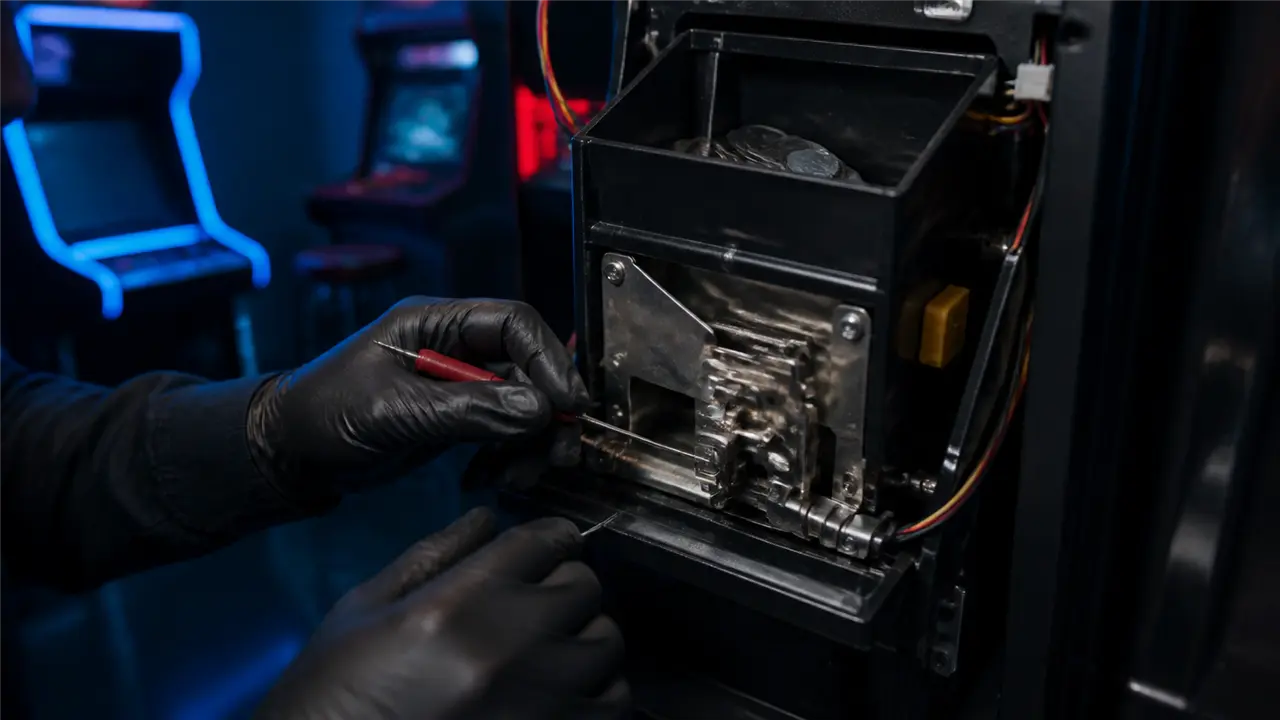
The single most pervasive and devastating attack vector deployed against commercial arcade operators today is the electromagnetic pulse (EMP) jammer. Colloquially known within cheating syndicates as a “slot jammer,” “EMP generator,” or “clicker,” these covert devices are engineered to emit localized, high-intensity transient electromagnetic fields. The anatomy of an EMP attack relies on the fundamental principles of electromagnetic induction. When an attacker activates the jammer near the bill acceptor, coin comparator, or mainboard chassis, the device discharges a massive burst of radio-frequency energy, typically generated by a piezoelectric crystal or a high-voltage oscillator circuit powered by lithium-ion cells. This invisible wave of energy permeates the physical boundaries of the arcade cabinet and couples with the internal copper traces of the printed circuit boards (PCBs) and the unshielded wiring harnesses connecting peripheral devices to the main input/output (I/O) controller.
This coupling effect acts exactly like a transformer, inducing immense voltage spikes across sensitive logic lines. Traditional arcade machine I/O boards operate on standard 5V or 3.3V TTL logic, where a voltage level above 2.5V is interpreted as a logical “HIGH” (or a pulse indicating a coin drop or bill insertion). When the EMP induces a voltage spike exceeding this threshold, the microcontroller interprets the interference as a rapid succession of valid credit pulses. Within seconds, a skilled attacker can rack up thousands of fraudulent credits without ever inserting physical currency. Furthermore, if the EMP is directed at the hopper or ticket dispenser control lines, it can force the output driver transistors into an active state, causing the machine to continuously dump tokens or dispense prize tickets until the hopper is physically empty. The sheer speed and invisible nature of this attack make it incredibly difficult for floor staff to detect visually, necessitating robust, hardware-level intervention.
To engineer a resilient defense against these devastating EMP and high-voltage static attacks, arcade machine security architects must implement picosecond surge clamping protection combined with multi-stage filtering networks. Standard metal oxide varistors (MOVs) and simple fuse mechanisms are woefully inadequate for EMP defense because their reaction times (often in the microsecond range) are far too slow to arrest the initial wavefront of a high-frequency transient spike. By the time a standard fuse blows or an MOV clamps, the malicious logic pulse has already reached the microcontroller, and the fraudulent credit has been registered. Instead, modern arcade machine anti theft hardware mandates the deployment of specialized transient voltage suppression (TVS) diodes and high-speed gas discharge tubes (GDTs) configured in a multi-stage avalanche clamping topology.
These advanced TVS arrays boast a response time in the picosecond (one trillionth of a second) domain. When an EMP induces a voltage spike on the coin or bill acceptor pulse line, the TVS diode instantly transitions from a high-impedance state to a low-impedance avalanche breakdown state. This action aggressively shunts the lethal transient energy away from the sensitive logic pins and directly into a massive ground plane, effectively capping the voltage at a safe level (e.g., clamping a 1000V spike down to 4.5V before it reaches the CPU). To further enhance this protection, ferrite bead chokes and heavy inductive filtering must be placed in series with all signal lines entering the mainboard. These inductors act as high-frequency roadblocks, severely attenuating the rapid rise-time of the EMP waveform. Furthermore, the entire PCB layout must utilize strict galvanic isolation techniques, utilizing optocouplers (which we will discuss in depth later) to create an absolute physical break in the electrical pathway between the vulnerable external peripherals and the core processing unit. When combined with proper Faraday shielding (conductive mesh over ventilation holes and copper tape sealing cabinet seams), picosecond surge clamping guarantees that even the most powerful commercial EMP jammers fail to register false credits or damage the machine’s internal circuitry.
AI Trojan Terminator Architecture with Dynamic Cipher Stream Scrambling

As EMP shielding has become more prevalent in top-tier gaming venues, sophisticated cheating syndicates have transitioned toward invasive hardware modifications, specifically the deployment of inline hardware trojans. These microscopic, covert microcontrollers are physically spliced into the wiring harnesses between the bill acceptor, the mainboard, or the payout hopper. A typical hardware trojan is designed to passively monitor the communication bus. Upon receiving a specific, hidden trigger—such as a precise sequence of button presses, a specific RF signal, or a predefined sequence of low-denomination coin insertions—the trojan activates its payload. It then intercepts the legitimate communication stream and injects spoofed data packets, instructing the arcade mainboard to register hundreds of dollars in fake credits or commanding the hopper to empty its contents. Because these trojans sit behind the machine’s physical locks and directly on the trusted data lines, traditional software-based anti-cheat mechanisms are completely blind to their presence, assuming the injected data is coming from a legitimate, trusted peripheral.
To eradicate this insidious threat vector, arcade hardware engineers have developed the AI Trojan Terminator Architecture. This advanced security paradigm abandons the concept of “trusted” internal wiring and instead treats every wire and connection within the arcade cabinet as a potentially hostile environment. The core of this defense is the implementation of continuous, hardware-level impedance checking and signal timing analysis, powered by a dedicated machine-learning co-processor (the AI Trojan Terminator). This specialized chip continuously analyzes the electrical characteristics of the communication lines. Because adding an inline trojan microchip fundamentally alters the capacitance, resistance, and inductance of the wiring harness, the AI co-processor can detect these microscopic electrical deviations in real-time. By profiling the baseline electrical signature of a clean, uncompromised wiring harness during the machine’s initial factory calibration, the AI Terminator can instantly flag any deviation caused by a spliced wire, an added microchip, or an alligator clip attached by an internal employee attempting to skim credits.
However, detecting a physical tap is only the first layer of the Trojan Terminator defense; the second, and arguably more critical layer, is the implementation of Dynamic Cipher Stream Scrambling. In legacy arcade systems, a coin or bill insertion generated a simple, static 50-millisecond 5V pulse. A hardware trojan only needs to replicate this exact pulse to steal money. Dynamic Cipher Stream Scrambling completely abolishes static pulse logic. Instead, the peripheral (e.g., the bill acceptor) and the mainboard must perform a continuous cryptographic handshake. When a legitimate $100 bill is inserted, the bill acceptor does not send a simple electrical pulse. Instead, it utilizes an embedded cryptographic module to generate a highly complex, time-sensitive digital signature, scrambled using an AES-256 rolling cipher.
This cipher stream is dynamic; the cryptographic key changes every few milliseconds based on a synchronized, unpredictable pseudorandom number generator (PRNG) shared only between the secure peripheral and the secure mainboard. If a hardware trojan attempts to record a valid “credit granted” signal and replay it later (a classic replay attack), the mainboard will instantly reject it because the cryptographic timestamp and the expected rolling key will no longer match. Furthermore, the cipher stream scrambling ensures that the actual data pulses look like random electrical noise to any unauthorized device monitoring the line. If the AI Trojan Terminator detects an invalid cryptographic signature, a timing anomaly, or a physical impedance mismatch, it immediately executes a hard hardware lockout. This severs power to the payout mechanisms, drops the machine into a loud, flashing “TILT / SECURITY LOCKOUT” state, and instantly transmits an encrypted alert to the casino floor management server, pinpointing the exact machine and the nature of the hardware intrusion.
RF Spectrum Monitoring Across 300MHz to 1200MHz Frequencies for Wireless Attack Interception

The proliferation of cheap, programmable software-defined radios (SDRs) and automated wireless transmission tools has introduced a terrifying new dimension to arcade machine security. Attackers no longer need physical access to the wiring or close proximity to the coin slot. By utilizing high-powered directional antennas concealed in backpacks or jackets, cheating syndicates can launch wireless radio frequency (RF) attacks from several meters away. These attacks frequently target the unshielded traces of the machine’s internal communication buses or attempt to wirelessly trigger specific vulnerabilities in older wireless communication modules (such as legacy Bluetooth or outdated Wi-Fi telemetry systems) that may be present on the board. The frequencies utilized by these wireless hacking tools typically fall within the broad spectrum of 300MHz to 1200MHz, a range that encompasses common garage door openers, automotive key fobs, and industrial remote controls, making the malicious signals difficult to distinguish from ambient environmental noise in a crowded entertainment venue.
To counter this invisible wireless assault, premium arcade machine anti theft hardware now mandates the integration of dedicated, continuous RF Spectrum Monitoring modules operating specifically across the critical 300MHz to 1200MHz bandwidth. This is not a simple “signal strength” meter; it is a highly tuned, sweeping spectrum analyzer compressed onto a dedicated security daughterboard mounted inside the arcade cabinet. This RF monitoring hardware utilizes a wideband software-defined radio receiver coupled with a fast Fourier transform (FFT) digital signal processor. The system continuously sweeps the designated frequency ranges, breaking down the ambient electromagnetic environment into a high-resolution spectral map multiple times per second.
The true defensive power of this system lies in its heuristic anomaly detection engine. A commercial game room is inherently noisy from an RF perspective, flooded with legitimate Wi-Fi routers, customer smartphones, and bluetooth devices. The RF Spectrum Monitor is programmed to establish a dynamic baseline of this normal ambient noise. However, when an attacker activates a wireless jammer, a targeted RF spoofer, or an EMP generator, the device emits a highly anomalous signal footprint—often characterized by a sudden, massive spike in amplitude at a very specific, narrow frequency, or a rapidly sweeping broad-spectrum transmission that violates FCC regulatory profiles. The security module’s DSP analyzes the rise time, pulse width, and spectral density of every incoming signal. If a signal profile matches known attack signatures within the 300-1200MHz range, the system triggers a defensive response in milliseconds.
Upon detecting a verified wireless attack interception, the arcade machine executes a pre-programmed defensive cascade. First, it immediately isolates its internal processing state, freezing all credit accumulation and payout logic to prevent the RF interference from altering memory registers or forcing false outputs. Second, it can activate an internal RF suppression system (where legal and applicable) or simply drop the physical communication lines to the bill acceptors and hoppers to ensure they cannot be wirelessly triggered. Finally, the machine logs the exact time, duration, frequency, and estimated proximity of the RF attack into a secure, non-volatile forensic black box, and transmits a high-priority silent alarm to the venue’s loss prevention team. By weaponizing RF spectrum monitoring, arcade operators transform their machines from passive victims of wireless exploitation into active listening posts that detect and neutralize digital snipers before a single fraudulent token can be dispensed.
Optical and Galvanic Pulse Isolation Modules for Bill Acceptors and Coin Hoppers
While wireless and EMP attacks dominate the high-tech cheating landscape, operators must not overlook the persistence of direct electrical injection and optical spoofing attacks targeting the most fundamental I/O ports: the bill acceptor and the coin hopper. A classic exploitation technique involves using an “optical string” or a modified laser pointer to blind the optical sensors inside a coin comparator or bill validator. By overwhelming the infrared (IR) receivers with a precisely timed strobe light, an attacker can trick the internal logic into registering a continuous flow of physical currency. Alternatively, attackers may attempt galvanic injection, where they thread a highly conductive micro-wire down the coin chute to directly touch the internal credit pulse pins, bridging the circuit with an external battery pack to rapidly click up thousands of credits.
The absolute defense against these direct physical and electrical assaults requires the implementation of strict Optical and Galvanic Pulse Isolation Modules at the hardware architecture level. Galvanic isolation is a critical engineering principle that ensures there is absolutely no direct electrical conduction path between the external peripheral (the bill acceptor, which the public can interact with) and the internal logic controller (the main CPU holding the credit balance). This is achieved through the use of high-speed optoisolators (optocouplers). An optocoupler consists of an infrared LED and a phototransistor sealed within a single, light-tight microchip package. When the bill acceptor validates a genuine $50 bill, it sends a voltage pulse to the LED side of the optocoupler. The LED flashes, and the phototransistor on the opposite side detects the light and recreates the pulse for the main CPU. Because the signal is transmitted purely via light across a physical gap (the dielectric barrier), any high-voltage shock, static discharge, or electrical short-circuit applied to the bill acceptor cannot physically reach the main CPU. It will simply burn out the cheap LED side of the optocoupler, acting as an impenetrable electronic firewall and saving the expensive mainboard from catastrophic failure.
Beyond galvanic isolation, the optical sensors within the bill acceptors and hoppers themselves must be hardened against optical pulse injection. Modern arcade machine security requires the deployment of anti-stranding, encrypted optical arrays. Instead of a single IR beam, advanced validators utilize a complex matrix of multi-wavelength optical sensors (red, green, blue, and infrared) that analyze the entire spectral transmissivity and reflectivity of the inserted banknote or token. To defeat the laser pointer strobe attack, the optical sensors do not simply wait for a light pulse; they actively pulse their own LEDs at a high, proprietary frequency and only read the reflected light synchronized precisely to that specific frequency phase. This is known as synchronous demodulation. If an attacker shines an external light source—no matter how bright or rapidly flashing—it will not match the precise cryptographic timing phase of the internal sensors and will be instantly rejected as ambient noise or a hostile blinding attempt.
Furthermore, the connection between the isolated peripheral and the mainboard must implement strict pulse timing analysis. A human inserting a coin or a mechanical bill stacker processing a note operates within specific, predictable mechanical timing tolerances. A malicious electrical injector or an optical spoofer typically inputs pulses at incredibly high, inhuman speeds to rack up credits quickly. The galvanic isolation module includes a hardware-level pulse-width discriminator that measures the exact millisecond duration of the HIGH and LOW states of every credit pulse. If the pulses arrive too quickly, are too short in duration, or lack the expected mechanical bounce characteristics of a physical coin microswitch, the isolation module physically blocks the transmission to the CPU and triggers an immediate fraud alert. This dual-layered approach of galvanic electrical separation and rigorous optical/timing analysis ensures that the physical I/O ports remain totally impervious to direct injection methodologies.
SAS 6.02 Secure Protocol Encryption Cryptographic Dongles and Firmware Hardening
As the hardware layers of the arcade cabinet become increasingly fortified with EMP clamping and galvanic isolation, sophisticated cheating syndicates pivot their focus toward the logical communication layers. In modern commercial gaming and casino environments, electronic gaming machines (EGMs) communicate with the central casino management system (CMS) and accounting servers using standardized protocols, the most prevalent being the Slot Accounting System (SAS) protocol. If an attacker can tap into the RS-232 or RS-485 serial lines carrying the SAS data, they can intercept meter readings, spoof progressive jackpot triggers, or manipulate electronic fund transfers (EFT) to artificially credit a machine. Legacy implementations of the SAS protocol transmitted data in plain text, making it trivially easy for an inline hardware sniffer or a compromised employee to read and manipulate the financial data flow of the entire venue.
To eliminate this catastrophic vulnerability, the implementation of SAS 6.02 Secure Protocol Encryption combined with hardware cryptographic dongles is an absolute necessity for modern arcade machine security. SAS 6.02 introduced critical enhancements, but true security requires wrapping the standard SAS payload within a robust cryptographic tunnel. This is achieved by installing dedicated hardware security modules (HSMs) or cryptographic dongles directly onto the machine’s mainboard and at the central server terminus. These dongles act as inline encryption gateways. Before a machine transmits a credit update or a jackpot verification over the SAS network, the data is passed into the cryptographic dongle. The dongle encrypts the payload using industry-standard algorithms, such as AES-256 (Advanced Encryption Standard), utilizing unique, machine-specific keys negotiated through secure public key infrastructure (PKI) handshakes (e.g., RSA or Elliptic Curve Cryptography).
This ensures that any data traversing the wiring across the arcade floor is entirely unreadable ciphertext. Even if an attacker successfully splices into the central SAS backbone and captures gigabytes of communication data, they cannot decipher the meter values, nor can they inject spoofed commands, because they do not possess the private cryptographic keys physically locked inside the hardware dongles. To prevent replay attacks—where an attacker records an encrypted “grant $100 credit” packet and re-transmits it later—the SAS secure protocol encryption mandates the use of rolling cryptographic nonces and strict timestamping. Every packet must have a unique, sequential identifier. If the server receives an encrypted packet with a duplicated nonce or an expired timestamp, it is immediately discarded, and a critical network security breach alarm is triggered.
Complementing this encrypted communication pipeline is the rigorous necessity for Firmware Hardening at the local machine level. The most secure hardware encryption is rendered useless if the underlying operating system running the arcade game can be compromised. Firmware hardening involves locking down the machine’s boot process and execution environment. Modern secure mainboards utilize Secure Boot architectures, where the CPU will only execute firmware that has been cryptographically signed by the original manufacturer (e.g., Guangzhou Miba Animation Technology Co., Ltd.). If an attacker attempts to re-flash the EPROM or swap the SD card with a modified, cheated version of the game software, the CPU will detect the invalid signature during the boot sequence and halt execution entirely. Furthermore, the hardened firmware disables all unneeded debugging ports (like JTAG or exposed serial consoles), encrypts the sensitive game math and payout percentage tables stored in non-volatile memory, and utilizes memory randomization techniques (ASLR) to prevent buffer overflow attacks. This triad of SAS protocol encryption, physical cryptographic dongles, and unyielding firmware hardening creates an impenetrable logical fortress that secures the venue’s financial data flow from end to end.
Commercial Game Room Loss Prevention Protocols Machine Audit SOPs and Evidence Collection
The most advanced arcade machine anti theft hardware, EMP surge clamping, and dynamic cipher scrambling can only reach their maximum defensive potential when integrated into a rigorous framework of Commercial Game Room Loss Prevention Protocols. Technology is a tool, but security is an ongoing operational process. Human error, employee collusion, and poor procedural oversight remain significant vulnerabilities that cheating syndicates relentlessly exploit. To achieve holistic venue security, operators must establish strictly enforced Standard Operating Procedures (SOPs) governing every aspect of machine interaction, from routine maintenance and cash collection to incident response and forensic evidence gathering. These protocols transform the raw data provided by the hardware security modules into actionable intelligence and legal accountability.
The foundation of operational security rests upon draconian Machine Audit SOPs and strict key control. Physical keys to the machine cabinets, bill stackers, and logic areas must never be held by a single individual. The implementation of a dual-control, multi-tier key management system—preferably utilizing electronic, auditable key cabinets—is mandatory. Every time a machine door is opened, it must require two authorized personnel (e.g., a technician and a security officer). Furthermore, the physical opening of the cabinet must synchronize perfectly with the logical alerts generated by the machine’s hardware security modules. When a technician opens the main door, the machine’s SAS communication system instantly logs a “Door Open” event to the central server. The loss prevention protocol dictates that the central surveillance team must immediately verify via PTZ (pan-tilt-zoom) cameras that the individuals opening the machine are authorized and scheduled for that specific maintenance task. Any unscheduled “Door Open” event, or a door opening that occurs without a corresponding camera verification, must trigger an immediate physical security response to the machine’s location.
Regular, unannounced physical audits of the internal cabinet hardware are critical to detecting the physical installation of trojans or skimming devices that may have bypassed initial detection. Audit SOPs must require technicians to utilize specialized inspection tools, such as UV flashlights to detect tampered tamper-evident seals on logic boards, and portable multimeters to verify that the resistance and capacitance values of the internal wiring harnesses match the factory baselines. Technicians must be trained to identify microscopic splice marks on communication lines, unauthorized alligator clips near the coin mechanisms, or suspicious daughterboards piggybacked onto the main CPU. Additionally, the daily cash and ticket reconciliation process must be heavily scrutinized. The physical drop (the actual cash counted in the bill validator) must perfectly match the electronic meters recorded by the SAS system and the hardened non-volatile memory of the machine itself. Any discrepancy, even a few dollars, must be treated as a potential security breach and investigated thoroughly, as attackers often test the waters with small amounts before launching a massive theft operation.
When a hardware attack, EMP jamming attempt, or protocol spoofing incident is detected by the machine’s defense systems, the Evidence Collection protocols must be executed flawlessly to ensure the perpetrators can be legally prosecuted and the venue’s financial losses can be recovered. The first step is the immediate physical quarantine of the compromised machine. It must be powered down, physically locked, and removed from the active gaming floor under constant camera surveillance. Security personnel must extract the machine’s internal non-volatile black box data logs, which contain the exact timestamps, error codes, RF spectrum anomaly graphs, and EMP voltage spike records of the attack. This digital evidence must be cryptographically hashed upon extraction to ensure the chain of custody and prevent tampering. Simultaneously, surveillance video covering the machine for the 24 hours preceding the attack must be secured, focusing not only on the attacker but also on their spotters and potential accomplices in the venue. By combining the undeniable forensic data logged by the arcade machine security hardware with strict operational protocols and meticulous evidence collection, arcade operators can transition from a reactive defensive posture to an aggressive, proactive stance that dismantles cheating syndicates and permanently safeguards their revenue streams.
Frequently Asked Questions
Question 1: How does an EMP jammer actually trick an arcade machine into registering false credits?
An EMP (Electromagnetic Pulse) jammer works by generating a highly localized, intense burst of radio-frequency energy, essentially a rapid magnetic field fluctuation. When brought near an arcade machine’s unshielded wiring—specifically the pulse lines connecting the coin mechanism or bill acceptor to the mainboard—this magnetic wave induces a high-voltage electrical spike inside the copper wires (acting like an antenna). The arcade machine’s internal microcontrollers are designed to interpret small, specific voltage pulses as a valid coin drop. The massive EMP spike overwhelms the standard input logic, causing the processor to rapidly register hundreds of fake pulses, resulting in massive fraudulent credit accumulation without physical money being inserted.
Question 2: Why are standard fuses and surge protectors not enough to stop EMP attacks on gaming cabinets?
Standard physical fuses and common Metal Oxide Varistors (MOVs) found in commercial surge protectors are simply too slow to stop an EMP. An EMP transient voltage spike occurs in the nanosecond or even picosecond range. A standard fuse relies on thermal melting (heat), which takes milliseconds to break the circuit. By the time the fuse blows, the high-voltage EMP spike has already bypassed it, entered the logic board, registered the fake credits, and potentially fried the CPU. Effective EMP defense requires ultra-high-speed TVS (Transient Voltage Suppressor) diode arrays that can clamp the voltage spike in picoseconds, shunting the dangerous energy to ground before it can penetrate the logic circuits.
Question 3: What is a hardware trojan in the context of arcade machine security, and how is it installed?
A hardware trojan is a small, covert microchip or modified circuit board that cheating syndicates physically splice into the internal wiring of an arcade machine. It is typically installed by a compromised employee or a highly skilled thief who manages to pick the physical locks quickly. The trojan sits silently on the communication lines between the bill acceptor and the mainboard. It waits for a specific trigger—like a hidden sequence of button presses—and then injects spoofed data packets, telling the mainboard to add credits or commanding the hopper to empty coins. Because it is hardware-based and sits behind the machine’s physical defenses, software anti-cheat cannot easily detect it.
Question 4: How does AI dynamic cipher stream scrambling defeat replay attacks and wire tapping?
Legacy arcade machines used simple, predictable electrical pulses to signal a credit. An attacker could record this pulse and replay it later to steal credits. Dynamic cipher stream scrambling changes this by requiring a cryptographic handshake. When a bill is accepted, the peripheral generates a complex digital signature encrypted with an AES-256 rolling key. This key changes constantly (dynamically) based on a shared secret with the mainboard. If an attacker records a valid credit signal and tries to replay it, the mainboard will reject it because the cryptographic timestamp has expired and the rolling key no longer matches, rendering wire-tapping and replay attacks mathematically impossible to execute successfully.
Question 5: Why is monitoring the 300MHz to 1200MHz RF spectrum critical for modern arcade hall defense?
Many modern cheating tools have evolved into wireless devices, utilizing programmable software-defined radios (SDRs) to launch attacks from a distance, without needing to touch the machine. These wireless attacks, including RF spoofing and wireless EMP bursts, typically operate within the 300MHz to 1200MHz frequency bands. By embedding dedicated RF spectrum monitoring hardware inside the arcade cabinets, the machine can continuously scan this bandwidth. If it detects the anomalous, high-intensity signal signatures characteristic of a wireless cheating device, it can instantly shut down communication lines, freeze credit accumulation, and send a silent alarm, neutralizing the invisible wireless threat before it causes financial loss.
Question 6: What is galvanic isolation, and how does it protect the main CPU from direct voltage injection attacks?
Galvanic isolation is an engineering technique that completely separates electrical circuits, ensuring there is no direct conductive copper path between them. In arcade machines, this is achieved using optocouplers (devices that transmit signals using light). The external bill acceptor is separated from the internal CPU by this optical gap. If an attacker tries a direct voltage injection attack—sending a massive electrical shock down the coin slot or bill bezel to force credits or fry the board—the high voltage cannot cross the physical gap in the optocoupler. The shock will simply destroy the cheap optical LED, acting as a firewall that completely protects the expensive, sensitive main CPU from the electrical assault.
Question 7: How does SAS 6.02 secure protocol encryption protect a casino or arcade’s centralized accounting data?
The Slot Accounting System (SAS) protocol is the standard communication language used by gaming machines to report financial data, meters, and jackpots to the central casino server. Older versions sent this data in unencrypted plain text, allowing attackers to tap the network wires and manipulate financial records. SAS 6.02, when implemented with hardware cryptographic dongles, wraps all this communication in military-grade AES encryption. This means all data traveling across the gaming floor is unreadable ciphertext. Even if an attacker physically taps the network, they cannot read the meter values or inject fake jackpot commands because they do not possess the cryptographic keys locked inside the hardware modules.
Question 8: What are the most important Standard Operating Procedures (SOPs) for preventing internal employee collusion and skimming?
The most critical SOPs revolve around strict access control, dual-verification, and precise auditing. Key control is paramount; no single employee should have the keys to open the logic area and the cash box simultaneously. Every machine access must require two authorized personnel and be strictly scheduled. Furthermore, physical cabinet openings must immediately correlate with logical “Door Open” alerts monitored live by surveillance cameras. Finally, daily forensic reconciliation must be ruthless—the physical cash drop must flawlessly match the encrypted electronic meters. Any discrepancy, no matter how minor, must trigger a mandatory security investigation to root out internal skimming operations before they scale.
Technical Consultation & Hardware Security Integration: Engineer Wang WhatsApp / WeChat: +86 17620842078 Telegram: https://t.me/JLwyc Email: miba515527@gmail.com Guangzhou Miba Animation Technology Co., Ltd.