- Technical Comparison Matrix WebGL 2.0 In-Browser Play vs Native Executable Client vs Video Streamed Remote Play
- WebGL 2.0 Graphics Pipeline and Shader Optimizations for Aquatic Physics
- Advanced Memory Management and Garbage Collection Avoidance
- AssetBundle Management and WebAssembly Memory Compression Strategies
- Scalable Backend Microservices for Demo Orchestration
- AI Pathfinding and Deterministic Behavioral Modeling
- Real-Time WebSocket Synchronization and Authoritative Bullet Collision
- Cryptographic Security and Anti-Tamper Mechanisms
- Instant Play Demo Sandbox Architecture and Session Isolation
- Advanced Collision Detection using Spatial Hashing
- Mathematical RTP Hold Validation and In-Browser Analytics Telemetry
- High Dynamic Range Rendering and Post-Processing
- Continuous Integration and Automated Load Testing
- Multi-Platform Deployment Pipeline from Browser to Native Enclosures
- Frequently Asked Questions
Modern arcade operators and online gaming platforms demand immediate validation of game mechanics before committing capital to full source code acquisitions or hardware investments. The transition from legacy executables to instant-play web environments has necessitated a radical shift in how developers showcase their products. Buyers now expect a zero-download, low-latency playable fish game demo directly in their browser. By providing a turnkey fish game webgl demo, developers enable operators to test collision physics, visual fidelity, and backend mathematical hold stability instantaneously. This guide explores the deep technical architecture behind deploying a browser based fish shooting game demo, detailing the rendering pipeline, asset management, network synchronization, and gameplay analytics required to build a custom webgl fish shooting game sandbox. If your platform requires an immediate technical evaluation of our high-performance multiplayer arcade software, we invite you to experience our live WebGL arcade game sandbox demo.
Technical Comparison Matrix WebGL 2.0 In-Browser Play vs Native Executable Client vs Video Streamed Remote Play
When engineering a demo environment, architects must weigh the trade-offs between local rendering technologies and remote streaming solutions. The table below outlines the performance characteristics and resource constraints of three primary deployment methodologies. For a comprehensive architectural overview and turnkey procurement frameworks, review our master guide on custom game development and mathematical modeling. For factory-direct procurement and comprehensive engineering specs, consult our master guide on white label casino game engine and source code ownership.
| Metric | WebGL 2.0 In-Browser Play | Native Executable Client | Video Streamed Remote Play |
|---|---|---|---|
| Rendering Engine | WebGL 2.0 / WebAssembly | DirectX 12 / Vulkan | Server-Side GPU Encoding |
| Initial Payload Size | 15MB to 35MB (Progressive) | 500MB to 2GB+ (Monolithic) | Minimal (Thin Client) |
| Maximum Draw Calls | 2000 to 3000 per frame | 10000+ per frame | Server dependent |
| Memory Ceiling | 2GB to 4GB (Browser limit) | System RAM limit | Negligible on client |
| Input Latency | 16ms to 32ms (V-Sync) | 8ms to 16ms (Raw input) | 50ms to 150ms+ (Network) |
| Device Reach | Universal (Desktop & Mobile) | OS Specific (Windows/Linux) | Universal (High Bandwidth Required) |
| Hardware Dependency | Moderate Client GPU | High Client GPU | High Server GPU |
WebGL 2.0 Graphics Pipeline and Shader Optimizations for Aquatic Physics

Rendering a visually captivating underwater environment in a browser necessitates strict adherence to WebGL 2.0 constraints. Unlike native DirectX 12 pipelines that can brute-force thousands of draw calls, browser-based renderers require intelligent batching and shader-level optimization to maintain a stable sixty frames per second. The aquatic environment heavily relies on fluid dynamics, caustic lighting, and complex particle systems, all of which must be processed efficiently within the WebAssembly execution context. To explore detailed technical specifications and deployment considerations, see our operational guide on How White Label Online Gaming Hall Software. To explore detailed technical specifications and deployment considerations, see our operational guide on How B2B Studios Build Telegram Mini App. To explore detailed technical specifications and deployment considerations, see our operational guide on How Platform Operators Select a Custom Online. To explore detailed technical specifications and deployment considerations, see our operational guide on How B2B Operators Select a Teen Patti. To explore detailed technical specifications and deployment considerations, see our operational guide on How Operators Deploy PWA Online Casino Game. To explore detailed technical specifications and deployment considerations, see our operational guide on How Studios Build Plinko Game Source Code. To explore detailed technical specifications and deployment considerations, see our operational guide on How Studios Engineer Custom WebGL Fish Shooting.
To achieve high-fidelity caustic effects without overwhelming the client GPU, engineers utilize animated textures generated via noise functions combined with screen-space projection techniques. Instead of calculating ray-traced caustics, the fragment shader samples a pre-computed caustic atlas and applies a scrolling UV matrix driven by the uniform time variable. This approach reduces the computational overhead from complex intersection tests to a simple texture fetch and arithmetic blend.
Fish models, particularly the boss characters, require smooth skeletal animation. In a turnkey fish game webgl demo, vertex shader skinning is mandatory. The CPU calculates the bone transformation matrices and uploads them to the GPU as uniform arrays or textures. The vertex shader then interpolates these matrices based on vertex weights, moving the deformation calculations entirely to the graphics hardware. By limiting the bone influence to a maximum of four bones per vertex, developers minimize the data payload and maximize processing speed.
Particle systems for bullet impacts, net casting, and gold coin explosions are implemented via GPU instancing. Instead of issuing a separate draw call for each particle, the application issues a single draw call with an instanced attribute buffer containing the position, velocity, and lifetime of thousands of particles. The vertex shader computes the deterministic physics integration for each particle based on the elapsed time, completely bypassing the CPU bottleneck.
Advanced Memory Management and Garbage Collection Avoidance
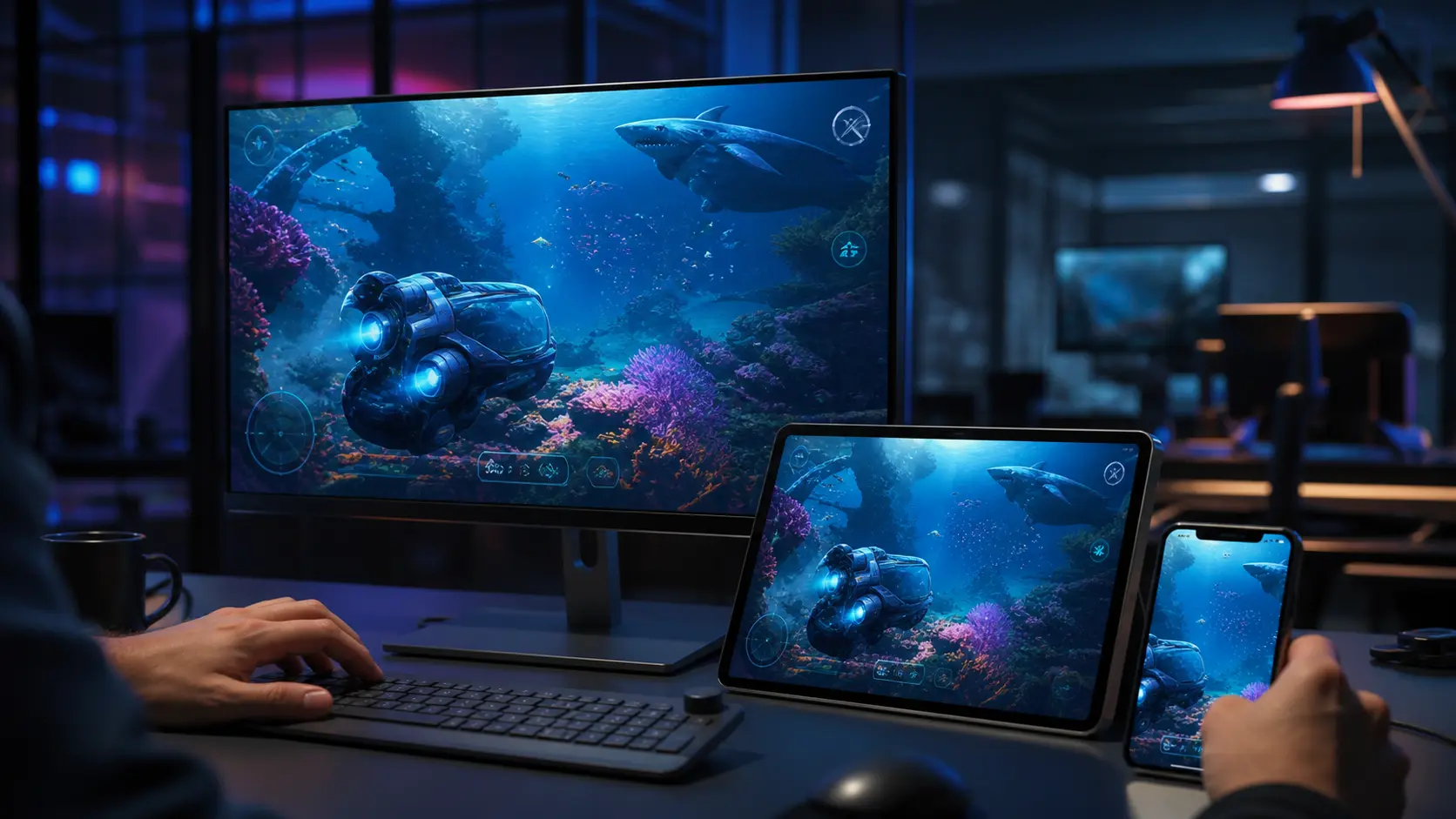
To further elaborate on WebAssembly memory constraints, the avoidance of garbage collection pauses in JavaScript and the heap fragmentation in WebAssembly is a critical architectural requirement. High-performance gaming environments cannot tolerate the non-deterministic execution times inherent in mark-and-sweep garbage collectors. In a custom webgl fish shooting game, the entity count can easily exceed several thousand active objects when considering schools of fish, overlapping bullet trajectories, particle emitters, and dynamic text overlays.
If the application were to continuously allocate and deallocate memory for these objects, the runtime environment would inevitably trigger a garbage collection cycle. This cycle suspends the main execution thread, resulting in a visible frame drop—a phenomenon entirely unacceptable for a turnkey fish game webgl demo where operators are specifically evaluating the fluidity of the rendering pipeline.
Engineers solve this by implementing robust object pooling architectures. At the commencement of the session, during the initial loading phase, the engine pre-allocates massive contiguous blocks of memory representing the maximum theoretical capacity for each entity type. For example, a pool of two thousand bullet objects is instantiated and held in reserve. When a player triggers the fire command, the engine queries the pool for an inactive bullet, initializes its state vectors (position, velocity, damage multiplier), and marks it as active. Upon collision or boundary exit, the bullet is not destroyed or deallocated; it is merely flagged as inactive and returned to the available pool.
This paradigm extends beyond entities to complex data structures like transformation matrices, physics contact manifolds, and network serialization buffers. The entire runtime memory footprint remains completely static after initialization. This strict adherence to zero-allocation runtime engineering ensures that the browser based fish shooting game demo maintains a flawless sixty frames per second execution, proving to the evaluating operator that the underlying architecture is robust enough for commercial deployment.
AssetBundle Management and WebAssembly Memory Compression Strategies

The primary challenge of a webgl arcade game sandbox demo is the initial load time. Operators will abandon a demo if it takes more than a few seconds to become interactive. Therefore, the asset pipeline must aggressively compress and progressively stream content. The monolithic build process used for native clients is entirely unsuited for the web.
Engineers employ a granular AssetBundle architecture, segmenting the game payload into essential and deferred modules. The critical path bundle contains only the core engine, UI frameworks, and the lowest tier of fish species required to start the game. Once the player enters the scene, background web workers asynchronously download higher-tier boss assets, complex sound banks, and detailed background environments.
Texture compression is paramount for memory management within the restricted browser environment. Standard PNG or JPEG formats must be decoded into raw pixel data, rapidly consuming the available memory ceiling. Modern WebGL deployments utilize hardware-supported compressed texture formats such as Basis Universal or ASTC. These formats remain compressed in GPU memory, drastically reducing the memory footprint and bandwidth requirements. The engine detects the optimal compression format supported by the client browser during initialization and fetches the corresponding texture payload.
WebAssembly memory growth must be carefully monitored. The linear memory space allocated to the Wasm module cannot be easily shrunk once expanded. Developers must implement custom memory allocators, often based on object pooling and slab allocation techniques, to prevent memory fragmentation and unnecessary heap expansion. By pre-allocating memory pools for bullets, fish entities, and visual effects, the engine avoids the overhead of frequent garbage collection pauses, which manifest as noticeable stuttering during gameplay.
Scalable Backend Microservices for Demo Orchestration
The infrastructure supporting the instant play demo sandbox is equally sophisticated. To handle an influx of concurrent evaluations from global operators, the backend architecture eschews traditional monolithic server designs in favor of highly scalable microservices orchestrated via Kubernetes.
When a prospective client navigates to the demo portal, the request hits a global load balancer which routes the traffic to the nearest geographic edge node. This edge node runs a lightweight matchmaking service that authenticates the session request. The matchmaker then communicates with a fleet manager service responsible for maintaining a warm pool of game server containers.
These game server containers are pre-initialized, having already loaded the level geometry, collision meshes, and AI navigation meshes into memory. By maintaining a warm pool, the fleet manager eliminates the cold start latency typically associated with provisioning new server instances. The evaluating operator experiences an instantaneous transition from the landing page directly into the playable webgl arcade game sandbox demo.
Furthermore, these microservices are engineered for resilience. If a hardware failure occurs on a specific node, the Kubernetes control plane automatically detects the unresponsive game server and seamlessly migrates the session state to a healthy instance. The client-side application is designed to handle WebSocket reconnections gracefully, presenting the operator with a brief loading spinner while the session state is restored from a centralized Redis datastore. This level of enterprise-grade fault tolerance is a key selling point for operators evaluating the reliability of the turnkey fish game webgl demo architecture.
AI Pathfinding and Deterministic Behavioral Modeling
The realism of the underwater ecosystem directly correlates with the perceived quality of the custom webgl fish shooting game. Traditional arcade cabinets often relied on simple, pre-computed splines for fish movement. However, modern expectations demand dynamic, reactive artificial intelligence that provides a challenging and unpredictable gameplay experience.
The demo environment showcases a sophisticated flocking algorithm based on the principles of Craig Reynolds’ Boids. Each fish evaluates its immediate surroundings and adjusts its velocity based on three primary steering behaviors: separation (avoiding crowding local flockmates), alignment (steering towards the average heading of local flockmates), and cohesion (steering to move toward the average position of local flockmates).
To ensure synchronization across all connected clients in the webgl arcade game sandbox demo, these steering behaviors must be completely deterministic. The server executes the authoritative AI pathfinding simulation utilizing a fixed-step physics engine. The server utilizes a seeded pseudo-random number generator to determine spawn locations, initial trajectories, and behavioral variations.
Because the simulation is deterministic, the server only needs to transmit the initial state parameters and periodic synchronization checkpoints to the client. The client’s local physics engine runs the identical simulation, perfectly predicting the position of every fish on the screen. This drastically reduces the network bandwidth requirements, as the server is not forced to broadcast positional updates every frame. The operator evaluating the browser based fish shooting game demo immediately recognizes the smoothness of the movement and the responsiveness of the targeting system, validating the efficiency of the deterministic network model.
Real-Time WebSocket Synchronization and Authoritative Bullet Collision
A playable fish game demo must accurately simulate the multiplayer mechanics of a production environment. The network architecture relies on persistent WebSocket connections using a binary protocol, such as FlatBuffers or Protocol Buffers, rather than verbose JSON payloads. This binary serialization minimizes bandwidth consumption and accelerates parsing speed within the WebAssembly module.
The server remains the absolute authority regarding bullet trajectories and collision detection. The client merely acts as a dumb terminal predicting the local state to mask network latency. When a player fires, the client instantly spawns a local projectile and transmits a fire command containing the timestamp, firing angle, and weapon tier. The server validates the command against the player balance and firing rate limits, then broadcasts the confirmed bullet entity to all connected clients in the room.
Collision detection for a custom webgl fish shooting game involves continuous collision algorithms. Standard discrete collision checks fail at high bullet velocities, allowing projectiles to tunnel through thin colliders. The server engine utilizes ray casting or swept sphere intersection tests to determine precisely when and where a bullet intersects a fish’s bounding volume.
To optimize the broad-phase collision detection, the server employs spatial partitioning algorithms such as a quadtree or a uniform grid. The screen area is divided into cells, and entities are registered within their overlapping cells. When calculating collisions for a specific bullet, the engine only tests against fish within the adjacent cells, reducing the algorithmic complexity from quadratic to linear time.
Cryptographic Security and Anti-Tamper Mechanisms
Security is a paramount concern for arcade operators, and the architecture demonstrated within the turnkey fish game webgl demo must reflect the rigorous security posture of the final production build. Browser environments are inherently untrusted execution contexts; players have full access to the client-side memory space, the network traffic payload, and the underlying JavaScript execution engine.
To combat memory injection and variable manipulation, the core game state is isolated within the WebAssembly linear memory. Furthermore, sensitive values such as the player’s balance, the current weapon multiplier, and the server’s cryptographic nonce are completely obfuscated in memory. The client engine utilizes dynamic encryption keys to scramble these values during runtime, decrypting them only momentarily within CPU registers for calculation. If a malicious user attempts to use a memory scanner to locate and modify their credit balance, they will only encounter meaningless, rapidly shifting encrypted byte sequences.
The WebSocket communication protocol is similarly hardened. The binary serialization format is encapsulated within a custom cryptographic tunnel utilizing AES-GCM encryption with dynamic key rotation. The initial handshake sequence involves an asymmetric key exchange using elliptic curve cryptography (ECDH), establishing a secure shared secret between the client and the matchmaking server. The symmetric AES keys are then derived from this shared secret and rotated every few minutes during the session.
This cryptographic layer ensures that all network traffic is immune to packet sniffing and man-in-the-middle attacks. Even if a user captures the WebSocket stream, they cannot decipher the proprietary protocol or inject forged command packets. The server rigorously validates all incoming payloads against temporal sequence numbers and digital signatures, immediately dropping any malformed or out-of-order packets and flagging the session for potential abuse. The robust security architecture showcased in the browser based fish shooting game demo provides operators with the absolute confidence necessary to deploy the software in high-stakes, real-money gaming environments.
Instant Play Demo Sandbox Architecture and Session Isolation
Providing a secure and isolated environment for prospective buyers requires a robust sandbox architecture. The browser based fish shooting game demo operates within a transient session lifecycle. When an operator requests demo access, the backend orchestrates a dedicated game room instance.
This session isolation is achieved through containerization technologies like Docker and Kubernetes. The matchmaking service spins up a lightweight game server container tailored specifically for the demo session. This container runs a modified configuration file that injects infinite demo credits and enables diagnostic overlays, allowing the operator to inspect frame rates, network latency, and memory consumption.
To prevent abuse and reverse engineering, the demo sandbox implements aggressive rate limiting and session timeouts. A typical demo session is hard-capped at ten to fifteen minutes, after which the WebSocket connection is forcefully terminated, and the container is gracefully shut down. The WebAssembly payload itself is obfuscated, stripping all symbolic debug information and minifying the JavaScript glue code.
Cross-Origin Resource Sharing policies are strictly enforced. The API endpoints and WebSocket endpoints are configured to only accept connections originating from the authorized demo portal domain. This prevents malicious actors from embedding the demo client into unauthorized third-party websites or attempting to interface with the demo backend using custom scripts.
Advanced Collision Detection using Spatial Hashing
A critical component of a high-performance turnkey fish game webgl demo is the collision detection system. With hundreds of overlapping fish trajectories and dozens of high-speed projectiles in flight simultaneously, the computational overhead of testing every bullet against every target would cripple the physics thread. To mitigate this algorithmic complexity, the engine employs an advanced spatial partitioning technique known as spatial hashing.
Unlike hierarchical structures such as quadtrees, which require continuous rebalancing and recursive traversal, a spatial hash grid provides extremely fast, constant-time entity insertion and localized query lookups. The two-dimensional play area is superimposed with a virtual grid of fixed-size buckets. The cell size is meticulously tuned to roughly match the bounding volume of the largest common fish entity.
During the physics update step, the engine calculates a unique integer hash key for every active entity based on its current coordinates. The entity’s reference is then inserted into the corresponding hash bucket. When a bullet travels through the environment, the engine calculates the hash keys for the cells intersected by the bullet’s trajectory vector. The collision algorithm only executes intersection tests against the fish entities residing in those specific buckets.
This spatial hashing technique is particularly efficient in a browser based fish shooting game demo because it maps cleanly to one-dimensional arrays in WebAssembly linear memory, maximizing cache coherence and minimizing pointer indirection. The server-side authoritative simulation utilizes the exact same spatial hash grid, ensuring perfect parity between the client-side visual prediction and the server-side mathematical validation.
Mathematical RTP Hold Validation and In-Browser Analytics Telemetry
Operators evaluating a turnkey fish game webgl demo are acutely interested in the mathematical stability of the Return to Player algorithmic model. While the visual presentation is crucial for player acquisition, the underlying math dictates the long-term profitability of the machine. The demo sandbox must provide transparent, yet protected, visibility into this mathematical engine.
The core RTP logic operates exclusively on the authoritative server. When a bullet collides with a fish, the server calculates the capture probability based on the weapon multiplier, the fish multiplier, and the current dynamic state of the payout pool. To demonstrate the stability of this system, the demo environment includes a developer telemetry overlay.
This overlay streams real-time analytics data via a secondary WebSocket channel. Operators can observe the instantaneous hold percentage, the volumetric bullet throughput, and the variance distribution of large payout events. The telemetry engine aggregates this data over rolling windows, providing moving averages that illustrate how the algorithm smooths out short-term volatility to achieve the target long-term RTP.
In-browser performance analytics are also crucial for the evaluation process. The engine continuously monitors client-side metrics such as the time spent per frame in the update loop versus the render loop, the number of dropped frames, and the latency variance of the primary WebSocket connection. This data proves to the operator that the software can maintain a consistent user experience across diverse hardware profiles and network conditions.
High Dynamic Range Rendering and Post-Processing
The visual impact of the custom webgl fish shooting game must rival the sensory overload of physical arcade cabinets. Achieving this within a browser necessitates a sophisticated rendering pipeline utilizing High Dynamic Range imaging and complex post-processing effects.
The traditional color space is insufficient to capture the intense luminescence of underwater explosions, laser beams, and glowing deep-sea creatures. The WebGL 2.0 rendering pipeline operates on 16-bit floating-point framebuffers, allowing the shader calculations to output color values far exceeding the standard displayable range.
This data is then passed through a post-processing stack before being displayed on the monitor. The most critical effect is the bloom pass. The engine extracts the brightest pixels from the framebuffer, downsamples them through a series of successively smaller textures, and applies a Gaussian blur to simulate the optical scattering of light in the camera lens. This bloom texture is then additively blended back onto the main scene, creating the intense, glowing halos around high-energy weapon impacts.
Following the bloom pass, the engine applies a tone mapping operator, such as the filmic curve, to compress the extended dynamic range back into the displayable color space. This process preserves detail in extreme highlights and deep shadows, preventing the image from appearing washed out or overexposed. The implementation of a complete high dynamic range pipeline with advanced post-processing within a webgl arcade game sandbox demo is a significant engineering achievement, demonstrating the engine’s capability to deliver a premium, visually stunning experience without requiring dedicated hardware.
Continuous Integration and Automated Load Testing
Delivering a flawless webgl arcade game sandbox demo requires a rigorous deployment methodology. Our engineering teams utilize a robust continuous integration and deployment pipeline to automate testing, build compilation, and server provisioning.
Every commit to the source repository triggers a comprehensive suite of automated tests. These include unit tests validating the mathematical accuracy of the algorithms, integration tests verifying the serialization of the binary network protocol, and headless browser tests that programmatically navigate the UI and simulate player input.
Furthermore, the deployment pipeline automatically executes load testing scenarios against the custom webgl fish shooting game backend. A fleet of automated bots is spun up on cloud infrastructure, simulating thousands of concurrent client connections. These bots bombard the server with fire commands, movement updates, and connection events, stressing the WebSocket gateway, the matchmaking service, and the core game server containers.
Engineers closely monitor the server metrics during these load tests, analyzing CPU utilization, memory allocation rates, and database latency. The deployment pipeline will automatically halt if the server response time exceeds the established threshold or if memory leaks are detected during the simulation. This commitment to automated load testing guarantees that when a major operator drives significant traffic to the turnkey fish game webgl demo environment, the infrastructure will handle the load flawlessly, preserving the high-performance reputation of the software.
Multi-Platform Deployment Pipeline from Browser to Native Enclosures
The ultimate value proposition of a modern arcade architecture is write-once, deploy-anywhere flexibility. The codebase powering the browser based fish shooting game demo must be entirely isomorphic with the codebase running in physical arcade cabinets. This unified deployment pipeline eliminates the overhead of maintaining divergent code branches for different platforms.
The core game logic, physics engine, and network protocol are written in a strictly platform-agnostic language such as C++ or Rust. This core module is then compiled via Emscripten into WebAssembly for the browser demo, and via native toolchains for Windows or Linux arcade enclosures. The rendering layer relies on cross-platform graphics APIs, utilizing Vulkan or DirectX for native cabinets and WebGL 2.0 for the browser sandbox.
When deploying to a physical cabinet, the software interfaces with proprietary hardware via an abstraction layer. The native build links against serial communication libraries to parse inputs from custom joysticks and physical buttons, and to interface with bill validators and ticket dispensers. The WebGL demo utilizes a keyboard and mouse emulation layer to map these physical inputs to browser events.
This unified architecture guarantees that the mathematical behavior and gameplay feel experienced in the custom webgl fish shooting game sandbox are perfectly replicated on the casino floor. Operators can conduct their due diligence from a laptop in an office, confident that the performance characteristics will remain identical when deployed to specialized hardware in an active arcade environment.
Frequently Asked Questions
Question What are the minimum system requirements for the WebGL fish game demo
The WebGL demo is designed to run on any modern browser supporting WebAssembly and WebGL 2.0. We recommend a minimum of 4GB RAM, a dual-core processor, and a GPU equivalent to an Intel HD Graphics 4000 or better. For mobile devices, recent generation iOS or Android hardware will provide a smooth sixty frames per second experience.
Question How accurate is the browser demo compared to the actual arcade cabinet software
The browser sandbox uses the exact same core C++ logic and mathematical engine as the production arcade cabinet. The only differences are the graphics API translation layer and the input mapping. The collision physics, network latency compensation, and Return to Player algorithms are completely identical.
Question Can we customize the mathematics and payout rates in the demo environment
The standard instant-play sandbox operates on a fixed demonstration profile to highlight baseline volatility. However, for serious enterprise evaluations, we can provision a private sandbox container that exposes backend administrative panels, allowing operators to adjust volatility parameters and observe the mathematical results in real-time.
Question How does the WebGL demo handle network instability and packet loss
Our proprietary binary WebSocket protocol includes aggressive client-side prediction and server reconciliation. If the connection experiences packet loss, the client will continue to simulate bullet trajectories and local entity movement. Once the network recovers, the client rapidly fast-forwards to the authoritative server state, masking short disruptions from the player.
Question Do you provide the full source code after we evaluate the web sandbox
Yes, our turnkey enterprise agreements include options for full source code licensing, comprehensive technical documentation, and ongoing engineering support. The demo sandbox is merely the first step in our technical evaluation and onboarding process for strategic partners.
Guangzhou Miba Animation Technology Co., Ltd.
Engineer Wang
WhatsApp/WeChat: +86 17620842078
Telegram: https://t.me/JLwyc
Email: miba515527@gmail.com