- Technical Comparison Matrix Table
- Sub 80 Millisecond Glass to Glass Video Streaming Architecture via WebRTC
- Industrial Embedded IoT Gateway Boards and Optically Isolated Relay Control
- Real Time Physical Machine State Synchronization and Virtual Queue Machines
- Warehouse Facility Rigging, Dual HD Camera Alignment, and Power Infrastructure
- Cryptographic API Defense, Anti Replay Nonces, and Emergency Signal Severing
- Tokenization Economics, Mobile App UX Design, and Automated Logistics APIs
- Specialized Remote Arcade Architecture and Engineering Deep Dives
- Frequently Asked Questions
- Structured FAQ Data and Contact Information
The intersection of physical amusement machines and digital platforms has created a monumental shift in the arcade and entertainment industry. Remote live arcade teleoperation represents a paradigm shift where players from any geographic location can interact with real physical arcade equipment, such as claw machines, coin pushers, and fish tables, using their mobile devices or desktop computers. This comprehensive guide is engineered specifically for live streaming operators, arcade business owners, software architects, and tech entrepreneurs who are launching physical-to-digital remote gaming platforms with ultra-low latency. By bridging the tangible excitement of mechanical amusement devices with the boundless reach of mobile applications, remote teleoperation opens up unprecedented revenue channels and operational efficiencies.
Operating a remote claw machine business or digital coin pusher facility demands an extraordinary integration of mechanical hardware, industrial internet of things (IoT) communication protocols, real-time video encoding, and resilient cloud backend architectures. Unlike traditional digital gaming where rendering happens locally on the user’s device, remote arcade teleoperation hinges upon sending control commands over the internet to physical actuators in a warehouse and broadcasting the resulting mechanical actions back to the user via high-definition video streams in real time. The tolerance for delay is essentially zero. A lag of even a few hundred milliseconds between tapping a directional button and witnessing the physical claw move can severely degrade the user experience, leading to frustration and customer churn. Achieving a sub-eighty-millisecond glass-to-glass latency is not just a technical luxury; it is the fundamental requirement for a viable remote arcade product. For factory-direct procurement and comprehensive engineering specs, consult our master guide on cloud arcade machine teleoperation and turnkey engineering.
This deep dive into remote live arcade teleoperation will systematically unpack the intricate web of technologies required to build, deploy, and scale a profitable remote arcade operation. We will explore the nuances of WebRTC streaming architecture and how to reduce remote arcade video latency through custom signaling servers and optimized video pipelines. We will dissect the hardware requirements, specifically focusing on industrial embedded IoT gateway boards, optically isolated relay control circuits, and dual-axis stepper motor drivers. Furthermore, we will delve into the complexities of real-time physical machine state synchronization, ensuring that virtual queue systems accurately reflect the availability of real-world machines. Facility management, including warehouse rigging, dual HD camera alignment, and redundant power infrastructure, will be addressed to guarantee continuous uptime. Security is paramount, and we will outline cryptographic API defenses, anti-replay nonces, and emergency signal severing techniques to protect your physical and digital assets. Finally, we will cover the commercial aspects, exploring tokenization economics, mobile application user experience design, and automated logistics APIs for physical prize fulfillment.
Technical Comparison Matrix Table
Evaluating the underlying technology stack is the first step in architecting a successful hybrid arcade platform. The following technical comparison matrix table evaluates the WebRTC teleoperation stack against traditional video live streaming protocols and pure digital arcade simulators across eight critical technical and commercial metrics.
| Metric | WebRTC Teleoperation Stack | Traditional Video Live Streaming | Pure Digital Arcade Simulators |
|---|---|---|---|
| Glass to Glass Latency | Ultra Low (50ms to 120ms) | High (3000ms to 15000ms) | Zero (Local Rendering) |
| Video Protocol | WebRTC with UDP Transport | HLS RTMP with TCP Transport | None required for gameplay |
| Hardware Integration | Complex IoT Gateway and Relays | None | None |
| Player Experience | Highly Authentic Physical Interaction | Non Interactive Viewing Only | Synthetic Physics Engine |
| Bandwidth Consumption | High (Variable Bitrate Streaming) | Medium to High (Adaptive Bitrate) | Low (Only state sync data) |
| Infrastructure Cost | High (Warehousing and Bandwidth) | Medium (CDN and Transcoding) | Low (Cloud Compute Only) |
| Monetization Yield | Premium (High perceived value of physical goods) | Low (Ads and Donations) | Medium (In App Purchases) |
| Operational Complexity | Extreme (Mechanical maintenance and shipping) | Low (Software management) | Low (Software updates) |
The WebRTC teleoperation stack is the only viable solution for interactive remote control due to its utilization of UDP for transport, which sacrifices guaranteed delivery for absolute speed, eliminating the buffering delays inherent in TCP-based protocols like HLS and RTMP. While pure digital simulators offer lower costs, they completely lack the authentic mechanical randomness and tangible reward loop that drives the high monetization yield of physical arcade machines.
Sub 80 Millisecond Glass to Glass Video Streaming Architecture via WebRTC
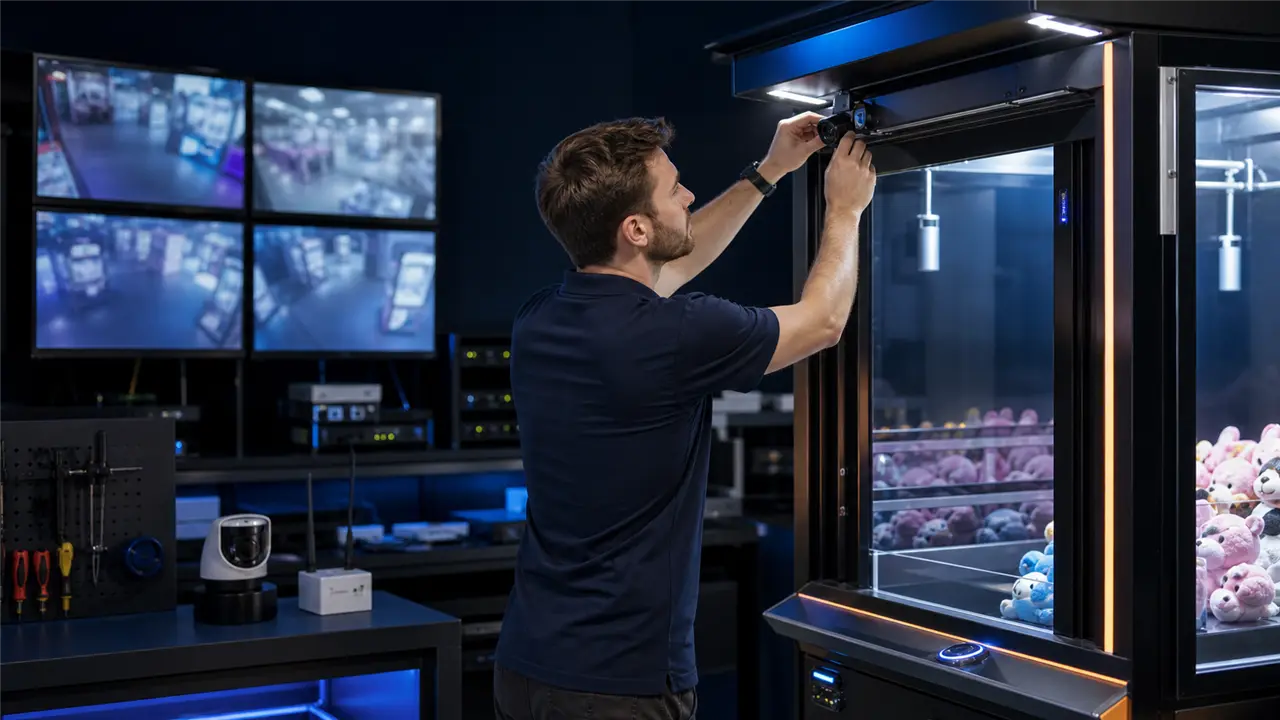
Achieving glass-to-glass latency below eighty milliseconds is the holy grail of remote arcade teleoperation. Glass-to-glass latency is defined as the total time elapsed from the moment a physical event occurs in the warehouse (such as the claw dropping) to the moment that specific frame of video is displayed on the glass screen of the user’s mobile device. This tight operational window requires a ruthless optimization of every single component in the video pipeline, starting from the image sensor on the camera, through the hardware encoder, across the network, and finally to the hardware decoder and rendering engine on the client device.
The traditional broadcasting stack, reliant on RTMP for ingest and HLS or MPEG-DASH for egress, is fundamentally flawed for real-time interactive teleoperation. These protocols employ TCP (Transmission Control Protocol), which mandates packet acknowledgment and retransmission of lost packets. In a live streaming environment, this results in head-of-line blocking, forcing the video player to buffer and wait for delayed packets, thereby accumulating seconds of latency. WebRTC (Web Real-Time Communication) circumvents this by utilizing RTP (Real-time Transport Protocol) over UDP (User Datagram Protocol). UDP is a fire-and-forget protocol. If a video packet drops over a congested cellular network, WebRTC simply skips it and renders the next available frame, prioritizing immediate temporal accuracy over perfect visual fidelity.
The journey begins at the edge with the camera hardware. Standard USB webcams introduce significant processing delay via their internal ISP (Image Signal Processor) and USB bus polling. Industrial installations instead utilize MIPI CSI-2 (Camera Serial Interface) or specialized IP cameras outputting raw YUV streams directly into a dedicated hardware encoder. The encoder, typically a dedicated ASIC or hardware-accelerated block on a System-on-Chip (SoC) like the NVIDIA Jetson or Rockchip RK3588, must be configured for zero-latency encoding. This involves disabling B-frames (Bidirectional predictive frames) entirely, relying exclusively on I-frames (Intra-coded frames) and P-frames (Predicted frames). B-frames require looking ahead to future frames to calculate compression, inherently introducing buffer delay. The encoder must also be set to CBR (Constant Bitrate) with a strict VBV (Video Buffering Verifier) buffer size approaching zero to ensure frames are dispatched to the network interface the instant they are compressed.
Once encoded, the H.264 or H.265 (HEVC) Network Abstraction Layer (NAL) units are packetized into RTP payloads. The signaling phase of WebRTC, which establishes the peer-to-peer connection, requires a custom signaling server utilizing WebSockets and SDP (Session Description Protocol) exchange. To reduce connection setup time for mobile users, ICE (Interactive Connectivity Establishment) candidate gathering can be optimized by forcing relay through geographically distributed TURN (Traversal Using Relays around NAT) servers, guaranteeing NAT traversal regardless of the user’s cellular carrier configuration. A cloud arcade platform architecture must deploy an SFU (Selective Forwarding Unit) globally to route WebRTC streams efficiently. The SFU acts as a ultra-low latency media router, taking the single upstream from the arcade machine and multicasting it to the active player and all passive spectators in the virtual room without decoding and re-encoding the video.
On the client side, the mobile application must bypass the standard operating system media players, which typically enforce a minimum buffer size for smooth playback. Native WebRTC libraries for iOS and Android provide direct access to the hardware decoders. The jitter buffer, a mechanism designed to absorb variations in packet arrival time, must be tuned aggressively. In standard VoIP applications, a jitter buffer might hold 50 to 100 milliseconds of audio. In remote arcade teleoperation, the jitter buffer must dynamically collapse to near-zero when network conditions are stable, rendering frames immediately upon arrival. If the network experiences heavy jitter, the application should intelligently degrade the video bitrate via RTCP (RTP Control Protocol) feedback mechanisms like REMB (Receiver Estimated Maximum Bitrate) or TWCC (Transport-wide Congestion Control) rather than increasing the buffer size.
Industrial Embedded IoT Gateway Boards and Optically Isolated Relay Control
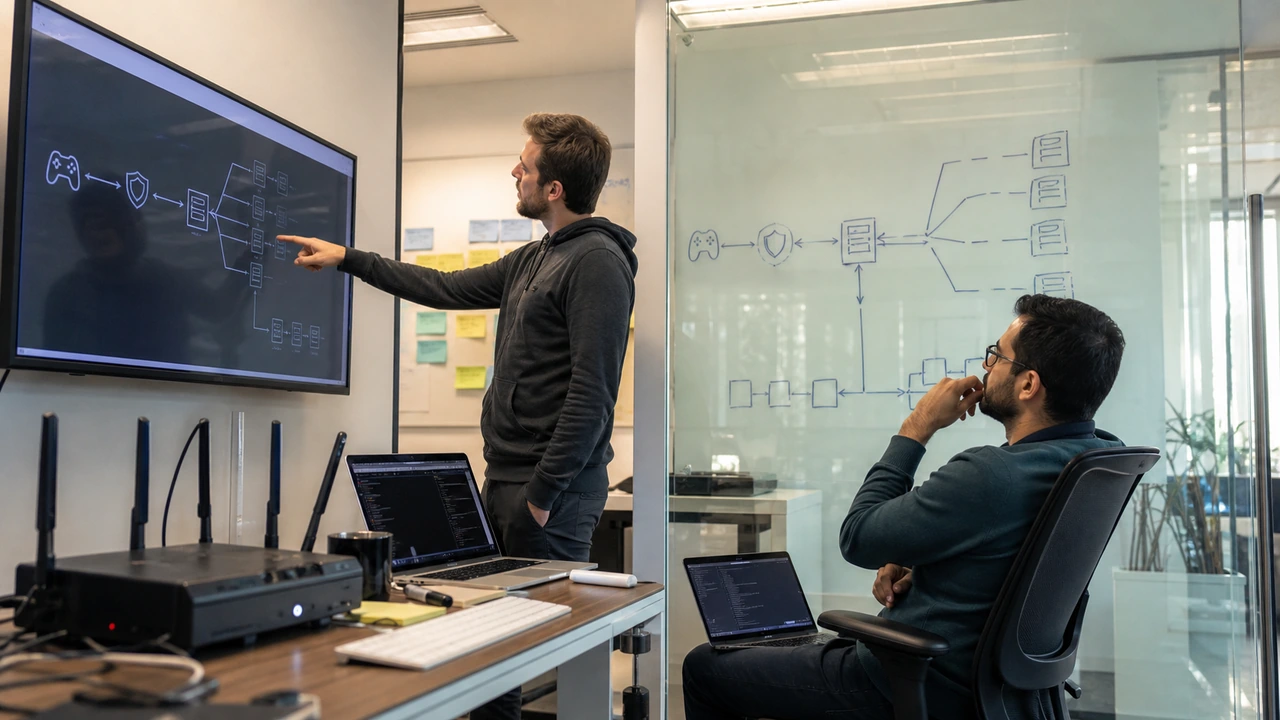
The translation of digital commands into physical mechanical motion is orchestrated by the industrial embedded IoT gateway board. This hardware component serves as the central nervous system of the remote arcade machine. Consumer-grade microcontrollers like standard Arduinos or Raspberry Pis are woefully inadequate for the rigorous demands of a 24/7 commercial warehouse environment. They lack the necessary electrical protection, thermal dissipation, and real-time operating system (RTOS) capabilities required to manage precise timing and withstand voltage spikes from high-power inductive loads.
The architecture of a robust industrial IoT gateway begins with a powerful, deterministic microcontroller, such as an STM32 ARM Cortex-M series or an ESP32-S3 for dual-core processing with integrated Wi-Fi and Bluetooth Low Energy. This primary MCU handles the high-frequency control loops and peripheral interfacing. For network communication, while Wi-Fi provides flexibility, hardwired Ethernet via a dedicated PHY and MAC is mandatory for production environments to eliminate wireless interference and packet loss. The gateway maintains a persistent, full-duplex connection to the cloud control servers, typically utilizing a lightweight publish-subscribe protocol like MQTT over TLS or a custom persistent WebSocket connection optimized for minimal overhead.
The interface between the delicate logic level circuitry of the gateway (operating at 3.3V or 5V) and the high-voltage, high-current components of the arcade machine (motors, solenoids, mainboards operating at 12V, 24V, or 48V) requires strict electrical isolation. This is achieved through optically isolated relay control modules and optocouplers. When a user presses a directional button on their mobile app, the command travels through the cloud to the IoT gateway. The gateway then energizes an LED inside an optocoupler. The light from this LED activates a phototransistor on the high-voltage side, completing the circuit to trigger a relay or motor driver. This optical barrier prevents high-voltage transients, back electromotive force (EMF) from spinning motors, and ground loops from feeding back into and destroying the gateway’s sensitive electronics.
Controlling a claw machine involves manipulating a gantry across an X and Y axis and lowering a claw on the Z axis. Traditional arcade machines utilize rudimentary brushed DC motors controlled by basic H-bridge circuits or relays, relying on physical microswitches at the end of the tracks to cut power and prevent the gantry from crashing into the walls. While the IoT gateway can interface directly with these legacy arcade mainboards by simulating joystick and button presses via relays (a technique known as piggybacking), modern ground-up designs utilize stepper motors and closed-loop servo systems for absolute precision.
When replacing the entire arcade mainboard, the IoT gateway must incorporate advanced motor control algorithms. Acceleration and deceleration ramps (trapezoidal or S-curve profiles) must be computed in real-time to ensure smooth movement of the gantry, preventing the claw from swinging wildly and dropping the prize. The gateway must also accurately manage the PWM (Pulse Width Modulation) signal to the claw’s solenoid, controlling the precise voltage applied during the grab and carry phases to adjust the grip strength dynamically based on operator settings and game logic. Furthermore, the gateway monitors an array of sensors: drop sensors (infrared break beams) to detect when a prize has been successfully won, limit switches for homing the gantry, and current sensors to detect motor stalls or mechanical jams, immediately cutting power to prevent electrical fires.
Real Time Physical Machine State Synchronization and Virtual Queue Machines
Managing a fleet of physical arcade machines accessed by a global digital audience necessitates a highly sophisticated real-time physical machine state synchronization engine. Unlike purely digital games where instances can be spun up infinitely on demand in the cloud, physical machines are strictly scarce resources. Only one player can actively control a machine at any given millisecond. The state machine governing the lifecycle of a remote arcade session must be meticulously designed to prevent race conditions, handle network disconnects gracefully, and maintain the illusion of instant availability through virtual queue systems.
The core state synchronization architecture relies on a highly available, in-memory data store like Redis or KeyDB to act as the single source of truth for the status of every physical machine in the warehouse. Each machine operates as an independent state machine with defined transitions: Offline, Available, Reserved, Playing, Settling, and Maintenance. When the IoT gateway boots up and establishes a secure connection to the cloud backend, it registers itself and transitions to the Available state.
When a user taps the “Play” button in the mobile application, a high-stakes transaction occurs. The backend system must atomically lock the machine, transition its state from Available to Reserved, and deduct the required digital tokens from the user’s wallet wallet balance within milliseconds. If this transaction is not atomic, two users could theoretically lock the same machine simultaneously, resulting in a chaotic scenario where conflicting commands are sent to the IoT gateway. Redis features like Lua scripting are heavily utilized to execute this reservation and deduction logic as a single, indivisible operation.
Once reserved, the machine transitions to the Playing state, and the IoT gateway begins accepting control commands exclusively from that specific user’s authenticated session. The backend establishes a high-frequency, bidirectional command pipeline, typically using WebSockets. Every movement command (up, down, left, right, drop) sent by the user is time-stamped and assigned a sequential nonce. The IoT gateway acknowledges receipt of each command. This sequence numbering is critical for resolving out-of-order packet delivery. If a user rapidly taps left and then right, and the network delivers the right command before the left command, the gateway must possess the logic to discard the delayed, older command based on its sequence number to prevent erratic physical movement.
If a popular machine is currently in the Playing state, subsequent users wishing to play are placed into a virtual queue machine. The virtual queue is not merely a waiting list; it is an active engagement system. While in the queue, users are fed the live WebRTC stream of the current player’s session, transforming the wait time into a spectator event. The backend manages the queue hierarchy, providing real-time updates to waiting users about their position and estimated wait time.
Crucially, the state synchronization system must handle edge cases gracefully. If the active player’s internet connection drops, the system cannot leave the machine locked indefinitely. The IoT gateway acts as a dead man’s switch. It expects a continuous heartbeat ping from the client application. If this heartbeat is missing for a predefined threshold (e.g., three seconds), the gateway automatically commands the physical machine to halt all movement, drops the claw to safely conclude the game cycle, and signals the backend that the session has timed out. The backend then resolves the game outcome, refunds tokens if necessary according to business logic, and automatically transitions the machine to the next user in the virtual queue, minimizing expensive idle time.
Warehouse Facility Rigging, Dual HD Camera Alignment, and Power Infrastructure
The digital success of a remote live arcade platform is entirely dependent on the physical integrity of the warehouse facility. Operating hundreds or thousands of electromechanical machines simultaneously creates extreme challenges regarding space optimization, camera rigging, thermal management, and electrical infrastructure. A poorly designed warehouse architecture will manifest as degraded video quality, frequent hardware failures, and ultimately, a catastrophic loss of revenue.
The physical layout of the warehouse must prioritize density while maintaining accessibility for technicians. Machines are typically arranged in long, back-to-back aisles. To maximize vertical space, specialized multi-tier scaffolding and racking systems are engineered, stacking claw machines two or even three levels high. This vertical integration requires custom-designed chassis for the machines, stripping away the heavy wooden cabinets and decorative lighting used in retail arcades, leaving only the essential metal framework, gantry mechanism, and prize display area.
The visual presentation to the remote user is dictated by the dual HD camera alignment. A standard remote claw machine setup requires two distinct camera angles: a front-facing camera providing a comprehensive view of the prize pit and a side-facing camera offering depth perception crucial for aligning the claw precisely over the target. Achieving flawless camera alignment is an intricate process. The cameras cannot be mounted directly to the vibrating frame of the arcade machine, as the movement of the heavy gantry will induce micro-vibrations, resulting in a blurry, nauseating video feed.
Instead, cameras are mounted on independent, rigid rigging structures constructed from extruded aluminum profiles that span the length of the aisles, completely decoupled from the machine chassis. High-quality, motorized pan-tilt-zoom (PTZ) mechanisms are occasionally used, but fixed-lens industrial cameras with manual micro-adjustment brackets are preferred for their reliability and lower cost. The lighting environment must be meticulously controlled. Retail arcades use flashy, dynamic LEDs, but remote teleoperation requires intense, diffuse, and absolutely consistent lighting to eliminate shadows and glare on the prize pit glass. High-CRI (Color Rendering Index) LED panels are installed above each machine, providing uniform illumination that allows the camera sensors to operate at low ISO settings, minimizing image noise and reducing the load on the video encoder.
Power infrastructure is the lifeblood of the facility. A warehouse operating a thousand machines is an immense electrical load, characterized by high inrush currents when inductive loads like solenoids and motors activate simultaneously. Relying on standard commercial power grids without substantial conditioning is a recipe for disaster. The facility requires industrial three-phase power drops, distributed through massive step-down transformers to dedicated subpanels for each aisle.
Furthermore, robust uninterruptible power supply (UPS) systems and backup diesel generators are non-negotiable. A sudden power loss mid-game destroys the user experience and can lead to complex database reconciliation issues regarding token balances and prize inventory. The IoT gateways and networking equipment (switches, routers, optical network terminals) must be on a separate, dedicated pure-sine-wave UPS circuit to ensure that even during a total blackout, the central control system remains online long enough to gracefully terminate active sessions, save state data, and send alert notifications to the engineering team. Finally, thermal management requires industrial HVAC systems designed for server farms, not standard warehouses, to dissipate the massive heat generated by thousands of power supplies, motors, and lighting fixtures running continuously.
Cryptographic API Defense, Anti Replay Nonces, and Emergency Signal Severing
The convergence of real money, digital tokens, and physical asset control makes remote arcade platforms highly lucrative targets for malicious actors. Securing the API surface area and the command pipeline requires a paranoid, zero-trust architecture. Understanding how to secure remote arcade API endpoints is critical to preventing catastrophic exploitation, such as attackers hijacking machines to automatically win prizes or manipulating token balances to drain the company’s financial reserves.
The primary attack vector is the communication channel between the mobile application and the backend server, and subsequently, between the backend and the IoT gateway. Standard SSL/TLS encryption for all HTTP and WebSocket traffic is merely the baseline. The command protocol itself must be cryptographically secured against interception and manipulation.
A sophisticated cryptographic API defense begins with payload signing. Every command sent from the client application (e.g., “move claw forward for 500ms”) must be signed using a cryptographic hash function like HMAC-SHA256. The client generates this signature using the payload data, a precise timestamp, and a closely guarded client secret key embedded and obfuscated within the mobile application binary. When the backend receives the command, it independently recalculates the signature. If the signatures do not match perfectly, the payload has been tampered with in transit, and the request is immediately dropped and logged as a potential security incident.
To defend against replay attacks—where an attacker captures a valid signed command and maliciously transmits it repeatedly to force the machine to perform an action multiple times—the system must implement strict anti-replay nonces. A nonce is a cryptographic number used only once. In the context of the remote arcade, every command payload must include a sequentially incrementing nonce and a strict timestamp. The backend server maintains a high-speed cache (like Redis) of the latest nonce received from each user session. If a command arrives with a nonce less than or equal to the currently stored value, or if the timestamp falls outside a narrow acceptability window (e.g., +/- 2 seconds), the command is rejected as a replay attempt. This ensures that even if an attacker successfully sniffs a valid “drop claw” command, they cannot reuse it.
Furthermore, the IoT gateway itself must employ robust authentication before accepting commands from the cloud backend. Gateways are provisioned in the factory with unique X.509 client certificates. Mutual TLS (mTLS) is enforced for the connection between the gateway and the message broker, verifying not only that the gateway is communicating with the legitimate server, but also that the server is communicating with a certified, untampered gateway.
In the event of a severe security breach, a distributed denial-of-service (DDoS) attack, or a critical hardware malfunction that poses a safety risk, the system requires an emergency signal severing mechanism. This is a highly privileged, low-latency API endpoint designed to instantly cut the command pipeline to specific machines, an entire aisle, or the entire warehouse. When triggered, the backend immediately terminates all active WebSocket connections, revokes active session tokens, and sends a broadcast command to the IoT gateways to instantly drop power to all high-voltage relays via their independent real-time operating system watchdogs. This digital kill switch prevents escalating damage while the engineering team investigates the anomaly.
Tokenization Economics, Mobile App UX Design, and Automated Logistics APIs
The transition from a technical marvel to a profitable enterprise hinges on masterful tokenization economics, frictionless mobile application user experience (UX) design, and heavily automated logistics integrations. The technical infrastructure merely facilitates the experience; the economic engine drives the revenue.
Tokenization economics refers to the complex system of digital currencies utilized within the platform. Operating a global platform dealing with multiple fiat currencies is unmanageable. Therefore, users purchase a centralized digital token (e.g., “Arcade Coins”) which abstracts away regional currency fluctuations and psychological spending barriers. The pricing strategy for these tokens and the cost per play for different physical machines must be meticulously calculated. The profit margin is derived from the delta between the cost of token acquisition by the user, the wholesale cost of the physical prize, the amortized cost of the hardware, the bandwidth expenses, and the logistics of shipping the prize.
Advanced platforms utilize dynamic pricing algorithms, automatically adjusting the token cost of a machine based on current demand, time of day, and the perceived value of the prize inside. Furthermore, complex reward loops are engineered to maximize user retention. Daily login bonuses, progressive jackpots for sequential wins, and VIP tier systems are integrated to stimulate continuous engagement and increase the lifetime value (LTV) of each user.
The mobile application UX design is the critical interface where users judge the quality of the entire operation. It must project a premium, trustworthy aesthetic while masking the immense technical complexity occurring in the background. The user interface during active gameplay must be aggressively minimalist. The video stream is paramount; control overlays must be semi-transparent and highly responsive. Haptic feedback is essential. When the user taps a directional button, the mobile device must instantly vibrate, providing immediate tactile confirmation that the command was registered, bridging the psychological gap caused by the physical distance to the warehouse.
Network latency indicators must be clearly displayed, giving users transparent feedback regarding their connection quality. If latency spikes, the app must gracefully degrade the experience, perhaps offering an automated “smart grab” feature to compensate for the delay, rather than allowing the user to fail unfairly. Furthermore, the transition from spectator to active player must be instantaneous and exhilarating, utilizing dynamic audio cues and visual animations to hype the user for their turn.
Finally, the logistics of fulfilling physical prizes must be entirely decoupled from human intervention to scale efficiently. When a user wins a plush toy or an electronic gadget, the event triggers an automated workflow. The backend system immediately communicates with automated logistics APIs provided by global shipping carriers (like FedEx, DHL, or regional couriers). The user is prompted to enter their shipping address within the app. The system validates the address, calculates shipping costs (which may be deducted from their token balance or offered for free based on VIP status), and generates a commercial invoice and shipping label directly to a thermal printer located in the warehouse packing station.
The warehouse staff merely scans a QR code on the prize, packs it into a standardized box, and attaches the automatically printed label. The tracking number is then injected back into the backend system and pushed to the user’s mobile app via push notification. This seamless integration of physical hardware, digital payment gateways, and global logistics networks represents the zenith of the modern hybrid arcade platform.
Specialized Remote Arcade Architecture and Engineering Deep Dives
For operators, mobile developers, and venue executives deploying commercial live teleoperation systems, explore our dedicated engineering breakdowns:
- Dual Camera Video Pipelines: For sub-80ms video transmission and spatial depth perception, inspect Remote Live Arcade Dual Camera Hardware Setup and Ultra Low Latency WebRTC Video Pipeline.
- Industrial IoT Controllers: For optical galvanic isolation and sub-millisecond coin pulse emulation, consult Industrial IoT Controller Board Integration for Remote Arcade Machines and Pulse Signal Conversion.
- Phygital App Development & Costs: For turnkey software architecture and venue ROI financial models, see Cost and Architecture Breakdown for Custom Remote Live Coin Pusher App Development.
- Real-Time WebSocket Security: For HMAC anti-tamper packet verification and hardware mutex session locks, review Real Time WebSocket Control Protocols and Anti Tamper Packet Verification for Remote Arcade Teleoperation.
- Bandwidth & TURN Relay Infrastructure: For edge transcoders and global Coturn cluster deployment to avoid cloud egress bills, read Network Bandwidth Architecture and Global TURN Server Deployments for Remote Live Arcade Venues.
- Unattended Venue Telemetry: For motor stall current sensing, smart relay PDUs, and automated Telegram alerts, examine Unattended Remote Live Arcade Venue Management and Hardware Fault Telemetry Systems.
Frequently Asked Questions
Question 1: How to reduce remote arcade video latency effectively?
To reduce remote arcade video latency effectively, you must abandon TCP-based protocols like RTMP and HLS and adopt WebRTC (UDP). On the hardware side, utilize specialized hardware encoders (like NVIDIA Jetson or dedicated ASICs) to encode raw MIPI CSI camera feeds directly into H.264/H.265 streams with zero B-frames and a near-zero VBV buffer. On the network side, deploy a geographically distributed Selective Forwarding Unit (SFU) network to route streams efficiently. On the client application, aggressively tune the WebRTC jitter buffer to collapse to zero under stable network conditions, prioritizing immediate frame rendering over smooth playback buffering.
Question 2: How to [start remote claw](/how-to-start-remote-claw-machine-business-turnkey-platform/) machine business from scratch?
To start a remote claw machine business, you must first secure a reliable supply chain for modified, screenless claw machine chassis and high-quality plush toys. Next, you need a warehouse facility equipped with industrial 3-phase power, heavy-duty racking systems, and fiber-optic internet. Technologically, you must procure or develop custom IoT gateway boards with optically isolated relays to control the machines, and architect a robust cloud backend for state synchronization and WebRTC streaming. Finally, develop native iOS and Android applications with integrated payment gateways and automated shipping logistics APIs. Many entrepreneurs choose to partner with turnkey solution providers like Guangzhou Miba Animation Technology Co., Ltd. for the hardware and software infrastructure to accelerate time to market.
Question 3: What is the optimal industrial IoT gateway architecture for these machines?
The optimal industrial IoT gateway architecture utilizes a deterministic microcontroller (e.g., STM32 ARM Cortex-M or ESP32-S3) for hard real-time motor control loops, coupled with a dedicated Ethernet MAC/PHY for stable network connectivity. It must incorporate optically isolated relay modules to physically separate the low-voltage logic circuitry from the high-voltage inductive loads of the arcade machine’s motors and solenoids. The software stack should run a Real-Time Operating System (RTOS), utilizing a lightweight publish-subscribe protocol like MQTT over TLS for cloud communication, and feature robust watchdog timers and dead-man switch logic for fail-safe operation during network disconnects.
Question 4: How does cloud arcade platform architecture manage thousands of concurrent players?
Cloud arcade platform architecture manages immense scale by utilizing microservices and heavily relying on high-speed, in-memory datastores like Redis for real-time physical machine state synchronization. When managing thousands of players, the video streaming infrastructure is separated from the control logic. A globally distributed network of WebRTC SFUs (Selective Forwarding Units) handles the massive bandwidth required for video multicasting, while stateless Go or Node.js control servers handle the lightweight WebSocket command pipelines. Load balancers distribute incoming traffic, and Kubernetes orchestration automatically scales backend resources based on active user demand and virtual queue lengths.
Question 5: How to secure remote arcade API endpoints against exploitation?
Securing remote arcade API endpoints requires a multi-layered cryptographic approach. All payloads must be signed using HMAC-SHA256 with an obfuscated client secret to prevent tampering. Strict anti-replay nonces and timestamp validation must be enforced on the backend to reject duplicate or delayed commands. Mutual TLS (mTLS) should be used for IoT gateway authentication. Rate limiting must be aggressively applied to all endpoints. Finally, implement an emergency signal severing API (a digital kill switch) that can instantly terminate WebSocket connections and command the IoT gateways to cut relay power in the event of a detected anomaly.
Question 6: How do remote claw machines work mechanically compared to traditional ones?
Mechanically, remote claw machines operate on the same fundamental physics as traditional ones—utilizing an X-Y gantry system and a Z-axis solenoid-actuated claw. However, the control mechanism is entirely different. Traditional machines rely on local printed circuit boards taking input directly from physical joysticks. Remote machines strip away these local controls and replace the mainboard with an IoT gateway. This gateway receives digital coordinates and timing commands over the internet from a cloud server, translates them into electrical PWM signals and relay triggers, and precisely drives the stepper motors and solenoids to execute the remote player’s intentions.
Question 7: What are the primary bandwidth requirements for a warehouse facility?
The primary bandwidth requirement is defined by the upstream capacity necessary to broadcast dual HD camera feeds from every active machine. A highly optimized 720p H.264 WebRTC stream running at 30fps with hardware encoding typically requires 1.5 to 2.5 Mbps of upstream bandwidth per camera. Therefore, a single machine requires approximately 3 to 5 Mbps dedicated upstream. A facility housing 100 machines requires a guaranteed, uncontended upstream capacity of at least 500 Mbps, necessitating enterprise-grade dedicated fiber optic lines with stringent Service Level Agreements (SLAs) regarding packet loss and routing latency.
Question 8: How is the virtual queue system optimized for maximum revenue?
The virtual queue system is optimized for revenue by transforming wait time into engaging spectator time. Instead of a static loading screen, users in the queue watch the live WebRTC feed of the current player, encouraging emotional investment and a desire to play. The backend logic aggressively manages state transitions; when a player wins, loses, or disconnects, the machine state is instantly updated via Redis, and the next user in the queue is automatically promoted and prompted to start within seconds. This relentless optimization minimizes machine idle time, ensuring the physical hardware is constantly generating token consumption.
Structured FAQ Data and Contact Information
For advanced architecture consultation, custom IoT hardware integration, or full turnkey deployment of remote live arcade systems, contact our engineering division:
Engineer Wang Guangzhou Miba Animation Technology Co., Ltd. WhatsApp/WeChat: +86 17620842078 Telegram: https://t.me/JLwyc Email: miba515527@gmail.com