- Technical Factory Sourcing Comparison
- Industrial CAD Design Rapid 3D Prototyping and Metal Laser Cutting
- High Precision CNC Sheet Bending and Robotic Seamless Welding
- Automated Electrostatic Powder Coating and Scratch Resistant Surface Finishing
- Industrial Harness Fabrication Molex Pin Crimping and Power Testing
- Full System Integration EMC Shielding and 72 Hour Burn In Stress Tests
- Export Packaging Custom Wooden Crating and Global Logistics Coordination
- Frequently Asked Questions
- Technical Specifications and Contact Information
The district of Panyu in Guangzhou has long been recognized as the undisputed global epicenter for amusement equipment, gaming hardware, and interactive digital entertainment kiosks. For international business-to-business buyers seeking a commercial slot machine cabinet builder Panyu represents a highly integrated industrial ecosystem where raw steel is transformed into fully functional, technologically advanced gaming terminals within remarkably compressed timeframes. Unlike fragmented supply chains where different vendors handle design, metal stamping, painting, and electronics, a true oem sheet metal slot machine chassis china factory consolidates all these crucial engineering phases under one massive roof. This authoritative technical guide provides enterprise procurement managers, casino operators, and game developers with a transparent, highly detailed breakdown of the turnkey sheet metal, electronics, and assembly production lines that define modern arcade and casino machine manufacturing in Southern China. By understanding the rigorous quality gateways and end-to-end structural processes employed by a top-tier custom arcade cabinet manufacturer oem odm partner, you can make informed decisions that optimize your product lifecycle, reduce hardware defect rates, and accelerate your speed to market. We will explore the deep technical workflows encompassing laser cutting, robotic welding, electrostatic coating, and strict burn-in testing protocols that elevate a standard metal box into a bespoke casino gaming cabinet fabrication masterpiece.
Technical Factory Sourcing Comparison
Choosing the right manufacturing partner dictates the structural integrity, regulatory compliance, and overall profitability of your gaming machine deployment. The table below illustrates the stark operational differences between sourcing directly from a Panyu-based integrated factory versus utilizing western third-party brokers or emerging Southeast Asian assembly plants. For a comprehensive architectural overview and turnkey procurement frameworks, review our master guide on custom slot cabinet OEM factory. For further architectural integration standards, refer to How B2B Operators Source Custom Aristocrat. For factory-direct procurement and comprehensive engineering specs, consult our master guide on complete commercial arcade machines factory guide.
| Manufacturing Metric | Panyu Direct Factory Manufacturing | Western Third-Party Brokers | Southeast Asian Assembly Plants |
|---|---|---|---|
| Tooling Lead Time | 14 to 21 Days (In-house tooling) | 45 to 60 Days (Outsourced) | 30 to 45 Days (Imported tools) |
| MOQ Flexibility | Highly Flexible (1 to 10 units for prototypes) | High (Often 100+ units required) | Moderate (Usually 50+ units) |
| Custom Prototype Turnaround | 7 to 10 Days | 30 to 40 Days | 21 to 30 Days |
| Bill Acceptor Integration Testing | Native Support (JCM, MEI, ICT, ITL direct testing) | Indirect (Requires client validation) | Limited (Basic pulse/serial testing) |
| Price to Quality Ratio | Exceptional (Direct factory pricing with high QC) | Poor (Significant markup applied) | Moderate (Cheaper labor but lower QC) |
| Supply Chain Integration | Full Stack (Sheet metal to electronics in one zone) | Fragmented (Multiple sub-contractors) | Developing (Reliant on imported parts) |
| EMC and EMI Shielding Competence | Advanced (Standardized grounding and Faraday cages) | Variable (Depends on the sub-contractor) | Basic (Often requires secondary retrofits) |
Industrial CAD Design Rapid 3D Prototyping and Metal Laser Cutting
The foundation of any robust and visually striking gaming terminal begins in the engineering department. A reputable commercial slot machine cabinet builder Panyu leverages advanced computer-aided design software, such as SolidWorks, AutoCAD, and Pro/ENGINEER, to conceptualize the structural framework of the cabinet. This initial phase goes far beyond mere aesthetics; it involves rigorous structural analysis, thermal dissipation modeling, and ergonomic studies to ensure player comfort during extended gaming sessions. Engineers must account for the precise mounting points of heavy components like dual 32-inch or 43-inch curved touchscreen monitors, internal hopper mechanisms, bill validators, and ticketing systems. For further architectural integration standards, refer to How Casino Machine Manufacturers Engineer Dual.
Once the digital blueprints undergo strict design rule checks, the factory initiates rapid 3D prototyping. Before committing to heavy metal tooling, critical plastic components, button decks, and custom bezel fascias are 3D printed using industrial stereolithography or selective laser sintering technologies. This rapid iteration allows clients to physically verify the ergonomics and component fitment, eliminating costly errors before mass production begins.
The transition from digital models to physical chassis relies on state-of-the-art metal laser cutting machinery. Unlike traditional arcade cabinet chassis metal stamping, which requires expensive and time-consuming custom dies for every minor revision, fiber laser cutting offers unparalleled precision and flexibility. High-wattage CNC fiber lasers slice through thick sheets of cold-rolled steel, galvanized iron, or aluminum with micrometer accuracy. This technology ensures clean, burr-free edges, precise ventilation louvers, and complex geometric cutouts for speakers and displays. The thermal distortion is minimized, resulting in perfectly flat panels that form the backbone of a premium bespoke casino gaming cabinet fabrication process. The laser cutting phase is continuously monitored by integrated vision systems that automatically adjust laser parameters based on material thickness and reflective properties, ensuring absolute consistency across production runs of thousands of units.
High Precision CNC Sheet Bending and Robotic Seamless Welding
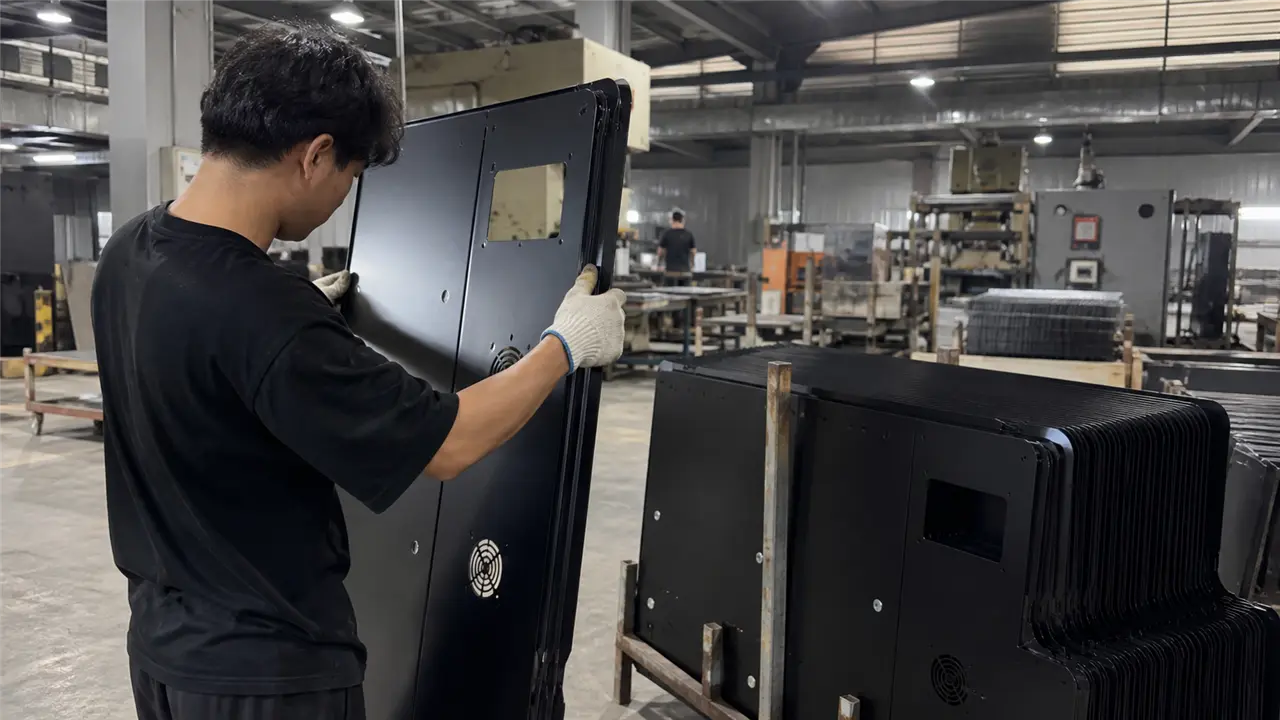
Following the laser cutting process, the two-dimensional metal profiles must be transformed into rigid, three-dimensional structures. This is achieved through high-precision CNC press brakes. Skilled technicians, guided by computer numerical control interfaces, fold the sheet metal along mathematically calculated bend lines. The CNC press brakes automatically compensate for material spring-back, ensuring that every angle, from the main chassis frame to intricate monitor mounting brackets, is formed to exact tolerances. This level of precision is critical for the oem sheet metal slot machine chassis china manufacturing process, as even a millimeter deviation can result in misaligned doors, compromised security locks, or uneven monitor bezels.
Once the primary components are folded, they move into the welding bays. Modern Panyu factories have heavily invested in automated robotic welding arms to handle the bulk of chassis assembly. Robotic seamless welding offers significant advantages over manual welding. Six-axis robotic arms deliver perfectly consistent, continuous weld beads that penetrate deeply into the metal joints without causing excessive heat warpage. This seamless integration ensures maximum structural rigidity, which is essential for cabinets that must endure the physical abuse of high-traffic casino floors or busy arcade centers.
For highly complex internal brackets or specific custom joints, master human welders utilize advanced TIG and MIG welding techniques. Every welded chassis undergoes strict non-destructive testing, including visual inspections and dye penetrant testing, to verify the integrity of the joints. The surface is then meticulously ground down and polished to remove any spatter or unevenness, ensuring a perfectly smooth canvas for the subsequent coating phases. The structural integrity achieved in this phase guarantees that the cabinet will support the massive weight of internal coin hoppers, heavy transformers, and large curved glass displays without flexing or warping over its operational lifespan.
Automated Electrostatic Powder Coating and Scratch Resistant Surface Finishing
The aesthetic appeal and environmental resilience of a slot machine cabinet depend heavily on its surface finishing. Bare metal chassis are highly susceptible to oxidation, corrosion, and physical damage. To combat this, leading manufacturers employ automated electrostatic powder coating lines. Before the coating is applied, every metal component undergoes a rigorous multi-stage chemical pretreatment process. This involves degreasing, acid pickling to remove rust, and phosphating or chromating to create a micro-porous surface that maximizes paint adhesion.
Once pretreated and dried, the chassis enters the pressurized coating booth. Electrostatically charged dry powder particles are sprayed onto the grounded metal parts. This electrostatic attraction ensures that the powder wraps around edges, penetrates deeply into corners, and coats complex geometries with perfectly uniform thickness, avoiding the runs, drips, and thin spots commonly associated with traditional wet paint. The coated parts are then conveyed into high-temperature curing ovens.
At temperatures typically ranging from 180 to 220 degrees Celsius, the powder melts, cross-links, and cures into a continuous, hardened polymer shell. This scratch-resistant surface finishing is vastly superior to liquid paint in terms of durability, chemical resistance, and environmental sustainability, as it emits zero volatile organic compounds. Clients can choose from an infinite spectrum of RAL colors, textured finishes like sand or wrinkle effects, and clear coats for added UV protection. For a custom arcade cabinet manufacturer oem odm, the powder coating process is a critical quality gateway that ensures the final product can withstand the harsh cleaning chemicals, cigarette smoke, and constant physical interaction typical of gaming environments while maintaining its vibrant showroom appearance for years.
Industrial Harness Fabrication Molex Pin Crimping and Power Testing
A flawless exterior is meaningless if the internal electronic nervous system is unreliable. The fabrication of industrial wiring harnesses is a meticulously controlled process within the factory. Rather than relying on generic, off-the-shelf cables that result in messy, untraceable “spaghetti” wiring, a professional commercial slot machine cabinet builder Panyu designs custom wiring looms specifically routed for the unique geometry of each cabinet model.
This process utilizes high-grade, UL-certified copper wiring enclosed in flame-retardant, braided sleeving for maximum protection against abrasion and electrical shorts. The critical connections rely on precision Molex pin crimping and premium terminal blocks. Automated crimping machines strip the wire and compress the pins with exact, repeatable pressure, eliminating the risk of loose connections that plague inferior assembly plants. Every wire is color-coded and clearly labeled with printed heat-shrink tubing, dramatically simplifying future maintenance, troubleshooting, and field upgrades for casino technicians.
Before the harnesses are installed into the chassis, they undergo rigorous automated continuity and power testing. Specialized harness testing boards verify every single pinout, checking for shorts, open circuits, and correct resistance levels. The power distribution units, isolation transformers, and high-wattage switching power supplies are load-tested to ensure they can deliver stable, clean voltage to sensitive internal components like the motherboard, bill validators, and high-brightness LED lighting strips, even under conditions of fluctuating input AC voltage common in many international markets.
Full System Integration EMC Shielding and 72 Hour Burn In Stress Tests
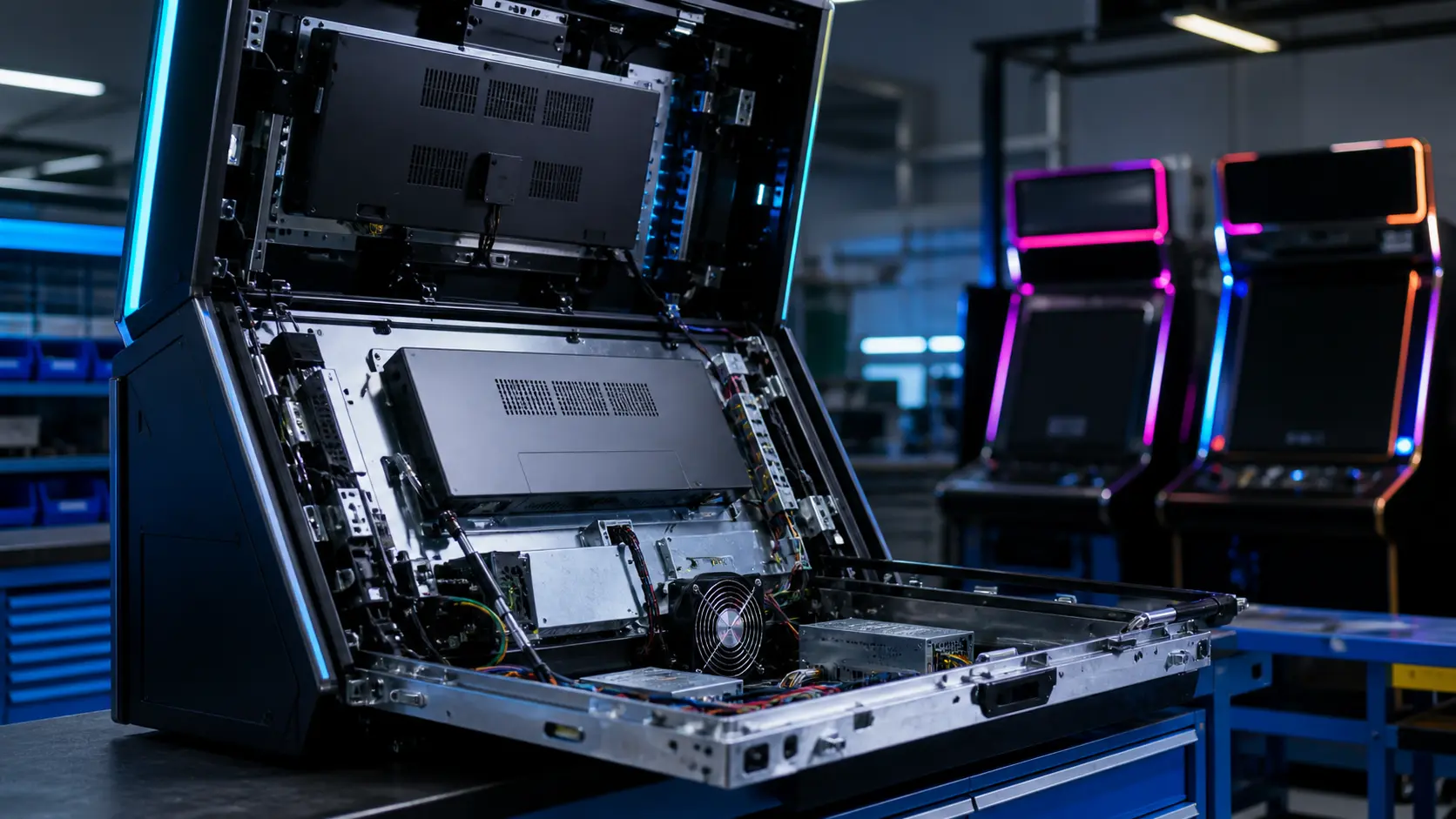
The final assembly line is where the bespoke casino gaming cabinet fabrication truly comes to life. Technicians carefully install the pre-tested wire harnesses, custom PC motherboards, high-definition displays, capacitive touch panels, and intricate halo LED lighting systems into the painted chassis. A major focus during this integration phase is Electromagnetic Compatibility shielding.
Gaming machines utilize high-frequency microprocessors and powerful lighting drivers that generate significant electromagnetic interference. To comply with strict international gaming regulations and FCC/CE standards, the factory engineers implement robust grounding strategies. EMI filters are installed on the power inlets, ferrite beads are clamped onto data cables, and sensitive logic boards are enclosed within grounded metal Faraday cages. This meticulous EMC shielding prevents the machine from interfering with nearby casino equipment and protects the terminal itself from external static discharges or radio frequency manipulation attempts by malicious actors.
Once fully assembled, every single cabinet must pass strict 72-hour burn-in stress tests. The machines are powered on and run continuous diagnostic software loops in a dedicated, climate-controlled testing room. This rigorous protocol pushes the processors, memory, power supplies, and cooling fans to their maximum limits. The burn-in process is designed to force early mortality failures in electronic components, ensuring that any defective parts are identified and replaced before the machine leaves the factory. Thermal imaging cameras may be used to identify localized hotspots, verifying that the internal airflow and exhaust fans are functioning as engineered. Only machines that survive this brutal three-day marathon without a single fault or reboot are cleared for the final quality control inspection.
Export Packaging Custom Wooden Crating and Global Logistics Coordination
Shipping highly sensitive, heavy, and expensive electronic gaming equipment across oceans requires specialized packaging engineering. A standard cardboard box is vastly insufficient. The Panyu factory utilizes multi-layered export packaging protocols to guarantee that the machines arrive in pristine condition, regardless of the turbulent journey.
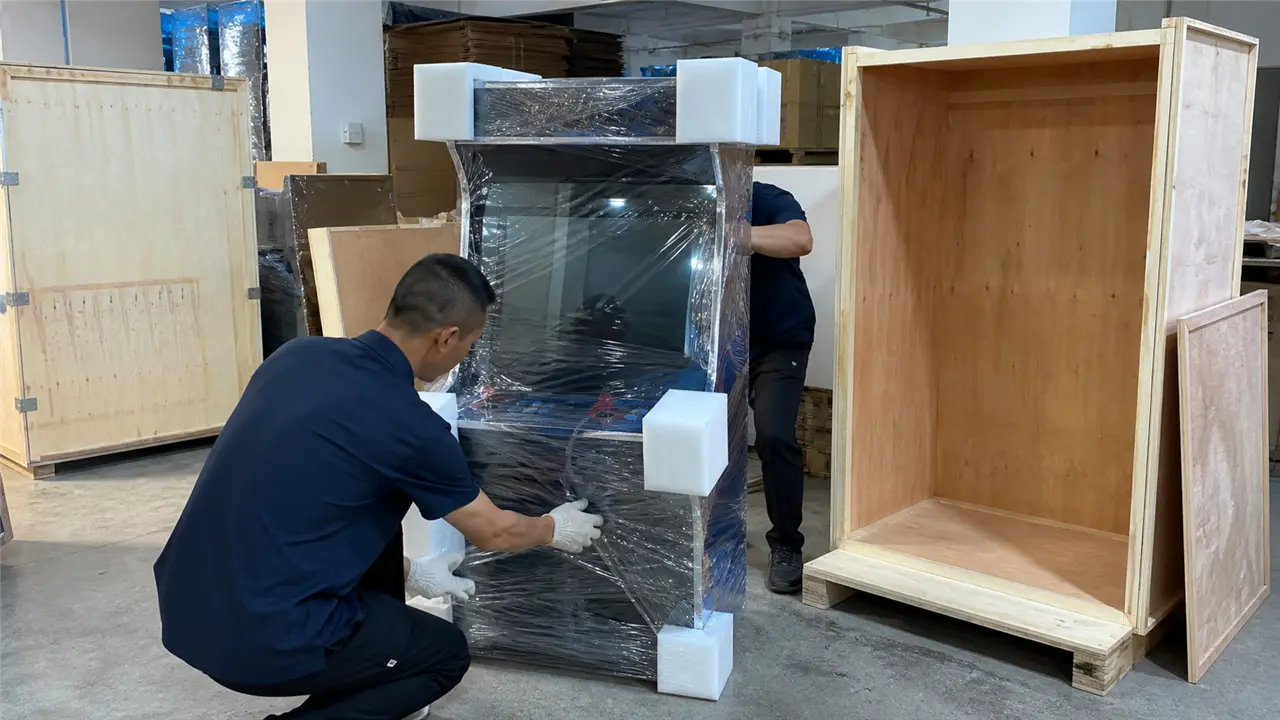
First, the entire cabinet is wrapped in thick, anti-static stretch film to protect the paint and displays from moisture and dust. Custom-molded EPE foam blocks are placed around the corners, monitors, and sensitive protruding components like button decks. The machine is then encapsulated in a heavy-duty, multi-wall corrugated cardboard sleeve. Finally, the wrapped machine is bolted securely to a shock-absorbing wooden pallet and enclosed within a custom wooden crating system. These crates are constructed from ISPM 15 certified treated plywood, complying with all international customs regulations regarding wood packaging materials.
The logistics coordination team then takes over, managing the complex process of container loading. Advanced software is used to optimize the spatial arrangement within 20-foot or 40-foot shipping containers, maximizing load density while ensuring the weight is evenly distributed. The factory handles all necessary export documentation, including commercial invoices, packing lists, bills of lading, and certificates of origin, working closely with international freight forwarders to provide seamless door-to-door or port-to-port delivery for global B2B clients.
Frequently Asked Questions
Question 1 How long does it typically take to manufacture a custom slot machine cabinet from scratch?
The timeline for developing a completely new cabinet design typically spans 30 to 45 days. This includes industrial CAD design, 3D prototyping, client revisions, and the manufacturing of the initial physical prototype. Once the prototype is approved, mass production of the bare chassis usually takes 15 to 20 days, while full turnkey assembly with electronics takes approximately 25 to 30 days depending on the complexity of the components and the order volume.
Question 2 Can you integrate specific brands of bill validators and ticket printers into the OEM chassis?
Yes. As a premier oem sheet metal slot machine chassis china manufacturer, we routinely design internal mounting brackets and bezel openings to precisely fit industry-standard peripherals. We natively support and integrate components from major brands such as JCM, MEI (CPI), ICT, ITL, TransAct, and FutureLogic. Our engineers will ensure that the specific wiring harnesses and communication protocols (such as ccTalk, pulse, or ID003) are perfectly matched to your chosen peripherals.
Question 3 What kind of quality control testing is performed on the metal chassis before painting?
Before electrostatic powder coating, the bare metal chassis undergoes severe inspection. We check for dimensional accuracy using digital calipers and precision gauges to ensure all folded angles meet the CAD specifications. Welds are inspected for structural integrity and aesthetic smoothness. Finally, the chemical pretreatment process is strictly monitored for correct pH levels and temperature to guarantee optimal paint adhesion and long-term corrosion resistance.
Question 4 Do you provide customized wiring harnesses and power supplies for different international markets?
Absolutely. We fabricate industrial wiring harnesses in-house tailored to the specific electrical layout of your machine. Furthermore, we equip the cabinets with high-quality, universal switching power supplies that can handle AC inputs ranging from 110V to 240V, making them ready for deployment in North America, Europe, Latin America, or Asia without the need for external voltage converters. All wiring meets strict CE and UL safety standards.
Question 5 Is it possible to order sample cabinets before committing to a large bulk order?
Yes, we highly encourage ordering a sample cabinet. Our highly flexible manufacturing process allows us to produce small prototype batches (1 to 5 units) with a rapid turnaround time. This allows your engineering and marketing teams to thoroughly test the hardware integration, assess the aesthetic quality, and verify regulatory compliance before finalizing a mass production contract with our custom arcade cabinet manufacturer oem odm facility.
Technical Specifications and Contact Information
For enterprise inquiries, custom technical specifications, or to schedule a comprehensive factory tour, please contact our lead engineering team:
Engineer Wang WhatsApp/WeChat: +86 17620842078 Telegram: https://t.me/JLwyc Email: miba515527@gmail.com Guangzhou Miba Animation Technology Co., Ltd.