- Architectural Comparison of Gaming Hardware Form Factors
- Slim-Profile Sheet Metal Chassis Design and VESA Wall Anchoring Standards
- Commercial PCAP Touchscreen Integration and Anti-Glare Glass Treatments
- Integrated Bill Acceptor Thermal Receipt Printer and Barcode Scanner Bays
- Dual-Key Cash Vault Security and Tamper-Detection Microswitch Sensors
- Compact PC and Android Industrial Motherboard Mounting Architectures
- Regulatory Compliance UL CE Electrical Certification and Cable Management
- Frequently Asked Questions
Modern retail and hospitality environments often demand maximum revenue generation from the smallest possible physical footprint. For operators managing convenience stores, laundromats, gas stations, and tight bar spaces, allocating valuable floor space to large amusement cabinets is rarely feasible. This operational reality has driven the rapid adoption of ultra-compact, high-security wall-mounted sweepstakes gaming and redemption kiosks. A premier wall mount casino gaming kiosk manufacturer understands that these specialized units must deliver the exact same robust performance, unbreakable security, and immersive player experience as their full-sized counterparts, but within a drastically reduced volume. The continuous drive for better space utilization without sacrificing performance is paramount in today’s highly competitive commercial amusement sector.
The engineering of these compact systems requires sophisticated knowledge of kiosk sheet metal fabrication, precision component integration, and advanced thermal management. Operators seeking to deploy high-yield gaming terminals in restricted environments rely on a trusted wall mounted sweepstakes kiosk builder to provide hardware that can withstand continuous public use while resisting tampering and theft. By utilizing customized arcade cabinet with payment kiosk configurations specifically tailored for vertical mounting, venue owners can convert previously unused wall space into highly profitable gaming zones. This comprehensive technical guide explores the architectural nuances, manufacturing techniques, and component integrations that define modern wall-mounted gaming hardware, from bespoke casino kiosk sheet metal bending to complex motherboard placement architectures, ensuring you are fully informed on the technical realities of deploying such hardware. For a comprehensive architectural overview and turnkey procurement frameworks, review our master guide on commercial arcade machine manufacturer. For further architectural integration standards, refer to How B2B Operators Source Custom Aristocrat. For factory-direct procurement and comprehensive engineering specs, consult our master guide on commercial arcade game machines manufacturing factory.
Architectural Comparison of Gaming Hardware Form Factors
Selecting the appropriate hardware form factor dictates both the initial installation complexity and the long-term revenue potential of a gaming deployment. The following technical comparison illustrates the fundamental differences between various terminal configurations and highlights why wall-mounted systems excel in constrained environments. For further architectural integration standards, refer to How Casino Machine Manufacturers Engineer Dual.
| Technical Specification | Compact Wall-Mount Metal Kiosk | Full-Size Upright Cabinet | Countertop Bar-Top Unit |
|---|---|---|---|
| **Floor Footprint** | Zero (Relies entirely on vertical wall space and load-bearing studs) | High (Requires dedicated floor space, typically 24 to 32 inches wide and deep) | Low to Medium (Consumes valuable bar or counter surface area) |
| **Installation Flexibility** | Extremely High (Can be installed at precise ADA-compliant heights on most load-bearing walls) | Low (Restricted by floor layout, aisles, and surrounding furniture) | Medium (Dependent on existing counter infrastructure and height) |
| **Anti-Theft Anchoring** | VESA standardized heavy-duty steel wall brackets with internal locking mechanisms | Floor bolting through internal chassis base plates | Security cables or under-counter bolt-through mechanisms |
| **Cash Box Capacity** | Moderate (Engineered for frequent collection with dual-key secure vaults) | Maximum (Deep chassis allows for expanded bill stackers and coin hoppers) | Minimal (Severely restricted by chassis dimensions and heat dissipation needs) |
| **Maintenance Access** | Front-door swing mechanism on heavy-duty hinges for complete internal component access | Rear or front modular panel removal requiring clearance space | Lift-top or rear access, often requiring removal from the counter |
The advantages of deploying wall-mounted units become clear when analyzing the spatial economics of high-traffic locations. A competent wall mounted sweepstakes kiosk builder leverages advanced engineering to overcome the inherent limitations of small enclosures, ensuring that operators do not sacrifice security or hardware capability when opting for a zero-footprint solution. By minimizing footprint and maximizing placement versatility, the financial metrics per square foot can skyrocket.
Slim-Profile Sheet Metal Chassis Design and VESA Wall Anchoring Standards
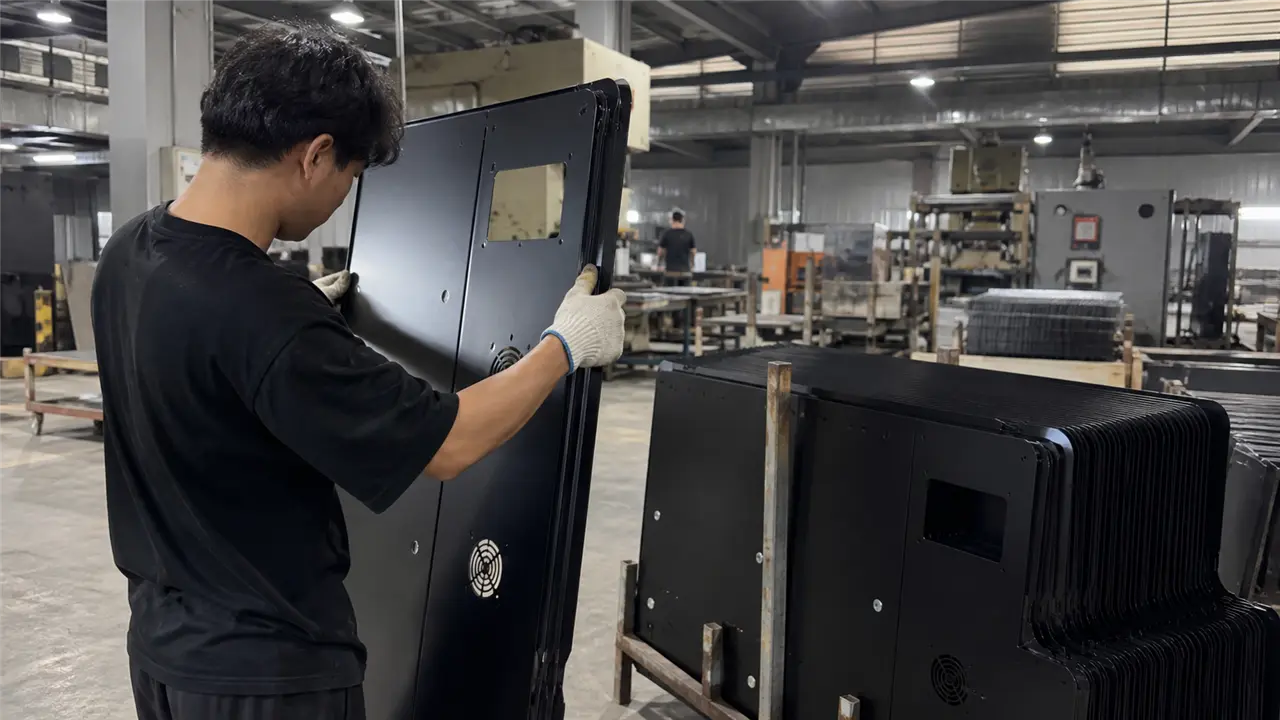
The structural integrity of a wall-mounted gaming terminal begins with the meticulous design and fabrication of its slim-profile chassis. As a specialized wall mount casino gaming kiosk manufacturer, achieving the perfect balance between minimal protrusion and maximum internal volume requires advanced bespoke casino kiosk sheet metal bending techniques. The primary housing is typically constructed from 14-gauge or 16-gauge cold-rolled steel, offering exceptional resistance to physical impact and vandalism. The bending and welding processes must maintain tolerances within fractions of a millimeter to ensure that all internal components fit perfectly without inducing mechanical stress on sensitive electronics. Deep-drawing techniques and automated CNC press brakes are utilized to fold complex angles that eliminate sharp exterior edges while simultaneously providing robust internal mounting flanges.
A critical engineering challenge in slim-profile design is managing the center of gravity and the sheer weight of the unit when suspended. To address this, manufacturers implement heavy-duty internal bracing that distributes the load evenly across the rear panel. This rear panel interfaces directly with structural mounting systems, most commonly utilizing enhanced VESA (Video Electronics Standards Association) mounting standards or proprietary heavy-duty French cleat systems engineered for industrial applications. A standard VESA 200×200 or 400×400 pattern is often reinforced with additional anchor points to prevent the unit from being torqued or wrenched from the wall. The entire weight distribution is calculated meticulously to avoid localized stress fractures in the metal chassis over years of heavy usage.
The anchoring hardware itself must be carefully specified based on the wall composition. When installing onto drywall over wooden or metal studs, heavy-duty lag bolts and specialized toggle anchors are mandatory. The backplate of the kiosk is designed with slotted mounting holes to allow for precise leveling during installation. Furthermore, to prevent unauthorized removal, the mounting bolts are typically accessed only from inside the locked chassis. Once the front door of the kiosk is secured, the mounting hardware is entirely inaccessible to the public, creating an exceptionally secure installation that deters smash-and-grab theft attempts. The precision application of kiosk sheet metal techniques ensures that the chassis remains rigid, preventing any flexing that could compromise the touchscreen or internal electronics, even when subjected to intense physical forces by aggressive patrons.
Commercial PCAP Touchscreen Integration and Anti-Glare Glass Treatments
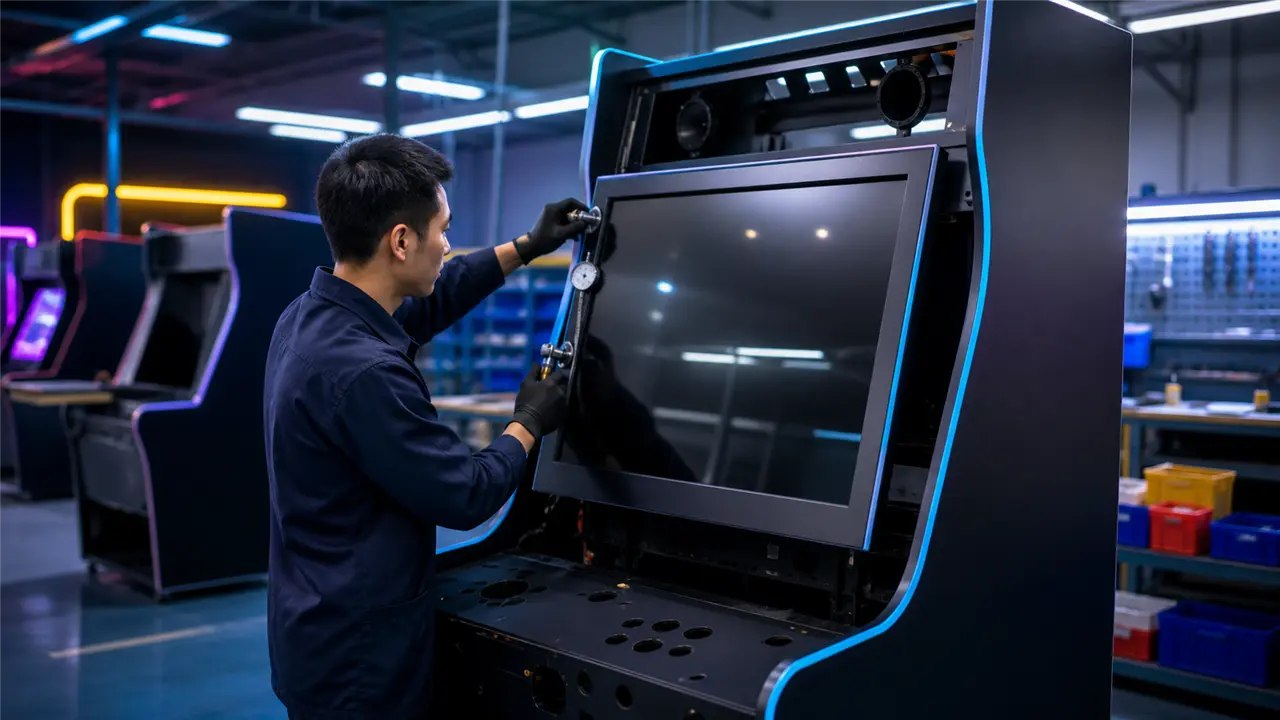
The primary interface between the player and the sweepstakes software is the touchscreen display, which must offer flawless responsiveness and rugged durability. In compact wall-mounted configurations, manufacturers overwhelmingly favor Projected Capacitive (PCAP) touch technology over older resistive or infrared frameworks. PCAP touchscreens provide a bezel-free, edge-to-edge glass aesthetic that not only looks modern but also eliminates the physical ridges where dust, liquid, and grime typically accumulate in traditional Infrared (IR) or Surface Acoustic Wave (SAW) touchframes. The implementation of this multi-touch capacitive layer allows for rapid, gesture-based inputs that mirror the responsiveness of premium consumer smartphones.
Integrating a commercial PCAP touchscreen into a slim sheet metal chassis requires specialized mounting brackets that isolate the display from mechanical vibrations and chassis flex. The display panel is bonded directly to a highly durable, tempered cover glass, typically 3mm to 4mm thick, which is capable of withstanding severe impacts (often rated to IK08 or IK09 standards). This robust construction ensures that the kiosk remains operational even in unsupervised environments where rough handling is common. The optical bonding process removes the air gap between the LCD panel and the touch glass, greatly reducing internal reflections and preventing condensation buildup, which is crucial for terminals deployed in fluctuating temperature environments like gas stations.
Furthermore, ambient lighting in locations such as convenience stores or gas stations can cause severe reflections that diminish the player experience. To combat this, a premium wall mount casino gaming kiosk manufacturer applies specialized anti-glare (AG) and anti-reflective (AR) surface treatments to the cover glass. The AG treatment involves microscopic etching of the glass surface to scatter reflected light, significantly reducing harsh glare from overhead fluorescent lighting or direct sunlight. Simultaneously, AR coatings reduce the refractive index of the glass, increasing light transmission from the LCD panel and resulting in deeper contrasts and more vibrant colors. The touch controller is precisely calibrated to ignore false inputs caused by environmental factors, ensuring that every touch, swipe, and gesture is registered with zero latency, providing an uninterrupted and engaging gaming experience that maximizes session length and operator revenue.
Integrated Bill Acceptor Thermal Receipt Printer and Barcode Scanner Bays
A customized arcade cabinet with payment kiosk capabilities relies heavily on its peripheral components to facilitate seamless transactions. Integrating bulky currency handling equipment into a slim wall-mounted chassis demands ingenious mechanical layouts. The payment integration bays are meticulously designed to house standard commercial bill acceptors, thermal receipt printers, and barcode scanners while minimizing the overall depth of the kiosk. Engineers spend countless hours in CAD software optimizing the internal three-dimensional space so that each module functions without interfering with the data cables or power lines of adjacent units.
Bill acceptors (such as those manufactured by MEI, JCM, or ICT) are standard requirements for sweepstakes and casino kiosks. In wall-mounted designs, these acceptors are often mounted horizontally or at a slight downward angle to capitalize on gravity for bill stacking. The sheet metal fascia is precision-cut to align perfectly with the bill validator’s bezel, allowing for smooth currency insertion. The cash box, or stacker, is positioned immediately behind the validator. Because overall unit depth is heavily restricted to comply with ADA protrusion regulations, manufacturers utilize specialized compact stackers that can hold 300 to 500 notes, ensuring sufficient capacity for high-turnover locations without requiring the massive 1000-note stackers found in upright cabinets. Firmware configurations on these bill acceptors utilize advanced optical and magnetic sensors to reject counterfeit currency with absolute precision.
In addition to currency validation, ticket-in/ticket-out (TITO) functionality and digital redemption require thermal receipt printers and 2D barcode scanners. The thermal printer bay is engineered with custom mounting brackets and paper roll guides that allow for easy paper replacement by location staff. A strategically placed payout bezel ensures that printed tickets are dispensed smoothly without jamming, utilizing anti-jamming mechanisms and presentation sensors that hold the ticket until fully cut. Adjacent to the printer, a wide-angle 2D barcode scanner is integrated behind a protective polycarbonate or tempered glass window. This scanner rapidly reads QR codes or traditional barcodes from printed tickets or mobile phone screens, enabling seamless player tracking, loyalty program integration, and automated redemption processes. The precise spatial arrangement of these three critical components within the restricted internal volume exemplifies the expertise of a top-tier wall mounted sweepstakes kiosk builder.
Dual-Key Cash Vault Security and Tamper-Detection Microswitch Sensors
Security is paramount when deploying self-service payment kiosks in locations with minimal supervision. Wall-mounted units, while avoiding floor-level vulnerabilities, present unique security challenges that must be addressed through comprehensive physical and electronic safeguards. The central defense mechanism is the dual-key cash vault security architecture.
The main chassis door is secured utilizing a multi-point locking system driven by high-security tubular or Medeco-style locks. Rather than relying on a single latch, rotating the key engages heavy steel locking cams at the top, bottom, and side of the door, firmly securing it to the main chassis frame. Once the outer door is opened, the currency handling components—specifically the bill stacker—are protected by a secondary, internal steel enclosure. This internal cash vault requires a separate, distinctly keyed lock to access the revenue. This dual-key protocol ensures that location staff can open the outer door to perform routine maintenance (such as clearing a paper jam, wiping down the touchscreen from the inside, or rebooting the system) without ever having access to the cash box, which is exclusively reserved for authorized route operators or collection personnel.
Beyond heavy-gauge steel and complex physical locks, electronic security plays a vital role. A premier wall mount casino gaming kiosk manufacturer implements a network of tamper-detection microswitch sensors throughout the chassis. These specialized intrusion switches monitor the status of the main exterior door, the internal cash vault door, and sometimes the bill acceptor assembly itself. If any of these sensors detect an unauthorized opening or physical tampering, they immediately trigger an alarm state at the hardware level. This hardware trigger communicates directly with the I/O control board via an encrypted serial protocol, which instantly halts all gameplay, disables the bill acceptor motor to prevent forced feeding, and sends an encrypted alert over the network to the operator’s central management system. This instantaneous response prevents sophisticated physical hacks and alerts operators to potential theft attempts in real-time, safeguarding both the physical cash and the operational integrity of the kiosk. Additional internal shock sensors and accelerometers can also be installed to detect aggressive hammering or drilling, further expanding the electronic security perimeter.
Compact PC and Android Industrial Motherboard Mounting Architectures
The processing power required to run modern, graphics-intensive sweepstakes software and casino gaming platforms is significant. Housing this computational power within a restricted wall-mounted enclosure necessitates highly efficient motherboard mounting architectures and rigorous thermal management. Depending on the software platform, manufacturers integrate either compact x86-based industrial PCs (Mini-ITX, Nano-ITX, or Pico-ITX form factors) or robust ARM-based Android mainboards.
The mounting architecture is designed to maximize airflow and minimize vibration. The motherboard is typically affixed to a removable internal backplate using brass standoffs, providing necessary electrical isolation and allowing for rapid field replacement if hardware failure occurs. In x86 environments, where heat generation from the high-frequency CPU and discrete GPU is a primary concern, the engineering team must implement active cooling solutions that fit within the slim chassis. Low-profile, high-CFM (cubic feet per minute) centrifugal blowers or slim axial fans are strategically positioned to draw cool ambient air through filtered intake vents at the bottom of the unit and exhaust hot air through precisely louvered vents at the top. The internal layout ensures that this airflow passes directly over the motherboard’s copper heatsinks and the power supply, preventing thermal throttling during continuous 24/7 operation under heavy graphics loads.
For deployments utilizing Android OS, specialized industrial ARM motherboards are employed. These boards are inherently more power-efficient and generate significantly less heat, often allowing for completely fanless, passive cooling architectures. The processor’s thermal output is dissipated by a massive aluminum heatsink that may physically contact the outer steel chassis through high-performance thermal paste or padding, effectively turning the entire metal enclosure into a giant radiator. Whether utilizing PC or Android architectures, all critical connections—including USB ports for touchscreens and peripherals, COM/Serial/RS-232 ports for bill validators and secure payout devices, and Ethernet/Wi-Fi antennas—are locked with high-retention connectors and reinforced with industrial adhesives to prevent accidental disconnections caused by mechanical vibration or rough handling in transit. SSDs (Solid State Drives) are universally used over traditional HDDs to further increase resilience against vibration and ensure instant read/write access speeds for rapidly loading game assets.
Regulatory Compliance UL CE Electrical Certification and Cable Management
The final, yet fundamentally crucial, aspect of manufacturing a commercial-grade wall-mounted gaming kiosk is ensuring strict adherence to international electrical safety standards. Operators deploying hardware across multiple jurisdictions require units that have passed rigorous independent testing to guarantee safe operation. A reputable wall mount casino gaming kiosk manufacturer ensures that all systems are designed to meet or exceed UL (Underwriters Laboratories) standards in North America and CE (Conformité Européenne) directives in Europe, as well as RoHS compliance regarding the restriction of hazardous substances.
Achieving these certifications dictates stringent requirements for internal electrical design, particularly concerning high-voltage power distribution. The main power entry module (PEM) is equipped with heavy-duty EMI/RFI filtering and dual fused protection to safeguard the internal electronics from power surges, voltage spikes, and dirty grid power commonly found in industrial or retail environments. All internal power supplies utilized for the motherboard, LED marquee lighting, and motor-driven peripherals are commercial-grade units with active Power Factor Correction (PFC) and high MTBF (Mean Time Between Failures) ratings, ensuring absolute electrical stability even during brownout conditions.
Cable management is not merely an aesthetic consideration but a strict regulatory requirement for safety and maintenance efficiency. High-voltage AC lines are strictly segregated from low-voltage DC communication cables to prevent electromagnetic interference and minimize the risk of electrical shorts. Manufacturers utilize specialized cable routing channels, heavy-duty zip ties, and robust nylon cable sleeves to secure every wire. Grounding is meticulously executed; every separate metallic component of the chassis, including the doors, internal vaults, and monitor mounting brackets, is bonded back to a central grounding stud with heavy-gauge grounding straps. This comprehensive approach to electrical engineering guarantees that the customized arcade cabinet with payment kiosk is electrically safe for both operators and players, ensuring continuous, compliant, and highly profitable operation.
Frequently Asked Questions
Question: What is the ideal wall material for mounting a compact casino gaming kiosk?
Answer: The ideal installation surface is a structurally sound wall constructed with wood or metal studs, or solid concrete/cinder block. When mounting to drywall, it is absolutely critical that the heavy-duty lag bolts anchor directly into the load-bearing studs using the VESA mount or French cleat system. Installing heavy kiosks using only drywall anchors, regardless of their weight rating, is unsafe and highly discouraged by any professional wall mounted sweepstakes kiosk builder due to the risk of structural failure under continuous public use and vibration.
Question: Can a wall-mounted sweepstakes kiosk hold the same amount of cash as a full-size cabinet?
Answer: Due to strict depth limitations required to maintain a slim profile (often driven by ADA requirements), wall-mounted kiosks generally cannot house the massive 1,000 to 2,000 note stackers found in deep, upright cabinets. However, they are engineered to utilize high-density compact stackers that comfortably hold between 300 and 500 notes. While this means operators may need to schedule slightly more frequent collections in ultra-high-volume locations, the dual-key security systems ensure that these collections can be performed swiftly and securely by route personnel.
Question: How do slim wall-mounted kiosks handle the heat generated by PC hardware?
Answer: Thermal management in restricted spaces relies on forced directional airflow and advanced chassis design. Specialized low-profile fans draw cool air from the bottom intake vents, push it precisely across the CPU and power supply copper heatsinks, and exhaust the warm air out the top. In advanced designs featuring industrial Android motherboards, passive cooling is achieved by thermally coupling the processor’s heatsink directly to the internal metal chassis, effectively utilizing the kiosk’s steel housing as a large, silent heat dissipator.
Question: Are the touchscreen displays in wall-mounted kiosks durable enough for unsupervised locations?
Answer: Yes. Commercial-grade wall-mounted kiosks utilize Projected Capacitive (PCAP) touchscreens bonded to 3mm or 4mm thick tempered cover glass. This glass is highly resistant to impacts, scratches, and vandalism, typically achieving IK08 or IK09 impact resistance ratings. Additionally, because PCAP glass extends edge-to-edge without a raised bezel, it eliminates vulnerabilities where liquids could seep in or where vandals might attempt to pry the screen away from the chassis frame.
Question: What happens if someone tries to pry open the wall-mounted kiosk to steal the cash?
Answer: A high-quality kiosk employs a multi-layered security approach. Physically, the 14-gauge cold-rolled steel chassis resists deformation, and multi-point cam locks firmly secure the door. If a pry attempt creates enough leverage to move the door slightly, internal tamper-detection microswitches immediately detect the breach. This triggers an instant hardware-level alarm that disables the bill validator, halts software operation, and sends a real-time alert via ethernet or cellular modem to the operator’s backend management system, effectively neutralizing the threat and recording the exact time of the incident.
Contact Guangzhou Miba Animation Technology Co., Ltd. for custom hardware configurations and bulk deployment pricing
- Engineering Lead Engineer Wang
- WhatsApp/WeChat +86 17620842078
- Telegram https://t.me/JLwyc
- Email miba515527@gmail.com
- Company Guangzhou Miba Animation Technology Co., Ltd. (Dedicated to professional B2B casino and amusement hardware manufacturing)