- Physical Casino Slot Machines and Texas 8 Liner Cabinets Versus Consumer Arcade Models
- Physical Button Pulse Conversion and Relay Matrix Interfacing
- SAS Protocol Bridge Real Time Meter Tracking and Cashless Credit Delivery
- Dual Stream WebRTC Pipeline and Direct Hardware Video Loop Out
- Simulating Pulse Coin Acceptors and Bill Validators for Legacy Logic Boards
- High Density Warehouse Slot Machine Farm Deployment
- Operator Unit Economics Cloud Sweepstakes Farm Versus Traditional Route Operations
- Panyu Manufacturing Base Factory FAT Inspection and Pre Wired Turnkey Cabinet Delivery
- Frequently Asked Questions Technical Engineering Inquiries
What are the engineering standards for physical slot machine cloud teleoperation? Physical slot machine cloud teleoperation requires sub 80ms WebRTC dual-stream video capture, optically isolated physical button relay matrices, and secure SAS 6.02 protocol bridging for real-time meter synchronization. Industrial-grade IoT control boards translate remote player taps into millisecond-precise hardware pulses, ensuring 100% mainboard firmware compliance and unhackable AFT cashless credit delivery.
Welcome to the definitive engineering masterclass on industrial grade physical slot machine virtualization. I am Engineer Wang, Lead Hardware and Game System Architect at Guangzhou Miba Animation Technology Co., Ltd. Over the past 12 years inside our 15,000 square meter Panyu manufacturing base, our team has designed, tested, and shipped tens of thousands of commercial arcade machines. Today, I am pulling back the curtain on our most complex and highly profitable B2B offering the complete remote live arcade turnkey system for casino slot machines and classic 8-liner cabinets.
Many software operators attempt to virtualize physical slot machines using consumer-grade webcams and hobbyist Raspberry Pi relays. Within 72 hours, their systems invariably crash due to EMP interference, misaligned pulse timings, or legacy mainboard audit lockouts. At Arcade Manufacturer, we build commercial grade turnkey venue solutions. We do not sell loose spare parts or DIY kits. We deliver fully assembled, pre-wired, and rigorously tested server farm cabinets ready for immediate cloud deployment. This guide will walk you through the exact technical architectures, SAS integrations, and unit economic models we use to empower global route operators to transition from retail route splits to highly scalable 24/7 cloud sweepstakes farms.
Physical Casino Slot Machines and Texas 8 Liner Cabinets Versus Consumer Arcade Models
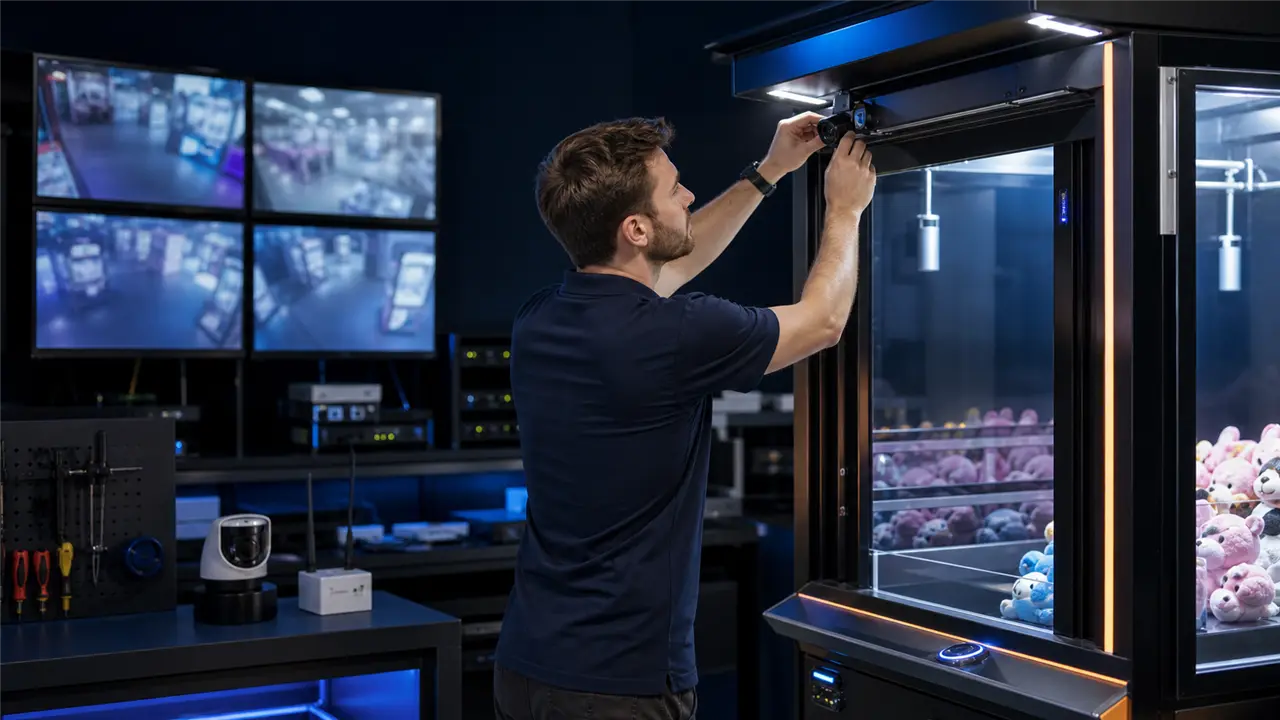
When building a high density cloud sweepstakes warehouse, the structural and electrical foundation of your hardware dictates your operational uptime. Consumer-grade arcade cabinets are built from medium-density fibreboard (MDF) and utilize generic USB encoders suitable for home amusement. In contrast, authentic casino slot machines and Georgia or Texas 8-liner skill game cabinets require industrial engineering designed to withstand continuous 24/7 commercial operation, extreme thermal loads, and targeted electrical sabotage attempts.
Hardened Steel Chassis and Commercial Anti Theft Architecture
Our commercial cabinets utilize 1.5mm and 2.0mm cold-rolled steel chassis, precision cut via automated laser fiber machines on our Panyu factory floor. For a warehouse farm hosting 50 to 100 cabinets, the sheer weight and thermal mass of these steel enclosures provide essential electromagnetic shielding and vibration dampening. When mechanical reels spin and stop violently, a flimsy chassis will introduce microscopic camera shake, destroying the remote player’s video experience.
Furthermore, these steel enclosures are engineered with multi-point locking cams and tamper-evident logic box cages. Even in a secure warehouse environment, the logic boards containing the critical math models and Return to Player (RTP) algorithms must be isolated. If an insider or maintenance technician attempts to physically bridge the logic board to alter payout percentages, our proprietary IoT monitoring boards immediately detect the voltage drop and sever the network connection, alerting the cloud management system. We build to commercial arcade game machines manufacturing standards to ensure absolute asset security.
Mechanical Reels and Dual Video Monitor Displays
The tactile appeal of a physical slot machine often relies on the kinetic energy of mechanical stepper motor reels or the immersive visual depth of dual video monitor displays. Traditional 8-liners, prevalent in specific regional markets like Texas and Georgia, utilize VGA or low-resolution DVI outputs that present unique challenges for high-definition cloud streaming.
For mechanical reel machines, we integrate specialized high-speed optical sensors and stepper motor feedback loops. When a remote player presses SPIN, they expect immediate kinetic response. Our custom IoT controllers map the network command to a localized pulse that triggers the reel controller instantly. For video-based slots, we utilize dual 22-inch or 27-inch industrial LCD panels with capacitive touch overlays. In a cloud environment, we capture the raw digital output of these screens before it ever reaches the physical monitor, ensuring the remote player sees exactly what the local hardware is rendering, pixel for pixel, without any optical distortion. This commitment to physical authenticity is why top-tier operators partner with us for their skill game machine and 8 liner cabinet manufacturing.
Physical Button Pulse Conversion and Relay Matrix Interfacing
The heart of any remote live slot machine teleoperation system is the interface between the cloud software and the physical buttons on the cabinet deck. You cannot simply solder network wires directly to a complex casino logic board. Doing so causes ground loops, voltage spikes, and immediate firmware audit failures that lock the machine into a permanent tilt state.
Bypassing Mainboard Firmware Restrictions
Modern slot machine logic boards perform continuous impedance testing on their button matrices. If the board detects resistance values outside the exact specification of a physical microswitch, it triggers a hardware fault. To bypass this without voiding the mainboard firmware or modifying the original game code, we employ high-speed, optically isolated solid-state relays (SSRs).
These SSRs act as perfect electrical mimics of a human finger pressing a physical button. When the cloud server sends a command, our IoT board illuminates an internal LED within the optocoupler. The phototransistor on the other side completes the circuit for the slot machine’s mainboard. There is zero electrical connection between your network infrastructure and the casino game board. This absolute galvanic isolation is critical for preventing electrical damage and ensuring the machine’s internal audit logs remain pristine.
Pulse Signal Validation and Mechanical Spin Automation
A remote player pressing a button on their smartphone generates a digital network event. This event must be translated into a precise electrical pulse. If the pulse is too short, the game board ignores it as switch bounce. If the pulse is too long, the board flags it as a jammed or sticky button and halts gameplay.
Our custom firmware dictates that every remote command is translated into a strict 50-millisecond closed-circuit pulse, regardless of how long the remote player holds their digital button. For games requiring rapid continuous firing, such as specific 8-liner skill stops, we program the IoT controller to manage the exact frequency and duty cycle of the pulse train. This level of precise physical slot machine button relay modification guarantees that the remote software can interact with complex Bet, Spin, Hold, and Payout matrices flawlessly, 24 hours a day.
SAS Protocol Bridge Real Time Meter Tracking and Cashless Credit Delivery

While relaying button presses allows a remote player to play the game, managing the money requires a completely different level of engineering. You cannot manually count digital coins or rely on rudimentary pulse-based accounting for a multi-million dollar cloud sweepstakes operation. You need casino-grade auditing. This is where the Slot Accounting System (SAS) protocol becomes mandatory.
The SAS protocol, originally developed by IGT, is the global standard for casino machine communication. It is a complex, serial-based language operating at 19200 baud with a highly specific 9-bit wakeup architecture. Most software developers fail completely when attempting to interface with physical SAS ports, resulting in polling timeouts and lost revenue data.
Advanced Funds Transfer and Cloud Wallet Synchronization
In our Panyu manufacturing base, we integrate a proprietary SAS 6.02 protocol bridge directly into the cabinet’s nervous system. This bridge speaks fluent SAS to the game board and translates it into secure, encrypted JSON payloads for your cloud backend over WebSockets.
This achieves two critical functions. First, real-time meter tracking. Every single coin in, coin out, jackpot payout, and internal tilt event is instantly synchronized with your cloud dashboard. You have absolute, to-the-penny visibility into the performance and RTP of every physical machine in your warehouse.
Second, it enables Advanced Funds Transfer (AFT). AFT allows your cloud software to instantly deposit and withdraw credits directly from the slot machine’s digital meter without any physical hardware simulation. When a remote user deposits $100 via your mobile app, the cloud server sends an AFT command through our bridge, and the physical machine’s credit meter instantly reads 10000 credits. When the user cashes out, the bridge withdraws the credits and updates the cloud wallet. This seamless slot machine SAS 6.02 protocol integration is the only mathematically secure way to run a high-volume cloud sweepstakes operation.
Dual Stream WebRTC Pipeline and Direct Hardware Video Loop Out
The illusion of telepresence shatters if the video feed is delayed or blurry. A remote player must see the reels stop or the bonus round trigger exactly as they press the button. Standard RTMP streaming protocols introduce 2 to 5 seconds of latency, which is completely unacceptable for skill games and slot machines. We require sub-80-millisecond latency from the physical machine in our warehouse to the player’s mobile phone screen on another continent.
Mechanical Reel Camera Integration and Sub 80ms Latency
To achieve this, we deploy a dual-stream WebRTC pipeline. For video slot machines, we absolutely refuse to point a webcam at the screen. That introduces glare, moiré patterns, and chromatic aberration. Instead, we use custom FPGA-based video capture cards that sit directly inline with the HDMI or DVI output of the game board. We capture the raw, uncompressed digital video frame, encode it instantly via a hardware H.264/H.265 ASIC, and push it directly into the WebRTC stream. This mechanical reel video capture direct hdmi streaming ensures pixel-perfect clarity.
For physical mechanical reel machines, direct video loop-out is impossible. We must use cameras. However, we do not use cheap USB webcams. We install industrial machine-vision cameras with global shutters and ultra-low distortion lenses, mounted precisely on custom internal brackets within the cabinet. A global shutter captures the entire frame simultaneously, eliminating the “jello effect” that occurs when high-speed mechanical reels spin past a standard rolling shutter camera.
The resulting video streams—whether direct HDMI or global shutter camera—are packaged into WebRTC packets and routed through our globally distributed TURN server network. This architecture guarantees that a player in New York experiencing a physical machine spinning in a warehouse in Texas or Asia receives the video frame in less than 80 milliseconds, creating a hyper-responsive, highly addictive gaming experience.
Simulating Pulse Coin Acceptors and Bill Validators for Legacy Logic Boards
While modern casino slots use the SAS protocol, many highly profitable classic 8-liner boards (such as legacy Cherry Master or Pot-O-Gold variants) rely entirely on hardware pulses for credit accounting. These older logic boards expect a physical coin acceptor to send a 50ms 12V pulse for every quarter, or a bill validator (like ICT, Pyramid, or CashCode) to send a rapid sequence of pulses for a $20 bill.
To integrate these legacy machines into a modern cloud sweepstakes platform, we must perform sophisticated hardware deception. Our IoT control boards feature dedicated, high-power pulse simulation circuits. When the cloud backend registers a $20 digital deposit, our board does not just send a generic signal. It exactly mimics the specific pulse timing, voltage, and sequence of an authentic CashCode bill validator.
We configure the exact milliseconds of the high state, the low state, and the gap between pulses. The legacy mainboard receives these pulses and increments its mechanical hard meters and internal digital counters, fully believing a physical $20 bill was just inserted into the cabinet. When the player wins and hits payout, our system intercepts the physical hopper payout pulses or ticket dispenser signals, counts them in micro-seconds, and credits the digital cloud wallet accordingly.
This meticulous slot machine pulse simulation sweepstakes ledger allows operators to digitize their entire catalog of classic, non-SAS legacy boards without altering a single line of original game code, bridging the 1990s hardware with 2020s cloud infrastructure.
High Density Warehouse Slot Machine Farm Deployment
Transitioning from a distributed retail route operation to a centralized cloud sweepstakes farm requires a fundamental shift in infrastructure planning. You are no longer managing single machines in dive bars; you are managing a high-density industrial data center where the servers happen to be heavy steel slot machines. Deploying 30 to 100 cabinets in a single warehouse introduces severe power, thermal, and electronic interference challenges that will destroy amateur setups.
EMP Shielding and Low Ripple Power Distribution
Physical slot machines draw massive surge currents when hoppers engage, stepper motors brake, or high-intensity LED light shows trigger. A standard warehouse electrical panel will experience severe voltage sag, causing logic boards to brown-out and reset mid-spin.
In our turnkey factory configurations, we completely strip the legacy, aging power supplies from used machines and upgrade every single cabinet with industrial-grade Mean Well power supplies. These power supplies offer ultra-low ripple noise and massive capacitor reserves to handle transient load spikes. We wire the entire warehouse farm using 3-phase power distribution units (PDUs) with heavy-duty surge protection and line conditioning.
Furthermore, high-density environments create significant electromagnetic interference (EMI). A poorly shielded power supply on Machine A can introduce noise that corrupts the SAS communication on Machine B. Our steel chassis designs, combined with strict grounding protocols and shielded twisted pair (STP) cabling for all data lines, create a Faraday cage effect, isolating each machine’s sensitive logic boards from the chaotic RF environment of the warehouse.
HVAC Thermal Ducting and 24 7 Operational Uptime
A warehouse packed with 100 slot machines running 24/7 generates an immense amount of heat. Traditional arcade machines are designed to operate in air-conditioned retail spaces, not densely packed rows. If the internal ambient temperature of the cabinet exceeds 45°C (113°F), logic board capacitors begin to bulge, and MTBF (Mean Time Between Failures) drops exponentially.
We engineer specific thermal ducting solutions for high-density deployments. Our cabinets feature high-CFM (Cubic Feet per Minute), dual-ball bearing industrial exhaust fans at the apex of the chassis, drawing cold air from the base and forcefully ejecting hot air from the logic enclosure. For large-scale operators, we provide detailed HVAC BTU calculation matrices, ensuring the warehouse cooling infrastructure can handle the exact thermal load of the entire farm. This rigorous approach to infrastructure is why our clients can review their cloud slot machine farm deployment costs and confidently project absolute operational stability.
Operator Unit Economics Cloud Sweepstakes Farm Versus Traditional Route Operations
The financial motivation for migrating to a remote live slot machine architecture is mathematically overwhelming. Traditional route operators face a ceiling dictated by geography, retail partnerships, and physical maintenance limitations. Cloud sweepstakes operations break every single one of those barriers.
Retail Revenue Split and Physical Site Inspections
In a traditional route operation, you place your physical 8-liner or slot machine in a convenience store or bar. Immediately, you sacrifice 30% to 50% of your gross revenue to the retail location owner. You must employ route drivers to physically visit the location, empty the bill validators, perform mechanical repairs on jammed coin mechs, and manually audit the meters. Your machine is limited by the operating hours of the retail location and the foot traffic of that specific neighborhood. Furthermore, your expensive hardware is vulnerable to physical vandalism, drink spills, and local regulatory crackdowns.
Thirty to Forty Five Day ROI Cloud Farm Financial Modeling
A remote live cloud sweepstakes farm radically transforms the unit economics. By centralizing 100 machines in an inexpensive, secure industrial warehouse, you eliminate the retail revenue split entirely—you keep 100% of the gross gaming revenue (GGR) minus your digital marketing and software platform fees.
Because the machines are online 24/7 and accessible globally via mobile apps, the utilization rate per machine skyrockets. A physical machine in a bar might see 2 hours of active play per day. A cloud-connected machine can easily sustain 12 to 16 hours of continuous active play from users across different time zones.
With zero physical cash handling, route driver expenses evaporate. Security risks are mitigated by locking the warehouse doors. When you factor in the increased utilization and the retention of the full revenue split, the Return on Investment (ROI) velocity is staggering. Even factoring in the premium cost of our industrial-grade, fully wired turnkey cabinets, operators typically model a complete hardware payback period of just 30 to 45 days. After that, the farm prints pure margin.
Panyu Manufacturing Base Factory FAT Inspection and Pre Wired Turnkey Cabinet Delivery
At Arcade Manufacturer, we do not expect you to be a hardware engineer. Your job is to run the marketing and the sweepstakes operation; our job is to deliver flawless, battle-tested hardware. We are not a broker; we are the source factory.
Before any container leaves our Panyu manufacturing base, it undergoes a rigorous Factory Acceptance Testing (FAT) protocol. Every single button relay, video capture card, IoT controller, and power supply is stress-tested under continuous load for 72 hours. We run automated scripts that simulate 10,000 rapid button presses to verify our optocoupler stability. We monitor the SAS bridge for dropped packets.
We welcome global buyers to our 15,000m² facility for live video inspections or physical visits. When the cabinets arrive at your warehouse, there is no soldering, no crimping, and no guesswork. The cabinets are pre-wired, pre-configured, and ready for power and ethernet. You plug them in, input your cloud dashboard IP, and your machines are live to the world within minutes. This is the definition of a true commercial-grade Turnkey System.
For customized OEM cabinet designs, integration with specific proprietary slot boards, or immediate factory pricing, contact my engineering desk directly. We handle the heavy metal; you handle the global scaling.
Contact Engineer Wang for Technical Specs & Factory Pricing:
- WhatsApp/WeChat: +86 17620842078
- Telegram: https://t.me/JLwyc
- Email: miba515527@gmail.com
Frequently Asked Questions Technical Engineering Inquiries
What is the maximum video latency acceptable for a remote live mechanical slot machine? For an immersive player experience, end-to-end video latency must remain below 120 milliseconds. Our integrated WebRTC pipeline and direct FPGA hardware capture cards routinely achieve sub-80ms latency globally, ensuring that when the remote player presses stop, the reels halt instantly on their screen without perceptible lag.
Can you extract meter data from older non-SAS 8-liner pulse boards? Yes. While legacy 8-liner boards do not support the SAS serial protocol, our custom IoT controllers intercept and count the raw electrical hardware pulses sent to the mechanical coin meters and ticket dispensers. We convert these microsecond pulse trains into digital JSON payloads, providing real-time cloud accounting for vintage equipment.
How do you prevent the physical slot machine from going into tilt due to button wiring? We never wire directly into the slot machine’s logic board. We utilize optically isolated solid-state relays (SSRs). This provides complete galvanic isolation. The slot machine’s impedance detection circuit only sees the correct resistance of an authentic closed switch, completely bypassing any anti-tamper tilt mechanisms in the firmware.
Is it possible to use AFT (Advanced Funds Transfer) for cashless deposits on remote live slots? Absolutely. If the physical machine supports SAS 6.02 or higher, our proprietary SAS bridge can push AFT commands directly to the machine. This allows your cloud sweepstakes platform to instantly deposit and withdraw digital credits from the machine’s meter without simulating pulse drops, ensuring mathematically perfect ledger synchronization.
What power infrastructure is required for a 50-cabinet cloud slot machine farm? A 50-cabinet farm requires serious industrial electrical planning. Depending on the machine types (video vs. mechanical hopper), you should provision at least 150 to 200 Amps of dedicated 3-phase power. We upgrade all our turnkey cabinets with low-ripple Mean Well power supplies and recommend heavy-duty, line-conditioned PDUs to handle the transient surge currents when multiple mechanical reels spin simultaneously.