- The Paradigm Shift in Route Operating Unit Economics
- Warehouse Farm Infrastructure and Engineering Excellence
- Detailed CapEx and OpEx Breakdown for Route Operators
- Operator ROI Math Model and Payback Period Projection
- Guangzhou Panyu Factory Turnkey Procurement Roadmap
- Contact Our Engineering Team Today
- Frequently Asked Questions About Cloud Slot Farm Deployment
The commercial amusement and sweepstakes industry is undergoing a massive transformation. As Engineer Wang at Guangzhou Miba Animation Technology Co., Ltd. (operating as Arcade Manufacturer), I have spent over twelve years on the factory floor and in our 15,000-square-meter Panyu manufacturing base architecting hardware and software solutions for global operators. We are witnessing a clear migration from traditional distributed street routes to centralized, heavily engineered cloud slot machine farms. This transition is not just a technological upgrade. It represents a fundamental restructuring of route operator economics, risk management, and profit scalability.
In this detailed technical and financial breakdown, I will walk you through the exact deployment costs, infrastructure requirements, and return on investment models for establishing a centralized cloud slot machine farm. We will explore the harsh realities of traditional street operations compared to the streamlined efficiency of a warehouse-based teleoperation setup. From industrial EMP shielding and thermal management to CAD custom metal fabrication and factory-direct procurement, our engineering team provides the complete turnkey hardware and software foundation required to dominate this emerging sector. If you are ready to scale your route operations without the headaches of physical cash collections and venue revenue sharing, our factory in Guangzhou is your direct manufacturing partner.
The Paradigm Shift in Route Operating Unit Economics
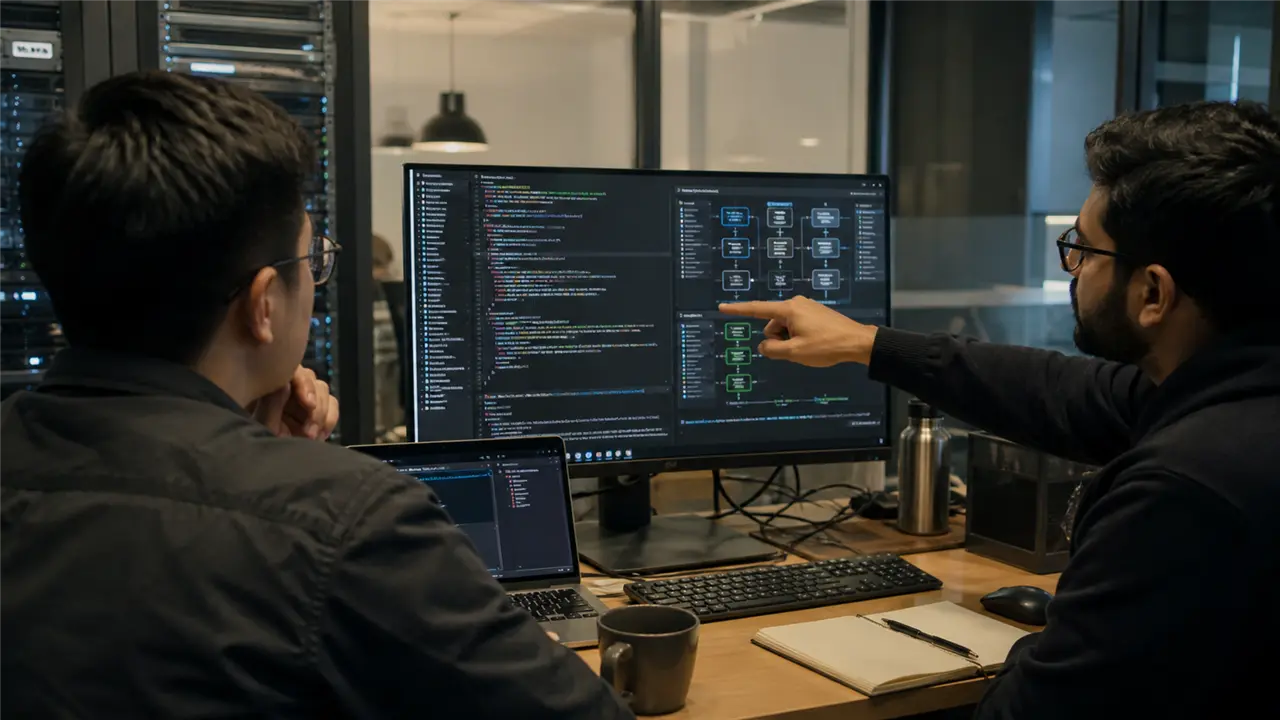
For decades, the standard business model for slot and skill game operators involved placing physical cabinets in bars, convenience stores, and dedicated sweepstakes cafes. While this model generated substantial cash flow, it also introduced severe operational bottlenecks. By comparing traditional street routes with centralized cloud operations, the financial incentives for modernization become overwhelmingly clear.
Traditional Street Route Profit Bottlenecks
Operating a traditional street route involves massive logistical overhead. First, there is the revenue sharing model. Operators typically forfeit 40% to 60% of their gross gaming revenue to the location owner simply for the privilege of utilizing their floor space. This massive cut significantly depresses the operator’s net margin.
Second, the physical security risks are enormous. Dispersed machines are prime targets for vandalism, smash-and-grab robberies, and sophisticated radio frequency spark attacks. When a machine is compromised, the operator loses not only the cash inside but also faces expensive hardware repair costs and extended downtime.
Third, the labor costs associated with route technicians and cash collectors eat directly into profits. Sending armed personnel or trusted technicians to dozens of locations every week to manually empty cash boxes, audit meters, and perform preventative maintenance is highly inefficient. Furthermore, relying on physical cash handling introduces the constant threat of internal shrinkage and accounting discrepancies. The traditional model limits scalability because adding more machines linearly increases your labor and security overhead.
Centralized Cloud Farm Financial Advantages
Transitioning to a centralized cloud slot farm eliminates these legacy bottlenecks entirely. Instead of fighting for premium retail floor space and sacrificing half your revenue, you deploy dozens or hundreds of cabinets in a secure, low-cost industrial warehouse. Industrial rent is a fraction of commercial retail space, and because the facility is closed to the public, you retain 100% of the gaming revenue.
The centralized model provides unparalleled global reach. A physical machine in a local bar only generates revenue when patrons are physically present during operating hours. A cloud-connected slot machine operates 24/7, accessible to players across different time zones via their smartphones or PCs. This maximizes cabinet utilization rates.
Furthermore, cloud teleoperation means zero physical cash handling. All transactions are routed through a secure, encrypted mobile application utilizing digital payment gateways, crypto integrations, or agent-based credit loading. This completely eliminates cash collection labor, eradicates the risk of armed robbery, and provides real-time, mathematically perfect accounting. When you combine these factors with our remote live slot machine turnkey system, the economic advantages over traditional routes are indisputable.
Warehouse Farm Infrastructure and Engineering Excellence
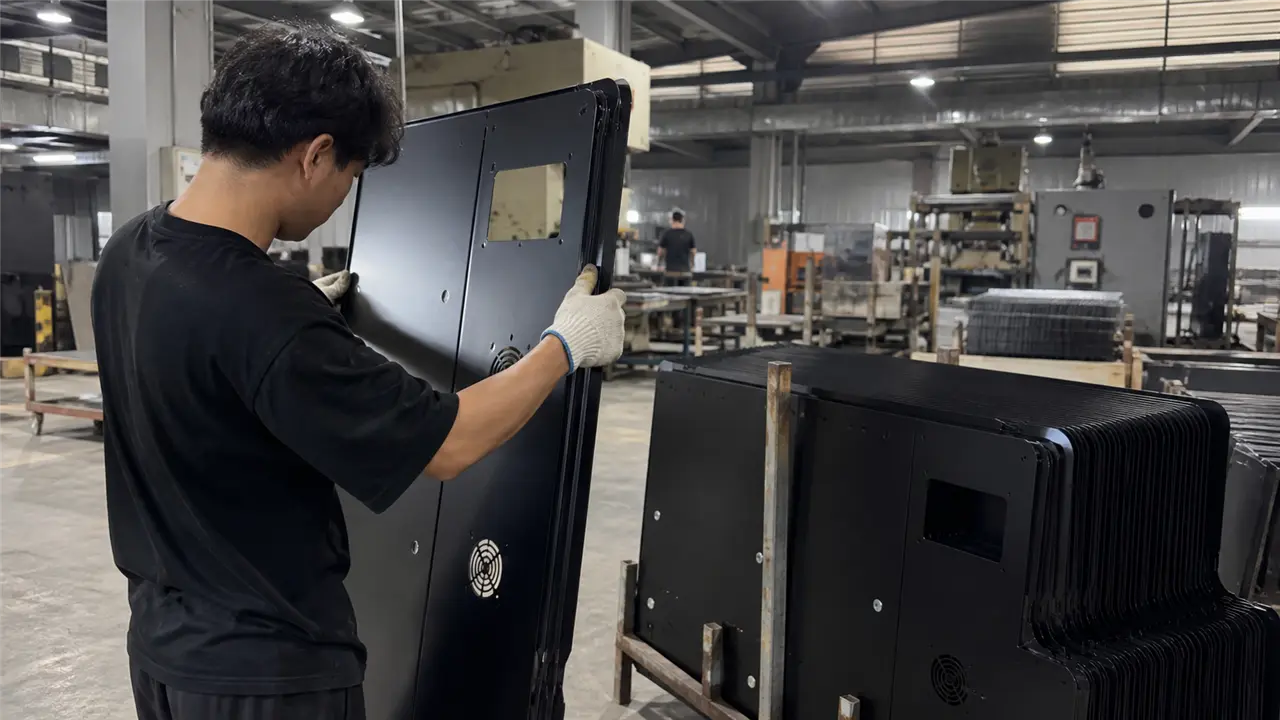
Building a profitable cloud slot farm requires much more than simply plugging standard cabinets into a router. Operating 30 to 100 cabinets simultaneously in a confined warehouse space demands rigorous industrial engineering. In our Panyu manufacturing base, we design and build infrastructure specifically optimized for high-density teleoperation environments.
High Density Layouts and Power Distribution
When deploying a farm of 30 to 100 cabinets, standard electrical wiring will inevitably fail under the continuous 24/7 load. We engineer our centralized setups with robust, low-ripple power distribution systems. Every cabinet is equipped with genuine Mean Well industrial power supplies, ensuring stable voltage delivery to the logic boards, motors, and IoT streaming hardware. We design custom power distribution panels equipped with heavy-duty surge protectors, isolated ground circuits, and intelligent load balancing to prevent catastrophic grid failures.
By eliminating the need for coin hoppers, bill validators, and large aesthetic toppers, we can manufacture stripped-down, high-density server-rack style cabinets. This allows operators to pack maximum computing and gaming power into the smallest possible square footage, drastically reducing industrial rent costs per unit. The elimination of unnecessary mechanical peripherals also dramatically reduces hardware failure rates and maintenance overhead.
Thermal Ducting and Heat Dissipation
A major challenge in high-density machine farms is thermal management. Standard cabinets rely on passive cooling or small exhaust fans, which are insufficient when dozens of machines are operating at peak CPU and GPU load continuously.
We implement specialized thermal ducting solutions for our warehouse deployments. Our engineered airflow systems ensure that ambient temperatures within the logic board enclosures remain below 26°C even under full 24/7 operational load. By utilizing high-CFM industrial intake fans, directional internal baffles, and exhaust manifolds that integrate with your warehouse HVAC system, we prevent thermal throttling and extend the lifespan of critical components by years.
EMP Faraday Shielding and Anti Cheat Hardening
Security in a closed warehouse differs from a public venue, but hardware integrity remains paramount. Even in a controlled environment, electronic interference can corrupt data or trigger false payouts. We integrate military-grade EMP Faraday shielding into the core logic enclosures. This shielding protects against radio frequency spark attacks and localized electromagnetic interference that might occur in industrial zones.
Our anti-cheat hardening extends to the software layer as well. The IoT teleoperation kits feature encrypted data streams, dynamic memory allocation to prevent buffer overflow attacks, and real-time checksum verification. If the system detects any unauthorized hardware manipulation or anomalous payout patterns, the master control server instantly isolates the affected machine and alerts your engineering team. This is the standard of commercial arcade game machines manufacturing standards that we mandate for all our B2B clients.
Detailed CapEx and OpEx Breakdown for Route Operators
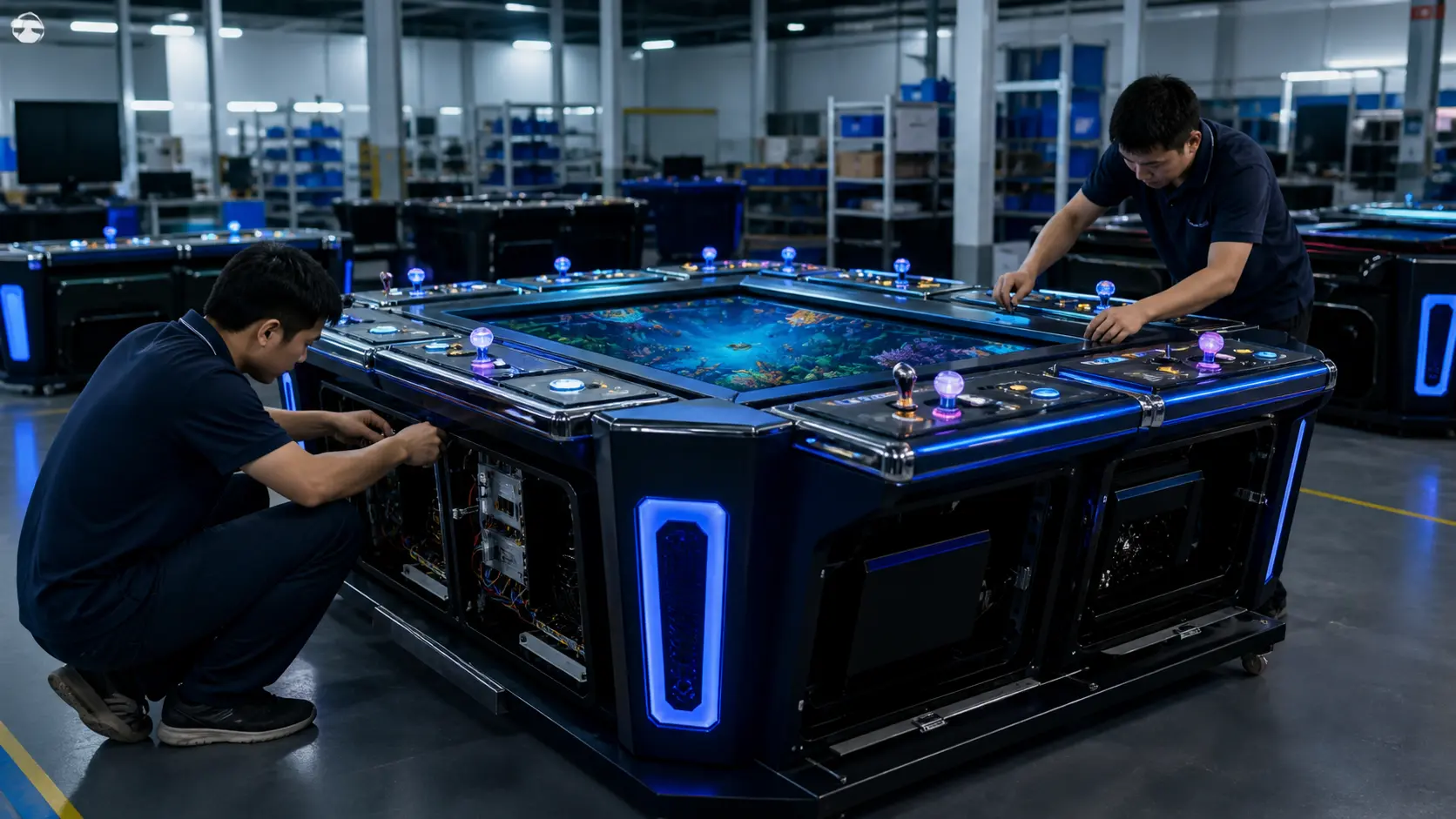
To build a realistic financial model, operators must understand the precise Capital Expenditure (CapEx) and Operational Expenditure (OpEx) required to launch and sustain a cloud slot farm. Because you are buying direct from the source factory in Guangzhou, you bypass the massive markups imposed by regional distributors.
Capital Expenditure Profiling
The initial investment for a 30-unit cloud slot farm involves several core components.
First is the factory-direct complete slot cabinets. Since these are engineered for remote play, we strip away the expensive aesthetic elements (like massive LCD toppers and premium button decks) and focus entirely on the core processing hardware, logic boards, and IoT integration. This significantly lowers the per-unit cost compared to traditional street cabinets. You are investing in pure gaming horsepower and reliability.
Second is the IoT teleoperation kits and hardware. Each cabinet requires a dedicated capture card, a low-latency encoding module, and specialized mechanical relays that translate web-based inputs into physical button presses on the logic board. We utilize custom-engineered PCBs that interface directly with the machine’s native JAMMA or SAS protocols.
Third is the white-label sweepstakes app customization. Our in-house software studio develops the player-facing mobile application and the backend operator portal. This includes custom UI/UX design matching your brand, secure payment gateway integration, and player management database architecture. Because we own the source code, we provide complete, uncapped platforms without hidden software licensing fees.
Operational Expenditure Metrics
Once the farm is deployed, the OpEx is remarkably low compared to traditional routes.
The primary monthly expense is the WebRTC TURN/STUN bandwidth infrastructure. Delivering sub-80 millisecond latency video streams to hundreds of concurrent players requires robust cloud server architecture. We assist in deploying scalable cloud infrastructure using AWS, Google Cloud, or localized high-bandwidth providers to ensure flawless video delivery. The cost scales linearly with player traffic.
Other OpEx factors include warehouse industrial rent, electricity consumption, and a small, centralized technical support team. Because there are no cash collections and no revenue sharing, your gross margins remain exceptionally high. The labor costs are shifted from field technicians driving vans to network administrators monitoring server health from a centralized dashboard. If you are also running competitive multiplayer games alongside slots, our cloud fish table machine farm deployment infrastructure seamlessly integrates into the same control network.
Operator ROI Math Model and Payback Period Projection
Let us analyze the unit economics and return on investment (ROI) for a standardized 30-unit cloud slot farm. Please note that these figures are projections based on historical data from our successful global partners, and your actual results will vary depending on marketing efficiency and local player demographics.
Assume a 30-unit machine farm operating at a conservative 60% daily capacity. In a 24-hour cycle, this equates to roughly 14.4 hours of active playtime per machine.
If the average player spins $0.50 per play at a rate of 10 spins per minute, a single machine processes $300 in wagers per hour. Over 14.4 hours, that is $4,320 in total daily handle per machine. With a mathematically verified factory-set hold percentage (RTP) of 8%, the net daily gross gaming revenue (GGR) per machine is $345.60. For a 30-machine farm, the total daily GGR is $10,368.
Now we deduct the operational expenditures. Subtracting server bandwidth costs, marketing acquisition costs, agent commissions, industrial rent, and electricity, operators typically maintain a net profit margin of roughly 40% to 50% of GGR in a fully optimized cloud setup. Using a 45% net margin, the daily net profit for the farm is $4,665.
When you factor in the direct-from-factory procurement costs for the stripped-down server cabinets, the IoT kits, the software development, and the shipping logistics, the total Capital Expenditure for a 30-unit farm is highly competitive. Based on these metrics, our partners consistently report a 30 to 45-day payback period projection. After this brief amortization window, the farm generates pure, unencumbered profit. This financial velocity is simply impossible to achieve with traditional street route operations where 50% of revenue is immediately lost to the venue owner.
Guangzhou Panyu Factory Turnkey Procurement Roadmap
Executing this financial model requires a manufacturing partner capable of delivering industrial-grade hardware seamlessly integrated with ultra-low latency software. Arcade Manufacturer is not a trading company; we are the source factory. Our procurement roadmap is designed to eliminate risk and guarantee flawless deployment.
CAD Custom Metal Fabrication and Engineering
Every cloud farm deployment begins with rigorous engineering. We do not force you to buy off-the-shelf cabinets. Our engineers utilize advanced CAD software to design custom metal fabrication layouts that perfectly match your warehouse dimensions. Whether you need high-density racking systems, slide-out maintenance trays, or specialized ventilation hoods, our CNC sheet metal division manufactures the exact enclosures required. This is the foundation of professional skill game machine and 8 liner cabinet manufacturing.
SAS and Pulse Pre Wiring Protocol Integration
Wiring 100 cabinets onsite is a logistical nightmare. We eliminate this by performing complete SAS and pulse pre-wiring at our Panyu facility. Our electrical engineers terminate every harness, solder every connection, and integrate the IoT relay boards directly into the logic system. The machines arrive at your facility in a true plug-and-play state. Your local technicians simply connect the power grid and the Ethernet backbone.
Stringent Factory Acceptance Testing and Logistics
Quality assurance is our absolute priority. Before any machine is crated, it undergoes a mandatory 72-hour burn-in testing cycle. We run the logic boards and power supplies at maximum synthetic load to identify and eliminate any early-life component failures.
During this phase, we conduct a live Video FAT (Factory Acceptance Test) inspection with your engineering team. I will personally walk you through the server rack, demonstrate the WebRTC latency, verify the payout mathematics, and prove the efficacy of the thermal management system via live video link. Only after you sign off on the engineering performance do we proceed to shipping.
Finally, we utilize robust ISPM-15 plywood crating to ensure your hardware survives international ocean freight without a single scratch or misaligned component. We handle the complex export customs documentation, providing a frictionless supply chain from our factory floor to your warehouse loading dock. This is the definitive standard for commercial arcade machine wholesale procurement.
Contact Our Engineering Team Today
The migration to centralized cloud slot farms is accelerating. Operators who transition early are securing massive market share and unprecedented profit margins. Stop sharing your revenue with street venues and stop risking your capital on vulnerable physical locations.
Partner with a true factory that understands the deep engineering and mathematical requirements of remote teleoperation. I invite you to contact me directly to discuss your warehouse dimensions, bandwidth infrastructure, and custom software requirements. We will provide a comprehensive CAD layout and an exact financial quotation within 24 hours.
Engineer Wang (Lead Hardware & Game System Architect) Guangzhou Miba Animation Technology Co., Ltd. (Arcade Manufacturer) Panyu Manufacturing Base, Guangzhou, China
- WhatsApp/WeChat: +86 17620842078
- Telegram: https://t.me/JLwyc
- Email: miba515527@gmail.com
Frequently Asked Questions About Cloud Slot Farm Deployment
How much bandwidth is required for a 30-unit cloud slot farm? A single machine utilizing our optimized WebRTC hardware typically requires 2 to 3 Mbps of stable upload bandwidth to deliver high-definition 60FPS video with sub-80ms latency. For a 30-unit farm, we mandate a dedicated, symmetrical fiber optic connection with a minimum of 100 Mbps upload capacity, though 250 Mbps is recommended to ensure network stability during peak traffic spikes and to accommodate control telemetry.
Do I need a commercial retail license to operate a warehouse farm? Because the physical warehouse is closed to the public and no on-site cash transactions occur, operators typically only need standard industrial warehouse leasing agreements and corporate business registrations. The gaming compliance and licensing requirements shift entirely to the jurisdiction where your digital platform and players are located. Always consult with local gaming attorneys regarding sweepstakes and skill game regulations in your target digital markets.
Can you integrate my existing street route machines into a cloud farm? Yes. If you currently own standard 8-liner or skill game logic boards (such as standard JAMMA or VGA multi-game systems), we can supply standalone IoT teleoperation conversion kits. However, for maximum density and thermal efficiency, we strongly recommend purchasing our purpose-built server-rack cabinets designed specifically for high-density warehouse environments.
What happens if the warehouse loses power or internet connectivity? Our software architecture includes robust state-saving mechanisms. If a connection drops during a spin, the logic board completes the mathematical cycle, and the exact game state (including credits and winnings) is instantly saved to the secure cloud database. When the player reconnects, they resume exactly where the interruption occurred. We also engineer Uninterruptible Power Supply (UPS) integration into our custom power distribution panels to safely power down the hardware during catastrophic grid failures.
How do players load credits if there are no bill validators? The entire financial ecosystem is digitized. Players deposit funds through your custom white-label mobile application using integrated fiat payment gateways, cryptocurrency processing, or through a network of digital distributors and agents. Our backend management portal credits the player’s digital wallet, which then securely communicates with the physical machine’s logic board via encrypted API pulses.
html
“`