- The Hidden Operational Risks of Substandard Arcade Hardware
- Industrial Arcade PCB Architecture and Anti Cheat Mechanisms
- Mastering the JAMMA Wiring Harness for Zero Downtime Operations
- ROI and CAPEX Payback Analysis for Arcade Operators
- Factory Acceptance Testing and QA Protocols in Our Panyu Lab
- Rapid Troubleshooting Hardware Faults on the Arcade Floor
- Frequently Asked Questions
The most devastating moment for any arcade operator is a Friday night power failure on a high-revenue machine. When the venue is packed and players are actively betting high stakes on a multiplayer fish game or a fast-paced slot cabinet, a sudden hardware freeze or a burned-out wiring harness means instant revenue evaporation. Worse than the immediate downtime is the hidden leakage of profits caused by malicious players using EMP jammers to manipulate standard, unshielded game boards, draining thousands of dollars in artificial credits.
I am Engineer Wang, Lead Hardware and Game System Architect at Guangzhou Miba Animation Technology Co., Ltd. Over my 12 years operating out of our 15,000-square-meter Panyu Manufacturing Base, I have audited hundreds of failed arcade cabinets from third-party suppliers. The root cause of 90 percent of field failures traces back to substandard PCB manufacturing and compromised JAMMA wiring harnesses. In this technical breakdown, we will examine the industrial engineering standards required to guarantee zero downtime, eradicate electronic theft, and secure your mathematical RTP (Return to Player) at a rock-solid 92 to 96 percent. For factory-direct procurement and comprehensive engineering specs, consult our master guide on complete commercial arcade machines factory guide.
If you are expanding your arcade venue or sourcing reliable OEM hardware for your distribution network, you need equipment built for continuous 24/7 commercial stress. Contact our Panyu factory direct to request our 2026 Hardware Catalog and schedule a live remote demonstration of our anti-cheat arcade systems.
The Hidden Operational Risks of Substandard Arcade Hardware
Many arcade owners and route operators mistakenly treat the internal hardware of a game cabinet as a generic commodity. They focus heavily on the external cabinet design and the flashing LED attract modes, entirely neglecting the underlying printed circuit board (PCB) architecture and power delivery systems. This is a critical commercial error.
When you purchase cheap, consumer-grade PCBs built by inexperienced suppliers, you are inheriting a ticking time bomb. Standard commercial boards often utilize extremely thin copper layers, typically 1oz per square foot. In a heavy-duty arcade environment, especially in 8-player or 10-player fish game tables that drive massive graphical processing units alongside mechanical hoppers and ticket dispensers, a 1oz copper trace cannot handle the sustained thermal load and high current draw. Over a period of three to six months, these traces suffer from thermal micro-fractures. The immediate symptom on the floor is intermittent rebooting. For a venue owner, an intermittent reboot during a high-stakes play session destroys player trust, leads to aggressive customer disputes at the front desk, and forces you to refund lost credits out of pocket.
Furthermore, cheap hardware fundamentally compromises the mathematical integrity of the game software. Arcade machines rely on complex Pseudo-Random Number Generators (PRNG) to maintain a strict RTP yield, ensuring the house retains its targeted 92 to 96 percent gross gaming revenue over time. When substandard power regulation causes momentary voltage dips, the CPU can suffer micro-resets. These micro-resets can desynchronize the PRNG state, pushing the game into an unintended payout loop. Your machine might suddenly payout at 110 percent RTP, actively bleeding your operational capital, all because the factory saved three dollars on inferior power regulation capacitors.
At Guangzhou Miba Animation Technology Co., Ltd., our engineering philosophy is built entirely around operator profit protection. We understand that a machine that is turned off for maintenance is a machine that is costing you money. We engineer our logic boards and power delivery systems to operate flawlessly in extreme environments, ensuring that your capital expenditure (CAPEX) translates rapidly into pure, uninterrupted operational revenue.
Industrial Arcade PCB Architecture and Anti Cheat Mechanisms
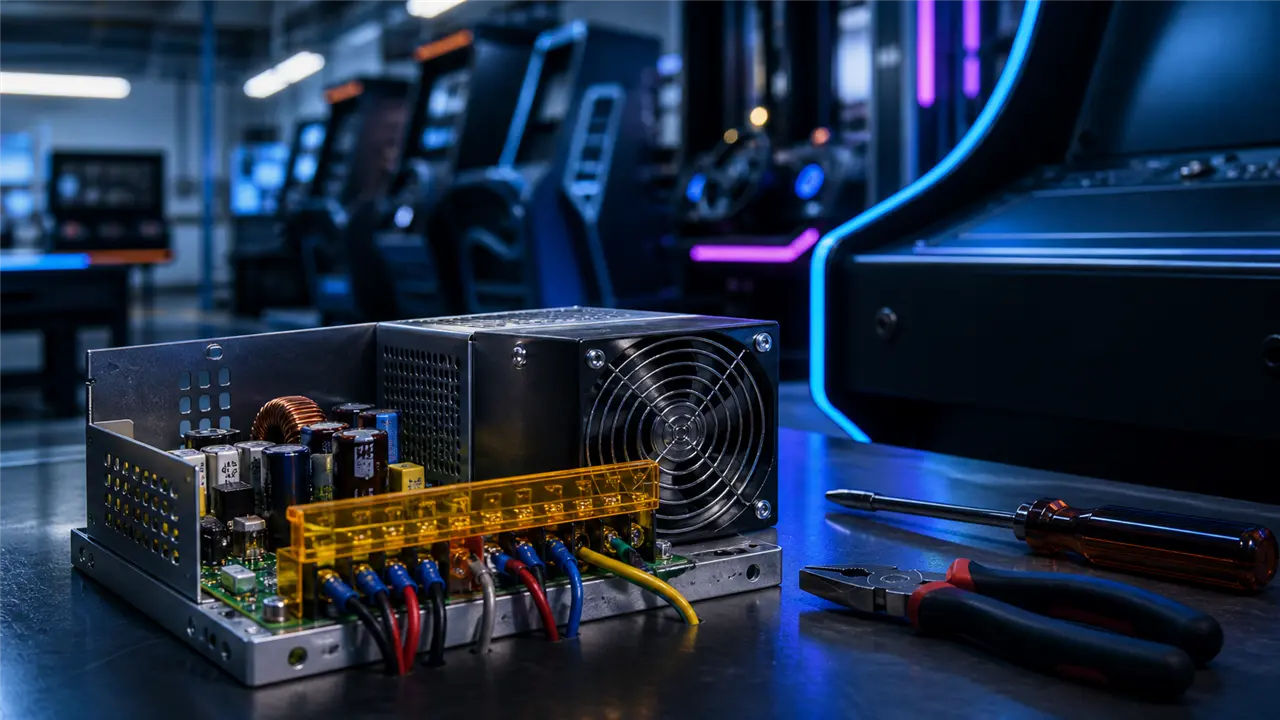
Securing an arcade machine requires defense-in-depth engineering at the hardware level. The most severe threat to modern arcade profitability is the proliferation of EMP (Electromagnetic Pulse) generators and high-frequency interference devices. Malicious players conceal these small devices and trigger massive electromagnetic bursts near the coin acceptors, bill validators, or mainboard housings. On a badly engineered machine, this burst induces a false electrical pulse on the input signal wires, tricking the CPU into registering hundreds of inserted coins without a single real dollar entering the cash box.
To combat this, we implement military-grade optical isolation across all critical input and output pathways. When a coin acceptor or bill validator sends a pulse to our customized game board, the electrical signal does not travel directly to the CPU. Instead, it powers a microscopic LED inside an opto-isolator chip, which transmits the signal as a beam of light to a photo-receiver on the protected side of the circuit. Because there is no physical electrical connection between the external peripheral and the core logic board, an EMP surge of 10,000 volts will simply stop at the isolation barrier, leaving your CPU and your credits completely untouched.
Beyond optical isolation, our boards integrate ultra-fast Transient Voltage Suppression (TVS) diodes. When an extreme voltage spike is detected from an external jammer, our TVS clamping circuits react in under 5 picoseconds (5ps), shunting the dangerous energy safely to the earth ground before it can disrupt the microprocessor. We also utilize localized Faraday cage shielding over the most sensitive RAM and CPU components, completely blocking external RF interference across the 300 to 1200MHz spectrums.
Our anti-cheat architecture extends into the software logic itself. We utilize custom V5 and K8 hardware dongles featuring dynamic key encryption. Instead of using a static communication key between the motherboard and the game software, our proprietary hardware generates a shifting, time-based cryptographic handshake. If a hacker attempts to intercept the data stream or clone the storage drive to run on unauthorized hardware, the dynamic key will fail to authenticate, and the system will immediately lock down into a secure vault mode. This ensures that your proprietary game math and venue data remain totally secure against intellectual property theft and unauthorized tampering.
For maximum reliability, we manufacture all our primary arcade motherboards using 4-layer and 6-layer FR-4 fiberglass substrates with 2oz heavy copper power planes. This robust physical construction ensures rapid heat dissipation, allowing our boards to run cool even in un-air-conditioned tropical environments. We also integrate dedicated hardware watchdog timers. If a cosmic ray or severe software anomaly causes the main execution thread to hang, the hardware watchdog detects the stall and triggers a cold reboot within milliseconds, restoring the machine to a playable state before the player even realizes a fault occurred.
Are you ready to secure your venue against electronic theft and hardware failure? Contact our engineering team today to request a comprehensive Technical Whitepaper and detailed PCB Architecture Diagrams for our latest high-yield arcade platforms.
Mastering the JAMMA Wiring Harness for Zero Downtime Operations
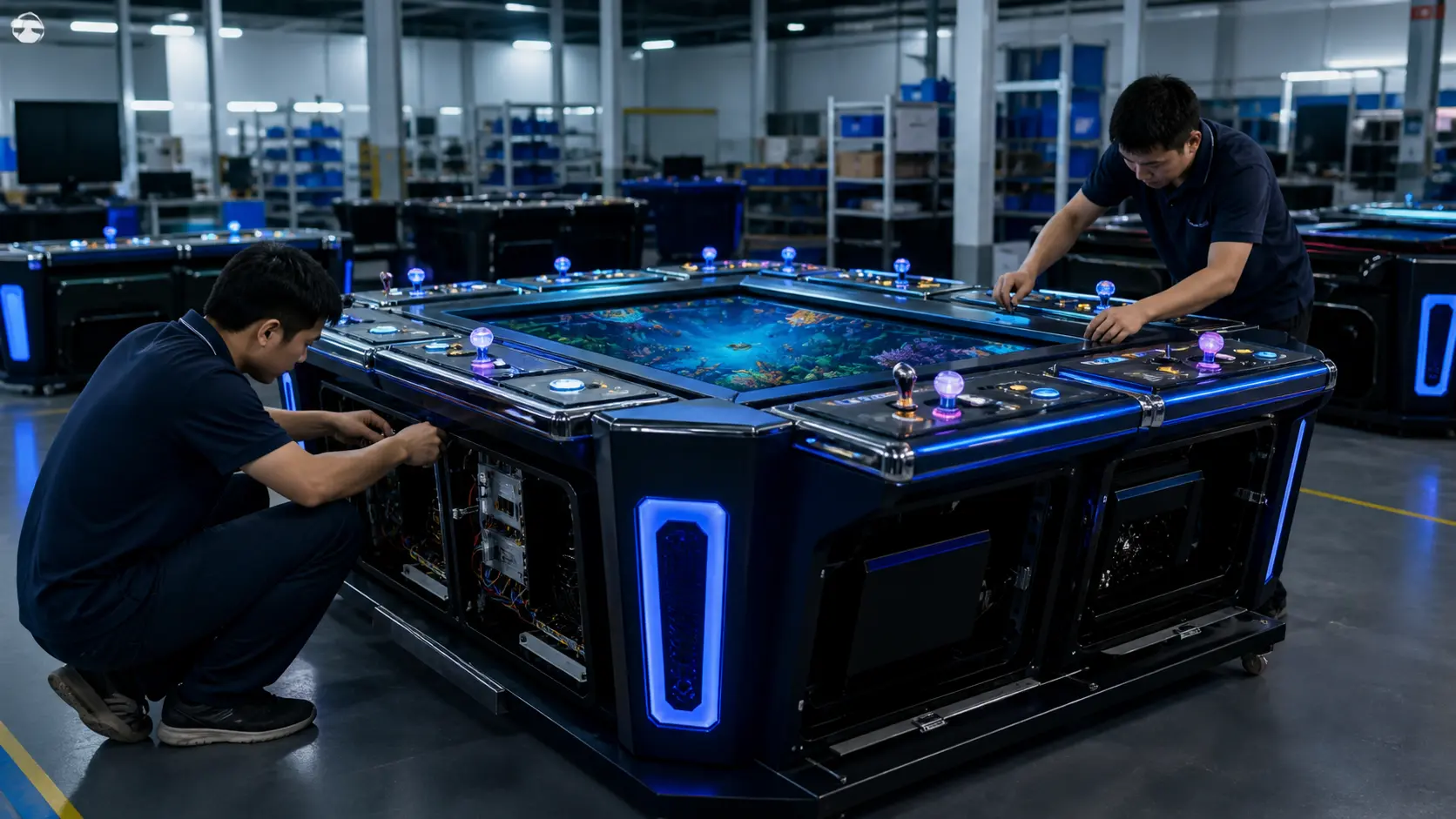
The PCB is the brain of the arcade machine, but the JAMMA (Japanese Amusement Machine Manufacturers Association) wiring harness is the central nervous system. It is the critical bridge that delivers power and transmits control signals between the motherboard, the power supply, the joysticks, the buttons, and the payment peripherals. Despite its importance, the wiring harness is often the most neglected component in third-party cabinet manufacturing.
Standard off-the-shelf JAMMA harnesses are typically constructed using cheap 22 AWG or even 24 AWG aluminum-clad wire to cut costs. This is a fatal flaw for high-power arcade machines. When pulling the heavy amperage required by modern audio amplifiers, multiple motorized hoppers, and large LED arrays, thin wires act like resistors. They generate heat and cause severe voltage drops. A power supply might push a perfect 5.0 Volts at the source, but by the time the current travels through two meters of thin, substandard wire, the PCB might only receive 4.6 Volts. This under-voltage condition leads directly to frozen screens, audio distortion, and corrupted memory states.
In our Panyu manufacturing facility, we mandate strict industrial specifications for all internal wiring. For all main power lines delivering 5V, 12V, and system ground, we exclusively use thick 18 AWG tinned copper wire. The tin plating prevents the raw copper from oxidizing in high-humidity coastal environments, ensuring the electrical resistance remains incredibly low over a ten-year operational lifespan. For signal lines connecting to buttons and joysticks, we use robust 20 AWG wire capable of withstanding constant physical vibration from aggressive players.
Furthermore, we utilize premium edge connectors featuring 30 microinches of hard gold plating on the contacts. Cheap harnesses use thin tin plating on the edge connector, which quickly oxidizes and degrades from friction every time the board is swapped or serviced, eventually causing dead inputs and phantom coin registrations. Our heavily gold-plated connectors guarantee perfect electrical continuity regardless of environmental degradation or mechanical wear.
Every crimp and terminal connection in our factory is executed using automated pneumatic crimping machines calibrated to exact pressure tolerances. A loose hand-crimped terminal can create microscopic electrical arcing, which generates localized heat and eventually melts the plastic connector housings, causing a catastrophic short circuit that can destroy an expensive PCB instantly. By removing human error from the crimping process, we guarantee that every JAMMA harness leaving our floor will endure continuous commercial abuse without failure.
ROI and CAPEX Payback Analysis for Arcade Operators
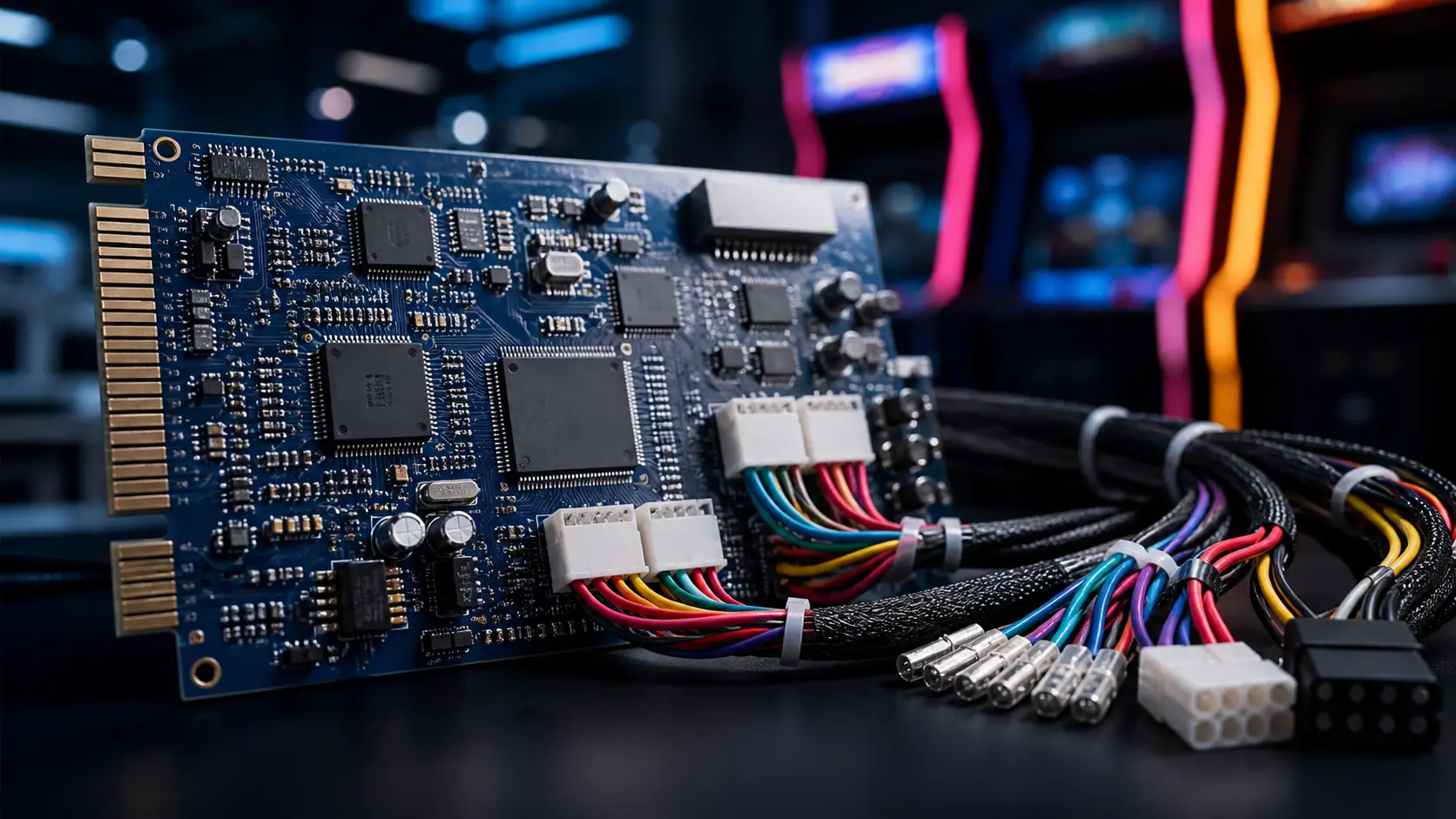
The true cost of arcade hardware is not the upfront purchase price; it is the lifetime cost of operation, maintenance, and lost revenue. Upgrading to industrial-grade PCBs and premium JAMMA harnesses represents a minor fractional increase in initial capital expenditure, but it yields massive dividends in long-term operational profitability.
To illustrate this, we have modeled the 24-month financial performance of a standard unshielded fish game cabinet versus our engineered Arcade Manufacturer premium cabinet in a high-traffic venue.
| Operational Metric | Standard Third-Party Cabinet | Our Premium Industrial Cabinet |
|---|---|---|
| Initial Hardware Cost | $2,500 | $2,950 |
| Monthly EMP Theft Losses | $400 (Average) | $0 (Fully Shielded) |
| Friday Night Downtime Incidents | 4 per year | 0 per year |
| Lost Revenue from Downtime | $1,200 | $0 |
| Replacement Parts (24 Months) | $350 (Power supplies, wiring) | $0 (Zero failure rate) |
| Total 24-Month Hardware Cost | $13,650 | $2,950 |
| Effective CAPEX Payback Period | 5.5 Months | 2.1 Months |
As demonstrated, the operator utilizing standard hardware bleeds profit continuously through hidden theft and catastrophic weekend downtime. By investing slightly more upfront in robust engineering, our partners achieve a complete return on investment in just over two months, followed by years of pure, uncompromised profit margins locked in by stable RTP math.
Factory Acceptance Testing and QA Protocols in Our Panyu Lab
We do not rely on hope or guesswork when deploying machines to international markets. Every single PCB, harness, and completed cabinet must pass our rigorous Factory Acceptance Testing (FAT) protocol inside our Panyu Quality Assurance Laboratory before it is certified for export. Our testing standards exceed standard consumer electronics regulations, focusing entirely on the extreme abuse unique to the arcade gaming sector.
Thermal Shock and Burn In Testing
Every motherboard undergoes a mandatory 72-hour continuous burn-in process inside our environmental test chambers. We cycle the ambient temperature from 10 degrees Celsius up to 55 degrees Celsius under maximum CPU and GPU utilization. If a capacitor is weak, or a solder joint is microscopicly flawed, this thermal expansion stress will force the failure to occur in our factory, not on your arcade floor.
Vibration and Transit Simulation
Arcade machines are subjected to brutal physical impacts from players and immense vibration during oceanic shipping. We mount our fully assembled cabinets and independent PCB racks onto multi-axis vibration tables, subjecting them to sustained 3G shock profiles. This guarantees that heavy components like heat sinks and inductors will not shear off the motherboard, and our precision-crimped JAMMA harnesses will remain flawlessly seated.
EMI and EMC Susceptibility Audits
We actively attack our own hardware. Using high-powered handheld EMP generators and radio-frequency sweepers, our engineers barrage the coin acceptors, card readers, and logic boards with extreme electromagnetic interference. A board is only certified for production if it completely rejects the interference, maintaining stable gameplay and perfect accounting logs without dropping a single credit.
Rapid Troubleshooting Hardware Faults on the Arcade Floor
Even with the highest quality hardware, operators and field technicians must be prepared to diagnose environmental or external issues rapidly. To minimize downtime, I have compiled a rapid-response troubleshooting matrix based on a decade of field service data. Train your floor staff on these exact protocols to resolve 95 percent of issues in minutes.
| Symptom Observed on Arcade Floor | Probable Root Cause | Immediate Technician Action Plan |
|---|---|---|
| Screen rolling continuously or displaying garbled horizontal lines | JAMMA video sync wire (Pin P) disconnected or monitor ground loop | Verify 20 AWG sync wire continuity. Ground the monitor chassis directly to the main switching power supply earth. |
| Game resets randomly when multi-players fire heavy weapons simultaneously | Voltage drop under heavy load or failing 5V power supply | Measure voltage directly at the JAMMA edge connector. Adjust the Mean Well power supply potentiometer to exactly 5.15V to compensate for load drop. |
| Coin acceptor rejects all physical coins and drops them to the return slot | Optical sensor blocked by dust or 12V power supply line severed | Clean the mechanical coin chute with compressed air. Verify the 18 AWG 12V line on the JAMMA harness is securely crimped and delivering power. |
| Machine powers on, fans spin, but screen remains entirely black | Missing 12V rail to audio/video ICs or loose RAM module | Reseat all RAM and ROM chips securely. Test the JAMMA harness for a catastrophic short on the 12V line causing the power supply safety circuit to trip. |
| Unexplained massive spikes in daily credit accounting without cash | Active EMP jammer attack in progress against unshielded wiring | Immediately upgrade to our optically isolated JAMMA IO board. Check surveillance footage for players keeping hands hidden near the coin door. |
Related Engineering References and Floor Operational Guides
- For our comprehensive factory production standards, review our China arcade machine manufacturer sourcing framework.
- To inspect our physical facility, see our Guangzhou arcade game factory sourcing guide.
- Analyze component BOM pricing with our arcade machine manufacturing cost breakdown.
- Compare direct cabinet pricing in our fish table wholesale manufacturer pricing guide.
Frequently Asked Questions
What makes an industrial arcade PCB different from a standard PC motherboard?
Unlike consumer PC motherboards designed for clean office environments, industrial arcade PCBs utilize specialized edge connectors for direct peripheral control, hardware-level watchdog timers to instantly recover from logic stalls, and conformal coating to protect microscopic surface-mount components from humidity, dust, and coastal salt air.
Can standard JAMMA harnesses handle modern 8-player fish game tables?
No. Standard JAMMA harnesses are designed for low-power retro 2-player fighting games. Modern 8-player tables require massive current to drive high-definition displays, complex LED lighting, and multiple thermal printers. Using standard thin wire will cause severe overheating, voltage drops, and random hardware reboots. You must use our heavy-duty 18 AWG power-rated wiring harnesses for these applications.
How does your hardware protect my game’s RTP profitability?
Our hardware protects the RTP (Return to Player) by ensuring the system’s Pseudo-Random Number Generator never suffers from under-voltage anomalies or EMP resets. When the hardware runs flawlessly, the math model runs flawlessly, guaranteeing that your machine mathematically hits its targeted 92 to 96 percent retention rate without unpredictable revenue leakage.
Do you provide custom software integration for your hardware platforms?
Absolutely. Beyond physical manufacturing, we house a dedicated team of over 50 software developers in Guangzhou. We provide full-stack Turnkey Solutions, including customizing game math, developing bespoke 3D assets in Unity and Unreal Engine, and integrating our hardware directly with your proprietary mobile sweepstakes or remote management applications.
How do I schedule a Factory Acceptance Test (FAT) or venue consultation?
We welcome global operators to audit our manufacturing standards. You can arrange a direct video call with our engineering team for a remote FAT, or schedule a physical tour of our Panyu facility.
Do not let inferior third-party hardware dictate your revenue potential. Secure your operations, lock in your RTP, and eliminate Friday night downtime forever. For precise manufacturing quotes, bulk PCB orders, and custom game architecture design, contact me, Engineer Wang, directly via WhatsApp at +86 17620842078, through Telegram at https://t.me/JLwyc, or email me at miba515527@gmail.com.