- Microswitch Wiring Anatomy and Active Low Pull Up Logic
- Optocoupler Isolated Solid State Relays and Ground Loop Prevention
- Firmware Debounce Filters and Anti Spam Throttling
- Capacitive and Resistive Touchscreen Coordinate Injection
- Inductive Relay Flyback Protection and Reverse Voltage Clamping
- Fail Safe Lockout Circuits and Connection State Management
- The Operator Advantage Partnering with a Source Factory
- Frequently Asked Questions
This is Engineer Wang from Guangzhou Miba Animation Technology Co., Ltd., also known globally as Arcade Manufacturer. Over my 12 years of designing hardware architectures and managing complete machine assembly at our 15,000-square-meter Panyu manufacturing base, I have witnessed the radical evolution of land-based gaming equipment. Today we are exploring the industrial engineering behind upgrading traditional gaming cabinets for modern teleoperation environments. By analyzing physical button retrofitting and microswitch pulse signal conversion, we can understand the rigorous protocols required to transition a standalone cabinet into a reliable node within a cloud-managed ecosystem. We do not deal in loose spare parts or DIY hobbyist kits. Our focus remains exclusively on turnkey venue solutions, complete industrial machine manufacturing, and seamless software integration for serious B2B operators.
If you are an operator losing revenue to hardware instability or seeking a robust remote live slot machine turnkey system, our engineering team is ready to deliver a custom solution. Let us dive into the core mechanics of physical relay manipulation and signal conversion.
Microswitch Wiring Anatomy and Active Low Pull Up Logic
The foundational interface of any physical slot machine or 8-liner cabinet revolves around its mechanical input arrays. In a standard commercial gaming environment, the SPIN, BET MAX, LINE SELECT, and CASHOUT buttons endure relentless physical punishment. From an electrical engineering perspective, interpreting these inputs accurately is critical for maintaining the integrity of the math model and ensuring regulatory compliance.
When inspecting the internal wiring harness of a commercial slot machine, the microswitches governing these primary functions typically operate on an active-low logic paradigm. This means the input pin on the main game board is held at a high voltage state (usually 5V or 12V DC) via an internal pull-up resistor. When a player strikes the physical button, the microswitch closes the circuit, shunting the voltage to the common ground and pulling the logic line low. The game board’s microcontroller detects this falling edge and triggers the corresponding action.
In our factory, we design custom wire harnesses and control boards that meticulously respect this legacy architecture. When implementing a remote live arcade turnkey system, injecting commands over the internet requires simulating this exact mechanical closure. We cannot simply inject a voltage into the line, as doing so could irreversibly damage the delicate logic gates on older game boards. Instead, we must employ electronic switching mechanisms that mimic a true dry contact closure to ground.
This requirement necessitates a deep understanding of the host board’s electrical thresholds. Some vintage 8-liner boards utilize 12V pull-ups for enhanced noise immunity on long wire runs, whereas modern PC-based platforms might use standard 3.3V or 5V TTL logic. Our proprietary bridging controllers auto-sense these voltages, ensuring that the simulated pull-down action provides a clean, zero-volt reference without exceeding current sinking limits. This level of precision is exactly why route operators trust our skill game machine and 8 liner cabinet manufacturing processes for their highest-grossing venues.
Optocoupler Isolated Solid State Relays and Ground Loop Prevention
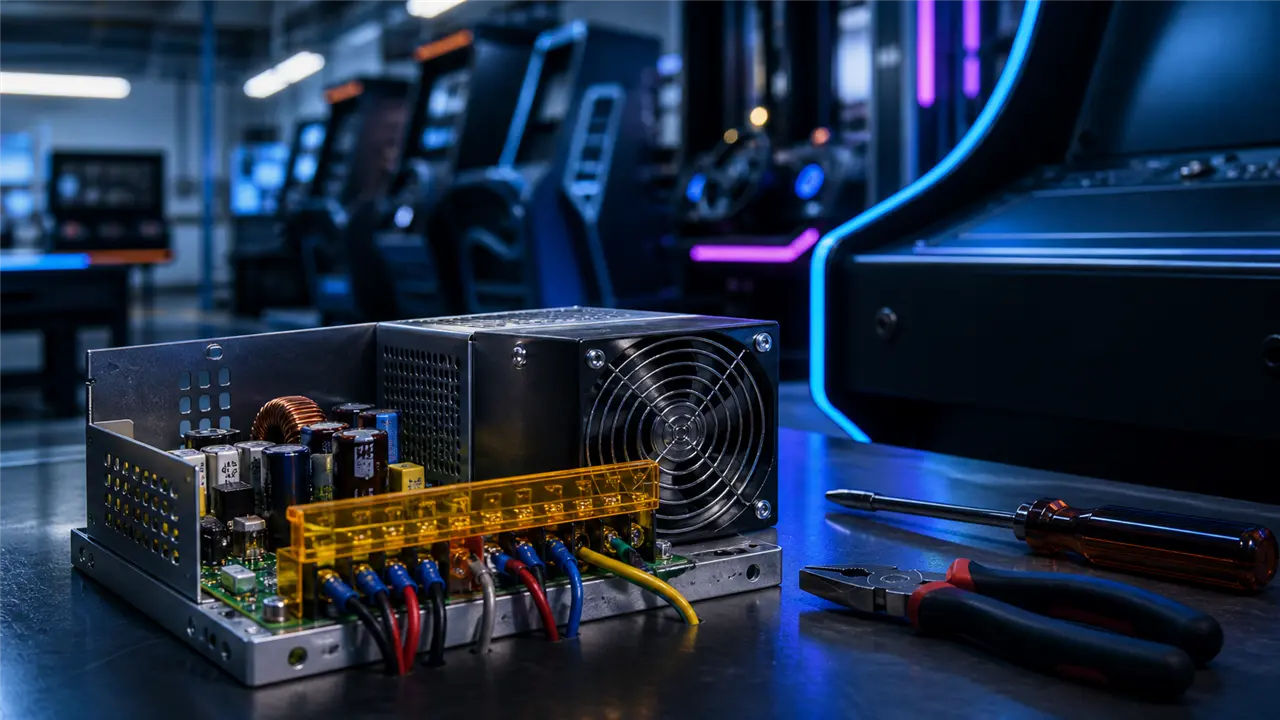
Interfacing a modern IoT controller with a legacy slot machine mainboard introduces significant electrical risks. The power supply units driving the mechanical hoppers, bill validators, and intense LED lighting arrays often generate substantial electrical noise. If the ground plane of the IoT module is directly tied to the ground plane of the legacy cabinet, a ground loop can form. This loop acts as an antenna, picking up electromagnetic interference and causing erratic behavior, phantom button presses, or even fatal voltage spikes across the microcontrollers.
To eliminate this vulnerability, our hardware engineers mandate the use of 2500V optocoupler-isolated solid-state relays. Components like the industry-standard TLP281 or PC817 opto-isolators form an impenetrable galvanic barrier between the cloud-facing internet hardware and the local game board logic.
When a remote player taps the SPIN button on their mobile device, the cloud server sends a WebSocket packet to our localized industrial IoT arcade controller board. The IoT microcontroller drives a minuscule current through the internal LED of the optocoupler. The resulting photons cross a microscopic physical gap and strike a phototransistor, causing it to conduct. This photo-transistor is connected to the slot machine’s button matrix, pulling the active-low line to the local ground without any electrical continuity between the two systems.
This complete galvanic isolation ensures that catastrophic transient spikes from a jammed coin hopper motor cannot feedback into the networking gear. Furthermore, solid-state switching eliminates the mechanical bounce and wear associated with traditional electromagnetic relays. In a busy venue operating 24 hours a day, mechanical relays will eventually succumb to contact pitting and carbon buildup. Our opto-isolated solid-state approach guarantees tens of millions of flawless actuation cycles, dramatically reducing maintenance overhead for our B2B partners.
Firmware Debounce Filters and Anti Spam Throttling
Simulating button presses electronically introduces a new set of timing challenges. Mechanical switches inherently suffer from contact bounce, a phenomenon where the metal contacts rapidly make and break connection several times before settling into a stable state. Legacy slot machine CPU boards compensate for this by employing hardware capacitor networks or rudimentary software debounce algorithms.
However, when injecting digital pulses via an IoT controller, the signals are perfectly square waves. While one might assume this is advantageous, sending pulses that are too short or too rapid can overwhelm legacy microcontrollers. A vintage CPU handling audio playback, reel spin animations, and basic math might miss a 1-millisecond digital pulse entirely, or worse, it might interpret a rapid sequence of digital pulses as a buffer overflow attempt, causing a system halt.
To bridge this gap, our engineering team implements sophisticated firmware debounce filters and pulse-shaping algorithms directly on the IoT gateway. When a remote command is received, the firmware artificially stretches the output pulse to a guaranteed 10ms to 25ms window. This precisely mimics the duration of an average human finger press, ensuring 100 percent recognition by any generation of game board.
Additionally, network latency and erratic mobile connections can result in “spamming” where a frustrated remote player repeatedly taps the screen. If these rapid-fire commands were instantly translated into physical switch closures, the game board’s input buffer could saturate. Our anti-spam throttling logic intelligently queues and spaces out incoming commands, enforcing a minimum rest period between actuations. This protects the legacy hardware from anomalous input floods while maintaining a fluid and responsive experience for the remote user.
Capacitive and Resistive Touchscreen Coordinate Injection
While mechanical buttons handle core functions like spinning and betting, modern video slot machines increasingly rely on touch interfaces for bonus rounds, game selection, and interactive features. Replicating a physical touch on a remote machine requires entirely different engineering paradigms compared to simple relay actuation.
For legacy machines equipped with resistive touch panels, the screen relies on physical pressure to connect two conductive layers, generating an analog voltage divider circuit that the controller interprets as X and Y coordinates. To simulate this remotely, we bypass the physical panel and interface directly with the touch controller’s analog inputs. By utilizing precision digital-to-analog converters (DACs), our IoT board injects specific voltage levels into the X and Y channels, perfectly spoofing the presence of a physical finger at exact coordinate locations.
Modern cabinets, however, utilize capacitive touch screens that communicate via USB Human Interface Device (HID) protocols. In these scenarios, analog voltage injection is impossible. Instead, we implement a USB-HID touch controller spoofing technique. Our custom hardware acts as a USB host device proxy, sitting seamlessly between the physical capacitive screen and the game’s internal PC.
When a remote player interacts with their mobile stream, their device captures the relative X and Y coordinates and transmits them over our ultra-low latency WebRTC channel. Our IoT gateway translates these coordinates into standard USB-HID multi-touch data packets and injects them directly into the game board’s USB bus. The game engine reacts instantaneously, completely unaware that the touch originated from a continent away rather than a physical finger on the local glass. This transparent integration is critical for maintaining the immersive quality of complex bonus rounds without requiring source code modifications to the original game software.
Inductive Relay Flyback Protection and Reverse Voltage Clamping
Although we prioritize solid-state isolation for logic-level signals, certain legacy modifications require driving higher current loads, such as electromechanical coin meters, custom payout solenoids, or mechanical reel brake releases. Driving these inductive loads introduces significant dangers to delicate control circuitry.
When an inductor (like a solenoid coil or mechanical relay coil) is energized, it stores energy in a magnetic field. When the control switch opens to turn off the device, that magnetic field collapses instantly. This rapid collapse induces a massive reverse voltage spike, known as flyback voltage, which can easily reach hundreds of volts and destroy the driving transistor or logic board.
In our Panyu QA lab, our protocol mandates absolute protection against inductive kickback. Every high-current drive circuit incorporated into our complete machine builds features robust flyback protection. We utilize high-speed reverse voltage clamping diodes (flyback diodes) placed in parallel with the inductive load.
When the driving transistor turns off, the induced reverse voltage is safely shunted through the diode back into the coil, dissipating the energy as heat rather than allowing it to arc across the transistor. For exceptionally noisy environments, we also implement Transient Voltage Suppression (TVS) diodes and specialized snubber networks. These components clamp transient spikes to safe levels within picoseconds, ensuring that the heavy electromechanical actions of a commercial arcade environment never compromise the delicate logic of the slot machine SAS 6.02 protocol integration systems.
Fail Safe Lockout Circuits and Connection State Management
Operating physical machinery via remote internet connections mandates stringent safety and operational protocols. A dropped connection, a server timeout, or a momentary loss of power must never result in an undefined state that could cost an operator money or damage equipment.
Consider a scenario where a remote player holds the BET MAX button, and at that exact moment, their mobile connection drops. If the local IoT relay simply remained locked in the closed state, the slot machine would continuously drain credits and spin endlessly until physical intervention occurred. This is an unacceptable risk in professional route operations.
To eliminate this hazard, we design our hardware with deterministic fail-safe lockout circuits. The local IoT microcontroller requires a continuous encrypted heartbeat signal from our cloud servers via the WebSocket connection. If this heartbeat is interrupted for more than a predefined threshold (typically 500 milliseconds), the microcontroller instantly executes a hardware-level safety interrupt.
This interrupt routine immediately forces all GPIO pins to their default, un-actuated state. All optocoupler relays are deactivated, all touch coordinate injections are halted, and the machine returns to a secure idle mode. Furthermore, this fail-safe logic is hardcoded into the lowest level of the firmware, meaning it will trigger reliably even if the higher-level operating system tasks become unresponsive.
By implementing automated button release on WebSocket disconnects, we prevent stuck spin loops and safeguard the operator’s financial integrity. This commitment to industrial-grade reliability is why leading global operators choose our factory for their complete machine manufacturing and remote teleoperation deployments.
The Operator Advantage Partnering with a Source Factory
Navigating the complexities of arcade hardware modification and remote teleoperation requires far more than basic soldering skills. It demands a holistic understanding of electronic engineering, software architecture, and commercial gaming regulations. As a premier source factory, we do not merely supply individual control boards or loose spare parts. We engineer and manufacture complete, turnkey gaming cabinets optimized for both local profitability and remote live streaming.
Our in-house software team ensures that every byte of data, from the physical microswitch to the cloud server, is handled with extreme low latency and cryptographic security. Our hardware engineers painstakingly layout every circuit board to withstand the grueling demands of 24/7 commercial operation, utilizing industrial-grade components and rigorous testing methodologies.
When you partner with Guangzhou Miba Animation Technology Co., Ltd., you are directly accessing a massive manufacturing infrastructure capable of rapid prototyping, custom OEM/ODM fabrication, and bulk wholesale delivery. We empower operators to scale their businesses confidently, backed by a team of dedicated engineers who understand the technical nuances of maximizing ROI.
If your operation requires industrial-grade teleoperation hardware, custom game development with full source code buyout, or comprehensive venue management solutions, connect with us directly.
Contact Engineer Wang for Technical Consultation and Factory Direct Pricing
- WhatsApp/WeChat: +86 17620842078
- Telegram: https://t.me/JLwyc
- Email: miba515527@gmail.com
Frequently Asked Questions
How do you prevent voltage spikes from damaging the slot machine board during remote operation?
We utilize 2500V optocoupler-isolated solid-state relays that provide a complete galvanic barrier between the IoT controller and the game board, ensuring no electrical noise or transient spikes can cross over.
Can your system handle modern capacitive touch screens as well as physical buttons?
Yes. For modern cabinets, we employ USB-HID touch controller spoofing, injecting exact digital coordinates directly into the USB bus without requiring physical analog manipulation.
What happens if the internet connection drops while a remote player is pressing a button?
Our hardware features hardcoded fail-safe lockout circuits. If the connection drops, a missing heartbeat triggers an immediate automated release of all simulated buttons, preventing stuck spins and credit loss.
Do you sell the individual relay boards for DIY modification?
No. We are a complete machine manufacturer and turnkey solutions provider. We deliver fully integrated, commercial-grade systems and cabinets tailored for serious B2B operators, not loose spare parts for hobbyists.