- The Foundation of Industrial Grade Arcade Cabinet Manufacturing
- Precision Laser Cutting and CNC Hydraulic Press Brake Bending Processes
- Customized Branding with Laser Etched Backlit Side Panels
- Modular Sub Assembly and Compact Flat Pack Shipping Economics
- Fast Turnaround Prototyping and Volume Production Scaling
- Start Your Bespoke Cabinet Project Today
- Frequently Asked Questions
When global arcade distributors, game studios, and casino operators source custom hardware, they face a recurring nightmare of mismatched sheet metal, delayed prototyping, and generic cabinet shells that fail to distinguish their brand on crowded gaming floors. A flimsy cabinet not only damages your premium brand image but also invites security breaches, hardware failures, and massive maintenance overheads. As the hardware foundation of any profitable gaming operation, the physical cabinet must be an impregnable, aesthetically stunning fortress that captivates players and protects the internal electronics.
I am Engineer Wang, Lead Hardware and Game System Architect. Here at our 15,000m² Panyu manufacturing base in Guangzhou, China, our 50-engineer CAD/SolidWorks design and laser-cutting workshop handles the heavy lifting for top-tier international distributors. We are not a trading company piecing together off-the-shelf components. We are a source factory delivering complete, turnkey bespoke cabinet development lifecycles. From initial conceptual sketches to rapid 10-day physical prototypes, and ultimately to full-scale volume production, we engineer industrial-grade gaming cabinets designed for rigorous 24/7 commercial environments. If you are seeking a reliable OEM and ODM partner to build your next generation of skill games, fish tables, or slot machines, you have found the definitive source.
The Foundation of Industrial Grade Arcade Cabinet Manufacturing
The difference between a consumer-grade toy and a commercial revenue-generating machine lies entirely in the underlying sheet metal engineering and structural design. We initiate every bespoke cabinet project with a rigorous needs analysis, translating your brand vision into precise mathematical parameters.
Advanced SolidWorks 3D Parametric Modeling Workflow
Our engineering team exclusively utilizes SolidWorks 3D parametric modeling to create a digital twin of your future cabinet. This approach allows us to simulate stress points, thermal dynamics, and ergonomic player angles before a single piece of steel is cut. By building parametric relationships within the CAD software, any adjustment to the cabinet width automatically updates the corresponding internal brackets, monitor mounts, and bezel dimensions. This eliminates the trial-and-error phase that plagues lesser manufacturers.
We map out the exact placement of power supplies, wiring harnesses, motherboard mounts, and cooling fans to ensure optimal airflow and serviceability. A well-designed cabinet allows technicians to swap a faulty component in under three minutes, minimizing floor downtime. This meticulous design phase aligns perfectly with our strict commercial arcade game machines manufacturing standards, ensuring every unit leaving our factory floor meets international safety and durability compliance.
Cold Rolled Steel and Heavy Duty Material Selection
We refuse to compromise on raw materials. While budget builders use thin, easily warped metals or cheap MDF wood that swells in humid environments, our standard structural chassis is constructed from high-grade 1.5mm to 2.0mm cold-rolled steel (SPCC). For high-security environments, such as street-route slot operations or unattended arcade venues, we can upgrade key vault areas and lock points to reinforced manganese steel or 40Cr steel, rendering crowbar attacks mathematically futile.
The weight and rigidity of cold-rolled steel provide a low center of gravity, preventing top-heavy cabinets from tipping during intense gameplay. Once fabricated, the bare metal undergoes a rigorous anti-corrosion electrostatic powder coating process. The cabinet is baked in industrial ovens at 200°C to cure the powder, resulting in a scratch-resistant, fingerprint-resistant, and rust-proof finish that withstands years of spilled drinks and physical abuse on the gaming floor.
Precision Laser Cutting and CNC Hydraulic Press Brake Bending Processes
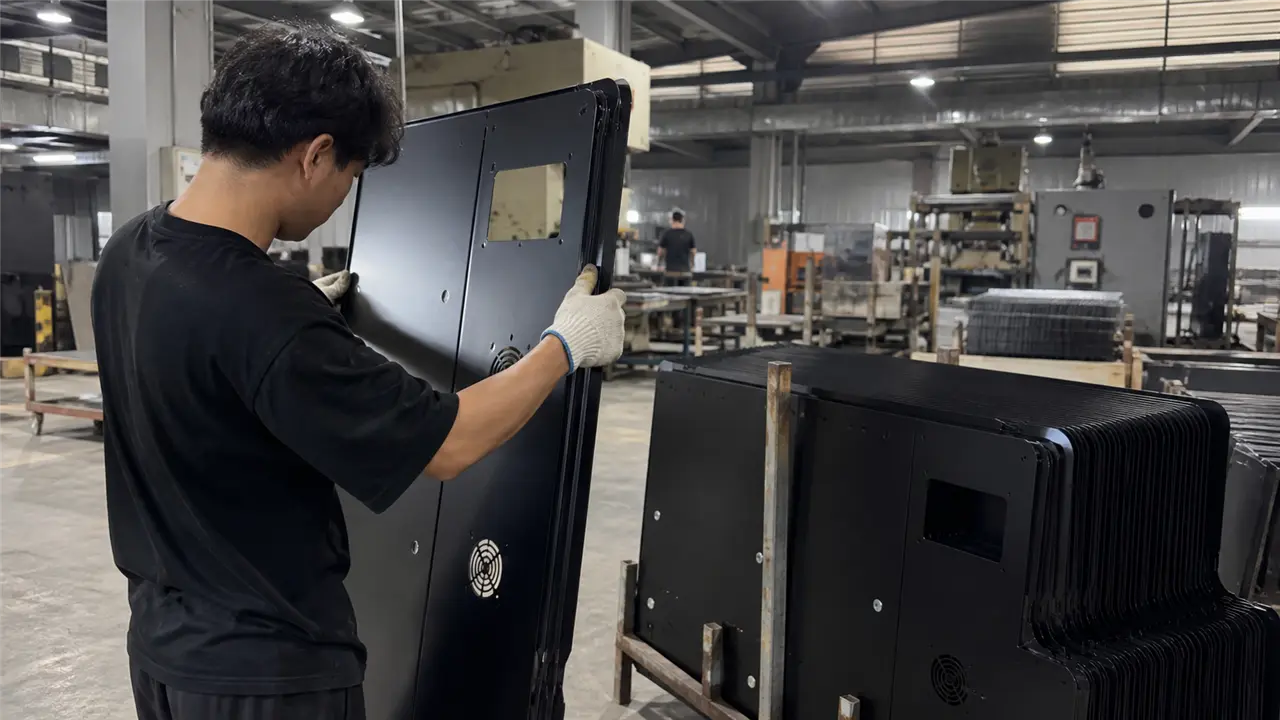
The secret to seamless panel alignment and zero-gap assembly lies in our multi-million-dollar fabrication equipment. Manual cutting and bending inevitably introduce human error, leading to squeaky joints, light leaks, and vulnerable seams. We rely entirely on automated, high-precision industrial machinery.
Achieving Zero Tolerance with Fiber Laser Cutting
Our factory floor is equipped with 6000W industrial fiber laser cutting machines that slice through raw steel sheets with a mind-boggling tolerance of just 0.05mm. This microscopic precision ensures that every bolt hole, ventilation slot, and button cutout aligns flawlessly. When mounting a 43-inch curved touchscreen, a variance of even two millimeters can cause the screen to sit unevenly, creating pressure points that eventually crack the display glass. Our laser cutting process guarantees a perfect, tension-free fit for all sensitive electronic peripherals.
Furthermore, laser cutting leaves a smooth, burr-free edge. This is critical not only for aesthetic perfection but also for the safety of our assembly technicians and your future maintenance staff, eliminating the risk of cuts from jagged metal edges during internal servicing.
Structural Integrity via CNC Hydraulic Press Brake Bending
Following the laser cutting phase, the flat metal profiles move to our CNC hydraulic press brake bending stations. Traditional folding methods often result in micro-fractures along the bend line or inconsistent angles. Our CNC press brakes use digitally controlled hydraulic force to achieve exact, repeatable angles across thousands of units.
By bending complex geometric profiles out of a single continuous sheet of steel rather than welding multiple pieces together, we drastically increase the cabinet’s structural integrity. Fewer welds mean fewer weak points. The result is a unified, monolithic chassis that feels incredibly solid and premium to the touch. This robust bending technique also allows us to create sleek, modern curves and ergonomic control panels that provide maximum comfort for players during marathon gaming sessions, thereby increasing coin-in revenue.
Customized Branding with Laser Etched Backlit Side Panels
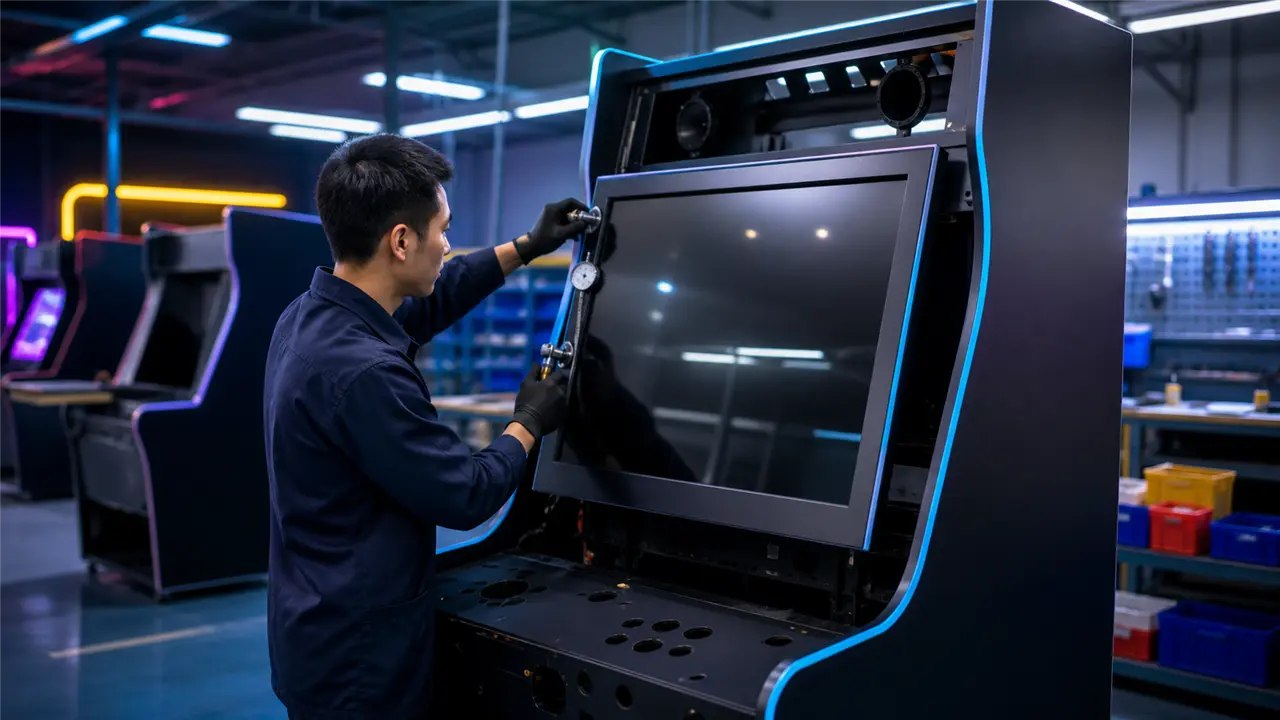
In today’s highly competitive arcade and casino environments, your cabinet must serve as its own illuminated billboard. A plain black box simply will not attract players away from competing machines. Our ODM service specializes in transforming the cabinet exterior into a visually explosive extension of your brand identity.
High Fidelity Acrylic and LED Integration
We utilize high-transmittance industrial acrylic for marquees, button decks, and side panels. Through precision laser etching, we can engrave your custom logos, character art, or geometric patterns directly into the acrylic surface. When backlit by our addressable RGB LED matrices, the etched designs catch the light, creating a stunning, floating neon effect that demands attention.
We do not just slap on generic LED strips. Our engineering team designs custom PCB LED arrays that sync seamlessly with the game’s software events. When a player hits a jackpot or triggers a bonus round, the entire cabinet can pulse, strobe, or chase colors in perfect harmony with the on-screen action and audio system. This integrated audiovisual feedback loop is a proven psychological trigger that enhances player excitement and retention.
Tempered Glass Bezels and Scratch Resistant Graphics
For the main monitor bezels and player control surfaces, we employ edge-to-edge tempered glass. Unlike cheap plastics that yellow and scratch over time, our tempered glass remains crystal clear and highly responsive to touch inputs. We utilize reverse-printed UV silk-screening on the back side of the glass. This means the vibrant graphics and branding are permanently protected behind a thick layer of shatter-resistant glass, entirely immune to scratching, fading, or vandalism from disgruntled players.
Modular Sub Assembly and Compact Flat Pack Shipping Economics
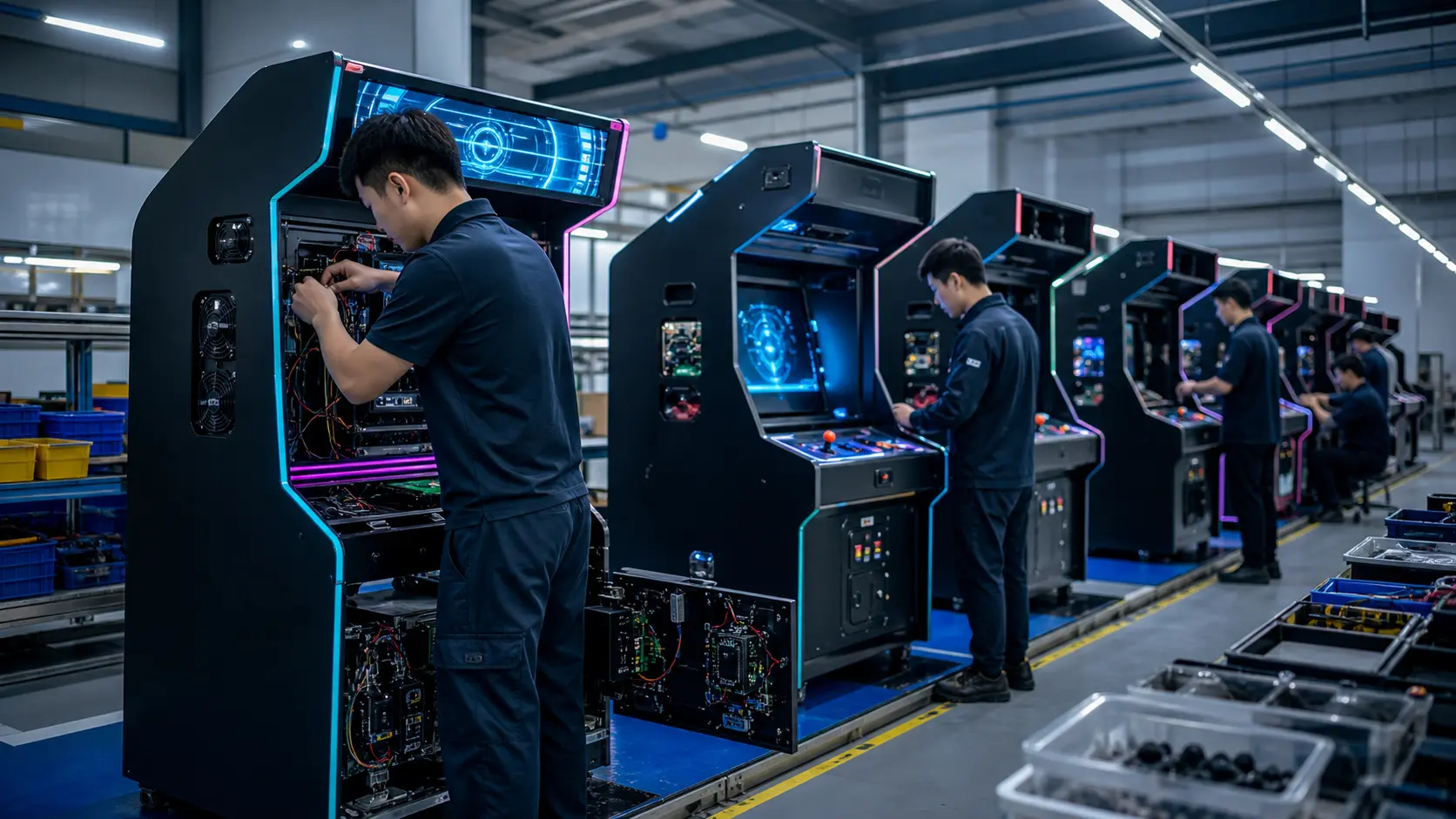
Shipping fully assembled, hollow steel cabinets across the Pacific Ocean is an incredibly inefficient use of expensive shipping container volume. As a seasoned OEM manufacturer, we engineer our cabinets with global logistics in mind, optimizing every cubic centimeter to maximize your freight ROI.
Intelligent Flat Pack Architectural Design
Through clever engineering, we design our custom cabinets utilizing a modular sub-assembly architecture. The heavy base, the main structural pillars, the control deck, and the monitor housing are manufactured as interlocking modules. These components can be shipped in a high-density flat-pack configuration, drastically reducing the volumetric weight of your order.
A standard 40HQ shipping container that might only hold 40 fully assembled oversized cabinets can comfortably fit over 120 units when engineered for modular flat-packing. This slashes your per-unit ocean freight cost by up to 60%, delivering massive bottom-line savings that significantly accelerate your return on investment (ROI).
Rapid Reassembly and Deployment
You might worry that a flat-pack design means a flimsy final product or a nightmare assembly process. We have solved this. Our cabinets utilize heavy-duty industrial cam locks, precision-threaded inserts, and interlocking steel tabs. No welding or specialized tools are required at the destination. Two technicians can assemble a complete, rigid cabinet in under 20 minutes.
To ensure complete transparency and peace of mind during the transit process, all packaging adheres strictly to our ocean freight packaging protocol, utilizing moisture-barrier vacuum sealing, shock-absorbing EPE foam, and fumigated solid wood crating to guarantee zero transit damage.
Fast Turnaround Prototyping and Volume Production Scaling
Time to market is critical in the gaming industry. A brilliant game concept is useless if the hardware takes six months to finalize. Our integrated factory ecosystem allows us to compress the traditional manufacturing timeline without sacrificing quality.
The Ten Day Physical Prototype Guarantee
Once you approve the final SolidWorks 3D renderings, our rapid prototyping division goes into overdrive. Because our design engineers and the factory floor operate in the same facility, there is zero communication lag. We bypass the slow back-and-forth of outsourcing. We can cut, bend, weld, paint, wire, and assemble a fully functional, physical pilot unit in just 10 days.
This prototype is not a mock-up; it is a production-grade unit. You can install your game boards, test the thermal load, evaluate the ergonomics, and present it to your stakeholders or regulatory testing labs. If tweaks are needed, we adjust the parametric CAD model and push the update to the laser cutters in minutes.
Seamless Scaling to Mass Volume Production
Once the prototype is validated, scaling up to mass production is simply a matter of feeding the finalized G-code into our automated machinery. Whether you need an initial test run of 50 units or a massive rollout of 2,000 cabinets for a national franchise, our facility is equipped to handle the volume.
We implement stringent Quality Assurance (QA) checkpoints at every stage: metal thickness verification, paint adhesion cross-cut testing, electrical hi-pot testing, and a mandatory 48-hour burn-in stress test for all electronic components. We actively encourage our international distributors to utilize our onsite FAT inspection checklist (Factory Acceptance Testing) to verify the flawless execution of their bulk orders prior to container loading.
Start Your Bespoke Cabinet Project Today
Stop settling for generic, off-the-shelf cabinets that dilute your brand and fail your operators. Elevate your hardware to match the quality of your software. Partner with a true source manufacturer capable of delivering industrial-grade sheet metal engineering, breathtaking customized aesthetics, and highly optimized shipping logistics.
We also offer complete Turnkey Solutions, including game software customization, 100% source code ownership buyouts, and remote live arcade IoT integration.
Ready to build your ultimate arcade cabinet? Connect with our engineering team directly for a confidential technical consultation and rapid 24-hour CAD design quote.
- Contact: Engineer Wang (Lead Hardware & Game System Architect)
- WhatsApp / WeChat: +86 17620842078
- Telegram: https://t.me/JLwyc
- Email: miba515527@gmail.com
- Factory Location: Panyu Manufacturing Base, Guangzhou, China
Frequently Asked Questions
What is the minimum order quantity (MOQ) for a completely custom ODM cabinet design? To justify the CAD engineering and machinery setup costs, we typically require an MOQ of 20 to 50 units for a fully bespoke sheet metal design. However, we are happy to produce a single prototype unit first to validate the design before you commit to a bulk order.
Can you match our specific corporate pantone colors for the cabinet paint? Absolutely. Our electrostatic powder coating line can match any specified Pantone or RAL color code. We can also provide dual-tone finishes, metallic flakes, and matte or high-gloss textures to perfectly align with your brand identity.
Do your custom cabinets meet international electrical safety certifications? Yes. All our wiring harnesses, power supplies (such as Mean Well), and electronic components are CE, RoHS, and UL compliant. We design the electrical distribution to meet strict international standards, ensuring smooth import customs clearance and safe operation in any jurisdiction.
How do you protect my intellectual property (IP) for custom cabinet designs? We operate under strict Non-Disclosure Agreements (NDAs). As a source manufacturer focused on B2B long-term partnerships, we absolutely never share your custom CAD files, schematics, or finished cabinet designs with other clients. Your bespoke design remains exclusively yours.
Can you integrate specialized hardware like bill validators, ticket dispensers, or card readers into the design? Yes. During the SolidWorks 3D modeling phase, you provide the specifications or dummy models for your preferred peripheral hardware (e.g., JCM bill validators, ICT printers, Nayax card readers). We precisely engineer the mounting brackets, cutouts, and cable routing paths to ensure seamless plug-and-play integration on your assembly line.
html