- Overcoming Video Capture Challenges for Large Format Displays
- Direct HDMI and SDI Hardware Loop-Out Capture Architecture
- Dual-Camera Composite Streaming for Physical Authenticity
- Engineering the Sub-80ms WebRTC Glass-to-Glass Pipeline
- Audio and Control Synchronization Achieving Zero Input Lag
- Partner with a Proven Manufacturer for Your Remote Arcade Expansion
- Technical FAQ
When global arcade operators expand into the cloud telemetry business, the immediate technical hurdle is transferring the fast-paced, visually complex gameplay of physical fish tables over the internet with zero perceived lag. I am Engineer Wang, Senior Video & Infrastructure Systems Architect at Guangzhou Miba Animation Technology Co., Ltd. (Arcade Manufacturer). From our 15,000m² manufacturing base in Panyu, China, our team of 50 R&D engineers has spent the last decade perfecting complete machine manufacturing and remote teleoperation systems. Today, we are deep diving into the ultra-low-latency video encoding and real-time WebRTC streaming architectures we build into our bespoke remote live arcade solutions.
Operators looking for a reliable setup cannot rely on consumer-grade webcams pointing at a screen. You need a robust, industrial-grade video pipeline capable of capturing 4K graphics at 60 frames per second and transmitting them across continents in under 80 milliseconds. For a complete understanding of how we integrate this into a custom build, refer to our remote live fish table machine custom deployment.
Overcoming Video Capture Challenges for Large Format Displays
Modern physical fish hunter games operate on 55-inch, 65-inch, or 85-inch 4K displays featuring extremely dynamic fish movement, high-frequency weapon particle effects, and rapid color transitions. Capturing this visual density without motion blur, artifacting, or dropped frames is an engineering feat.
If you just point an external IP camera at a glossy LCD screen, you immediately encounter moiré patterns, screen glare from ambient warehouse lighting, and a massive loss of color accuracy. More importantly, camera sensors introduce a minimum of 30ms to 50ms of capture latency before the image even reaches the encoder. In competitive fish shooting games where a fraction of a second determines whether a player catches the high-multiplier boss fish, this input lag is unacceptable and will destroy your player retention rates.
Our engineering standard dictates a direct hardware capture approach. We bypass the physical screen’s limitations by directly intercepting the game board’s video output signal. This requires specialized industrial components built specifically for continuous 24/7/365 arcade operation. If you are interested in how the physical hardware interfaces with these capture cards, you can review our multiplayer remote fish table hardware modification documentation.
Direct HDMI and SDI Hardware Loop-Out Capture Architecture
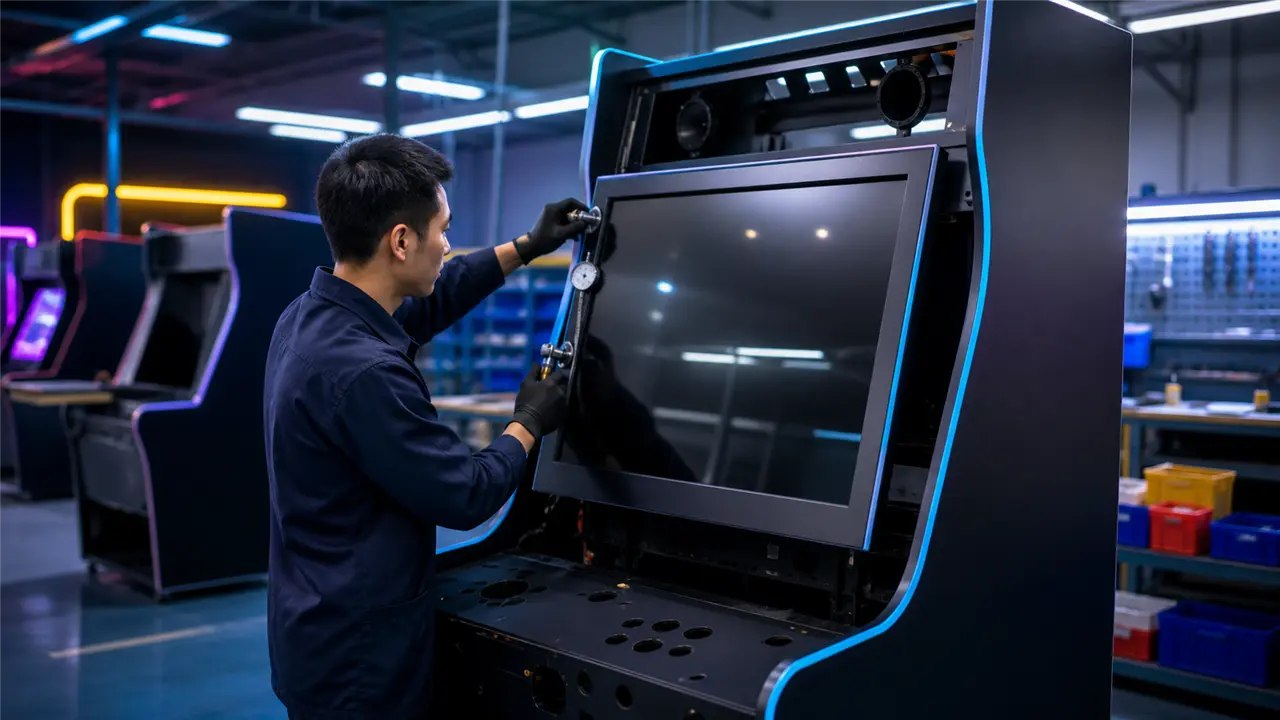
In our Panyu QA lab, our protocol mandates direct HDMI or SDI 4K@60fps hardware loop-out capture. Instead of relying on software encoding which taxes the game board’s CPU and causes game logic stutter, we install dedicated PCIe or FPGA-based capture modules inline between the game host and the display.
This hardware interception guarantees that the exact raw video feed intended for the monitor is duplicated and routed to a dedicated encoding DSP (Digital Signal Processor). By utilizing hardware-accelerated H.264 or H.265 (HEVC) encoding on these specialized chips, we achieve a baseline encoding latency of less than 15 milliseconds.
This process involves: 1. Signal Splitting: A zero-latency industrial video matrix splits the HDMI signal. 2. Hardware Encoding: The dedicated capture module compresses the raw 4K@60fps feed into a manageable H.265 bitstream. 3. Network Payload Packaging: The encoded frames are immediately packed into RTP/UDP packets for WebRTC transmission.
This direct capture pipeline ensures absolute visual clarity, preserving the vibrant colors and sharp details of the game. It also prevents the game board from thermal throttling, as the video encoding workload is completely offloaded to our IoT teleoperation gateway.
Dual-Camera Composite Streaming for Physical Authenticity
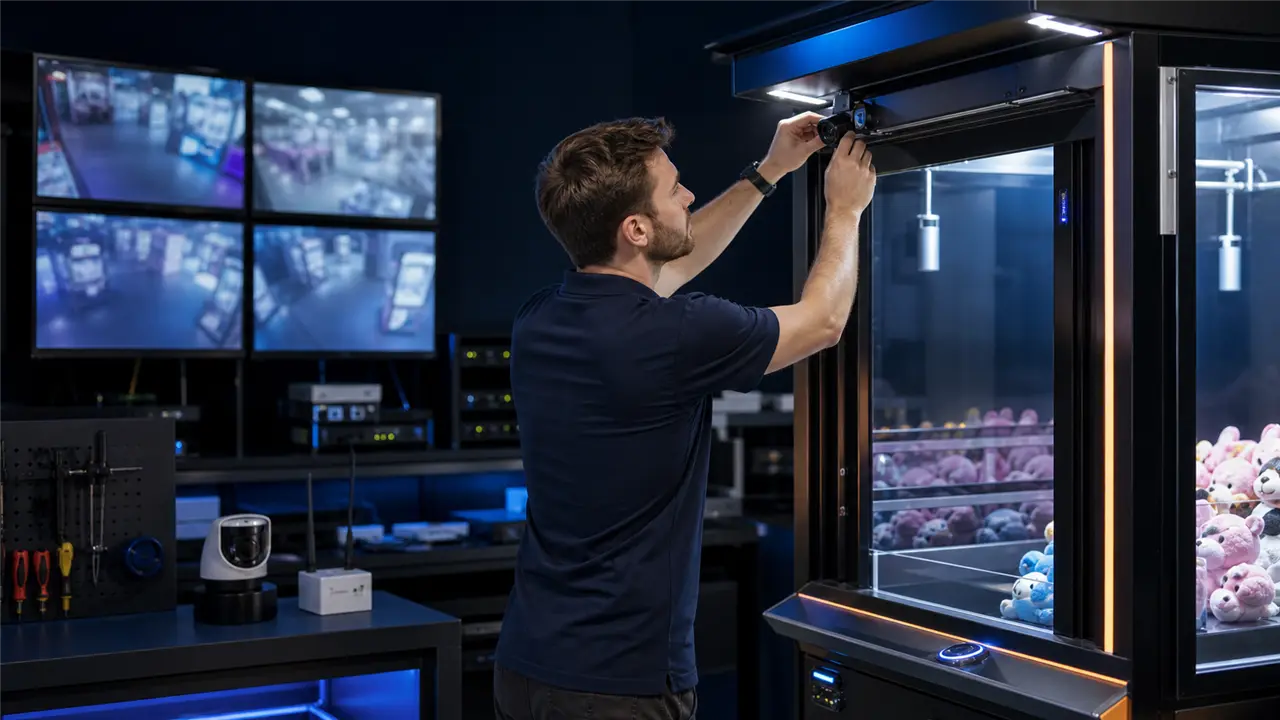
While the direct HDMI feed provides the ultimate gameplay visibility, players on remote apps still demand proof that they are controlling a real, physical machine rather than a purely virtual software simulation. To bridge this trust gap, we implement a dual-camera composite streaming layout.
The composite stream merges two distinct video sources: 1. The Player View: The crisp, direct HDMI loop-out capture covering 80% to 90% of the mobile app screen. 2. The Authenticity View: A wide-angle IP camera mounted above the physical cabinet in the server room, showing the physical joystick actuations (if automated via relays), coin hopper payouts, or simply the physical cabinet’s bezel and ambient environment.
Our IoT edge servers perform this video compositing in real-time, matching the timestamps of both video feeds before sending them through the WebRTC pipeline. This ensures that when the player fires a bullet, they see the bullet on the direct feed and simultaneously see the physical cabinet react in the wide-angle view without any desynchronization. You can explore the broader architecture of this dual-stream system in our remote live arcade turnkey system breakdown.
Engineering the Sub-80ms WebRTC Glass-to-Glass Pipeline
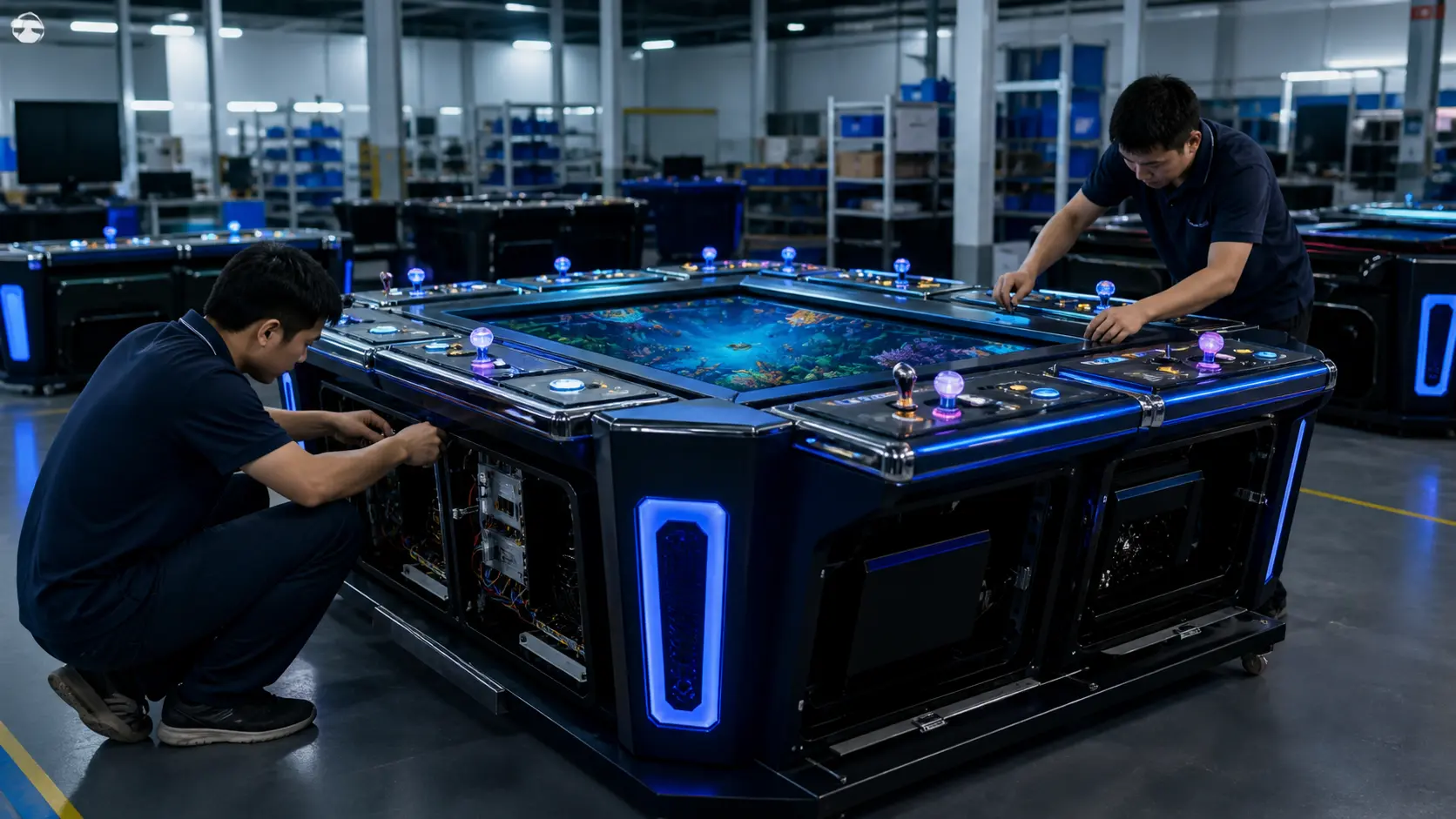
Capturing the video quickly is only half the battle. Delivering it across the globe in under 80 milliseconds (the “glass-to-glass” latency from the physical screen to the player’s mobile glass) requires an aggressively optimized WebRTC architecture. Standard streaming protocols like RTMP or HLS introduce 3 to 10 seconds of delay, which is entirely unusable for real-time arcade gaming.
WebRTC utilizes UDP (User Datagram Protocol) to prioritize speed over guaranteed packet delivery. However, the open internet is chaotic. To maintain a smooth stream despite packet loss and network jitter, our network engineers implement several advanced strategies:
- Jitter Buffer Minimization: We tune the WebRTC jitter buffer on the client app to the absolute minimum safe threshold. Rather than buffering frames to ensure smooth playback (which adds latency), we instruct the player to render frames as quickly as possible.
- Aggressive Frame Dropping Strategies: If a packet arrives late, it is immediately discarded. The decoder is optimized to recover from dropped I-frames or P-frames almost instantly without causing visual corruption.
- Forward Error Correction (FEC): We inject redundant parity packets into the video stream. If a video packet is lost in transit, the client can use the FEC packets to mathematically reconstruct the missing frame without requesting a retransmission, saving precious milliseconds.
- STUN and TURN Edge Server Deployment: We assist operators in deploying distributed STUN and TURN relay servers close to their target player demographics. This ensures the shortest possible network route and bypasses strict NAT firewalls.
Scaling this WebRTC infrastructure across dozens of machines requires robust backend management. You can learn more about how we structure the server racks for this in our cloud fish table machine farm deployment guide.
Audio and Control Synchronization Achieving Zero Input Lag
Video is only one dimension of the player experience. The audio and the control inputs must be perfectly synchronized with the visual feed. When a player taps the ‘Fire’ button on their mobile app, the physical machine in our warehouse must actuate the firing relay, register the bullet, and transmit the resulting sound effect back to the player simultaneously.
Audio Capture and Encoding: We tap directly into the game board’s analog or digital audio outputs, routing them into an ultra-low-latency Opus audio encoder. The Opus codec is specifically designed for interactive real-time applications, offering excellent compression without sacrificing the punchy, dynamic sound effects of arcade games. The audio and video streams are multiplexed at the hardware level, ensuring perfect lip-sync equivalent alignment.
Control Synchronization: The control pathway is handled by a separate WebSocket or raw TCP/UDP control channel, which operates concurrently with the WebRTC stream. When the player triggers a command, the packet travels to our proprietary IoT control board inside the cabinet. Because we manufacture the entire system, we optimize the GPIO relay firing speed to actuate in under 2 milliseconds.
This holistic approach guarantees zero perceived input lag. The player feels directly connected to the physical hardware, providing the immersive, satisfying tactile response that keeps them engaged and spending credits. We detail how this logic is managed at scale in our remote fish table room allocation backend.
Partner with a Proven Manufacturer for Your Remote Arcade Expansion
Building a reliable remote live arcade is not about stringing together consumer webcams and generic streaming software. It requires deep vertical integration of industrial hardware, optimized network protocols, and real-time software engineering. At Guangzhou Miba Animation Technology Co., Ltd., we provide true turnkey solutions, delivering 100% bespoke hardware cabinets, proprietary IoT control systems, and robust WebRTC streaming pipelines.
If you are an operator looking to deploy a high-performance, ultra-low-latency remote fish table fleet, we have the manufacturing scale and engineering expertise to guarantee your success. Reach out to us for a technical consultation, structural blueprint review, or 24-hour factory direct quotation.
Contact Engineer Wang for Technical Consultation & Quotations:
- WhatsApp/WeChat: +86 17620842078
- Telegram: https://t.me/JLwyc
- Email: miba515527@gmail.com
Technical FAQ
html
“`
Why is RTMP not used for [remote live arcade](/remote-live-arcade-dual-camera-webrtc-pipeline/) streaming?
RTMP (Real-Time Messaging Protocol) is built on TCP, which requires packet acknowledgment and buffering. This inherently introduces 2 to 5 seconds of latency, making it impossible to use for fast-paced arcade games that require sub-80ms reaction times. WebRTC over UDP is the only viable protocol for zero-lag remote gameplay.
What is the difference between software encoding and hardware capture for fish tables?
Software encoding forces the game board’s CPU to compress video, causing frame drops and game logic lag. Hardware capture uses a dedicated PCIe or FPGA device to intercept the HDMI signal and compress it independently, offloading the work and achieving less than 15ms encoding latency.
How does Forward Error Correction (FEC) improve remote arcade video?
FEC sends redundant data alongside the video stream. If network jitter or packet loss occurs over the open internet, the receiving app uses this redundant data to rebuild the missing video frame instantly, rather than waiting for the server to resend it, preserving the ultra-low latency.