- Resolving Legacy Communication Bottlenecks for Cloud Operators
- Physical Layer Engineering for the SAS Protocol Standard
- Designing the Continuous Polling Engine Architecture
- Advanced Funds Transfer Cashless Wagering Execution
- Multi Meter Accounting and Cryptographic Cloud Audit Logs
- Automated Machine Tilt Resolution and Maintenance
- Production Capabilities at Our Panyu Manufacturing Base
- Frequently Asked Questions FAQ
As a Senior Casino Protocols and Low-Latency Video Systems Architect Engineer, I have spent the last decade debugging, reverse-engineering, and integrating legacy slot machine communication standards. The Slot Accounting System protocol, universally known as SAS, remains the undisputed backbone of land-based casino floors globally. However, adapting this legacy standard designed for 1980s-era serial links to modern, high-speed, cloud-native sweepstakes and cashless arcade platforms requires intense hardware and software engineering.
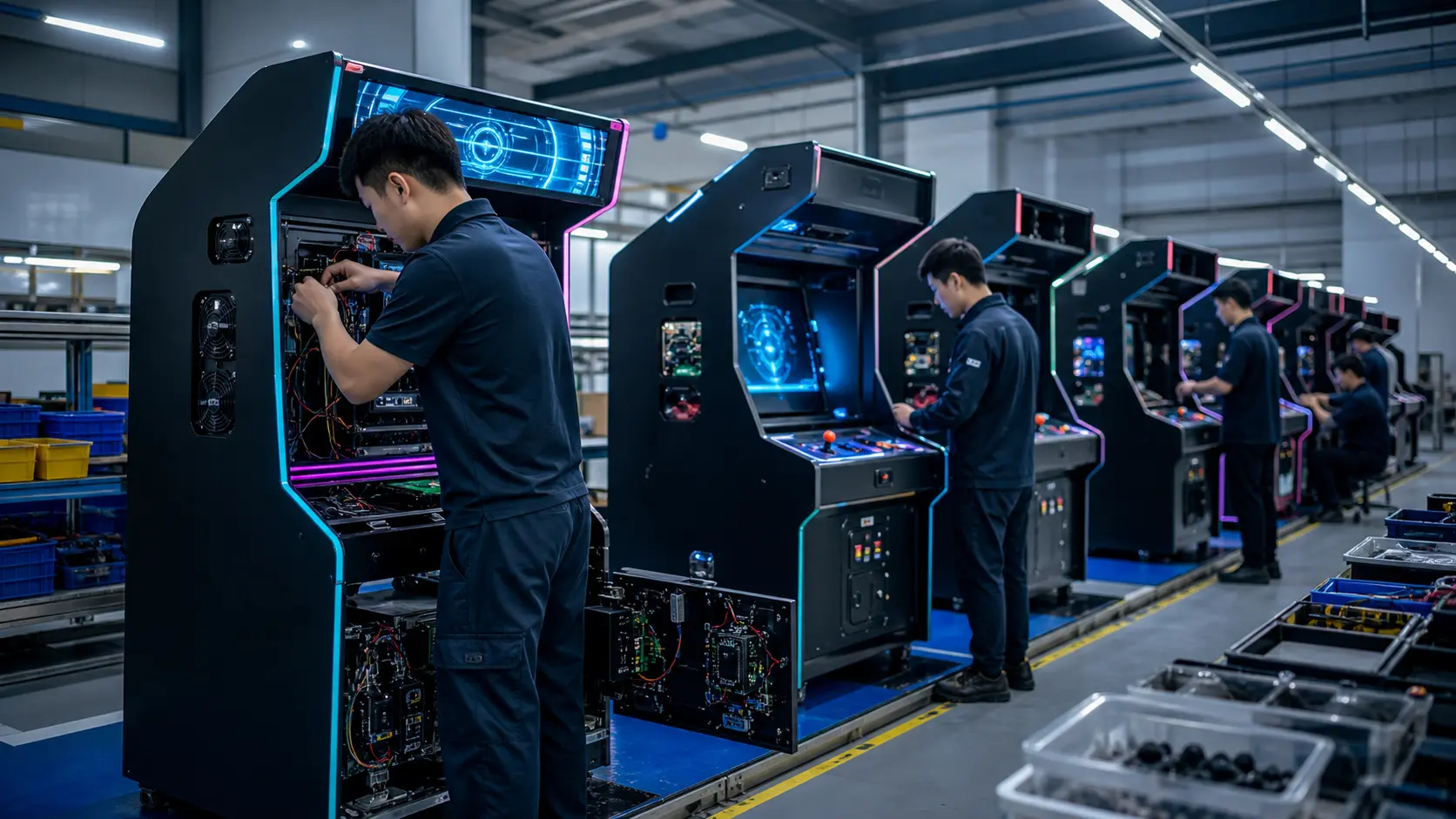
At our Guangzhou Miba Animation Technology Co., Ltd. facility, we bridge the gap between traditional casino engineering and modern IoT network topology. Inside our Panyu 15,000m² manufacturing base, we don’t just build hardware cabinets; we engineer complete, turnkey, full-stack ecosystems. Whether operators are looking to deploy a remote live arcade turnkey system or upgrade their on-premise floors to 100% cashless operation, understanding the rigorous demands of SAS 6.02 is strictly non-negotiable.
This deep dive explains how our custom-designed protocol gateways interact with Electronic Gaming Machines (EGMs) to deliver seamless Advanced Funds Transfer (AFT), multi-meter accounting, and real-time remote telemetry.
Resolving Legacy Communication Bottlenecks for Cloud Operators

The primary friction point for operators bridging land-based machines to the cloud is the fundamental mismatch in architectural philosophy. EGMs are explicitly designed to be physically isolated, highly secure, and slow-communicating deterministic state machines. Conversely, modern sweepstakes software and remote live streaming applications expect asynchronous, high-bandwidth, API-driven RESTful or WebSocket communications.
I regularly see operators attempt to bridge this divide using cheap off-the-shelf serial-to-USB adapters paired with generic script wrappers. These invariably fail under the load of a live casino floor. When an EGM sends an exception code indicating a bill jam or a jackpot lockup, the host controller must acknowledge the event within a strictly enforced 20-millisecond timing window. Failure to meet these polling timing constraints causes the EGM to declare a communication timeout and lock up, displaying a “TILT” or “HOST COMM ERROR” message that stops gameplay and bleeds operator revenue.
To solve this, we engineer dedicated embedded gateway microcontrollers that sit at the edge, directly inside the slot machine cabinet. These edge nodes handle the strict, microsecond-accurate serial polling loop required by the EGM natively, and then translate those state changes into secure, encrypted TCP/IP payloads transmitted to our cloud backends. This edge-computing architecture is exactly what powers our remote live slot machine turnkey system, ensuring the physical machine never realizes it is being operated by a player on a smartphone 5,000 miles away.
Physical Layer Engineering for the SAS Protocol Standard
The physical layer of the SAS protocol is notoriously unforgiving. To integrate successfully, you must conquer the hardware characteristics before writing a single line of software.
The 19200 Baud 9 Bit Serial Challenge
SAS 6.02 operates at 19,200 baud, which is glacially slow by today’s standards. More critically, it utilizes a 9-bit serial protocol format (1 start bit, 8 data bits, 1 wake-up bit, 1 stop bit). The 9th bit, known as the “wake-up bit,” is a clever hardware-level optimization designed for multi-drop networks where multiple EGMs share a single polling wire.
When the host wants to address a specific machine, it sets the 9th bit high on the first byte of the packet (the address byte). The UART microcontrollers inside the EGMs are configured to ignore all incoming serial traffic until they see a byte with the 9th bit set. Once an EGM sees its own address with the wake-up bit, it begins listening to the subsequent payload bytes (where the 9th bit is pulled low).
Standard PC hardware and conventional Linux serial drivers struggle massively with 9-bit serial because standard UARTs (like the ubiquitous 16550) are hardwired for 8-bit frames. In our factory, we bypass standard UART limitations by utilizing specialized microcontrollers (such as STM32 Cortex-M4 series) configured specifically for 9-bit addressing mode. This guarantees zero software overhead and zero missed wake-up bits, eliminating the dropped packets that plague amateur integration attempts.
Optical Current Loop and RS232 Level Shifting
Another massive hurdle is the physical electrical standard. While the protocol is logical serial, the physical transport on legacy boards is not standard RS-232 voltage levels (+/- 12V). Instead, SAS historically relies on an optical current loop.
A casino floor is a disastrously noisy electrical environment. Hundreds of machines with switching power supplies, neon ballasts, and fluorescent lights generate massive electromagnetic interference (EMI) and ground loops. If you simply wire the ground of a host server to the ground of 50 slot machines, the resulting ground loop will destroy the I/O chips on the motherboards.
We utilize specialized opto-isolated current loop converters. The transmission line relies on the presence or absence of a 20mA current to represent logic states, passing through an optocoupler (like the PC817 or MOC3021) that uses infrared light to transmit the data across a physical air gap. This provides total galvanic isolation. When we combine this isolation with our physical slot machine button relay modification boards, we guarantee that the EGM logic board is completely protected from transient voltage spikes, ensuring a 10-year operational lifespan for our turnkey cabinets.
Designing the Continuous Polling Engine Architecture

Once the physical layer is perfectly electrically isolated and properly clocked for 9-bit wake-ups, the next architectural layer is the Polling Engine. SAS is a strictly Master-Slave protocol. The EGM (Slave) will absolutely never speak unless spoken to by the Host (Master). If the Host stops talking, the EGM assumes the casino network has crashed and will lock itself out to prevent unregulated play.
General Polls and Long Polls
Our gateway firmware executes a deterministic, infinite loop of polling. The foundation of this loop is the General Poll (GP). The host constantly sends the single byte `80h` (with the wake-up bit set for the specific machine address). The EGM must respond immediately.
If nothing has happened at the machine, the EGM responds with `00h` (No Activity). However, if a player has inserted a bill, pressed a button, or hit a jackpot, the EGM holds this information in an internal buffer. Upon receiving the General Poll, the EGM will reply with a single-byte exception code (for example, `71h` for “Bill Validator Door Open” or `51h` for “Handpay is pending”).
When the host receives an exception code from a GP, it must acknowledge it, typically by sending a Long Poll (LP). Long Polls are multi-byte packets that request detailed information. For example, if the machine reports a bill was inserted, the host sends a Long Poll to ask “What was the denomination of the bill?” The machine replies with the exact currency value. The host then sends an acknowledgment, and only then will the EGM clear that event from its internal memory.
Real Time Exception Reporting and Machine State
Building a robust polling engine requires an incredibly strict state machine on the host side. EGMs have limited memory buffers for exceptions. If the host software gets bogged down doing database queries or waiting for a cloud HTTP response, it will miss the 20-millisecond polling window. The EGM buffer will overflow, and the machine will crash.
We solve this by separating the real-time polling loop from the cloud communication logic. Core Polling runs on a dedicated RTOS (Real-Time Operating System) thread. When it detects exceptions, it places them in a thread-safe FIFO queue. A secondary background thread consumes this queue, wraps the events in JSON, and securely transmits them via WebSockets to our cloud infrastructure. This dual-thread architecture guarantees the EGM is polled exactly every 40 milliseconds, regardless of internet latency or server load.
Advanced Funds Transfer Cashless Wagering Execution
For modern arcade operators, managing physical coins and paper tickets (TITO) is an operational nightmare. Hardware mechanisms break, bill validators get jammed, and cash collection introduces severe security risks. The ultimate solution is Advanced Funds Transfer (AFT), standard within SAS 6.02, which allows us to inject and extract digital credits entirely over the network.
Injecting Digital Sweepstakes Credits
AFT allows our cloud systems to bypass physical payment hardware entirely. When a player logs into one of our sweepstakes apps and decides to play a specific physical machine on the floor, our system initiates a cashless transfer.
This process relies heavily on a synchronized slot machine pulse simulation sweepstakes ledger. The cloud validates the player’s balance, deducts the digital funds from their wallet, and sends an instruction down to the edge gateway.
The edge gateway translates this into a highly specific SAS AFT Long Poll sequence. First, the host sends an AFT Lock command to ensure the EGM is idle and no physical player is currently interacting with the cash mechanisms. Once locked, the host sends a “Transfer Funds to Machine” command, embedding the exact dollar value and a unique transaction ID.
Transaction Sequence and Verification
The machine processes the transfer, updates its internal RAM and non-volatile NVRAM meters, and responds with a transfer receipt containing the transaction ID and the new machine balance. Only after this cryptographic handshake is verified does our system send the AFT Unlock command, allowing the game to proceed.
If the power is cut at the exact millisecond the transfer occurs, the SAS AFT protocol utilizes a sophisticated state-recovery mechanism. Upon reboot, the host interrogates the EGM’s AFT transaction history buffer. If the transaction was completed before the power failure, the cloud ledger considers it settled. If the EGM never registered it, the cloud ledger refunds the player. This atomic transaction guarantee ensures that operators never lose money to desynchronization errors, and players are never shortchanged by network drops.
Multi Meter Accounting and Cryptographic Cloud Audit Logs
No commercial arcade system is complete without rigorous, verifiable accounting. Relying on hand-written logs or mechanical meter readings is a recipe for employee theft and operator ruin. The SAS protocol exposes deep, unalterable accounting meters that we extract and cloud-sync continuously.
Extracting Core Accounting Meters
Using SAS Long Polls, our gateways extract the critical lifecycle meters of the EGM
- Total In (Total amount wagered by the player)
- Total Out (Total amount won by the player)
- Total Cancelled Credits (Amounts cashed out via handpay)
- Total Games Played
- Coin Drop and Bill Drop values
By constantly polling these meters, our turnkey sweepstakes software backend maintains a real-time, shadow copy of the machine’s internal NVRAM. This allows operators to sit in an office in another country and watch the exact profitability, RTP (Return to Player), and coin-in velocity of a specific cabinet on a live dashboard.
Immutable Audit Trails for Compliance
Because we service B2B operators scaling into regulated and semi-regulated sweepstakes markets, data integrity is paramount. As we pull meter data via SAS, our edge microcontrollers apply a cryptographic SHA-256 hash to the payload, timestamp it, and sign it with a unique hardware key before transmission.
When this data lands in our AWS/GCP cloud environments, the signature is verified. This creates an immutable, cryptographically verifiable audit log. If a dispute arises over a massive jackpot, or if an operator suspects an employee of skimming, they can pull the cryptographic audit log. This proves exactly what the EGM hardware reported to the millisecond, completely bypassing human intervention.
Automated Machine Tilt Resolution and Maintenance
Physical hardware in high-traffic environments inevitably experiences faults. Bill validators get jammed with crumpled currency, main doors are left unlatched by careless technicians, and internal logic boards throw parity errors. In the SAS protocol, these are called “Tilts.”
When a machine tilts, revenue drops to zero until it is fixed. In traditional setups, a floor attendant must physically walk to the machine with a key, open the door, clear the error, and reset the board.
Through our deep SAS 6.02 integration, we have automated the majority of tilt resolution. When the gateway detects a non-critical tilt (such as a memory warning or an AFT buffer overflow), our cloud management system can issue remote reset commands. We utilize SAS Long Polls to force the machine to clear its error state, run a self-diagnostic, and return to an idle state. For physical faults (like a jammed hopper), the system instantly fires Telegram and SMS alerts to the operator’s maintenance crew, complete with the exact SAS hex error code and the recommended hardware fix, drastically reducing machine downtime.
Production Capabilities at Our Panyu Manufacturing Base
At Guangzhou Miba Animation Technology Co., Ltd., we refuse to cobble together third-party components. Integration at this level requires total control over the manufacturing pipeline. In our Panyu 15,000m² factory, we design the PCBs, surface-mount the ICs, and write the C/C++ firmware that executes the SAS protocol.
Because we write the firmware, we can dynamically adjust polling timings, voltage thresholds, and exception handling routines to match the exact quirks of specific EGM manufacturers (from Aristocrat and IGT to custom 8-liner boards). When you purchase turnkey cabinets or cloud integration services from us, you are buying 100% proprietary, factory-direct engineering. We provide source-code-level buyouts, complete hardware schematics, and white-labeled administrative backends for major distributors.
If you are an operator looking to eliminate cash handling, bring legacy machines onto a cloud network, or build a remote-teleoperation gaming floor from the ground up, skip the middlemen. Go straight to the source factory that engineers the protocols.
Reach out to our engineering team directly for a technical consultation, a live video factory tour, or a hardware sample shipment.
WhatsApp/WeChat: +86 17620842078 Telegram: https://t.me/JLwyc Email: miba515527@gmail.com
Frequently Asked Questions FAQ
Why does my SAS to USB serial converter keep dropping connections with the EGM? Standard USB serial converters cannot natively handle the 9-bit wake-up protocol required by SAS without heavy software emulation, which introduces latency. Additionally, USB lacks the optical isolation necessary to prevent ground loops. You must use a dedicated, opto-isolated microcontroller capable of native 9-bit UART operations to maintain a stable connection.
Can AFT Cashless transfers completely replace my physical coin hoppers and bill validators? Yes. By integrating SAS 6.02 AFT commands, the game board’s software is tricked into believing credits are being inserted via a validator or paid out via a hopper. This allows you to completely remove the physical mechanical hardware, dramatically reducing cabinet maintenance, eliminating coin jams, and preventing employee cash theft.
How fast is the polling loop between your cloud gateway and the EGM? Our edge microcontrollers run a Real-Time Operating System (RTOS) that polls the EGM every 20 to 40 milliseconds, depending on the specific manufacturer’s tolerance. This ensures that all button presses, jackpot events, and tilts are captured instantaneously without overflowing the machine’s internal buffer.
Is it possible to remotely reset a machine that is in a Tilt state over the cloud? It depends on the severity of the Tilt. Software-based tilts (like AFT desynchronization or soft memory errors) can be cleared remotely using specific SAS administrative commands. However, physical hardware faults (like a broken microswitch or a physically jammed bill validator) require a human technician, though our system will instantly ping your staff with the exact error code.