- The Economics of Unattended Venues How a Jammed Coin Mechanism Destroys Weekend Profits
- Hardware Fault Telemetry Architecture Current Sensing and Optical Counters
- Automated Recovery and Power Cycling Smart Relays and Watchdog Heartbeats
- Real-Time Telemetry and Notification Pipelines MQTT Brokers and PagerDuty Alerts
- Preventative Maintenance Schedules Lubrication Cycles and Optical Sensor Cleaning
- Granular Sensor Calibration and Microswitch Threshold Verification Protocols
- Frequently Asked Questions
As the lead hardware and game system architect at the Panyu Manufacturing Base in Guangzhou, I have overseen the design, assembly, and deployment of thousands of arcade cabinets globally. From high-torque claw machines destined for Tokyo arcades to complex coin pushers shipped to South America, our 15,000-square-meter facility has seen it all. However, over the past 12 years, the paradigm of arcade operations has shifted dramatically. The traditional model of a brightly lit venue packed with roaming technicians and floor staff is rapidly being replaced by the remote live arcade model.
In a remote live arcade, the physical machines sit in a dark, secure warehouse, completely unattended by human staff, while thousands of players control them via mobile apps from the comfort of their homes. This business model offers unprecedented scalability and global reach, but it introduces a terrifying operational reality: when a machine breaks down at 2 AM, there is no technician on the floor to open the coin door, clear the jam, and reboot the system. For factory-direct procurement and comprehensive engineering specs, consult our master guide on cloud arcade machine teleoperation and turnkey engineering.
An unattended venue is entirely dependent on its hardware telemetry and automated fault recovery systems. Without deep, granular insight into the physical state of every motor, relay, and sensor on the floor, your operation is flying blind. You will bleed revenue through unnoticed downtime, and you will bleed player goodwill through faulty gameplay experiences.
I am Engineer Wang, and in this comprehensive technical deep dive, we will explore the economics of unattended venue failures, the architecture of hardware fault telemetry, and how to build automated self-healing arcade infrastructure that keeps your machines earning 24/7.
Before we delve into the circuitry of limit switches and MQTT brokers, click here to access our bandwidth calculator and edge gateway hardware blueprint to ensure your fundamental infrastructure is ready for advanced telemetry integration.
The Economics of Unattended Venues How a Jammed Coin Mechanism Destroys Weekend Profits
To understand the absolute necessity of hardware fault telemetry, we must first look at the brutal economics of an unattended remote arcade venue.
Imagine a bustling Friday night. Your mobile app is running a massive promotional campaign, and thousands of players are logging in to play your flagship coin pushers and premium plush claw machines. At exactly 8:00 PM, the coin escalator on Machine #42 jams due to a slightly bent token. The main drive motor stalls, and the machine stops dropping coins onto the playfield.
In a traditional arcade, a player would flag down a staff member, the machine would be fixed in three minutes, and the player would resume spending. In an unattended remote arcade with poor telemetry, the scenario is disastrous.
The player taps the “Drop Coin” button on their app. They hear the digital sound effect, and their digital wallet balance decreases, but they see no coin drop on the live video feed. Frustrated, they report a bug and demand a refund. Meanwhile, the machine remains listed as “Online and Available” in the app lobby. Over the next four hours, thirty different players connect to Machine #42, experience the exact same failure, lose their money, and leave furious one-star reviews on the App Store.
By the time the venue operator wakes up the next morning and manually checks the security cameras, the damage is done. Not only has Machine #42 generated zero actual revenue during peak hours, but it has actively destroyed player goodwill, triggered dozens of customer support tickets, and caused chargebacks.
This is the hidden cost of the remote live arcade model. You are trading expensive on-site labor for the absolute necessity of bulletproof iot hardware solutions for arcade operators. A robust telemetry system doesn’t just alert you to a problem; it prevents the cascade of negative user experiences that kill an app’s reputation. The upfront cost of integrating advanced sensors is negligible compared to the continuous bleed of unearned machine holds and lost lifetime player value.
Hardware Fault Telemetry Architecture Current Sensing and Optical Counters
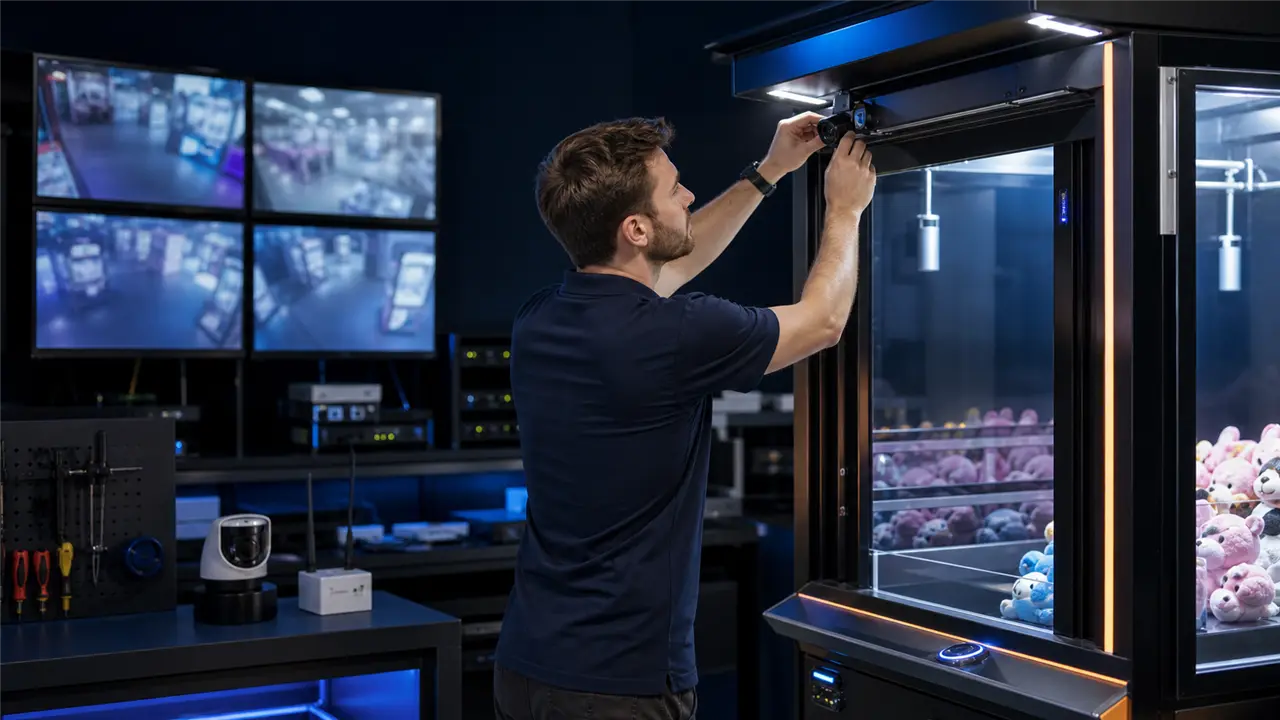
> Unattended remote arcade telemetry combines inline Hall-effect current sensors (ACS712) for motor stall detection, optical coin chute counters, and smart relay PDUs for automated remote AC power cycling. When jams or logic freezes occur, firmware watchdog routines initiate automatic motor reverse sequences, reducing on-site technician dispatches by over 80%.
How do we give eyes and ears to a machine sitting in a dark warehouse? We build a comprehensive hardware fault telemetry architecture that monitors the vital signs of every electromechanical component. In our Panyu factory, we integrate this telemetry directly into the custom JAMMA boards and motor controllers we manufacture.
The most critical telemetry data point for any physical arcade machine is motor health. Whether it is the X-Y gantry motors on a crane machine or the massive wiper motor sweeping the deck of a coin pusher, motor failure equals immediate downtime. We deploy ACS712 Hall-effect current sensors inline with the power supply of every critical motor.
By constantly monitoring the current draw, we can detect faults before they become catastrophic. During normal operation, a gantry motor might draw 1.5 Amps. If the claw gets tangled or hits a physical obstruction, the motor stalls, and the current draw instantly spikes to 4.0 Amps. The edge microcontroller detects this overcurrent condition within milliseconds, immediately cuts power to the motor to prevent the coils from burning out, and flags a “Motor Stall Error” to the central telemetry server.
Similarly, we rely heavily on optical sensors and microswitch limit sensors. In a coin pusher, we install dual optical break-beam sensors on the coin entry chute and the prize payout hopper. If the app commands a coin drop, but the optical sensor does not register a token passing through the chute within 500 milliseconds, the system instantly knows there is a jam or an empty hopper. It immediately takes the machine offline in the app, preventing further players from joining a broken game.
This granular level of hardware monitoring is essential. To understand how these sensors connect back to the central network, review our guide on industrial iot gateway architecture physical arcade control.
Automated Recovery and Power Cycling Smart Relays and Watchdog Heartbeats

Detecting a fault is only half the battle. In an unattended venue, the system must attempt to heal itself without human intervention. This is where automated recovery and power cycling routines become the unsung heroes of venue management.
Many common arcade machine faults are software glitches, communication lockups on legacy serial boards, or minor mechanical binds that can be resolved simply by power cycling the equipment. To enable this, every machine in our remote deployments is connected to a Smart Relay PDU (Power Distribution Unit) managed by the local edge server.
We implement a sophisticated Firmware Watchdog Heartbeat system. The edge gateway constantly pings the machine’s primary microcontroller over the RS485 control bus. If the machine stops responding to heartbeats for 5 seconds—indicating a frozen logic board—the gateway automatically triggers the Smart Relay PDU to hard-cycle the AC power to that specific cabinet. This remote arcade machine power management strategy instantly clears 80% of transient lockups without waking up the venue operator.
For mechanical jams, we program soft-reset routines. If the ACS712 sensor detects a stall on a coin escalator, the microcontroller doesn’t just halt; it enters an unjamming sequence. It rapidly reverses the motor direction for a fraction of a second, then drives forward again, attempting to dislodge the jammed token. It will attempt this three times. If the jam clears, the machine automatically returns to service. If it fails, the machine locks out and escalates a critical alert.
This automated self-healing significantly increases uptime and drastically reduces the need for emergency late-night warehouse visits.
For operators looking to deploy similar automated edge logic, grab our turnkey telemetry dashboard schematic and Coturn deployment configuration script right now to integrate these protocols into your infrastructure.
Real-Time Telemetry and Notification Pipelines MQTT Brokers and PagerDuty Alerts
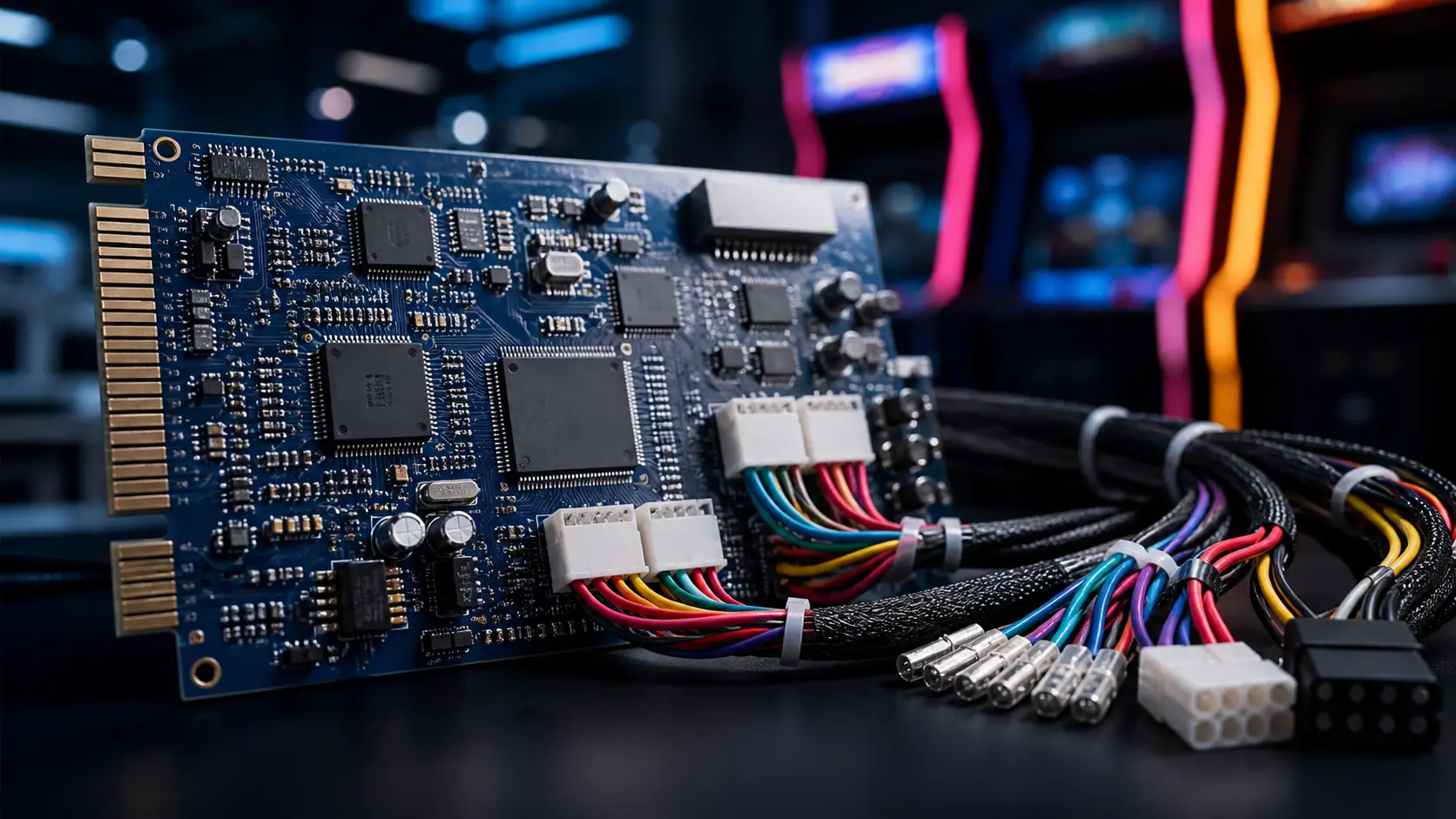
Once the local edge gateway collects the sensor data, it needs a robust pipeline to deliver that information to the venue operator in real-time. We rely entirely on the MQTT protocol for our telemetry pipelines. MQTT is extremely lightweight, requires minimal bandwidth, and is designed specifically for high-latency IoT networks.
Every edge gateway acts as an MQTT publisher, constantly broadcasting the health status, current draw, and sensor states of its connected machines to a central MQTT Broker hosted in the venue’s secure server rack. From there, the data is ingested into a time-series database like Prometheus and visualized using Grafana dashboards.
This gives the venue operator a beautiful, real-time “god view” of their entire warehouse. They can instantly see the exact voltage rails of every machine, the temperature of the server racks, and the real-time RTP (Return to Player) payout ratios.
However, dashboards require someone to look at them. For critical faults that require immediate human intervention (like a completely jammed hopper or a severed network cable), we integrate the MQTT broker with webhook notification systems like PagerDuty or direct Telegram bots.
If a machine goes completely dark, or if an optical sensor triggers a remote arcade machine false trigger fix routine that fails to resolve, a localized alert is instantly pushed to the shift manager’s phone. The alert specifies the exact machine ID, its physical location in the warehouse aisle, and the specific sensor that triggered the fault. This precision drastically reduces troubleshooting time when a technician finally arrives on site.
To see how this telemetry integrates with the broader cloud infrastructure, read our extensive documentation on deploying cloud hardware control gateways remote arcade operations.
Preventative Maintenance Schedules Lubrication Cycles and Optical Sensor Cleaning
The ultimate goal of hardware fault telemetry is not just to react to breakdowns, but to predict them. By analyzing the time-series data stored in Prometheus, we can implement rigorous Preventative Maintenance Schedules (SOPs) based on actual machine usage rather than arbitrary calendar dates.
For example, we track the total run-time and revolution count of every stepper motor in the venue. We know from our Panyu factory stress tests that the nylon gears on a specific gantry assembly require white lithium grease lubrication every 500,000 movements. The telemetry system automatically flags a maintenance task for the on-site technician when a machine hits 480,000 movements, allowing them to service the machine during off-peak hours before it catastrophically fails during a busy weekend.
Similarly, optical sensors in coin chutes are highly susceptible to dust buildup and metal shavings from tokens. As the lens gets dirty, the analog value of the light reception degrades. By monitoring this gradual degradation in the telemetry dashboard, the system can trigger an “Optical Sensor Dust Cleaning SOP” alert days before the sensor actually fails and causes a coin jam.
This transition from reactive firefighting to predictive maintenance is the hallmark of a mature, highly profitable remote live arcade operation. It maximizes uptime, extends the lifespan of the hardware, and ensures a flawless player experience.
For a deeper understanding of how these maintenance protocols fit into a complete turnkey solution, review our remote live arcade teleoperation and industrial IoT solutions.
For custom venue engineering consultation, architectural design, hardware acquisition, or predictive maintenance auditing,
Commercial Risk-Reversal Guarantees for Direct Factory Procurement
To eliminate overseas purchasing hesitation and guarantee zero capital risk, our Panyu factory backs every commercial order with four ironclad commitments: 1. Low-Risk Sample Prototyping: We support 1-unit custom sample trial orders before committing to 20GP/40HQ container runs, allowing you to test physical chassis build quality, coin mech reliability, and game RTP firsthand. 2. Third-Party FAT Audits Welcome: We welcome third-party inspection teams from SGS, Intertek, or TÜV to conduct comprehensive onsite Factory Acceptance Testing on our assembly floor before container loading. 3. 100% Clean IP and Source Code Ownership: All custom software development contracts include full uncompiled Unity/C++ source code buyout with zero backdoors, perpetual commercial licenses, and clean IP indemnification. 4. 12-Hour Remote Engineering SLA: Direct WhatsApp and WeChat priority technical support groups linked directly to Engineer Wang’s hardware lab for live video debugging, schematic reviews, and replacement component dispatch.
contact me directly. We build arcade infrastructure that never sleeps. WhatsApp/WeChat: +86 17620842078 Telegram: https://t.me/JLwyc Email: miba515527@gmail.com
#
Granular Sensor Calibration and Microswitch Threshold Verification Protocols
In our Panyu manufacturing facility, every electromechanical subsystem intended for unattended remote deployment undergoes a rigid 72-hour automated sensor stress test before crating. Telemetry reliability is not merely a software consideration; it is fundamentally governed by the physical calibration of limit switches, optical photo-interrupters, and current-sensing thresholds.
Optical Interrupter Debounce and Ambient Lux Thresholds
Standard commercial claw machines rely on generic 3-pin mechanical microswitches for X-Y carriage endstops. In a high-throughput remote facility operating 18 hours daily, these mechanical leaf springs experience metal fatigue after approximately 120,000 cycles, resulting in phantom limit triggers or total failure to stop the gantry.
Our factory protocol replaces mechanical leaf switches with Omron EE-SX672 slotted optical transmissive sensors. These solid-state sensors feature a 940nm infrared LED and a phototransistor detector with built-in Schmitt trigger circuitry. To eliminate false triggers caused by venue overhead LED wash or strobe illumination, our firmware implements an active digital low-pass debounce filter:
| Sensor Type | Operational Lifespan | Debounce Window | Failure Mode in Unattended Venues | Factory Preventive Solution |
|---|---|---|---|---|
| **Mechanical Leaf Switch** | ~120,000 cycles | 15ms – 25ms mechanical bounce | Contact oxidation, spring fatigue, carriage slamming | Replaced by solid-state optical interrupters |
| **Omron EE-SX672 Optical** | > 10,000,000 cycles | 2.5ms digital low-pass | Optical slit dust occlusion | Periodic pneumatic self-purge nozzle protocol |
| **ACS712 Current Hall Sensor** | Infinite (galvanic) | 500us moving average | Thermal drift at >45°C ambient temp | Dynamic baseline zero-point calibration on idle |
| **Reflective Prize Drop Sensor** | > 5,000,000 cycles | Dual-beam cross validation | External flashlight or reflective plush glare | Modulated 38kHz infrared carrier pulse detection |
Automated Hopper Coin Count Calibration and Payout Verification
In live coin pusher installations, coin replenishment and payout verification represent the highest financial liability for venue owners. A coin jam inside the rotary disc dispenser that goes undetected for even two hours can prompt dozens of credit dispute chargebacks from frustrated mobile players.
Our telemetry board reads raw optical quadrature pulses directly from the hopper dispenser wheel. When the remote server issues an escrow command for 10 coins, the STM32 microcontroller initializes an isolated hardware timer. Each falling edge of the hopper optical sensor triggers an interrupt service routine (ISR) that increments the verified payout counter:
c // Sub-millisecond Hardware ISR for Unattended Coin Payout Validation void EXTI9_5_IRQHandler(void) { if (EXTI_GetITStatus(EXTI_Line7) != RESET) { static uint32_t last_pulse_tick = 0; uint32_t current_tick = DWT->CYCCNT; // Enforce 12ms minimum pulse separation to reject electrical noise spikes if ((current_tick – last_pulse_tick) > (SystemCoreClock / 1000 * 12)) { payout_verified_pulses++; last_pulse_tick = current_tick; } EXTI_ClearITPendingBit(EXTI_Line7); } }
If the hopper motor runs continuously for 3,500 milliseconds without a single validated pulse, the firmware asserts a `STATUS_HOPPER_EMPTY_OR_JAMMED` condition. Rather than waiting for a player complaint, the machine instantly flags its state in the local Redis cache, marks itself unavailable in the mobile app lobby, and dispatches a JSON telemetry packet to the operator’s monitoring hub via MQTT over TLS.
Frequently Asked Questions
How does the system differentiate between a real coin drop and a false trigger? A remote arcade machine false trigger fix usually involves implementing debouncing logic on the microswitches and utilizing dual-sensor verification. If an optical sensor registers a coin passing through, but the physical microswitch at the bottom of the chute does not register a hit 100 milliseconds later, the system flags it as a false optical trigger (often caused by dust or a hovering token) and ignores it, preventing the player from being incorrectly charged or awarded points.
What is the best way to handle remote arcade machine power management for hundreds of machines? The industry standard is to utilize addressable Smart PDUs integrated with your local edge servers via RS485 or SNMP. This allows your custom venue management software to individually hard-cycle the AC power to any specific machine on the floor based on watchdog timeouts or manual operator commands, without affecting the adjacent machines.
Can I retrofit IoT telemetry sensors onto old, legacy arcade cabinets? Yes, retrofitting is entirely possible and very common. We design specialized non-invasive telemetry boards that sit between the legacy JAMMA wiring harness and the game board. These boards can intercept button presses, read coin meter pulses, and monitor motor voltage rails without requiring any modification to the original, proprietary game software or PCB.
What happens if the local edge server controlling the telemetry fails? Redundancy is critical in unattended venues. We always deploy edge servers in High Availability (HA) pairs using protocols like VRRP or Keepalived. If the primary edge server experiences a hardware failure or kernel panic, the secondary server instantly takes over the MQTT broker and RS485 control lines, ensuring continuous machine management and telemetry reporting with zero downtime.
How do you prevent players from exploiting known hardware glitches remotely? Exploit prevention relies on aggressive server-side state management combined with rapid physical telemetry. For instance, if a player discovers a way to rapidly tap the drop button to cause a coin hopper to double-feed, our edge gateway will detect the anomalous optical sensor pulse rate. It will immediately ignore further commands from that player, force the hardware hopper to halt, and flag the user account for administrative review, completely mitigating the exploit.