The deployment of automated self-service cash redemption kiosks fundamentally transforms the operational economics of any large-scale gaming facility. For arcade operators, casino floor managers, and street route operators, the continuous handling of cash through human cashiers introduces unavoidable inefficiencies. Manual payout processes suffer from miscounts, extended wait times during peak hours, and substantial payroll overhead. By integrating industrial-grade wholesale casino redemption kiosk chassis hardware into the facility, operators successfully shift the burden of cash handling from expensive human labor to highly secure, precise, and untiring automated systems.
These sophisticated redemption terminals eliminate the potential for human error in cash dispensing while dramatically tightening the overall security posture of the venue. Modern self-service cashiers function as heavily armored mini-vaults, equipped with industrial PCs, high-capacity banknote dispensers, barcode scanners for TITO (Ticket-In, Ticket-Out) tickets, and robust touchscreen interfaces. The Return on Investment (ROI) equation is compelling. Facilities typically recover their capital expenditure within months simply by reducing the required number of active cashier stations, streamlining cash-in-transit (CIT) processes, and mitigating shrinkage. For factory-direct procurement and comprehensive engineering specs, consult our master guide on arcade game machine manufacturing and custom cabinet sourcing.
When sourcing these units at scale, acquiring bare metal chassis and turnkey assemblies from specialized manufacturing facilities presents a significant competitive advantage. Engaging directly with original equipment manufacturers (OEM) allows operators to dictate exact sheet metal specifications, security locking mechanisms, peripheral mounting brackets, and brand-specific aesthetic wraps. This comprehensive technical breakdown explores the critical engineering parameters required when procuring wholesale casino redemption kiosk chassis hardware, focusing on enclosure durability, cash handling peripherals, computing cores, and factory-level customization. To explore detailed technical specifications and deployment considerations, see our operational guide on How Casino Machine Manufacturers Engineer OEM. To explore detailed technical specifications and deployment considerations, see our operational guide on How Engineers Wire Industrial 56-Pin JAMMA. To explore detailed technical specifications and deployment considerations, see our operational guide on How Factory Builders Fabricate Custom 8. To explore detailed technical specifications and deployment considerations, see our operational guide on How Venue Owners Deploy Bartop Skill.
For procurement executives and technical directors looking to source custom redemption kiosk enclosures directly from the manufacturing floor, consult with Engineer Wang to discuss your exact deployment requirements. Reach out via WhatsApp at +86 17620842078, Telegram at https://t.me/JLwyc, or Email at miba515527@gmail.com for comprehensive CAD blueprints and wholesale volume pricing.
Evaluating Vault Security and Heavy Duty Enclosure Architecture
The physical foundation of any self-service redemption kiosk is its sheet metal enclosure. Because these machines store tens of thousands of dollars in physical currency at any given moment, the chassis cannot be built using standard consumer-grade materials. True casino-grade redemption kiosks rely on advanced metallurgical engineering and physical security protocols designed to thwart brute-force attacks, drilling, prying, and tampering.
Cold Rolled Steel Construction Specifications
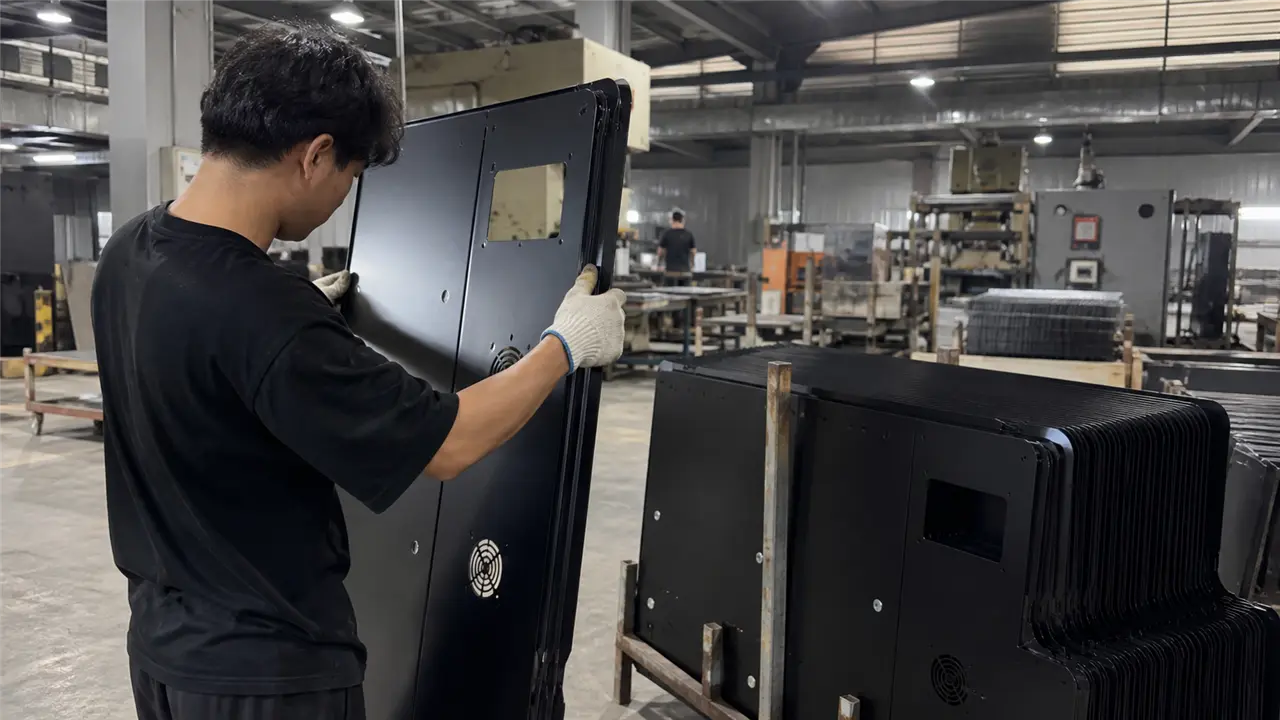
The primary cabinet body must be fabricated from high-grade cold-rolled steel (CRS). Unlike standard mild steel, cold-rolled steel undergoes processing at room temperature, which increases its yield strength and hardness while allowing for much tighter dimensional tolerances. For the upper cabinet housing the touchscreen and non-cash peripherals, manufacturers typically utilize 1.5mm to 2.0mm CRS. However, the lower vault section—where the cash dispenser and bill validator stackers reside—demands significantly thicker materials.
A professional casino kiosk vault is engineered using 2.5mm to 3.0mm (approximately 11 to 9 gauge) CRS. In extreme high-risk deployments, manufacturers may integrate dual-layer steel walls with internal anti-drill plating. The welding process is equally critical. Seams must be continuous TIG (Tungsten Inert Gas) welded rather than spot welded, eliminating structural weak points that could be exploited by heavy prying tools. The exterior finish should consist of a high-temperature baked powder coating, providing a scratch-resistant, anti-corrosive layer that maintains a premium aesthetic across years of heavy floor use.
Multi Point Locking Mechanisms and Electronic Security
Traditional key locks are insufficient for high-capacity cash redemption terminals. The vault doors require complex multi-point locking systems where a single actuator engages thick steel deadbolts across the top, bottom, and unhinged side of the door. The locking core itself must meet stringent security standards.
Many high-end wholesale casino redemption kiosk chassis feature cutouts specifically designed to accommodate Cencon electronic locks or equivalent high-security ATM locks. These lock bodies require one-time use dynamic codes generated by a central dispatch software, ensuring that local route attendants cannot open the vault without explicit real-time authorization. Furthermore, the enclosure design must incorporate internal lock protection plates to prevent drill attacks from reaching the lock’s internal mechanism.
Integrated Environmental and Tamper Sensing
Beyond passive physical strength, modern kiosk chassis act as active nodes in the facility’s security network. The enclosures are designed with strategically placed mounting points for a variety of sensors. Door switch sensors (magnetic reed switches or microswitches) instantly detect unauthorized opening attempts, sending immediate alerts to the casino management system (CMS).
Advanced chassis designs also incorporate mounting studs for seismic sensors and tilt switches. If the kiosk experiences heavy vibration from a drilling attempt or is physically tilted for unauthorized removal, these sensors trigger local high-decibel alarms and disable the internal cash dispensing hardware. When procuring wholesale enclosures, operators must ensure the factory provides pre-drilled brackets and cable routing channels for these critical security sensors.
Engineering Cash In and Cash Out Hardware Subsystems
The primary functional purpose of a redemption kiosk rests entirely on its ability to process currency quickly, accurately, and reliably. The integration of specialized bill validators and banknote dispensers dictates the mechanical layout of the chassis interior. Wholesale procurement allows operators to specify mounting dimensions for their preferred peripheral brands, ensuring perfect compatibility and eliminating the need for aftermarket modifications.
High Capacity Banknote Acceptors
For the cash-in functionality, kiosks rely on industrial bill validators designed for high acceptance rates and extensive fraud detection. Brands like JCM Global (e.g., the iVIZION series) and MEI (Advance series) are industry standards. These units utilize multi-wavelength optical sensors, magnetic footprint detection, and mechanical anti-stringing mechanisms to validate genuine currency and reject counterfeits within milliseconds.
In a redemption kiosk environment, the capacity of the cashbox (stacker) is a vital metric. Kiosk chassis must be physically deep enough to accommodate extended multi-cassette stackers. While standard arcade cabinets might use 500-note stackers, high-volume redemption kiosks require stackers capable of holding 2,000 to 3,000 notes. The chassis design must provide a smooth, unobstructed sliding rail system allowing armored transport personnel to quickly swap full cashboxes with empty ones during routine servicing.
Multi Denomination Banknote Dispensers
The cash-out subsystem is arguably the most complex mechanical component within the kiosk. Dispensing accurate payouts requires high-speed friction-feed or vacuum-feed banknote dispensers. Industry leaders such as Fujitsu (e.g., F53/F56 series), Glory, and Puloon manufacture the dispensing modules that integrate into these chassis.
A professional redemption kiosk chassis must support multi-cassette configurations. A typical setup utilizes two to four separate lockable cassettes, each holding a different denomination (e.g., $1, $5, $20, $100). The chassis internal framework must perfectly align the dispenser’s output bezel with the customer-facing fascia plate. Any misalignment here results in cash jams and poor user experience. Furthermore, the communication protocol between the dispenser and the industrial PC is typically RS-232 serial or encrypted USB, requiring the chassis to feature superior cable management capabilities to prevent data interference from neighboring electrical components.
If you are upgrading your venue’s self-service infrastructure and need to source custom kiosk chassis designed precisely for Fujitsu or JCM hardware payloads, partner directly with our manufacturing facilities. Contact Engineer Wang via WhatsApp at +86 17620842078, Telegram at https://t.me/JLwyc, or Email at miba515527@gmail.com to request technical datasheets and OEM integration guides.
Thermal Receipt Printers and Coin Hoppers
Completing the transaction loop requires issuing a physical receipt or a new TITO ticket. The chassis upper section incorporates custom brackets for heavy-duty thermal printers, such as those from Custom, Epson, or TransAct. These printers utilize large paper rolls (up to 8 inches in diameter) to minimize the frequency of paper replenishment. The kiosk fascia must feature a specially designed printer bezel with an integrated presenter, which physically holds the printed ticket inside the machine until it is cut, preventing users from pulling the paper mid-print and causing mechanical jams.
In jurisdictions where exact change down to the cent is required, the lower vault may also house multi-denomination coin hoppers. The chassis must incorporate robust shelving to support the immense weight of hundreds of metallic coins, along with precise chute routing to deliver the coins smoothly to the external collection cup without spillage into the internal cabinet.
Industrial PC Core and Ruggedized Touch Interface
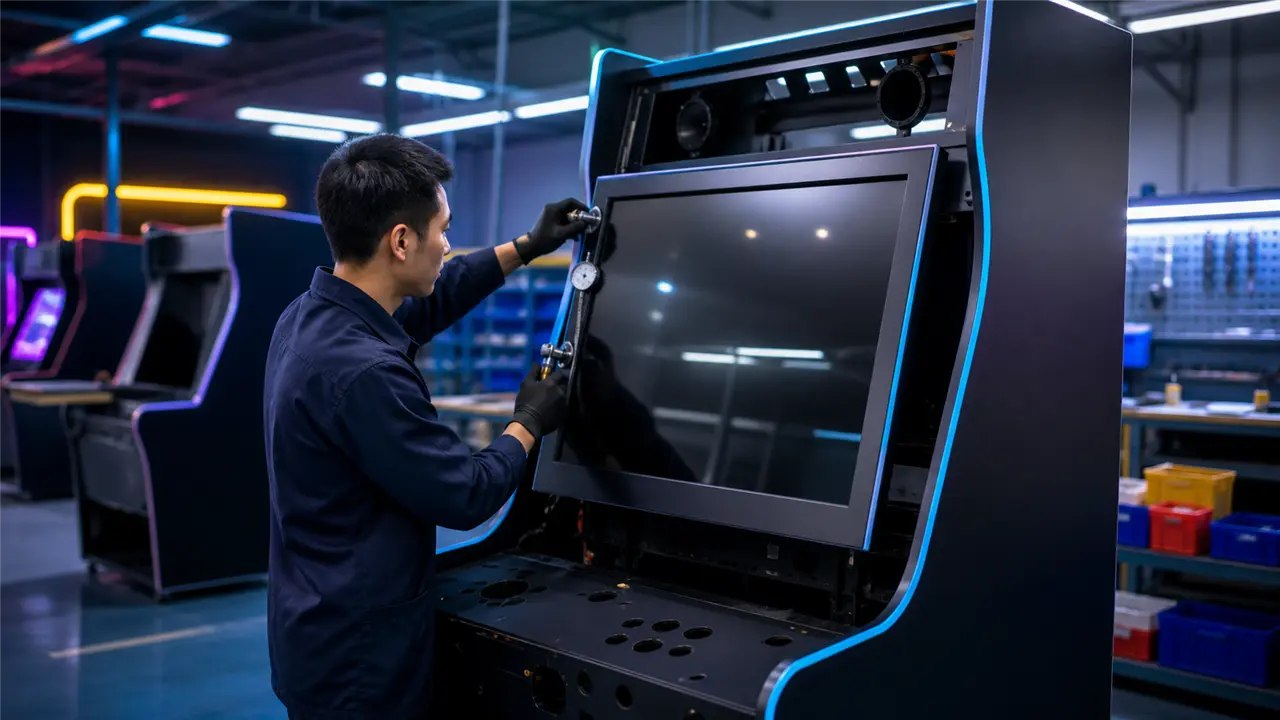
Driving the complex array of serial peripherals, security sensors, and user interface graphics requires a highly stable, industrial-grade computing platform. Consumer-grade motherboards are wholly inadequate for 24/7/365 casino operations, as they lack the necessary I/O density, thermal resilience, and long-term component availability.
Fanless Industrial Motherboards and I/O Connectivity
The brain of the wholesale casino redemption kiosk chassis hardware is an Industrial PC (IPC). These motherboards (often in Mini-ITX or 3.5-inch Single Board Computer form factors) are built with industrial-grade capacitors and utilize fanless passive cooling designs to prevent dust accumulation inside the sensitive electronic core.
Crucially, the IPC must offer extensive native I/O connectivity. A typical automated cashier requires direct connections to the touchscreen, bill acceptor, bill dispenser, receipt printer, barcode scanner, NFC reader, and security controller. This often mandates motherboards equipped with six to ten native COM (RS-232/RS-485) ports and multiple high-current USB ports. Relying on USB-to-Serial hub adapters introduces points of failure and protocol latency; direct hardware-level serial connectivity is paramount. Additionally, the motherboard must feature Dual Gigabit Ethernet controllers to support redundant network topologies, ensuring the kiosk remains connected to the central CMS even if one network switch fails.
Ruggedized PCAP Touchscreen Monitors
The primary human-machine interface (HMI) for the patron is the integrated display. Modern kiosks utilize 19-inch, 21.5-inch, or even 27-inch widescreen monitors featuring Projected Capacitive (PCAP) touch technology. PCAP offers a zero-bezel, edge-to-edge glass aesthetic identical to modern smartphones, while providing superior durability compared to older resistive or surface acoustic wave (SAW) touch panels.
The touchscreen glass must be heavily tempered (typically 3mm to 4mm thick) and rated for IK08 or IK10 impact resistance to withstand aggressive patron behavior. The LCD panel itself requires high brightness specifications (350 to 500 nits) for clear visibility under the intense ambient lighting of a casino floor, along with ultra-wide viewing angles. The chassis front door must be precisely engineered to mount this monitor securely, ensuring a seamless, watertight seal between the touchscreen glass and the sheet metal fascia.
Uninterruptible Power Supply Integration
Power anomalies present a severe risk to redemption operations. If a power outage occurs exactly as a high-speed dispenser is ejecting a bundle of hundred-dollar bills, the exact transaction state must be preserved to prevent financial disputes. Therefore, wholesale casino redemption kiosk chassis must include designated floor space and mounting brackets for a heavy-duty Uninterruptible Power Supply (UPS) battery backup.
The UPS provides instantaneous failover power, giving the IPC enough time to log the exact mechanical state of all cash handling peripherals, complete any ongoing mechanical dispensing cycles, and perform a graceful software shutdown. The chassis design must account for the substantial weight and heat dissipation requirements of this critical power component.
Procurement and Factory Customization Checklist
Sourcing wholesale casino redemption kiosk chassis hardware directly from Asian manufacturing hubs allows operators to bypass intermediary markups while retaining total control over the engineering design. However, successful international procurement requires strict attention to several factory-level operational parameters.
Minimum Order Quantity Tiers and Prototyping
When dealing directly with sheet metal fabrication facilities, pricing is strictly tied to Minimum Order Quantity (MOQ) volume tiers. While some factories accept low-volume runs (e.g., 10 to 20 units), the true economy of scale is achieved at MOQs of 50, 100, or more.
Before committing to a mass production run, operators must mandate a physical prototype. This sample unit is shipped to the operator’s laboratory where technicians install the exact IPC, dispenser, and validator hardware. This physical integration test is critical to verify that cable lengths are sufficient, mounting holes perfectly align with peripheral threads, and heat dissipation is adequate under full load. Only after the prototype receives final engineering sign-off should mass production commence.
OEM Branding and Aesthetic Customization
A kiosk should seamlessly blend into the venue’s interior design architecture or prominently display the operator’s brand identity. Wholesale procurement allows for extensive factory-level customization. Operators can specify custom powder coat RAL colors rather than settling for generic black or silver.
Furthermore, factories can provide pre-applied exterior vinyl wraps, backlit acrylic marquees, and programmable RGB LED accent lighting integrated into the chassis trim. Custom laser-cut logos in the sheet metal, illuminated from behind, add a premium architectural touch that elevates the perceived value of the hardware on the gaming floor.
Payment Gateway Compliance and Peripheral Cutouts
The specific mix of peripherals required depends heavily on the regional payment ecosystem. While cash dispensing is universal, the method of customer identification varies. The factory must be capable of modifying the front fascia CAD drawings to accommodate diverse payment and identification hardware.
This includes precise cutouts for EMV chip-and-pin card readers, NFC/RFID contactless tap pads for digital wallets, and omnidirectional barcode scanners for reading mobile phone screens or printed TITO tickets. The placement of these peripherals must adhere to local accessibility regulations (such as ADA compliance in the United States), ensuring that all interactive elements fall within specified height parameters for wheelchair access.
Export Crating and Freight Logistics
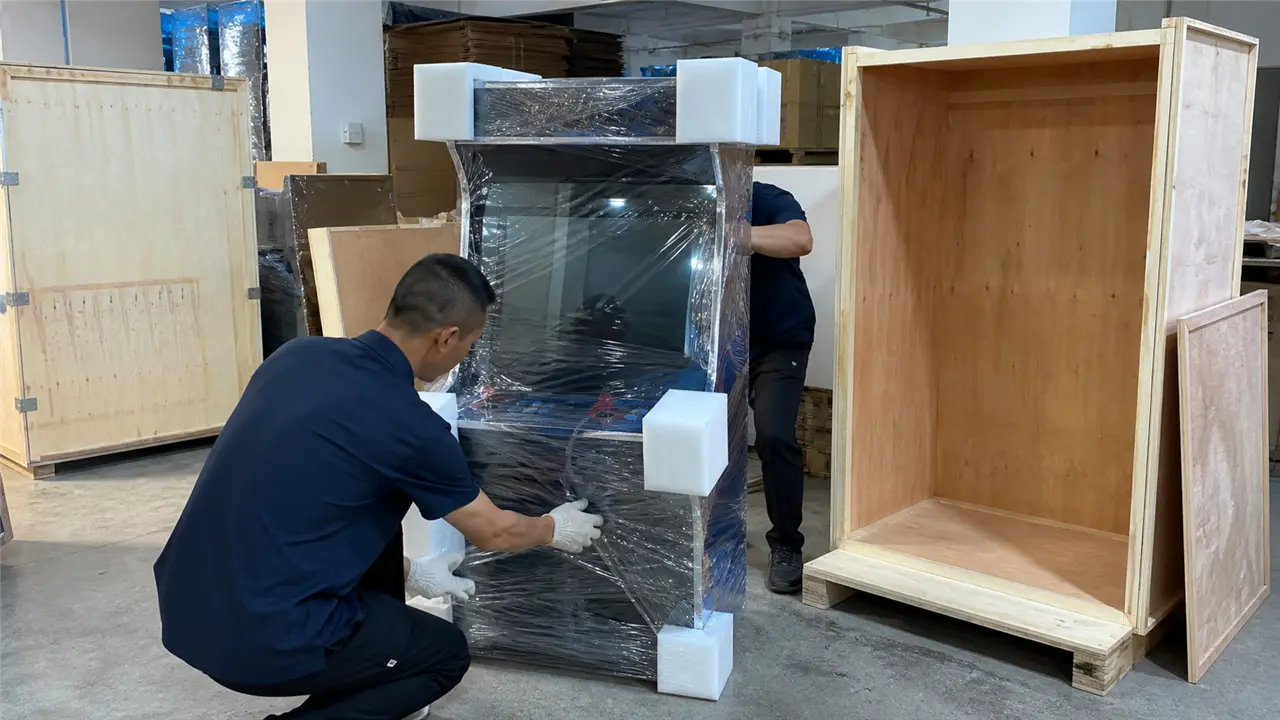
Finally, the physical transportation of heavy steel cabinets requires rigorous packaging protocols. A fully assembled kiosk chassis, even without the heavy internal cash dispensers, can weigh upwards of 100 to 150 kilograms.
Factories must utilize ISPM-15 certified wooden crating. The chassis should be bolted to a heavy-duty pallet, wrapped in protective moisture-barrier film, and cushioned with high-density EPE foam. Procuring teams must calculate container utilization rates (how many units fit optimally into a standard 20-foot or 40-foot HQ shipping container) to minimize per-unit freight costs. Working with a dedicated hardware consultant ensures that all export documentation, bill of materials (BOM), and commercial invoices are perfectly aligned for smooth customs clearance.
To streamline your procurement pipeline and design the ultimate automated cashier for your casino or arcade route, leverage the manufacturing expertise of our production network. Reach out to Engineer Wang to finalize your custom chassis specifications. Contact via WhatsApp at +86 17620842078, Telegram at https://t.me/JLwyc, or Email at miba515527@gmail.com to start your prototype design today.
Frequently Asked Questions
What gauge of steel is strictly required for a casino grade redemption kiosk vault? For true casino-grade applications, the lower vault housing the cash dispenser must be constructed from at least 2.5mm to 3.0mm (11 to 9 gauge) cold-rolled steel. Standard arcade cabinets utilizing 1.2mm steel do not provide adequate physical resistance against organized drill or pry attacks.
Can wholesale chassis manufacturers pre wire the cabinets for specific bill dispenser brands? Yes, reputable wholesale manufacturing facilities will utilize your specific CAD footprints to pre-weld mounting brackets and pre-route wiring harnesses for specific brands like Fujitsu, Puloon, or Glory. This true turnkey approach drastically reduces final assembly time in your local warehouse.
How does the kiosk chassis manage heat generated by the industrial PC and power supplies? Proper chassis engineering includes strategic thermal management. This involves utilizing fanless IPCs to minimize internal dust, along with strategically placed louvered vents, high-CFM exhaust fans near the top of the cabinet, and dedicated thermal pathways to ensure the UPS and bill validator do not overheat during continuous 24/7 operation.
Are these wholesale kiosk enclosures fully compliant with ADA height accessibility regulations? When placing wholesale orders, operators provide the factory with precise dimensional requirements based on their local jurisdiction. The factory engineers will adjust the height and angle of the touchscreen, card reader, and cash dispensing bezel to ensure they comply with the 48-inch maximum height requirements mandated by the Americans with Disabilities Act (ADA) or equivalent local accessibility laws.