When a venue operator reviews an invoice for a new fleet of arcade cabinets, the first thought is often whether the price aligns with the true manufacturing cost. A Friday-night failure of a single joystick or a blown I/O board not only halts revenue but rapidly destroys your return on investment. I am Engineer Wang, Lead Hardware and Game System Architect at Guangzhou Miba Animation Technology Co., Ltd. For over 12 years at our Panyu manufacturing base, I have designed the electrical architecture and math models that keep operators highly profitable.
In this technical breakdown, we strip away the marketing fluff and expose the actual Bill of Materials (BOM). I will show you exactly where your money goes when you buy a machine from our factory, and why investing in industrial-grade components guarantees your 92% to 96% RTP draw while completely eliminating Friday-night downtime. For factory-direct procurement and comprehensive engineering specs, consult our master guide on arcade game machine manufacturing and custom cabinet sourcing.
Deconstructing the Bill of Materials
An arcade cabinet is not just a wooden box with a screen. It is a highly tuned revenue-generating appliance. Buying cheap means buying twice, and cheap components directly invite player theft and downtime. Here is the unvarnished look at what constitutes a true commercial-grade arcade machine. For detailed BOM cost trade-offs between cold-rolled steel and ABS trim, review our low cost slot machine cabinet procurement strategy.
The Metal Work and Chassis Integrity
Brokers will sell you machines made from thin, 1.2mm cold-rolled steel or even MDF wood disguised with vinyl wraps. These cabinets flex, warp in humid environments, and are easily breached by vandals.
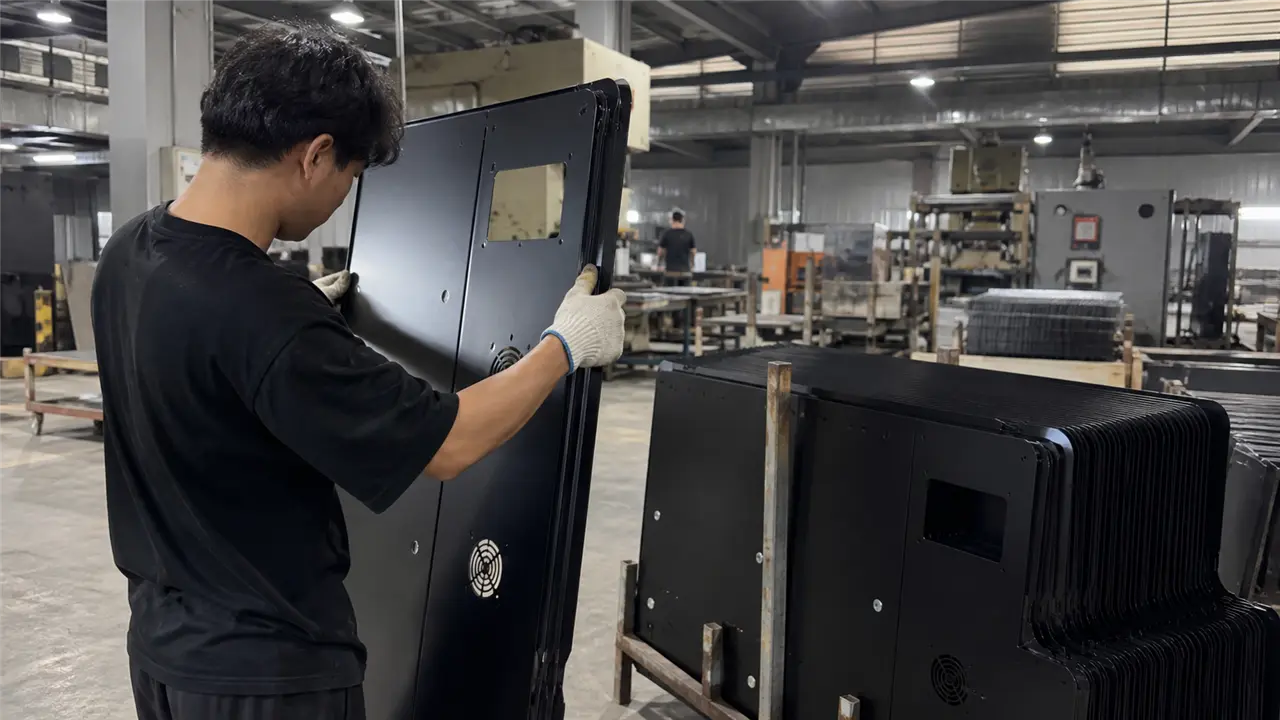
At Arcade Manufacturer, our chassis are fabricated from 2.0mm to 2.5mm galvanized steel, precision-cut using industrial laser CNC machines. This structural rigidity is crucial for heavy-duty components like large LCDs and robust coin mechanisms. The cost of a premium metal shell ranges from $250 to $400 depending on the complexity of the mold and powder coating. It ensures the physical security of the cash box and logic boards inside.
Industrial Displays and Touch Overlays
The visual interface is where player engagement happens. Standard PC monitors fail under 24/7 operation and lack the brightness required for a glaring casino floor. We utilize A+ grade industrial LCD panels with a minimum brightness of 500 nits and ultra-wide viewing angles. For touch-enabled fish games or roulette systems, we deploy 10-point capacitive touch overlays laminated with 4mm tempered, anti-smash glass.
A premium 55-inch display assembly with touch integration costs approximately $350 to $500. This investment prevents screen burn-in and ensures the touch matrix remains responsive even after millions of interactions.
The Core Logic Board and Mathematical Integrity
The brain of the machine dictates your profit margin. We engineer our own proprietary game boards integrating robust ARM Cortex or x86 architectures, coupled with secure FPGAs.
This is where your 92% to 96% RTP is rigorously enforced. The logic board, complete with encrypted NVRAM and secure boot loaders to prevent ROM tampering, typically costs between $150 and $300. This is the heart of your anti-cheat system. It is physically protected within a tamper-evident steel enclosure inside the cabinet.
Power Delivery and Surge Mitigation
Never compromise on power. We exclusively use Mean Well industrial power supplies. A standard 400W to 600W Mean Well PSU costs around $40 to $70. It provides ultra-clean DC power with <50mVp-p ripple noise.
Furthermore, our power distribution boards incorporate <5ps transient voltage suppressors (TVS). If a malicious player fires an EMP gun at the coin slot, the TVS clamps the surge instantly, protecting the logic board and maintaining the integrity of the player's credit balance.
ROI Financial Projections and Hardware Payback
Let’s analyze how quality components affect your bottom line. We will compare a cheap, broker-supplied cabinet against a factory-direct Arcade Manufacturer premium build.
| Component Category | Cheap Broker Build (Est. Cost) | Arcade Manufacturer Premium Build | Operator Profit Impact |
|---|---|---|---|
| Chassis & Metalwork | $150 (MDF/Thin Steel) | $350 (2.5mm Galvanized Steel) | Prevents break-ins; zero structural warping. |
| Display Assembly | $200 (Consumer Grade) | $450 (Industrial A+ Capacitive) | Eliminates screen burn-in; sustains player engagement. |
| Logic & Security | $80 (Pirated/Cloned Board) | $250 (Proprietary Encrypted System) | Guarantees exact 92-96% RTP; blocks all known software hacks. |
| Power & Anti-EMP | $20 (Generic PSU) | $80 (Mean Well + TVS Isolation) | Zero Friday-night downtime from blown capacitors or EMP attacks. |
| Total Base BOM | $450 | $1,130 | A $680 difference that prevents $5,000+ in annual lost revenue per machine. |
Your initial CAPEX is slightly higher when demanding premium parts, but the OPEX plummets. A machine with 99.9% uptime achieves full CAPEX payback in less than 6 to 8 months, compared to a cheap machine that spends every other weekend out of order.
Factory Acceptance Testing QA Checklist
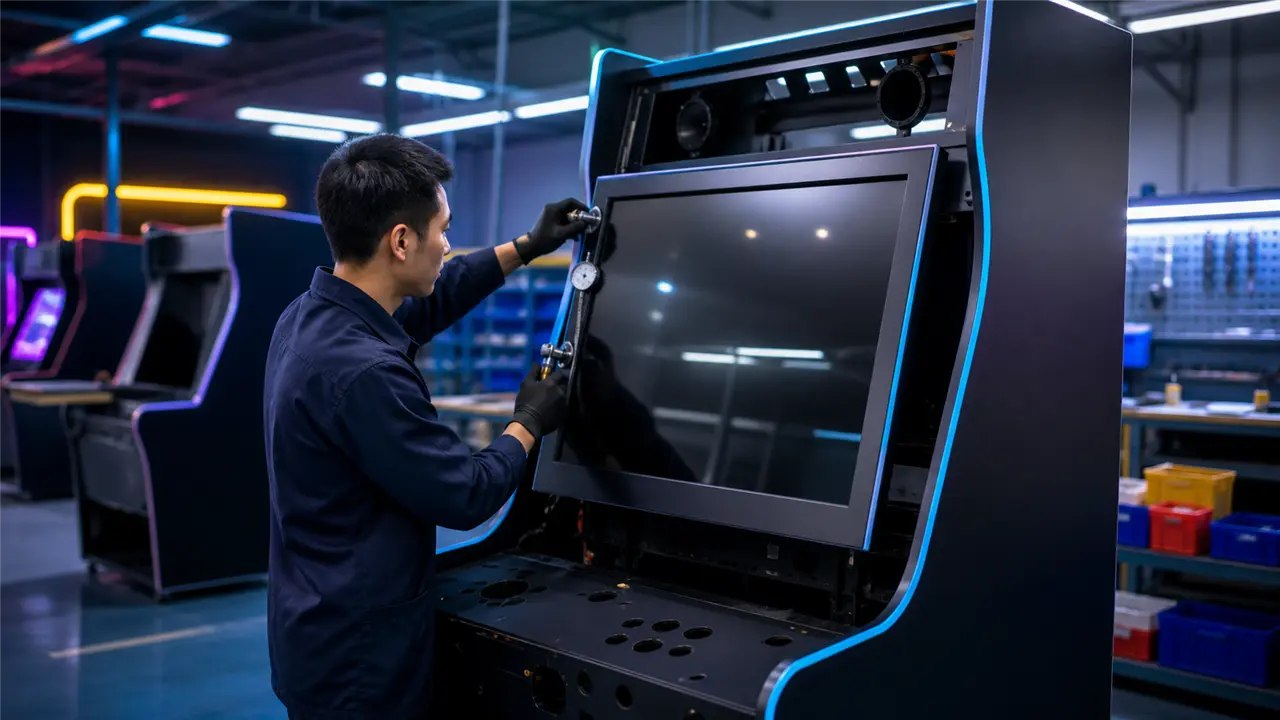
We do not guess if our machines will survive your arcade floor; we prove it in our lab.
1. Thermal Soak Testing 48 hours running maximum CPU/GPU load inside a 45°C thermal chamber. 2. Input Actuation Endurance 500,000 automated strikes on buttons and joysticks to verify microswitch longevity. 3. Power Fluctuation Simulation Rapid cycling of input AC voltage (90V to 260V) to ensure the logic board never loses NVRAM state. 4. EMP and RF Jamming Resistance Firing 50kV static bursts directly at the coin acceptor to confirm the optical isolators protect the mainboard. 5. RTP Auditing Running automated simulations of 2,000,000 spins or shots to certify the math model strictly adheres to the promised 95% hold.
Troubleshooting Common Hardware Failures
| Issue | Root Cause in Cheap Builds | The Arcade Manufacturer Solution |
|---|---|---|
| Logic Board Restarts Randomly | Unstable 5V rail from a cheap PSU under heavy load. | We deploy oversized Mean Well PSUs and thick-gauge copper wiring to guarantee voltage stability. |
| Credits Registering Erratically | EMP interference or ground loop noise. | Our V5/K8 hardware dongles and optical pulse isolation prevent fraudulent signal injection. |
| Touch Screen Drift | Inferior infrared or cheap capacitive matrices failing under heat. | We use highly calibrated, temperature-resistant capacitive controllers bonded to 4mm tempered glass. |
Related Engineering References and Floor Operational Guides
- For our comprehensive factory production standards, review our China arcade machine manufacturer sourcing framework.
- To inspect our physical facility, see our Guangzhou arcade game factory sourcing guide.
- Compare direct cabinet pricing in our fish table wholesale manufacturer pricing guide.
- For complete software and hardware turnkeys, review our turnkey arcade machine bundled manufacturing guide.
Frequently Asked Questions
Can I request a custom BOM for my specific budget?
Absolutely. If you operate in a highly regulated market or require specific hardware like JCM bill validators or Nayax cashless systems, we adjust the BOM directly in our Panyu factory before assembly.
How do you prevent software theft and cloning?
Our software is tied to the hardware via cryptographic keys. The dynamic “AI Trojan Terminator” protocol scrambles the communication between the I/O board and the main CPU, making cloning impossible.
What is the lead time for a 40HQ container of custom machines?
For standard configurations, our 50-person R&D and manufacturing team can fulfill a 40-foot High Cube container (approx. 40-50 machines depending on size) in 15 to 20 working days.
Partner with True Engineering Excellence
Do not let subpar hardware dictate your revenue. As an operator, your focus should be on scaling your business, not repairing broken machines on a busy weekend.
1. Request the Full BOM Spreadsheet See the exact component pricing for your desired machine type. 2. Schedule a Video Walkthrough Join me for a live tour of our CNC fabrication and QA testing labs. 3. Direct Contact – Engineer Wang (Lead Hardware & Game System Architect) – WhatsApp/WeChat: +86 17620842078 – Telegram: https://t.me/JLwyc – Email: miba515527@gmail.com – Location: Panyu Manufacturing Base, Guangzhou, China
Secure your floor with hardware built for profit. Let’s talk architecture.