The profitability of modern arcade venues and online sweepstakes platforms hinges entirely on continuous player engagement, a metric driven by the seamless convergence of high-fidelity visual rendering and sophisticated mathematical hold models. To maintain maximum seat occupancy, operators must deploy fish hunting games that leverage advanced 3D mesh processing alongside dynamic RTP (Return to Player) balancing algorithms. By optimizing GPU shader pipelines for stunning underwater environments and executing real-time volatility matrix calculations, route operators can drastically increase session lengths and lifetime player value. Contact our development studio today for a live technical demonstration of our proprietary fish game engine capabilities and backend management tools.
Fish Game Engine Architecture Comparison
For a comprehensive architectural overview and turnkey procurement frameworks, review our master guide on turnkey online gaming software source code. For factory-direct procurement and comprehensive engineering specs, consult our master guide on custom arcade game software studio engineering.| Engine Type | Draw Calls | Particle Limits | Dynamic Lighting | RTP Adaptability |
|---|---|---|---|---|
| Legacy 2D Sprite Fish Games | High (Unbatched) | < 500 (CPU Bound) | None (Baked) | Static/Rigid |
| Modern 3D Mesh & Shader Rendered Fish Games | Low (GPU Instancing) | > 5,000 (Compute Shaders) | Real-time PBR | Fully Dynamic (88%-97%) |
| Custom Hybrid Spine Animated Engines | Medium (Sprite Batching) | ~ 2,000 (GPU Accelerated) | Faked/Normal Mapped | Tiered/Algorithmic |
3D Asset Optimization and Real-Time GPU Shader Pipelines
Creating immersive aquatic environments that captivate players for hours requires rigorous optimization of 3D assets and advanced GPU shader pipelines. The visual fidelity of a fish game directly correlates with player retention; when high-value boss monsters enter the screen, the visual spectacle must be flawless to trigger the psychological reward mechanisms necessary for sustained play. Achieving this without tanking framerates on lower-end hardware or standard casino cabinets demands strict adherence to performance budgets.
To accomplish this, our engineering teams utilize custom Universal Render Pipeline (URP) configurations tailored specifically for underwater physics and optics. Standard rendering pipelines often struggle with the complex caustics, refraction, and volumetric lighting necessary to simulate water convincingly. By writing highly optimized custom shaders, we offload the processing of these effects from the CPU to the GPU. For the fish models themselves, we implement strict Level of Detail (LOD) hierarchies. As a fish swims closer to the camera, a high-poly mesh is swapped in; as it moves away, the engine transitions to a lower-poly version. This ensures that the scene can handle hundreds of simultaneous entities without exceeding tight rendering budgets.
Furthermore, we utilize aggressive draw call batching and GPU instancing. Instead of issuing a separate draw command for every single fish in a massive school, the engine issues a single command that tells the GPU to render multiple instances of the same mesh, significantly reducing CPU overhead.
- [GPU Rendering Pipeline Architecture]
- [3D Fish Meshes] –> [LOD Manager] –> [Frustum Culling]
- [Caustics/Refraction] –> [Custom URP Water Shaders] –> [Draw Call Batching]
- [Collision Hulls] –> [Physics Engine (Raycast)] –> [GPU Instancing]
- [Final Frame Output (60/120 FPS Target)]
- Collision detection in these dense environments is another critical performance bottleneck. Traditional mesh colliders are too computationally expensive when dozens of players are firing thousands of bullets per minute. Instead, we implement high-density primitive collision hulls—simplified geometric shapes that approximate the fish’s volume. This allows the physics engine to calculate thousands of raycast intersections with near-zero latency. It is also within this hardware interaction layer where arcade machine security is fundamentally established. By ensuring that hit detection logic is processed securely and efficiently within the engine’s core, the software acts in concert with hardware defense systems to prevent injection attacks or memory manipulation that might attempt to register false hits or bypass the cost-per-shot mechanics.
- ## Mathematical Modeling and Dynamic RTP Balancing
- While breathtaking visuals attract players, it is the underlying mathematical engine that keeps them seated. The core of any successful fish hunting game is its volatility curve and Return to Player (RTP) algorithm. Unlike traditional slot machines that rely on independent reel spins, fish games operate on a continuous, multi-player, interactive math model where every fired bullet is a micro-transaction, and every fish death is a calculated payout event.
- Our proprietary mathematical engines are designed to support dynamic RTP tuning, typically ranging between 88% and 97%. This adaptability allows operators to configure their profit margins based on location demographics, competitive pressure, or specific promotional events. The math model operates on a sophisticated matrix of probabilities, where the base health of a fish is modified by the current pool size, the player’s cannon multiplier, and the historical payout ratio of the specific terminal.
- For high-value targets, such as multi-phase boss monsters, we implement complex boss capture volatility curves. These algorithms ensure that bosses are not defeated too easily, maintaining the suspense and encouraging players to increase their cannon multipliers (bet sizes). The system tracks the cumulative damage dealt to the boss across all active players and uses a weighted RNG (Random Number Generator) to determine the exact moment of capture, ensuring that the payout distribution feels fair and exciting while mathematically protecting the house edge.
- [Dynamic RTP Mathematical Flow]
- [Player Bullet Fire (Bet)] –> [Cannon Multiplier Matrix] –> [Global Bet Pool]
- [Collision Event] –> [Hit Evaluation RNG] <----------- [Current RTP Target (88-97%)]
- [Boss Volatility Curve] –> [Payout Decision Engine] –> [Credit Awarded]
- [Database Transaction] –> [Live Telemetry Update]
This dynamic balancing acts as the ultimate anti cheat device. Because the core math is handled server-side or deeply encrypted within the master control unit, malicious attempts to speed-hack the client or alter visual hitboxes are rendered useless; the payout decision engine only validates requests that align with the mathematically calculated state. Furthermore, this rigorous mathematical tracking is essential for accurate daily cash reconciliation. Venue managers can pull highly detailed reports that match the theoretical mathematical hold exactly with the physical drop in the bill acceptors, ensuring absolute financial transparency across all terminals.
Mathematical Modeling and Dynamic RTP Balancing
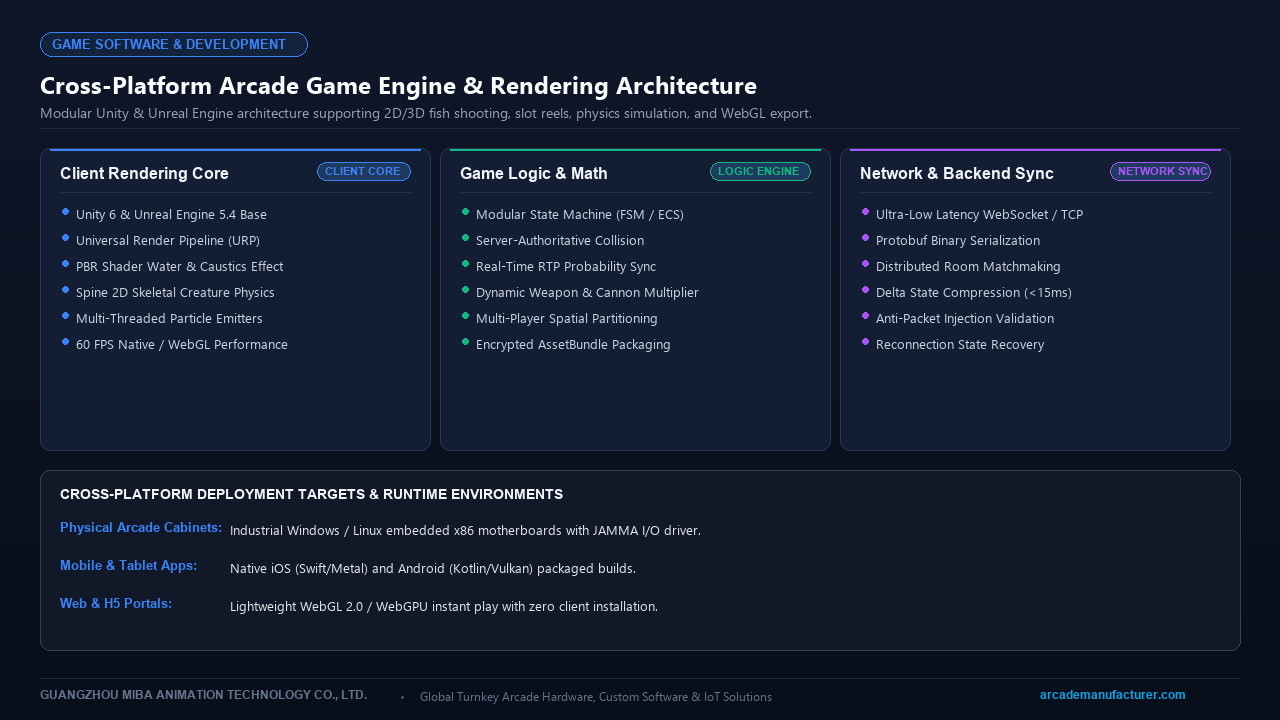
Optimizing return-to-player (RTP) parameters is essential for sustaining player engagement and venue profitability. Dynamic mathematical models simulate billions of coin outcomes to balance high-hit-frequency base gameplay with high-volatility jackpot rounds:
- Dynamic RTP Yield: Configurable between 88.0% and 97.0% to meet regional regulatory frameworks and floor hold objectives.
- Volatility Curve Shaping: Algorithmic weight distribution ensures smooth transition between small fish sweeps and massive mythical boss captures.
- Concurrency Protection: Real-time calculation threads isolate individual player sessions to prevent mathematical race conditions.
- Anti-Tamper Safeguards: Integrating dedicated arcade machine security modules ensures the math engine remains tamper-resistant against external voltage drops.
Multi-Platform Cross-Engine Architecture
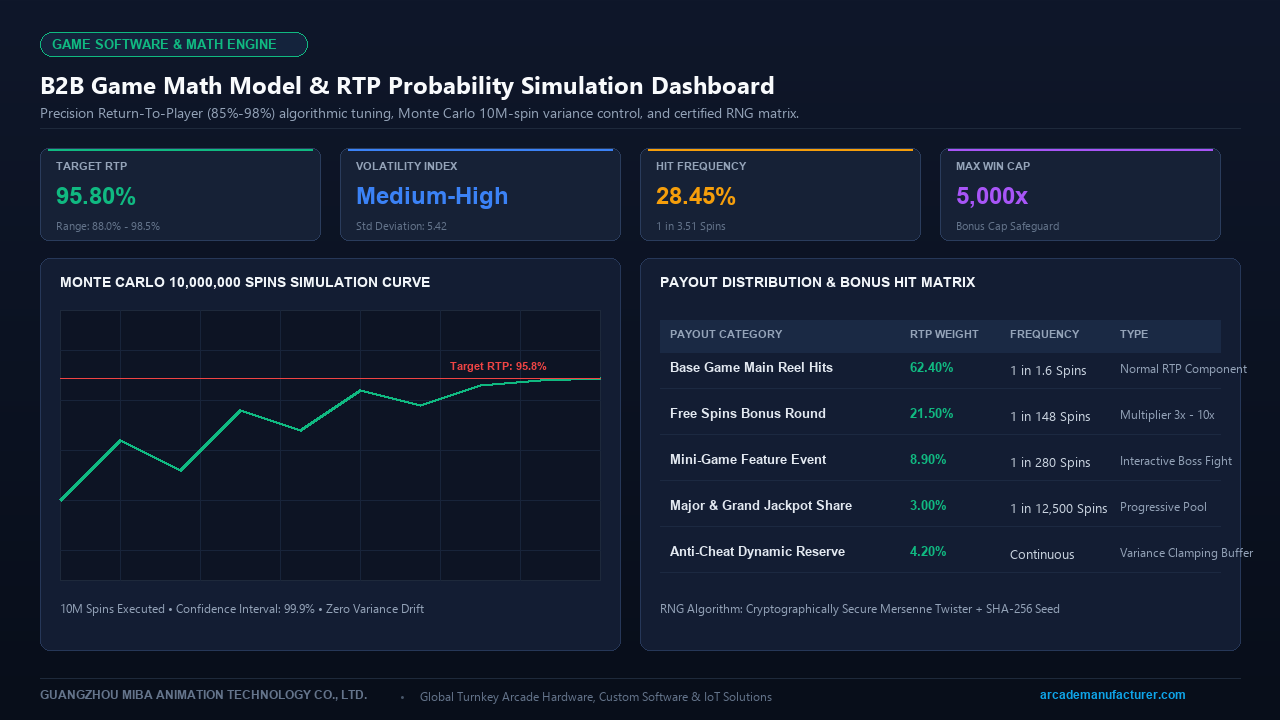
In the modern gaming landscape, route operators and platform providers demand maximum flexibility in deployment. A top-tier fish game must be capable of running flawlessly on an eight-player physical arcade table, a mobile device via a web browser, and a dedicated desktop client. Achieving this requires a robust multi-platform cross-engine architecture built from the ground up to support extreme scalability.
Our development pipeline utilizes both Unity and Unreal Engine, depending on the specific visual and performance requirements of the project. For high-end, dedicated cabinet deployments where maximum visual fidelity is required, Unreal Engine provides unparalleled rendering capabilities. However, for cross-platform deployments that must reach the widest possible audience, we heavily leverage Unity’s Universal Render Pipeline.
To ensure seamless performance on low-spec mobile devices and browser-based WebGL/H5 platforms, we employ aggressive asset compression and memory management strategies. High-resolution textures are compressed using adaptive algorithms that reduce file size without unacceptable losses in quality. Audio files are dynamically loaded and unloaded from memory to prevent RAM bloat. The engine’s architecture utilizes Addressable Asset Systems, allowing the game to download only the necessary assets for the current level, drastically reducing initial load times and data consumption for cellular users.
This cross-platform architecture also demands sophisticated network prediction and latency compensation algorithms. When multiple players are shooting at the same fish from different devices, potentially across varying network connections, the server must seamlessly reconcile the state of the game world. We utilize authoritative server architectures combined with client-side prediction to ensure that the gameplay feels instantaneous to the user, even on connections with high ping. When a player on an H5 mobile client fires a net, their local engine immediately displays the visual effect, while the background network layer silently verifies the transaction with the server to ensure mathematical consistency.
Turnkey Source Code Integration and Multi-Tier Agent Backoffice Hookup

Delivering a highly optimized game client is only half of the solution; operators require comprehensive management tools to deploy, monitor, and monetize the software effectively. We provide turnkey source code integration and sophisticated multi-tier agent backoffice platforms designed specifically for the complex hierarchies of the sweepstakes and arcade route industries.
Our backend architecture is built upon high-performance, scalable microservices, offering robust RESTful API integration. This allows operators to seamlessly connect the fish game engine to their existing wallet systems, player management databases, and loyalty programs. The APIs are heavily secured, utilizing token-based authentication and end-to-end encryption to protect sensitive player data and financial transactions.
The multi-tier agent backoffice hookup is critical for businesses operating on a distributor-agent-subagent model. The platform allows the master administrator to create unlimited tiers of agent accounts, each with granular permission controls. Master operators can assign specific RTP profiles, credit limits, and operational parameters to different geographical regions or individual sub-agents.
Real-time live telemetry is a cornerstone of this backoffice system. Operators have access to a comprehensive dashboard that displays concurrent user counts, live bet volumes, instantaneous RTP fluctuations, and server health metrics. This data is visualized through customizable graphs and reports, allowing management to make data-driven decisions on the fly. If a specific fish game table is experiencing abnormal win rates, the system can automatically flag it for review, allowing operators to adjust payout rate controls remotely and instantly without taking the machine offline. This level of granular control is essential to service arcade locations effectively, minimizing downtime and maximizing profitability across expansive operational footprints.
Frequently Asked Questions
How does 3D asset optimization improve fish game profitability?
Optimized 3D assets and efficient GPU shader pipelines prevent frame drops and lag during intense gameplay moments. Smooth, high-fidelity graphics increase player immersion and extend session durations, leading to higher coin-in metrics while allowing the software to run on cost-effective hardware configurations.
What is a dynamic RTP algorithm in fish games?
A dynamic Return to Player (RTP) algorithm constantly monitors the game’s payout history and active bet pools, adjusting the probability of capturing high-value fish in real-time. This ensures the operator maintains their target profit margin (e.g., 88% to 97%) while keeping the gameplay exciting and volatile for the players.
Why is cross-platform compatibility important for modern operators?
Cross-platform architecture allows operators to deploy the same game mathematics and core assets across physical arcade cabinets, mobile apps, and WebGL browsers. This omnichannel approach maximizes audience reach, allowing players to engage with the brand both in retail locations and from their personal devices.
How does the multi-tier agent backoffice system function?
The multi-tier backoffice allows master operators to distribute the game through a hierarchy of agents and sub-agents. Each tier can manage their own player base, monitor live telemetry, and execute daily cash reconciliation, while the master operator retains ultimate control over global API integration and overall RTP settings.— Upgrade Your Sweepstakes and Arcade Operations Today To discuss custom mathematical modeling, rendering pipeline optimizations, or multi-platform turnkey solutions for your next project, contact our lead development team. Contact Engineer Wang: +86 17620842078 Company: Guangzhou Miba Animation Technology Co., Ltd. Facility: Panyu District Manufacturing and Development Center *Delivering enterprise-grade architecture, unmatched security, and maximum ROI for global route operators and gaming platforms.*