- Overcoming The Remote Pusher Downtime Nightmare
- Core Architecture of Continuous Token Recycling
- Drive Mechanisms and Material Engineering
- Electronics and Intelligent Fault Recovery
- Complete Return On Investment and Operator Profitability
- Factory Integration and Source Code Ownership
- Frequently Asked Questions About Token Recycling Elevators
The transition from traditional offline arcades to remote live arcade turnkey system deployments has exposed a critical hardware vulnerability in many commercial venues. When a physical machine is operated via smartphone by a user thousands of miles away, the operator cannot simply open the cabinet to clear a jammed coin elevator or refill the hopper. Every minute of downtime translates directly to lost revenue and frustrated players. In this environment, achieving a zero-intervention continuous token recycling loop is not just a luxury but an absolute necessity for operator profitability.
I am Engineer Wang, Lead Hardware Architect at Guangzhou Miba Animation Technology Co., Ltd. Over the past twelve years, our manufacturing facility in Panyu has produced thousands of commercial cabinets. We have seen firsthand how cheap, off-the-shelf coin elevators fail under the relentless 24/7 duty cycles of remote operation. In our 15,000-square-meter factory, we engineer bespoke commercial coin pusher machine wholesale manufacturing solutions built explicitly for the cloud. This article provides a deep engineering teardown of our automated coin elevator systems, detailing the mechanical and electronic innovations that guarantee continuous token recycling without manual intervention.
Overcoming The Remote Pusher Downtime Nightmare
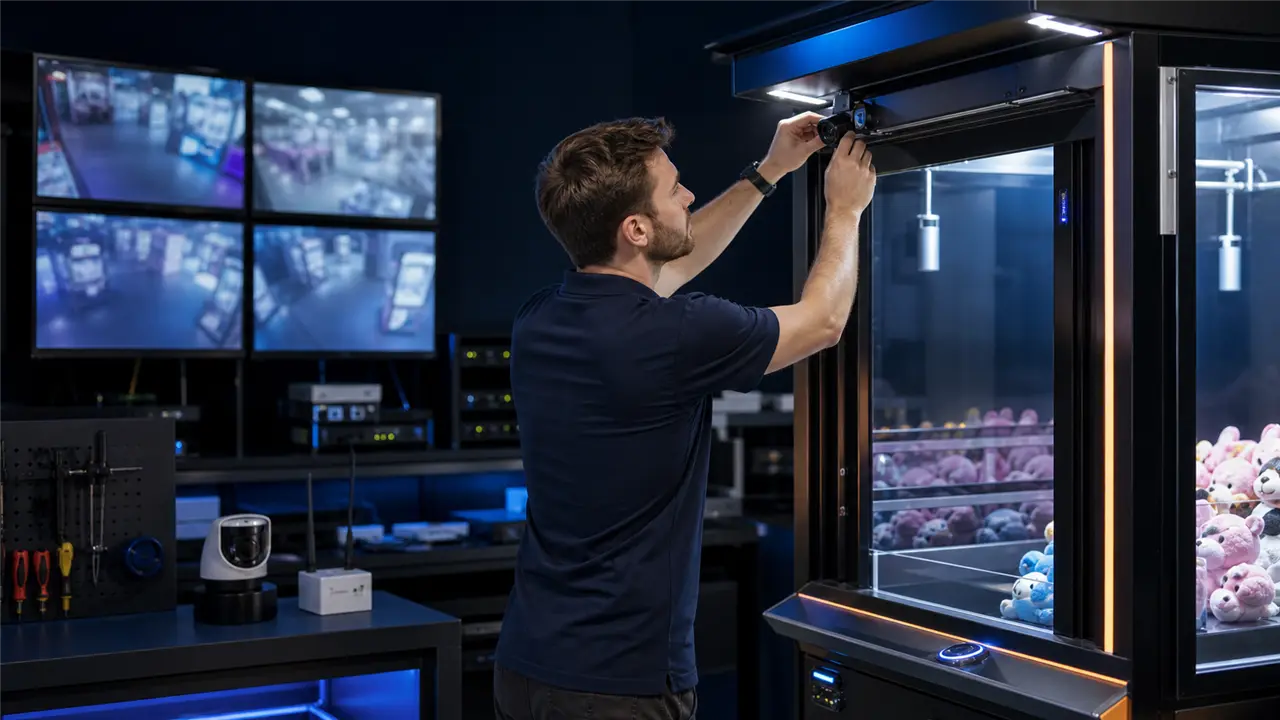
Standard arcade pushers rely on attendants to manage token levels and resolve jams. When adapting these machines for online streaming, operators quickly realize that standard elevators suffer from frequent bridging, token jams at the base, and motor burnout under sustained load. A remote setup requires a bulletproof recycling loop where tokens drop from the playfield, funnel precisely into an elevator, travel vertically without jamming, and feed directly back into the player’s active hopper.
To achieve this, we completely redesigned the remote live coin pusher turnkey architecture from the ground up. Our approach eliminates friction points and utilizes industrial-grade components to handle continuous operation. If you are struggling with unreliable retrofits, you need a hardware partner who understands the extreme demands of the live-streaming arcade business model.
Connect directly with our engineering team for a hardware evaluation. WhatsApp/WeChat: +86 17620842078 Telegram: https://t.me/JLwyc
Core Architecture of Continuous Token Recycling

The recycling loop is the circulatory system of the machine. It must maintain a consistent flow rate to ensure the player never experiences a dry hopper during gameplay.
Spiral Screw Lift Versus Vertical Polyurethane Flighted Belt Elevator
The industry primarily uses two mechanisms for vertical token transport. The first is the spiral screw lift, which uses a rotating auger to push tokens upward within a cylindrical tube. While inexpensive and compact, the screw lift creates immense friction. Tokens often scrape against the interior walls, generating metal dust that clogs optical sensors and degrades performance over time. Furthermore, a single bent or oversized token can instantly halt the auger, requiring complete disassembly.
In our premium setups and bespoke remote coin pusher machine hardware modification projects, we mandate the use of a vertical polyurethane flighted belt elevator. This system uses a continuous heavy-duty polyurethane belt equipped with molded horizontal flights (cleats) that act as individual shelves for the tokens.
The flighted belt approach offers superior reliability. It completely eliminates the metal-on-metal friction of the auger design. The polyurethane belt absorbs shock and operates quietly, preventing structural vibration from interfering with the HD camera feeds. Because the flights carry the tokens rather than dragging them, the system can handle a higher volume of tokens simultaneously without overloading the drive motor. This architecture is essential for maintaining the high-speed token recycling required by modern cloud setups.
Bottom Collection Funnel Geometry Optimization
The transition point where falling tokens enter the elevator base is the most common site for bridging and jamming. If the funnel angle is too shallow, tokens accumulate and stack laterally. If the angle is too steep without proper agitation, multiple tokens attempt to enter the elevator inlet simultaneously, creating an arch that blocks flow.
In our Panyu QA lab, our protocol mandates rigorous geometric testing of the bottom collection funnel. We construct our funnels using polished stainless steel to minimize surface friction. More importantly, we design the funnel with asymmetrical slope angles. By making one side of the funnel slightly steeper than the other, tokens do not arrive at the inlet throat at the exact same velocity. This asymmetrical flow breaks up potential bridges before they form.
Additionally, we integrate a low-frequency vibration transducer directly into the funnel chassis. This transducer operates intermittently, ensuring that tokens remain fluid and slide smoothly into the belt flights. This level of granular engineering guarantees that the token recycling loop remains unbroken, even during jackpot payout scenarios where hundreds of tokens cascade simultaneously.
Drive Mechanisms and Material Engineering
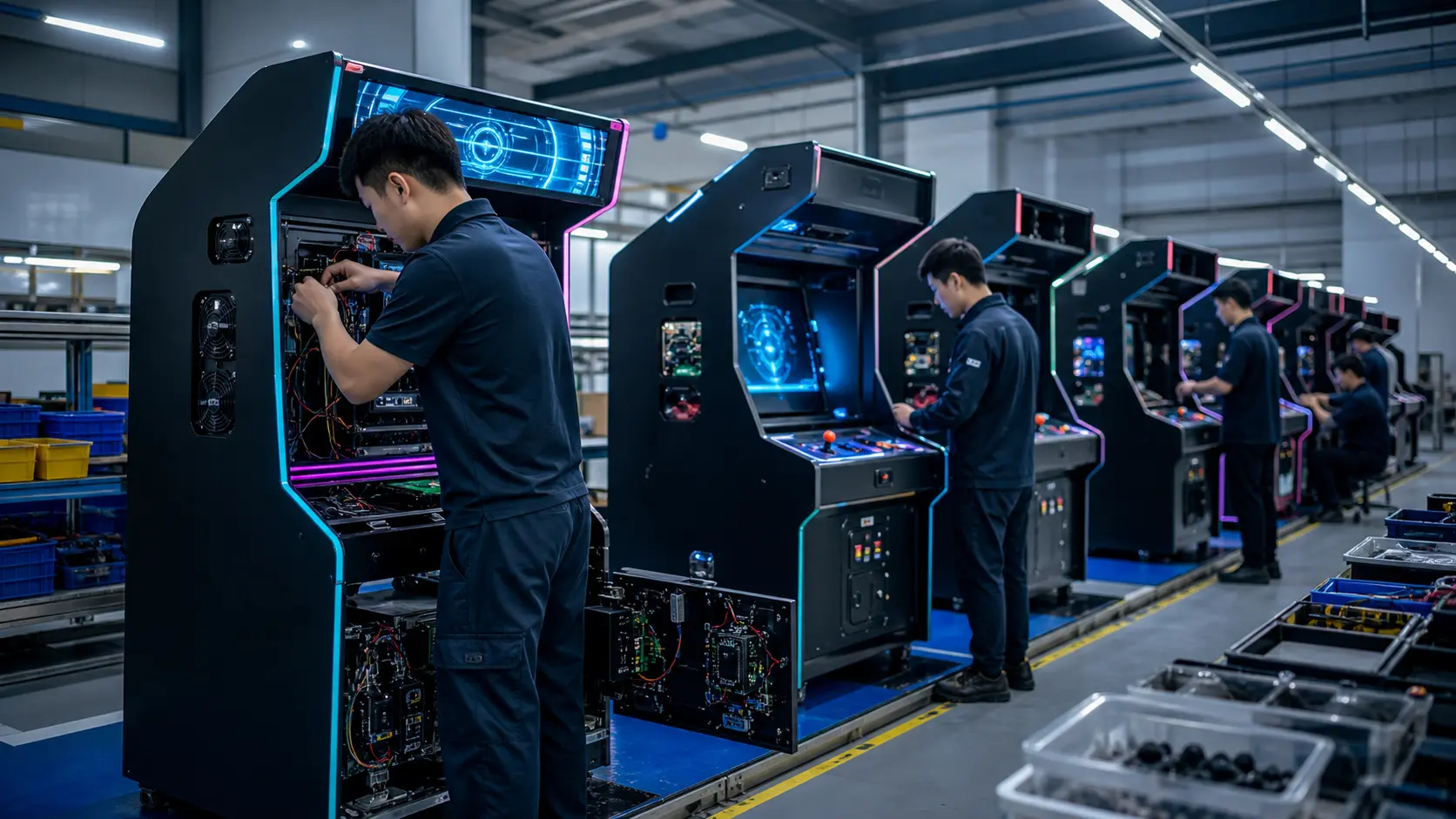
Moving thousands of metal tokens vertically requires serious mechanical torque and wear-resistant components. Cheap plastic gears will strip within weeks of 24/7 operation.
40Cr Hardened Steel Drive Gears For Unstoppable Torque
The transmission system driving the elevator belt must withstand both continuous load and sudden mechanical shocks. We reject the standard nylon or sintered metal gears found in consumer-grade equipment. Instead, we exclusively machine our primary drive train using 40Cr hardened steel.
40Cr steel undergoes a specific quenching and tempering process to achieve exceptional tensile strength and fatigue resistance. When a jam does occur, the sheer torque generated by the heavy-duty brushless DC motor is transferred directly through the gear train. 40Cr steel gears will not strip or deform under this immense pressure. This industrial-grade material selection ensures that the transmission can forcefully power through minor obstructions or safely stall without sustaining permanent damage. It is a critical investment in the longevity of the machine and the stability of the operator’s revenue stream.
Reciprocating Wiper Pusher Blade Mechanics
At the top of the elevator, tokens must be actively ejected from the belt flights and directed into the active player hopper. Relying solely on gravity is insufficient, as tokens can stick to the polyurethane due to static or grease accumulation.
We engineer a synchronized reciprocating wiper pusher blade mechanism to guarantee ejection. As each flight reaches the apex, a precision-timed mechanical arm sweeps across the flight, forcibly pushing the tokens into the return chute. This mechanism is directly tied to our advancements in coin pusher wiper arm motion control. The wiper blade is constructed from self-lubricating POM (Polyoxymethylene) plastic, ensuring minimal wear against the belt flights while delivering enough force to clear any stubborn tokens. This active ejection phase completes the mechanical portion of the recycling loop with zero tolerance for failure.
Electronics and Intelligent Fault Recovery
Mechanical robustness must be paired with intelligent electronic control. A dumb motor simply burns itself out against a jam. A smart system detects the anomaly and resolves it automatically.
Optocoupler Isolation and Low Noise DC Power Regulation
Coin pushers are electrically noisy environments. Solenoids firing, motors spinning, and relays clicking all generate electromagnetic interference (EMI). If this interference reaches the elevator control logic or the IoT microcontrollers managing the live stream, it can cause sensor misreads and system crashes.
To protect the logic circuits, we implement rigorous optocoupler isolation on all input and output signal lines connected to the elevator motor driver and optical sensors. Optocouplers transfer electrical signals using light waves, creating a physical air gap that completely blocks voltage spikes and transient noise.
Furthermore, we utilize high-efficiency, low-noise DC power regulation modules. We separate the high-current power rails for the drive motors from the low-voltage logic rails used by the sensors and IoT boards. This isolation ensures that even during motor startup spikes or sudden stalls, the logic circuits remain stable, preventing ghost sensor triggers and maintaining perfect synchronization with the cloud backend.
Automated Jam Clearing Firmware With Reverse Torque Pulses
The final line of defense against downtime is our proprietary automated jam clearing firmware. We monitor the continuous current draw of the elevator drive motor using precise current-sensing shunts. Under normal operation, the current draw remains within a predictable baseline.
If a severe jam occurs and the motor stalls, the current draw immediately spikes. Our firmware detects this overcurrent condition within milliseconds and instantly halts the motor to prevent thermal damage. The system then executes an automated recovery sequence. It applies a series of high-torque, reverse-direction pulses to the motor, forcefully backing the elevator down slightly to dislodge the jammed token. It then attempts to drive forward again.
The firmware will repeat this forward-and-reverse agitation cycle several times. In over 95% of cases, this action successfully clears the obstruction without any human intervention, immediately resuming the continuous token recycling loop. If the jam persists after multiple attempts, the system safely disables the elevator and triggers a high-priority alert to the operator’s cloud dashboard, providing exact diagnostics and minimizing diagnostic time.
Complete Return On Investment and Operator Profitability
Upgrading to an industrial-grade automated token recycling loop is not an expense; it is a strategic investment in operator profitability. A standard retrofitted cabinet might cost less upfront, but the hidden costs of downtime, lost player trust, and manual maintenance quickly destroy profit margins.
By implementing 40Cr steel gears, flighted polyurethane belts, and intelligent anti-jam firmware, our machines deliver true 24/7 reliability. For a venue operating 50 machines, eliminating just one hour of downtime per machine per week can result in tens of thousands of dollars in reclaimed revenue annually. Our hardware solutions provide the foundation for a scalable, highly profitable remote arcade business.
Ready to upgrade your infrastructure with zero-downtime hardware? Contact our engineering team for wholesale pricing and technical documentation. WhatsApp/WeChat: +86 17620842078 Telegram: https://t.me/JLwyc Email: miba515527@gmail.com
Factory Integration and Source Code Ownership
As a true source factory, Guangzhou Miba Animation Technology Co., Ltd. does not just assemble parts; we engineer complete turnkey solutions. We offer 100% source code ownership for our customized software platforms, ensuring that operators have total control over their data, mathematical models, and player management systems. We invite all prospective partners to schedule a live video tour of our Panyu manufacturing base or arrange an on-site Factory Acceptance Test (FAT). We prove our capabilities with transparent engineering and uncompromising quality control.
Frequently Asked Questions About Token Recycling Elevators
Why do traditional spiral screw lifts fail in remote setups? Spiral screw lifts generate excessive metal-on-metal friction, causing wear and creating metal dust that fouls optical sensors. They are also highly susceptible to permanent jams from bent tokens, lacking the shock absorption and capacity of flighted belt systems.
How does the firmware handle a severe coin jam? The firmware continuously monitors motor current. Upon detecting a stall-induced current spike, it halts the motor and executes a rapid sequence of reverse-torque pulses to automatically agitate and dislodge the jammed token before resuming normal forward operation.
Why is optocoupler isolation necessary for the elevator control board? Optocoupler isolation physically separates the high-voltage/high-current motor circuits from the sensitive low-voltage logic circuits. This prevents electromagnetic interference and voltage spikes from causing sensor errors or crashing the IoT communication boards.
Can the bottom funnel geometry really prevent token bridging? Yes. By designing the stainless steel collection funnel with asymmetrical slope angles and integrating a low-frequency vibration transducer, we ensure tokens enter the elevator throat at varying speeds and angles, effectively breaking up potential bridges before they form.
html
“`