- The Financial Mechanics of Multiplayer Arcade Systems
- Core Hardware Architecture for Uninterrupted Operation
- Advanced Anti-Cheat and Revenue Protection Mechanisms
- Mathematical Models and Adjustable RTP Settings
- Real World Venue ROI and Operator Payback Analysis
- Factory Acceptance Test Protocols
- Input Output Troubleshooting and Maintenance Matrix
- Frequently Asked Questions
- Secure Your Arcade Infrastructure Today
When venue owners install a high-stakes multiplayer cabinet like the golden toad fish game or the Monster Awaken series, the primary concern is never just the graphics. As an operator, your immediate worries center around weekend cashflow, machine uptime during peak hours, and absolute protection against EMP cheaters trying to siphon your hard-earned profits. A single hour of downtime on a Friday night or a compromised bill acceptor can mean thousands of dollars in lost revenue and escalating player disputes. You need guaranteed mathematical stability, unyielding hardware reliability, and complete control over the Return to Player (RTP) percentage to ensure a rapid return on your capital investment.
I am Engineer Wang, lead hardware and game system architect at Guangzhou Miba Animation Technology Co., Ltd. Over my twelve years of hands-on experience designing and deploying industrial-grade arcade machines globally, I have seen exactly what causes cheap cabinets to fail under pressure. In our 15,000-square-meter Panyu manufacturing base, our team of fifty dedicated engineers builds the Arcade Manufacturer ecosystem from the ground up. We do not just assemble parts; we engineer profit-protection systems. In this detailed breakdown, we will dissect the underlying hardware matrix, wiring protocols, and anti-cheat mechanisms that make our fish tables the most reliable revenue generators in the global market. For factory-direct procurement and comprehensive engineering specs, consult our master guide on arcade game machine manufacturing and custom cabinet sourcing.
If you are currently evaluating hardware vendors and need immediate access to our technical whitepapers or factory direct pricing, drop me a message on WhatsApp at +86 17620842078.
The Financial Mechanics of Multiplayer Arcade Systems
Before diving into the motherboard specifications, we must understand the financial velocity of a modern eight-player or ten-player fish table. The golden toad fish game operates on a continuous micro-transaction model. Eight players rapidly firing digital cannons creates an immense volume of input data and continuous credit fluctuations.
For the operator, the mathematics are clear. If a machine holds an adjustable 94% RTP, the house retains 6% of all credits cycled through the system. However, this mathematical edge only materializes if the hardware can accurately process hundreds of button inputs per second without freezing, dropping inputs, or rebooting due to thermal throttling. Every missed calculation is a direct threat to your bottom line.
Our engineering philosophy at Arcade Manufacturer treats the cabinet as a mission-critical financial terminal. The power supply unit must deliver pristine, ripple-free voltage to the mainboard. The I/O bridge must isolate mechanical button spikes from the central processor. The cabinet itself must act as a Faraday cage against external electromagnetic interference. When you invest in our Monster Awaken hardware, you are buying a fortress designed to protect your mathematical edge.
Core Hardware Architecture for Uninterrupted Operation
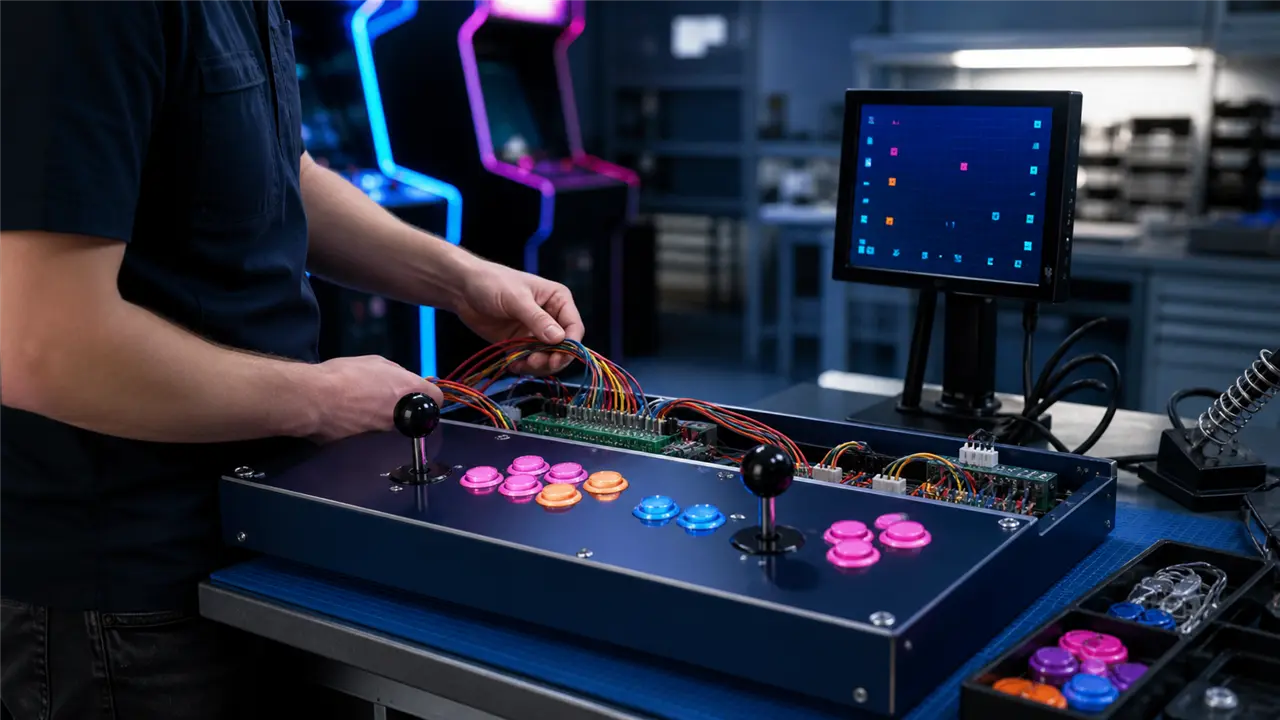
The heart of our golden toad fish game setups lies in the industrial-grade motherboard and the supporting electronic infrastructure. We have moved far beyond standard PC components, developing proprietary embedded systems designed for 24/7/365 operation in high-humidity, smoke-filled venue environments.
Industrial Mainboard Specifications
Standard consumer motherboards fail rapidly in arcade environments due to capacitor degradation and poor thermal management. Our custom PCB solutions utilize solid-state capacitors and conformal coating to resist dust and moisture accumulation. The processors are passively cooled using massive aluminum heatsinks, eliminating moving fan parts that inevitably clog and fail.
The mainboard features integrated JAMMA edge connectors alongside specialized I/O headers for advanced bill acceptors and ticket dispensers. By keeping the processing architecture proprietary, we prevent unauthorized software modifications and ensure that the mathematical models governing the golden toad fish game remain locked and encrypted.
Clean Power Delivery and Ripple Suppression
Power fluctuations are the silent killer of arcade profits. A sudden voltage drop can cause the mainboard to reset, resulting in lost player credits, immediate disputes on the venue floor, and a damaged reputation. We over-engineer our power distribution network to prevent this entirely.
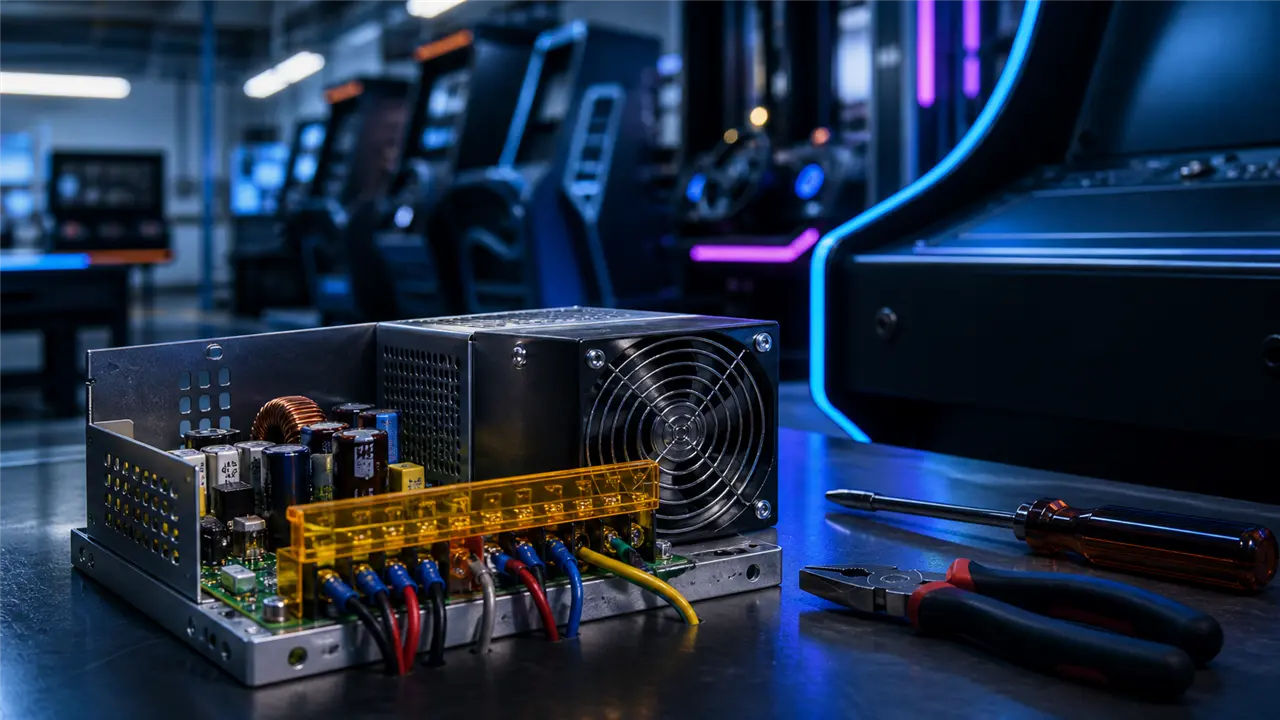
We utilize heavy-duty switching power supplies, specifically Mean Well industrial units, which provide exceptional voltage regulation and active power factor correction. Furthermore, we separate the logic power (5V and 12V for the mainboard) from the high-current peripheral power (24V for coin hoppers and ticket dispensers). This isolation ensures that a jammed hopper motor will never cause a voltage sag on the critical logic circuits.
If you want a live demonstration of our hardware stability under load, connect with me on Telegram at t.me/JLwyc to schedule a virtual tour of our burn-in testing facility.
The I/O Control Bridge and Signal Isolation
An eight-player cabinet has up to thirty-two physical buttons and eight heavy-duty joysticks. Players often abuse these controls during intense gameplay. The I/O control board acts as the critical intermediary between these physical switches and the delicate mainboard logic.
Our I/O bridge incorporates opto-isolators for every single input channel. When a player smashes the shoot button, the mechanical switch completes a circuit that lights a microscopic LED inside an optocoupler. A phototransistor detects this light and sends the signal to the processor. There is zero electrical connection between the sweaty, static-charged hands of the player and your expensive mainboard. This optical isolation prevents electrostatic discharge (ESD) from frying the CPU, a common point of failure in poorly designed cabinets.
Advanced Anti-Cheat and Revenue Protection Mechanisms
Venue operators lose millions annually to organized arcade cheating rings. These individuals utilize sophisticated devices to manipulate coin mechs, blast EMP waves to generate phantom credits, or exploit software vulnerabilities. At Guangzhou Miba Animation Technology Co., Ltd., we have implemented a multi-layered defense strategy to make our cabinets impervious to these attacks.
Electromagnetic Pulse Shielding
EMP jammers are the most common threat to fish tables. Cheaters use these handheld devices to induce current spikes in the wiring harness, tricking the bill acceptor or coin mech into registering false deposits.
We combat this through comprehensive electromagnetic shielding. The interior of our metal cabinets forms a continuous grounded enclosure. Sensitive communication lines between the bill acceptor and the mainboard are wrapped in braided copper shielding, tied directly to earth ground. Additionally, our I/O boards feature transient voltage suppression (TVS) diodes that clamp any induced high-voltage spikes within picoseconds, safely shunting the malicious energy to ground before it can register as a false credit.
Encrypted Communication Protocols
Legacy arcade machines rely on simple pulse signals to register credits. A bill acceptor sends five electrical pulses to indicate a five-dollar bill. Cheaters easily spoof these pulses.
Our advanced Monster Awaken cabinets utilize ccTalk or proprietary RS-232 encrypted serial communication between the currency handling devices and the mainboard. The bill acceptor does not send dumb pulses; it sends a digitally signed data packet. If a cheater attempts to inject signals onto the wire, the mainboard instantly detects the mismatched cryptographic signature, rejects the input, and triggers a loud audible alarm while locking the machine down.
Dynamic Key Rolling and Hardware Dongles
To prevent software piracy and unauthorized parameter cloning, our game software requires a physical hardware security dongle connected to the motherboard. This is not a simple static check. Our system uses dynamic key rolling, where the cryptographic handshake between the software and the dongle changes every few milliseconds. Even if someone manages to copy the hard drive, the software remains completely useless without the paired, factory-authorized hardware token.
Mathematical Models and Adjustable RTP Settings
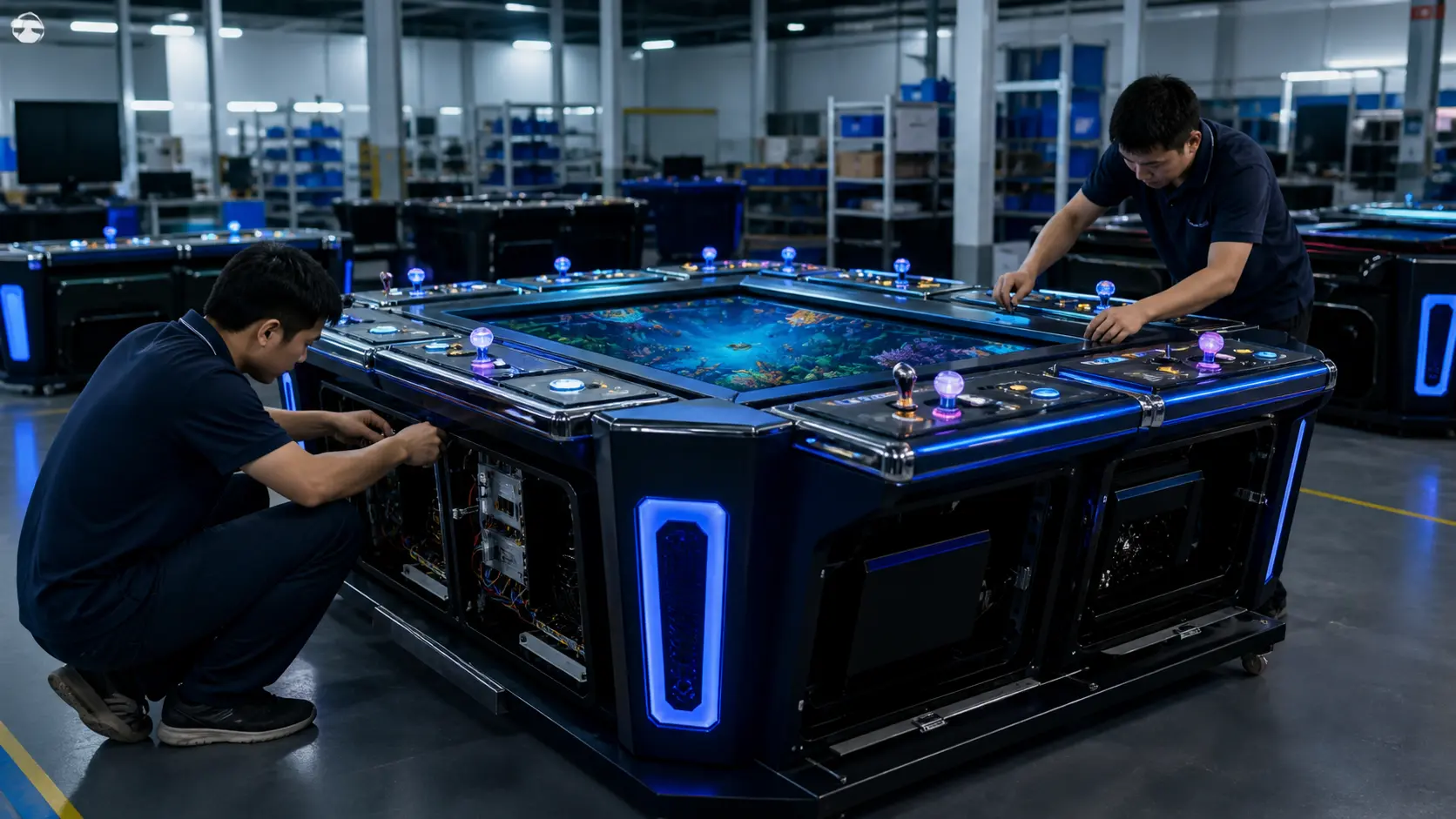
The visual spectacle of the golden toad fish game attracts players, but the underlying mathematical model is what keeps them playing and ensures the operator’s profitability. A poorly tuned game either drains players too quickly, discouraging repeat visits, or bleeds money to the players, bankrupting the venue.
Understanding the Volatility Engine
Our software architects have developed a highly sophisticated volatility engine. Unlike mechanical slot machines with fixed reels, fish games operate on dynamic collision detection and randomized hit points for the digital targets.
The operator has complete control over the hold percentage through the secure administrative menu. You can adjust the baseline difficulty, the maximum payout per target, and the frequency of boss appearances like the Golden Toad.
Location Specific Tuning Strategies
Different venues require different mathematical strategies. A high-traffic tourist location might benefit from a tighter RTP to maximize revenue from transient players. Conversely, a neighborhood arcade relies on regular patrons and might choose a looser setting to extend playtime and build long-term loyalty.
Our system allows for granular adjustments across different bet levels. You can incentivize higher wagers by slightly increasing the hit probability for maximum-bet cannons, ensuring that the players who risk the most feel appropriately rewarded while maintaining your overall house edge.
Real World Venue ROI and Operator Payback Analysis
Let us analyze the raw economics of deploying a premium Monster Awaken eight-player cabinet in a standard commercial venue. These figures represent averages based on our global client data, though local market conditions dictate exact results.
Capital Expenditure and Operating Costs
- Initial Hardware Investment (Cabinet, Board, Bill Acceptors, Shipping): $4,500 – $6,500 depending on configuration.
- Monthly Power Consumption: Approximately $30 – $50.
- Monthly Maintenance (Button replacements, cleaning): $20 – $40.
Projected Revenue and Payback Period
Assuming a conservative average of six players per hour, each spending $15 per hour, the machine handles $90 in coin-in per hour. Over a modest eight-hour operating day, that equals $720 in daily handle.
If the operator sets the game hold to a standard 8%, the daily gross profit is $57.60. Monthly Gross Profit: $1,728.
At these conservative estimates, the cabinet fully pays for itself in less than four months. After the payback period, the machine generates pure profit, constrained only by foot traffic and basic maintenance. By investing in reliable Guangzhou Miba Animation Technology Co., Ltd. hardware, you eliminate the catastrophic downtime events that destroy these ROI calculations.
Factory Acceptance Test Protocols
We do not ship promises; we ship verified industrial equipment. Before any golden toad fish game leaves our Panyu facility, it must pass a grueling Factory Acceptance Test (FAT). We invite our B2B partners to participate in this process via live video feed or in-person visits.
The 72 Hour Burn In Procedure
Every completed motherboard undergoes a strict 72-hour burn-in phase in our thermal testing chamber. The boards are subjected to maximum CPU and GPU loads while ambient temperatures are elevated to 45 degrees Celsius (113 Fahrenheit). This process forces any weak solder joints or defective microchips to fail on our factory floor, not in your venue.
Peripheral Stress Testing
We do not trust paper specifications. Our quality assurance team manually feeds thousands of worn, crumpled, and counterfeit bills through the installed bill acceptors to verify rejection rates and anti-jamming mechanisms. Every joystick is tested for dead zones, and every firing button undergoes automated pneumatic striking to ensure the microswitches can handle millions of rapid actuations without fatiguing.
If you require customized hardware configurations for your specific market, reach out to me directly at miba515527@gmail.com to discuss engineering timelines.
Input Output Troubleshooting and Maintenance Matrix
Even the most robust hardware requires basic maintenance. To assist our venue operators, we provide this quick-reference diagnostic matrix for common physical issues.
Identifying Button and Joystick Failures
Symptom: Player station three cannot shoot, but joystick works. Diagnosis: The microswitch on the shoot button has failed open, or the quick-disconnect wire has vibrated loose. Action: Open the control panel. Short the two wires leading to the microswitch together. If the cannon fires on screen, replace the microswitch. If it does not fire, trace the wire back to the I/O board to check for continuity.
Bill Acceptor Communication Errors
Symptom: Bill acceptor takes money but credits do not appear on screen. Diagnosis: Pulse wire disconnected, or serial communication protocol mismatch. Action: Verify the dip switch settings on the bill acceptor match the required protocol for the mainboard. Inspect the optical isolator chips on the I/O board for any signs of heat damage. Check the ground wire connecting the bill acceptor chassis to the main power supply ground.
Power Supply Voltage Calibration
Symptom: Cabinet randomly reboots when all eight players are firing simultaneously. Diagnosis: Voltage sag under peak load. The 5V logic line is dropping below 4.75V. Action: Use a digital multimeter to measure the voltage across the 5V and GND pins on the JAMMA edge connector while the machine is running. Use the small plastic potentiometer on the switching power supply to slowly increase the output voltage until it reads exactly 5.1V at the board edge.
Related Engineering References and Floor Operational Guides
- For our comprehensive factory production standards, review our turnkey fish table manufacturing framework.
- To secure your floor against transient spark attacks, see our breakdown on EMP jammer detectors for fish game arcades.
- Compare footprint and power demands with our commercial Ocean King hardware specifications.
- For pulse harness isolation schematics, inspect our fish table bill validator wiring guide.
Frequently Asked Questions
How does the Golden Toad multiplier system affect the daily payout?
The Golden Toad serves as a high-variance target. When defeated, it awards a massive multiplier based on the player’s current bullet value. Our administrative backend allows you to cap this maximum multiplier to prevent a single lucky shot from draining the daily profit pool. The math engine automatically balances the overall RTP over millions of simulated shots.
Can the software be modified to support a card swipe system instead of cash?
Absolutely. Our cabinets support standard RS-232 and pulse outputs compatible with all major arcade card swipe systems like Embed, Intercard, and Sacoa. We provide the necessary wiring harnesses and technical schematics to ensure a seamless integration with your existing venue management software.
What is the maximum screen size supported by the Monster Awaken hardware?
Our high-definition graphics engine supports 1080p and 4K resolutions. We routinely build cabinets ranging from 55-inch four-player setups to massive 85-inch ten-player tables. The hardware scales flawlessly without any drop in frame rate or input latency.
How do you handle warranty replacements for international buyers?
We stock spare components in several regional hubs. If a proprietary board fails, we ship a replacement via DHL Express immediately upon remote diagnostic confirmation. You do not need to wait for the broken part to arrive in China before we dispatch the replacement. Your uptime is our priority.
Is it possible to network multiple tables together for a venue-wide progressive jackpot?
Yes. Our premium mainboards feature dual Ethernet ports. You can link multiple golden toad fish game cabinets to a central server PC running our proprietary jackpot management software. This creates massive overhead displays showing accumulating progressive prizes, dramatically increasing player engagement and overall coin-in across the entire venue floor.
Secure Your Arcade Infrastructure Today
The difference between a struggling arcade and a highly profitable entertainment venue comes down to hardware reliability and mathematical control. Stop losing revenue to cheap, unstable imitation boards.
Partner with Arcade Manufacturer and equip your venue with the most secure, profitable fish game cabinets on the market. For immediate technical consultations, custom cabinet designs, or factory-direct quotes, contact Engineer Wang directly:
WhatsApp: +86 17620842078 Telegram: t.me/JLwyc Email: miba515527@gmail.com
Our Panyu engineering team is ready to build the infrastructure that will drive your business forward. Let us lock down your profits today.