- Precision Mechanical Wheel and Servo Motor Architecture
- Dual Laser Ball Drop Tracking and Optical Verification
- Eight Player and Twelve Player Stadium Gaming Terminals
- TCP IP Video Distribution and Zero Delay Switching
- Casino Management System Integration and SAS Protocol
- GLI Eleven Cabinet Compliance and Hardware Security
- Manufacturing Excellence at Our Panyu Base
- ROI Calculation and Commercial Procurement
- Contact Engineer Wang for Direct Factory Quotes
- Frequently Asked Questions
For casino operators and commercial gaming club owners across Europe, Macau, and the broader Asian market, the reliability of a multiplayer electronic roulette machine directly dictates floor profitability. The sheer throughput of automated roulette gameplay means that even a single mechanical failure, a delayed ball drop, or a sensor misread can halt betting and compromise player trust. As the lead hardware engineer at our 15,000-square-meter Panyu manufacturing base, I have spent the last decade designing, refining, and testing commercial-grade electronic gaming equipment. We are a direct source factory, delivering completely assembled hardware and turnkey software solutions. Our specialty is complete machine delivery, avoiding the fragmented spare parts market to focus entirely on robust, casino-ready architecture.
This technical breakdown will walk you through the engineering exactness required to build top-tier stadium gaming roulette cabinets. We will explore the mechanics behind our automated precision servo-driven mechanical wheels, the security layers of our dual-laser ball drop tracking systems, and the underlying network that powers zero-delay TCP/IP video distribution to local player terminals. By adhering to GLI-11 physical cabinet compliance standards and supporting full SAS 6.02 protocol compatibility, our factory ensures that every 8-player and 12-player electronic roulette cabinet we ship is built for continuous, uninterrupted operation. Our goal is to provide operators with an asset that begins generating a return on investment immediately upon deployment while requiring virtually zero unscheduled maintenance over a ten-year operational lifespan.
Precision Mechanical Wheel and Servo Motor Architecture
At the very center of any electronic roulette installation is the mechanical wheel. Unlike purely digital random number generators (RNG) found in standard video slots, hybrid and automated roulette systems rely on the physics of a physical ball spinning on a meticulously balanced cylinder. The core of our automated wheel design is an industrial-grade precision servo-driven mechanical system. We explicitly avoid standard open-loop stepper motors; instead, we deploy high-torque, continuous-duty closed-loop servo motors that maintain absolute rotational speed accuracy under constant load and rapidly changing environmental conditions.
The aluminum alloy rotor is CNC-machined from a solid block of aircraft-grade 6061-T6 aluminum, ensuring that weight distribution is mathematically flawless. In our Panyu QA lab, our protocol mandates a strict dynamic balancing test. Any rotor exhibiting a deviation greater than a fraction of a gram across its entire diameter is instantly rejected. The spindle rests on ceramic angular contact ball bearings, chosen specifically for their exceptionally low friction coefficient, resistance to thermal expansion, and extreme durability. These bearings allow the wheel to spin silently and smoothly, minimizing wear and extending the maintenance lifecycle to well over five years of continuous 24/7 casino floor use without the need for relubrication.
Furthermore, the ball launch mechanism is entirely automated using a proprietary compressed air system and a mechanical kicker. The system micro-controls the precise velocity and entry angle of the ball. By adjusting pneumatic pressure at the millisecond level, the launch introduces just enough randomized variation in the initial thrust to guarantee cryptographic randomness of the final outcome, completely satisfying international gaming laboratory standards. The integration of a closed-loop servo system means the wheel’s main controller board constantly reads the exact position of the wheel head and the rotor via absolute encoders, making real-time micro-adjustments to counteract any minute environmental shifts, such as localized temperature changes or slight cabinet vibrations from the casino floor.
Dual Laser Ball Drop Tracking and Optical Verification
The most critical moment in any roulette game is when the ball drops from the outer track into a numbered pocket. Accurately and instantaneously determining the winning number is paramount for paying out winning bets without delay and opening the next betting window. To achieve this zero-latency detection, our electronic roulette cabinets employ a state-of-the-art dual-laser ball drop tracking and optical speed verification array.
This tracking architecture is built on a highly redundant sensor methodology designed to eliminate false positives and circumvent any environmental interference. The primary layer consists of high-frequency Class 1 industrial laser arrays positioned strategically around the internal rim of the wheel. These lasers create a tightly woven, invisible optical grid that tracks the ball’s position, velocity, and trajectory in real-time. By utilizing a dual-laser setup operating at distinct nanometer wavelengths, we completely eliminate blind spots and dramatically reduce the margin for error caused by ambient casino lighting, strobe effects, or dust accumulation. When the ball’s velocity drops below a pre-calculated critical threshold, the optical speed verification algorithm determines the exact millisecond the ball makes its final descent into the rotor.
The secondary layer involves specialized CMOS optical image sensors mounted directly above the wheel hub within the secure glass dome. These sensors capture hundreds of frames per second, running advanced pattern recognition algorithms and edge-detection filters to definitively confirm the ball’s resting position inside the numbered pocket. This dual-authentication method—combining physical laser beam breaking with sophisticated optical image processing—ensures 100 percent accuracy. If a player contests a result or if the system detects an anomaly, the main logic board retains a high-resolution video snapshot and a data log of the exact drop, providing an irrefutable audit trail for casino management and regulatory bodies.
Security against physical manipulation is also baked into this sensor array. Any attempt to tamper with the glass dome, alter the lighting conditions unnaturally, or introduce external magnetic fields triggers an immediate hardware interrupt. This interrupt shuts down all betting, locks the player terminal balances, and alerts floor managers via the CMS network. Our factory strictly builds these defenses into the core hardware, ensuring our clients receive a complete, secure machine out of the box.
Eight Player and Twelve Player Stadium Gaming Terminals

The layout, ergonomics, and responsiveness of the player terminals define the user experience and dictate the volume of bets placed per hour. We engineer our multiplayer configurations to meet both Asian and Macau casino standards, as well as stringent European club standards. Our standard configurations feature 8-player circular setups ideal for intimate VIP rooms, and expansive 12-player stadium gaming arrays designed for the high traffic of main casino floors.
Each localized player terminal touchscreen console is built around a robust 23.8-inch or 27-inch projective capacitive (PCAP) touchscreen. We specify industrial-grade displays with a minimum brightness of 400 nits, high contrast ratios, and ultra-wide viewing angles, ensuring vibrant colors and sharp graphics under the harsh glare of overhead casino lighting. The touch glass is fortified with chemically strengthened, anti-glare, and anti-fingerprint treatments, capable of withstanding the heavy physical abuse typical in high-traffic gaming environments, including the impact of rings, watches, and heavy strikes. The IP65-rated front panel protects the sensitive internal electronics against liquid spills, cigarette ash, and dust ingress, a common hazard in food and beverage-friendly gaming clubs.
The terminal chassis itself is constructed from 1.5mm thick cold-rolled steel, offering exceptional rigidity and grounding. Inside, each terminal operates as an independent, fully isolated node powered by an industrial motherboard and a high-performance integrated GPU. This setup ensures buttery-smooth 3D rendering of the complex betting layout, fluid animations of chip placement, and seamless rendering of historical data charts. Despite operating as independent computing nodes, the terminals are networked via a tightly synchronized star topology to the main game server. This ensures that betting windows open and close uniformly across all seats to the millisecond, preventing late-betting disputes. This localized processing power prevents any single point of failure; if one terminal requires maintenance or rebooting, the rest of the stadium setup continues to generate revenue without interruption.
TCP IP Video Distribution and Zero Delay Switching
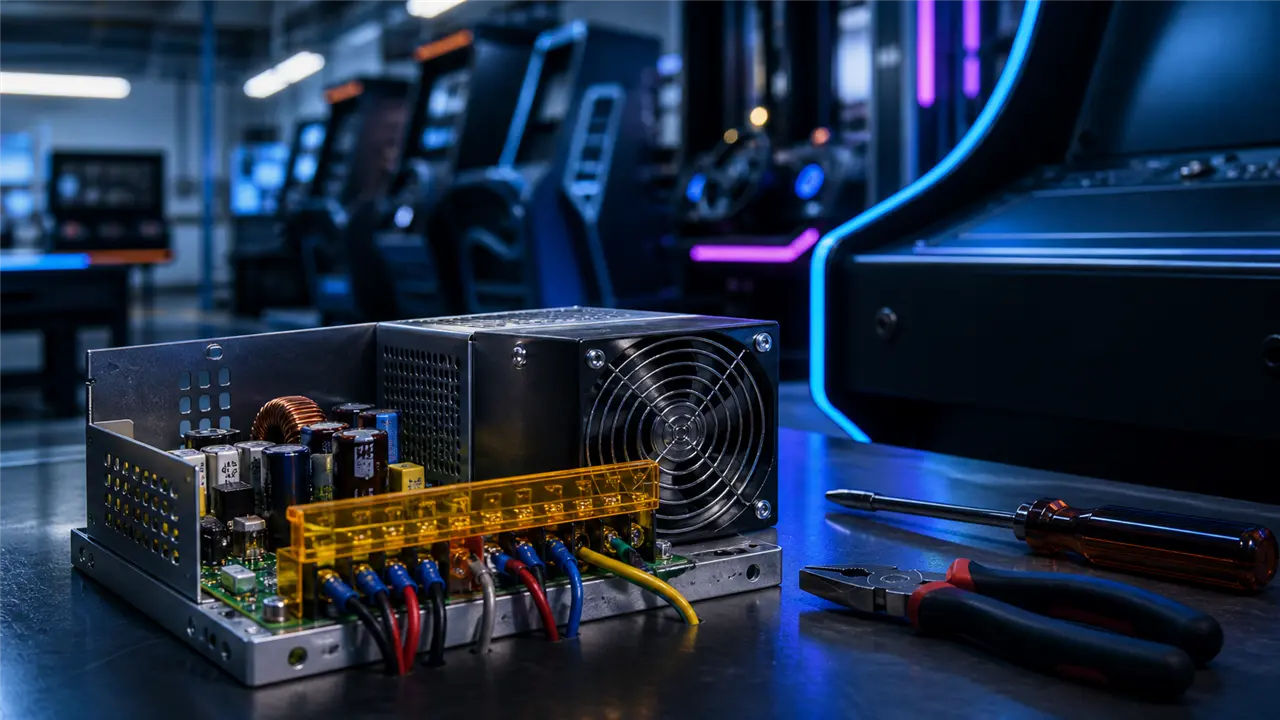
In a stadium gaming environment, players rely entirely on a live video feed of the central mechanical wheel to place their bets with confidence and verify the physical outcome. Latency between the physical ball drop and the video displayed on the player terminals is completely unacceptable and can lead to severe player disputes or regulatory fines for the operator. To combat this, our engineering team has implemented a proprietary zero-delay TCP/IP video distribution architecture.
Unlike older analog video splitters or coaxial cable runs that degrade signal quality over distance and introduce processing lag, our system utilizes a dedicated, physically isolated Gigabit Ethernet backbone exclusively for high-definition video and telemetry data. A broadcast-grade PTZ (Pan-Tilt-Zoom) camera, mounted above the wheel, captures the wheel’s action in uncompressed 1080p or 4K resolution at 60 frames per second. This raw feed is instantly processed by a hardware-based H.265 ASIC encoder that prioritizes ultra-low latency over extreme bandwidth compression.
The localized network switch employs IGMP snooping and multicast routing protocols to distribute the live feed to all 8 or 12 player terminals simultaneously without flooding the network. The result is an astonishing sub-30 millisecond glass-to-glass latency, meaning the video the player sees is effectively real-time, completely imperceptible to the human eye. This zero-delay architecture is vital for maintaining the psychological thrill and trust of the game. Furthermore, this robust TCP/IP backbone allows for seamless integration into larger casino-wide digital signage systems. Operators can easily route the live wheel action to overhead stadium displays, remote VIP rooms, or bar areas, effectively expanding the footprint and betting potential of a single roulette wheel across the entire property.
Casino Management System Integration and SAS Protocol
A commercial electronic roulette machine is only as valuable as its ability to integrate into a casino’s broader financial and operational ecosystem. Standalone machines are a liability for modern operators. Our complete machines are engineered from the ground up to feature native, certified SAS 6.02 protocol compatibility. The Slot Accounting System (SAS) protocol is the global standard for casino hardware communication, and our controller boards implement a highly robust, dual-channel RS-232 SAS interface equipped with optical isolation.
Through the SAS 6.02 protocol, our roulette cabinets communicate seamlessly with any major Casino Management System (CMS), including platforms from Aristocrat, Bally, IGT, and Novomatic. This allows for real-time reporting of absolute critical data: coin-in, coin-out, drop, win percentages, machine door status, and exact error codes. It also fully supports modern cashless gaming infrastructures, including Ticket-In Ticket-Out (TITO) systems and Advanced Funds Transfer (AFT) protocols. We integrate top-tier bill validators from industry leaders like JCM, MEI, or ICT, alongside high-speed thermal ticket printers from TransAct or Ithaca, ensuring fast, secure, and jam-free financial transactions.
Our system architecture strictly separates the game logic and graphics processing from the financial communication layer using a secure, isolated micro-controller. This means that even in the unlikely event of a game software crash, a user interface freeze, or a sudden complete power loss, the financial transaction data is held securely in non-volatile NVRAM and battery-backed SRAM. Upon reboot, the system instantly recovers the last known state, ensuring no player funds are lost and the casino’s accounting remains perfectly balanced. This uncompromising commitment to financial security is exactly why global operators trust our factory to deliver turnkey solutions rather than cobbling together disparate parts.
GLI Eleven Cabinet Compliance and Hardware Security
Regulatory compliance is the primary barrier to entry for any serious casino operator and manufacturer. Our engineering design process is heavily influenced by the stringent requirements of international gaming laboratories. Every cabinet we design aims to meet or exceed GLI-11 physical cabinet compliance standards. This comprehensive standard dictates the physical security, software integrity, electrical safety, and overall fairness of gaming devices.
Starting with the physical enclosure, the cabinet features a multi-point locking mechanism utilizing Medeco or equivalent high-security cam locks. The logic area, which houses the main processing unit, memory, and random number generator (for hybrid systems), is enclosed in a secondary, independently locked steel cage outfitted with intrusion detection microswitches. If any door or panel is opened—even while the machine is powered off—the event is immediately logged to the secure audit trail in NVRAM and instantly broadcast over the SAS network to the casino security desk.
Electrical security is equally critical in our design philosophy. In many global markets, operators face the continuous threat of malicious players using electromagnetic pulse (EMP) devices to scramble hardware, reset logic boards, and trigger false payouts. Our power distribution boards and logic controllers are encased in Faraday-cage-like enclosures and feature proprietary industrial-grade EMP suppression circuitry, aligning with our comprehensive anti-cheat hardware defense systems. We utilize ultra-fast transient voltage suppression (TVS) diodes, heavy-duty line filters, and optical isolators on all I/O lines to clamp high-voltage spikes within picoseconds, rendering EMP attacks completely ineffective. Furthermore, the main power supply is an active PFC, 80-Plus Gold certified industrial unit that guarantees clean, ripple-free DC power to all sensitive electronics, further enhancing system stability and longevity.
Manufacturing Excellence at Our Panyu Base
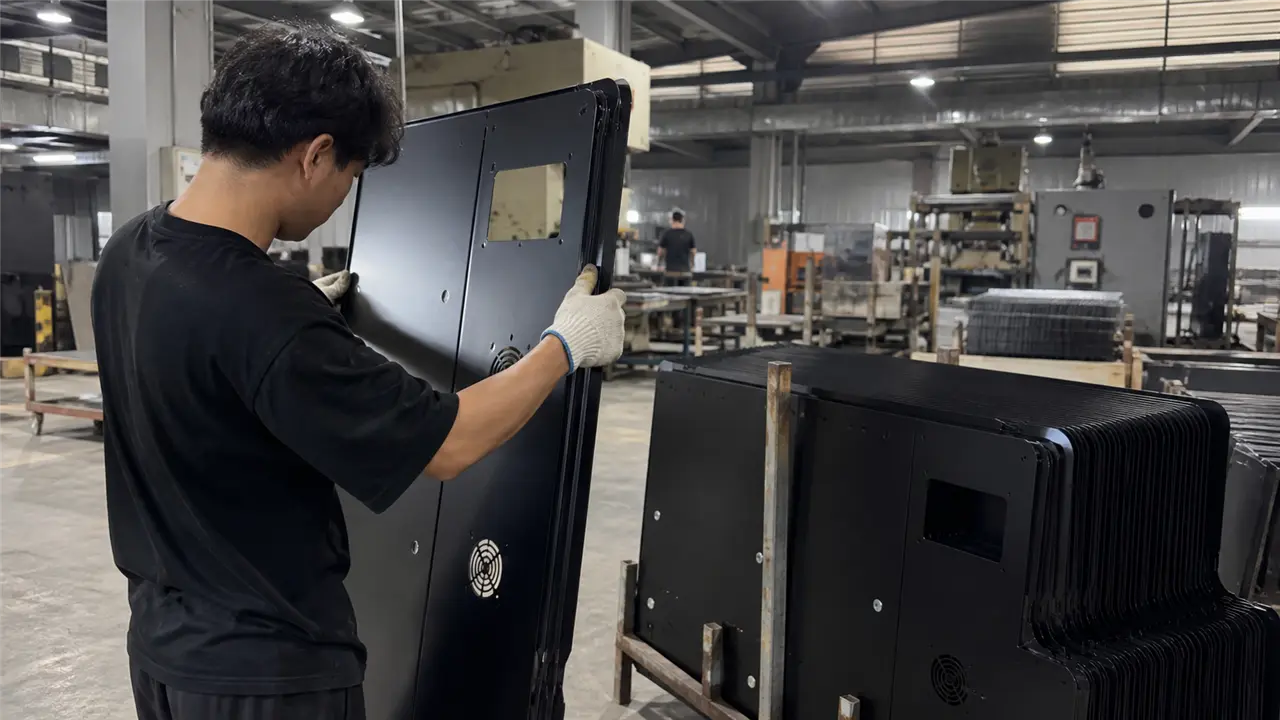
When you partner with our factory, you are bypassing the complex, risk-prone web of trading companies and spare parts aggregators. You are dealing directly with a 15,000-square-meter manufacturing powerhouse dedicated solely to complete machine delivery and turnkey solutions. We control the entire production lifecycle in-house, from the initial CAD design of the sheet metal to the final software QA testing and crating.
Our facility houses advanced Trumpf laser cutting machines, highly precise CNC press brakes, and a fully automated, environmentally controlled powder-coating line. This vertical integration allows us to offer deep OEM and ODM customization for your specific market needs while maintaining strict quality control over every component. If you require a unique cabinet shape to match your casino’s aesthetic, a specialized button deck layout, or integration of proprietary peripheral devices, our engineering team can prototype and produce it rapidly. For a deeper understanding of our production capabilities and QA methodologies, I encourage you to review our commercial arcade game machines manufacturing standards.
Furthermore, our expertise extends far beyond standard configurations. We frequently collaborate with major distributors and casino groups to engineer highly customized hardware platforms. Whether it involves modifying the seating ergonomics for specific demographics, integrating bespoke RGB lighting packages synced to game events, or adapting the cabinet footprint for specific regional compliance, our team has the proven track record to execute flawlessly. You can explore our custom fabrication capabilities in our guide on custom arcade cabinet builder OEM and ODM engineering.
ROI Calculation and Commercial Procurement
Procuring automated multiplayer electronic roulette machines is a significant capital expenditure, but the return on investment (ROI) metrics strongly favor complete, factory-direct solutions over maintaining traditional live tables. By automating the dealer role, casinos eliminate labor costs, eliminate human error, dramatically reduce the risk of internal theft, and significantly increase the number of games played per hour. An automated wheel can comfortably execute over 60 to 80 spins per hour depending on the configured betting window, significantly outpacing a live dealer while allowing a single physical wheel to serve up to 12 players simultaneously.
When you source directly from our Panyu factory, you acquire casino-grade technology without the inflated markups of traditional Western distributors. Our highly competitive B2B pricing structure allows operators to achieve a full ROI in a fraction of the time, often within the first six to eight months of operation on a busy floor. We offer comprehensive Factory Acceptance Testing (FAT) via live high-definition video link or in-person visits to our Guangzhou facility, ensuring your machines meet your exact specifications and perform flawlessly before they are crated and shipped. We provide full crating in fumigated solid wood, ensuring safe international transit via sea freight to ports across Europe, South America, and Southeast Asia. We do not sell spare parts; we sell high-yield commercial assets designed for immediate deployment.
Contact Engineer Wang for Direct Factory Quotes
If your casino, VIP club, or distribution network requires highly reliable, fully integrated multiplayer electronic roulette machines, do not settle for cobbled-together parts or opaque trading companies. Partner with a true source factory that understands the engineering rigor demanded by the commercial gaming industry and stands behind every machine we build.
For direct factory quotes, comprehensive technical whitepapers, detailed API documentation, or to schedule a live video demonstration of our automated wheel architecture and player terminal software, contact me directly.
Engineer Wang (Lead Hardware & Game System Architect)
- WhatsApp / WeChat: +86 17620842078
- Telegram: https://t.me/JLwyc
- Email: miba515527@gmail.com
- Factory Location: Panyu Manufacturing Base, Guangzhou, China
We look forward to engineering the robust backbone of your stadium gaming operations and driving your casino floor profitability.
Frequently Asked Questions
What sizes of multiplayer electronic roulette machines do you manufacture? We standardly manufacture 8-player circular configurations and 12-player stadium-style configurations. However, through our comprehensive OEM/ODM services, we can engineer custom terminal counts based strictly on your casino floor space requirements and architectural layout.
Are your automated mechanical wheels susceptible to magnetic tampering? Absolutely not. Our automated mechanical wheels utilize aircraft-grade aluminum rotors, non-magnetic ceramic bearings, and non-ferrous structural components. Furthermore, the logic boards and sensor circuits are protected by industrial-grade EMP suppression and anti-static shielding, making them highly resistant to external electromagnetic interference and tampering.
Do your electronic roulette cabinets support TITO (Ticket-In Ticket-Out) systems? Yes, our complete machine architectures are fully SAS 6.02 compliant. They integrate seamlessly with major brand bill validators (like JCM or MEI) and thermal ticket printers (like TransAct or Ithaca) to support standard TITO, AFT, and cashless gaming systems used globally by major casino management systems.
How does the dual-laser ball drop tracking technology work? Our proprietary system uses high-frequency laser grids to track the ball’s speed and position continuously on the rim. This physical tracking is paired with high-speed optical image sensors mounted above the wheel, which use pattern recognition to confirm the final resting pocket. This redundancy ensures 100% accuracy in result detection, eliminating misreads.
Can we customize the player terminal software interface and betting layout? Yes. Because we handle both the hardware manufacturing and the internal software development, we offer full customization of the user interface. This includes integrating localized languages, custom chip graphics, branded betting screens, and specific game rules or side bets required by your local jurisdiction.
What is the standard lead time for a complete 12-player stadium roulette setup? Standard lead times for complete multiplayer systems range from 25 to 35 days from deposit, depending heavily on the level of customization required and the current production schedule at our Panyu facility. Shipping times via sea freight will vary based on your destination port.