- The True Cost of Cabinet Instability and Revenue Drain
- Engineering the Unbreakable Casino Grade Roulette Machine
- Mathematical Profit Stability and Core RTP Architecture
- Capital Expenditure vs Operating Margins and ROI Modeling
- Factory Acceptance Test FAT Quality Assurance Protocols
- Operator Troubleshooting Guide and Maintenance Pinout
- Setting Up Secure Remote Telemetry and Accounting
- Expanding Your Floor with Multi Player Cabinets
- Frequently Asked Questions About Casino Grade Roulette Machines
Every Friday night, your arcade floor becomes a battlefield of capital flow. As an arcade operator, you are not just running games; you are managing a high-frequency financial clearinghouse. The biggest nightmare for any venue boss is a system crash or power failure on a fully loaded casino grade roulette machine during peak traffic. Losing player wagers in transit, suffering through prolonged reboot cycles, or worse, falling victim to EMP jammers and cheat devices can wipe out a month of profit in just one weekend.
I am Engineer Wang, Lead Hardware & Game System Architect at Guangzhou Miba Animation Technology Co., Ltd. Over the past 12 years, I have seen countless venue operators hemorrhage cash because they underestimated the engineering complexity required for a true casino grade roulette machine. In our Panyu manufacturing base, we design hardware and mathematical models from a completely defensive, profit-first perspective. This document is your comprehensive operational blueprint. We will dissect how industrial-grade electrical engineering protects your margins, how to calculate your real-world return on investment, and why securing your mathematical payout model is the most critical business decision you will make this year. For factory-direct procurement and comprehensive engineering specs, consult our master guide on arcade game machine manufacturing and custom cabinet sourcing.
Need our full hardware catalog and 2024 pricing matrix? [Contact us to reserve your Demo.]
The True Cost of Cabinet Instability and Revenue Drain
When a venue operator purchases a multi-player roulette setup like Forest Dance or Animal Roulette, the upfront cost is only a fraction of the financial equation. The real money is made—or lost—in the operational lifecycle of the machine. Cheaply manufactured cabinets might save you a few thousand dollars on the initial invoice, but they introduce catastrophic vulnerabilities to your floor.
Understanding Electrical Vulnerability and Board Level Failures
Most budget cabinets utilize off-the-shelf, non-isolated power supplies. In a busy arcade environment, electrical noise from neon signs, heavy air conditioning compressors, and neighboring machines creates severe voltage fluctuations. A sudden transient spike can bypass a cheap power supply and directly hit the main logic board. When this happens during a heavy betting phase, the machine resets. The credits vanish. The players demand refunds, and your floor staff is locked in bitter disputes instead of serving other customers.
The Threat of EMP Jammers and Profit Skimming
Beyond accidental failures, active theft is a persistent threat. Unscrupulous players use miniaturized Electromagnetic Pulse jammers to induce voltage anomalies in the coin acceptors or bill validators, forcing the machine to register phantom credits. If your casino grade roulette machine lacks military-grade shielding, you are basically leaving your vault unlocked. At Arcade Manufacturer, we do not treat this as a minor glitch; we treat it as an existential threat to your business.
Engineering the Unbreakable Casino Grade Roulette Machine
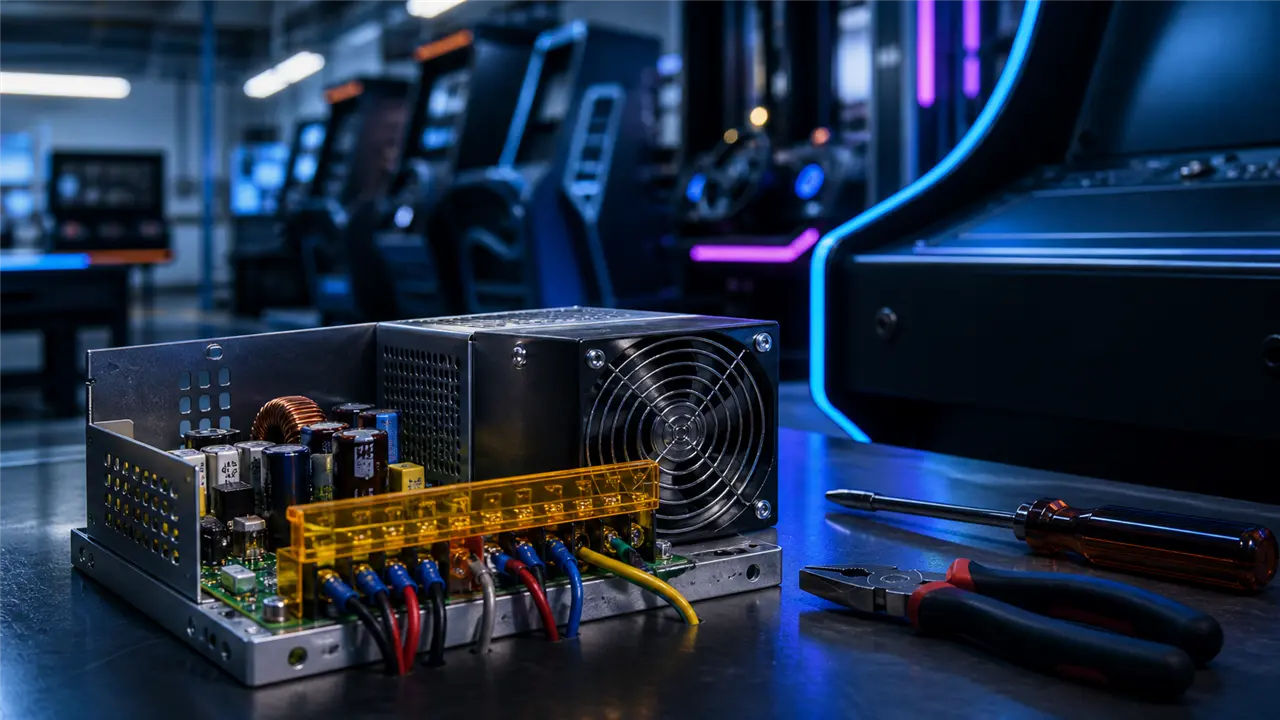
To guarantee your venue’s profitability, our engineering team in Panyu strips down the machine architecture to its core components. We rebuild the hardware environment to withstand continuous 24/7 operation under the most hostile electrical conditions. I oversee these integration processes personally because I know that a single burned-out relay costs you money every minute the machine sits idle.
Industrial Grade Power Supply and Ripple Suppression
We mandate the use of Mean Well industrial power supplies equipped with advanced ripple suppression circuitry. By filtering out high-frequency noise and stabilizing the DC output within a 1% tolerance, we ensure the CPU and the mechanical roulette wheel stepping motors receive absolutely pristine power. This prevents motor stuttering, which can cause the ball to land inconsistently and trigger tilt alarms.
Multi Layered Anti Cheat and Electromagnetic Isolation
To defeat external interference, we enclose the critical processing units in Faraday-style Faraday cages. Our anti-cheat architecture includes transient voltage suppression diodes capable of clamping multi-kilovolt surges in less than five picoseconds. Furthermore, the communication lines between the bill validators and the mainboard utilize optocoupler isolation. Even if a thief manages to send a massive electrical shock through the coin slot, the optocoupler converts the signal to light and back, physically breaking the electrical path and protecting the core logic.
[Are you planning a new venue layout? Request our Technical Whitepaper and PCB Architecture Diagrams to see exactly how we secure your hardware.]
Mathematical Profit Stability and Core RTP Architecture
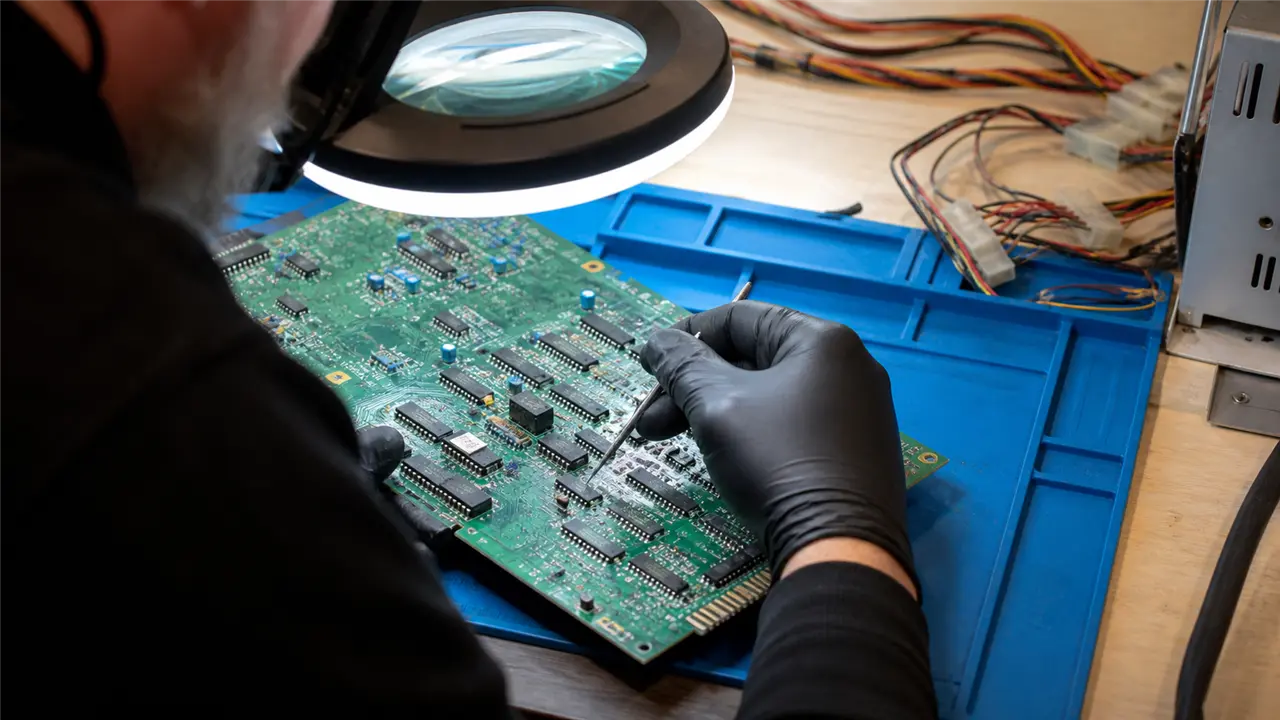
Hardware keeps the machine running, but mathematics generates your revenue. A casino grade roulette machine must deliver a precise, verifiable Return to Player percentage over millions of spins. If the math model fluctuates, your daily operating margins become unpredictable, making it impossible to forecast cash flow or scale your business.
Dynamic Probability and True Random Number Generation
Our game software integrates hardware-based True Random Number Generators that sample atmospheric thermal noise to seed the outcome algorithms. This ensures that the wheel results are mathematically unassailable and completely immune to pattern-tracking software used by professional advantage players. We give operators access to a secure backend management system where they can adjust the RTP within a strict, certified range—typically between 92% and 96%—allowing you to balance player retention with necessary house edge.
Volatility Tuning for Local Market Psychology
Different geographic markets require different payout behaviors. In some regions, players prefer frequent, smaller wins to stay engaged for hours. In others, players chase massive, low-probability jackpots. Our software allows you to tune the volatility index without altering the overall RTP. This psychological engineering keeps the seats full, maximizing the coin-in velocity which is the true driver of your gross gaming revenue.
Capital Expenditure vs Operating Margins and ROI Modeling
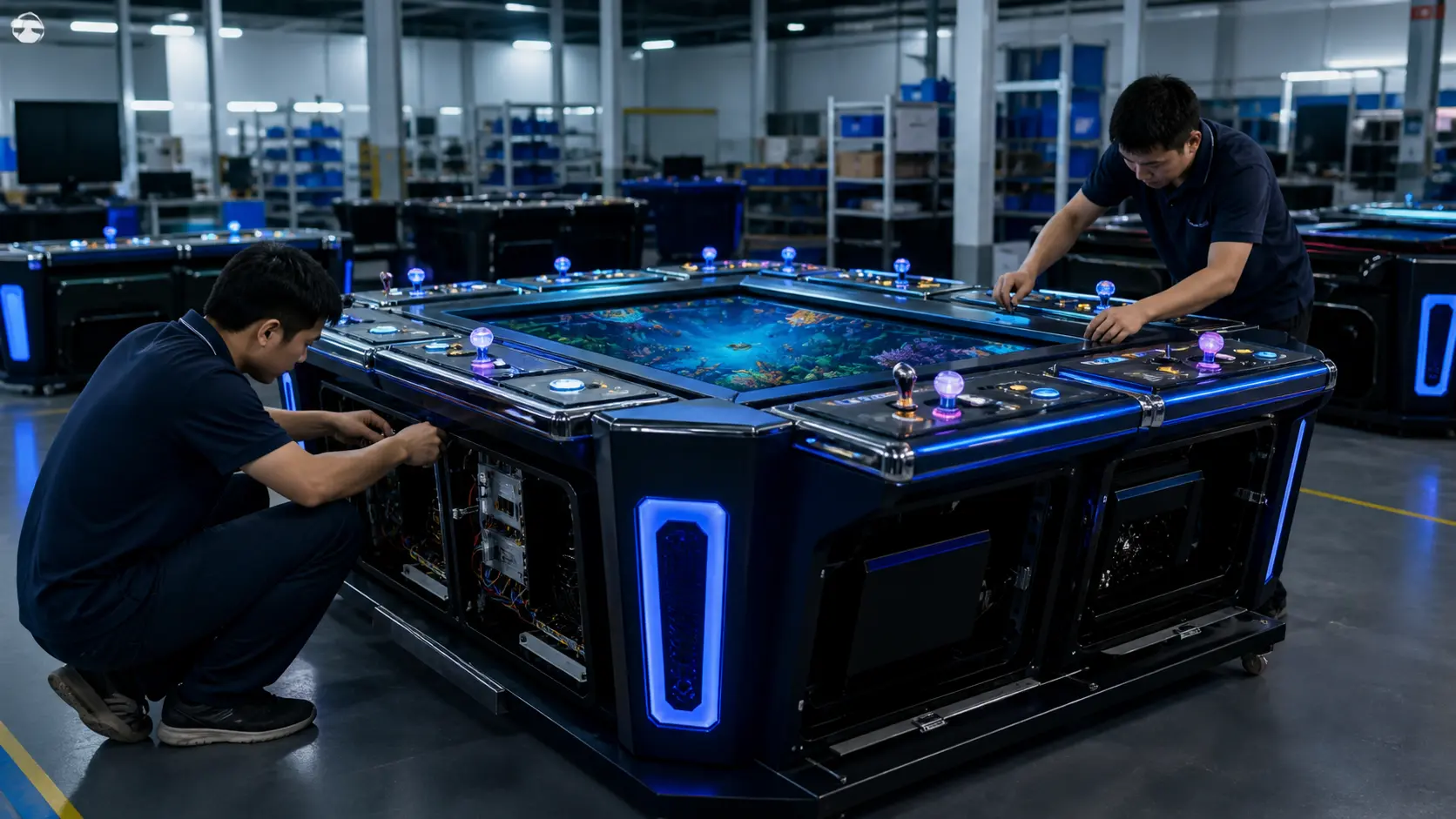
Let us move away from engineering and talk directly about your balance sheet. Buying a high-end, 8-player casino grade roulette machine represents a significant capital expenditure. How quickly can you recover this cost and move into pure profit? I have worked with hundreds of venue owners to build accurate Return on Investment models that factor in real-world variables, not just theoretical maximums.
Real World ROI Calculation for an Eight Player Setup
Assume a premium 8-player Forest Dance roulette cabinet costs $12,000 including shipping and installation.
First, we calculate the Gross Gaming Revenue. If the machine operates at an average of 40% capacity for 10 hours a day, generating $50 in wagers per hour per active seat, the total daily coin-in is $1,600.
Applying a conservative 94% RTP, your daily gross hold is 6% of $1,600, which equals $96.
Next, we subtract operating expenses. Electricity, floor space rent allocation, and routine maintenance might account for $16 per day. Your net daily operating margin on this single machine is $80.
At $80 per day in net profit, the $12,000 capital expenditure is fully recovered in exactly 150 days. After five months, that machine becomes a relentless cash-generating asset for your venue, producing approximately $2,400 in pure monthly profit. When you buy cheap, unverified machines, downtime and maintenance can easily double this payback period, choking your cash flow.
Factory Acceptance Test FAT Quality Assurance Protocols
Before any machine leaves our 15,000 square meter factory in Guangzhou, it must pass a brutal testing regimen. We do not ship prototypes to our clients; we ship battle-tested earning engines. My QA team follows a strict protocol that simulates years of floor abuse in a matter of days.
What We Check Before Any Cabinet Leaves Panyu
Our Factory Acceptance Test covers every single subsystem. We load the stepping motors with continuous 48-hour rotation cycles to verify bearing integrity. We inject simulated 500-volt spikes into the grounding lines to test the optocoupler isolation. The coin hoppers are run until they dispense 100,000 tokens to ensure the optical counting sensors do not degrade. Finally, the main logic board is baked in a 60-degree Celsius thermal chamber to verify that the solder joints and heat sinks can survive in poorly ventilated arcades.
Operator Troubleshooting Guide and Maintenance Pinout
Even the most robust casino grade roulette machine requires basic maintenance. When a minor fault occurs, you do not want to wait days for a technician. You need your floor staff to resolve the issue in minutes. Below is a rapid troubleshooting reference for the most common field anomalies.
Common Errors and Immediate Resolution Steps
- Error Code E-01 (Hopper Jam): This indicates foreign debris in the coin path. Power down the lower subsystem. Open the lower maintenance door, reverse the hopper gear manually via the service pin, and clear the obstruction. Do not use compressed air, as it may blind the optical counting sensor.
- Error Code E-04 (Communication Timeout): The mainboard has lost contact with a player terminal. Check the RS-485 serial data loop. Inspect the CAT5 cabling for physical crimps and verify the termination resistor switch on the last terminal board is set to ON.
- Mechanical Wheel Stutter: If the physical roulette wheel fails to spin smoothly, check the 24V DC line voltage at the motor driver board. If the voltage drops below 23.5V during spin initiation, adjust the potentiometer on the secondary power supply.
Critical System Pinout Reference Table
| Pin Designation | Wire Color | Signal Function | Expected Voltage | Troubleshooting Note |
|---|---|---|---|---|
| CN1-Pin 1 | Red | Main Logic Power VCC | +5.0V DC | Must be strictly between 4.9V and 5.1V |
| CN1-Pin 2 | Black | System Ground GND | 0V | Verify continuity to chassis ground |
| CN2-Pin 3 | Yellow | Coin Acceptor Pulse Signal | +12V DC (Idle) | Drops to 0V on pulse generation |
| CN3-Pin 1 | Blue | RS-485 Data A | +2.5V to +3.5V | Differential signaling line |
| CN3-Pin 2 | Green | RS-485 Data B | +1.5V to +2.5V | Differential signaling line |
Setting Up Secure Remote Telemetry and Accounting
In modern arcade operations, relying on manual meter reads is obsolete and prone to internal theft by staff. Our casino grade roulette machines are equipped with secure Internet of Things gateways. This allows you to monitor the machine’s performance from your smartphone anywhere in the world.
Real Time Data Auditing and Cloud Synchronization
The machine uploads every spin result, every coin drop, and every error code to an encrypted cloud server. If a player suddenly hits a massive statistical anomaly, or if the bill validator door is opened without authorization, you receive a push notification instantly. This telemetry data is protected by 256-bit AES encryption, ensuring that no third party can intercept your financial data.
Expanding Your Floor with Multi Player Cabinets
Once you see the ROI generated by a reliable 8-player setup, the natural progression is expansion. We manufacture expandable configurations that can link up to 16 player terminals to a single central roulette wheel. This maximizes the visual spectacle on your arcade floor, drawing in crowds and multiplying the coin-in velocity without multiplying the central hardware costs.
Networked Progressive Jackpots
To further enhance player engagement, our systems support networked progressive jackpots. A small fraction of every wager across the linked terminals is pooled into a central jackpot display. This visual accumulation creates a sense of urgency and competition among players, significantly boosting the average playtime per visit.
Related Engineering References and Floor Operational Guides
- For our factory engineering standards, review our multiplayer electronic roulette manufacturing framework.
- For multiplier calibration, see our Forest Dance and animal roulette setup guide.
- Compare terminal configurations in our 8-player electronic roulette machine specifications.
- Inspect anti-cheating laser circuits in our electronic roulette motherboard sensor calibration guide.
Frequently Asked Questions About Casino Grade Roulette Machines
What defines a true casino grade roulette machine compared to a standard arcade game?
A casino grade machine is defined by its fault tolerance and mathematical security. It utilizes industrial power supplies, optically isolated logic boards, and True Random Number Generators for payout calculations. Standard arcade games often use commercial-grade components that cannot withstand 24/7 continuous operation or sophisticated EMP jamming attacks.
How do I prevent players from using EMP devices on the cabinet?
Prevention requires physical and electrical shielding. At our Panyu factory, we install transient voltage suppression arrays and wrap the logic processing units in Faraday cages. Additionally, all peripheral communication lines are optically isolated, meaning an EMP burst at the coin slot cannot electrically travel to the mainboard to alter the credit balance.
Can I adjust the RTP after the machine has been installed on my floor?
Yes, operators have full access to a secure backend management portal. You can adjust the RTP parameters within a legally certified range, usually between 92% and 96%. This allows you to dynamically respond to local market conditions, balancing the need to retain players with the necessity of maintaining your venue’s profitability.
What happens to player credits if the venue experiences a sudden power outage?
Our mainboards are equipped with Non-Volatile Random Access Memory backed by a dedicated lithium button cell battery. In the event of a catastrophic power failure, the system instantaneously saves the exact state of every player terminal, including all active wagers and credit balances. Upon reboot, the game resumes exactly where it left off, preventing disputes.
How long does it take to manufacture and deliver a custom 8-player setup?
Standard models typically pass through our FAT QA protocols and are ready for crating within 15 to 20 working days. If you require deep software customization, such as modifying the user interface to suit specific regional preferences, the development and testing cycle requires approximately 30 to 45 days. We coordinate all logistics from Guangzhou to your nearest port.
At Arcade Manufacturer, we don’t just build hardware; we engineer reliable cash-flow engines. If you are tired of dealing with unstable machines and unpredictable profit margins, it is time to upgrade your infrastructure.
For technical consultations, custom software modifications, or direct factory pricing, reach out to me directly. Let’s optimize your arcade floor for maximum ROI.
Engineer Wang Lead Hardware & Game System Architect Guangzhou Miba Animation Technology Co., Ltd. WhatsApp / WeChat: +86 17620842078 Telegram: https://t.me/JLwyc Email: miba515527@gmail.com Factory: Panyu Manufacturing Base, Guangzhou, China
*(Our factory doors are always open for FAT inspections. Contact us to schedule a verified video tour of our QA labs today.)*