- The Rising Threat of Bill Acceptor Pulse Spoofing and Stringing Attacks
- Core Mechanisms of Optical Isolation in Coin and Bill Acceptors
- Engineering the 2500V Optocoupler Pulse Isolation Board
- Defeating Physical Stringing Attacks with Mechanical Hardware Baffles
- Firmware Level Dual Frequency Pulse Duration Validation
- Integrating Pulse Isolation with Global [Arcade Machine Security](/arcade-machine-security-anti-cheat-hardware-defense-guide/) Architecture
- Factory Grade Testing and QA Standards at Our Panyu Facility
- Operator Protocols for Route Protection and Loss Prevention
- Frequently Asked Questions About Bill Acceptor Security
I am Engineer Wang, Lead Hardware and Game System Architect at Arcade Manufacturer (Guangzhou Miba Animation Technology Co., Ltd.). Over my 12 years of designing commercial game machine hardware in our Panyu manufacturing base, I have witnessed countless route operators suffer massive revenue losses due to sophisticated bill acceptor attacks. Unprotected arcade machines are essentially open vaults for organized theft rings using pulse spoofers, EMP generators, and traditional stringing techniques.
When you operate a multi-location arcade venue or a widespread street route, every machine must be a fortress. In our facility, we do not just assemble cabinets; we engineer comprehensive hardware and software defense mechanisms. One of our most critical hardware implementations is the bill acceptor pulse optical isolator. This component, combined with firmware validation and mechanical baffles, forms an impenetrable barrier against unauthorized credit accumulation. We engineer these machines to secure your ROI and keep your cash box safe from modern arcade fraud.
The Rising Threat of Bill Acceptor Pulse Spoofing and Stringing Attacks
Arcade route operators face two primary vectors of attack against currency acceptors. The first is physical stringing, where a criminal attaches a thin transparent line or tape to a legitimate banknote. The bill is inserted, registered by the optical sensors inside the bill validator, and credit is issued. Before the internal stacking mechanism can push the bill into the secure cash box, the criminal forcefully retracts the bill using the attached string. Without proper mechanical and sensor protections, this single bill can be used to generate endless credits.
The second and more devastating attack is electronic pulse spoofing. Modern bill acceptors communicate with the main game board using a standardized pulse protocol. For example, a one-dollar bill might send one pulse, while a twenty-dollar bill sends twenty sequential pulses over the data line. Thieves utilize miniaturized high-frequency pulse generators hidden inside rings, watches, or modified mobile phones. By bringing these devices near the vulnerable wiring harness or the acceptor bezel, they induce electromagnetic interference that the game board misinterprets as legitimate currency pulses.
I have inspected operator machines brought into our lab where poorly shielded coin hopper and bill acceptor input lines were directly wired to the main IO board without any isolation. In these setups, a 5-volt transient spike induced by a spoofer immediately registers as a coin drop or bill insertion. This direct electrical pathway not only allows for credit theft but also exposes the CPU and memory components to catastrophic burnout if the attacker uses higher voltage equipment. Protecting these input lines requires industrial-grade electrical decoupling.
Core Mechanisms of Optical Isolation in Coin and Bill Acceptors

To stop electronic pulse spoofing dead in its tracks, we implement strict optical isolation on all currency input lines. The fundamental principle of an optical isolator (or optocoupler) is the complete electrical separation of the external peripheral from the sensitive internal logic board.
When a legitimate pulse is generated by the bill acceptor, it travels down the wire to the isolation board. Instead of flowing directly into the main game board processor, this electrical pulse powers a microscopic Light Emitting Diode inside the optocoupler chip. The LED flashes in exact synchronization with the incoming pulse. Across a physical gap within the same sealed chip, a phototransistor detects these flashes of light and converts them back into an electrical signal on the safe side of the circuit.
Because there is no physical wire connecting the input side to the output side—only light crossing a gap—high-voltage spikes, induced radio frequency interference, and rogue electromagnetic pulses cannot cross the barrier. If a criminal uses a high-power pulse spoofer, the induced voltage hits the LED side of the optocoupler. The LED might simply fail or burn out under extreme overvoltage, but the massive electrical surge is completely blocked from reaching the game board.
We utilize industrial-grade optocouplers rated for a minimum of 2500V isolation voltage. This specification ensures that even deliberate attempts to fry the machine’s electronics using modified stun guns or high-powered piezos will fail to bypass the isolation barrier. This approach is a cornerstone of our industrial arcade machine security engineering framework, ensuring that hardware vulnerabilities are sealed before the machine ever leaves our factory.
Engineering the 2500V Optocoupler Pulse Isolation Board
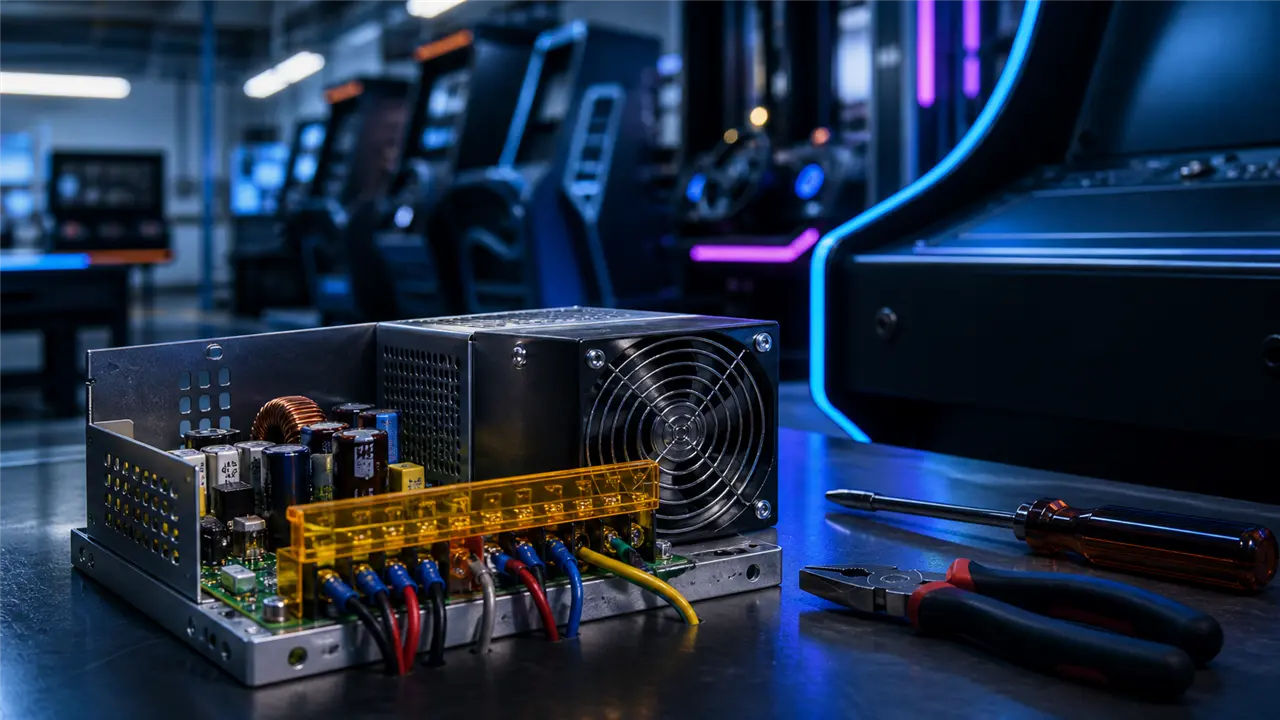
Designing an effective pulse isolation board requires more than just slapping a PC817 optocoupler onto a PCB. In our Panyu R&D lab, we engineer custom isolation interfaces that handle the harsh electrical environment of commercial arcade operations. We build our isolation circuits with dedicated power regulation and transient voltage suppression arrays.
First, we physically separate the ground planes. A common mistake made by low-end assembly workshops is tying the ground of the bill acceptor to the ground of the main motherboard. This entirely defeats the purpose of isolation, as noise and spikes can travel freely along the shared ground line. Our custom IO boards feature a fully split ground architecture. The peripheral side has its own isolated 12V power supply circuit, completely decoupled from the logic 5V rail.
Second, we incorporate Transient Voltage Suppressors (TVS) parallel to the input lines before they reach the optocoupler. These diodes act as lightning rods for fast electrical transients. If a high-voltage spike attempts to enter the bill acceptor harness, the TVS diode clamps the voltage down to a safe level within picoseconds, converting the excess energy into heat. This prevents the optocoupler LED from being degraded over time by repeated low-level attacks.
The PCB layout itself is designed with strict creepage and clearance distances. We maintain a minimum of 6mm physical separation on the circuit board between the high-risk peripheral traces and the secure logic traces. This physical gap prevents high-voltage electrical arcing across the board surface. The integration of these hardware safeguards shares many design principles with our specialized slot machine EMP jammer blocker engineering solutions, creating an overlapping web of hardware defense.
Defeating Physical Stringing Attacks with Mechanical Hardware Baffles
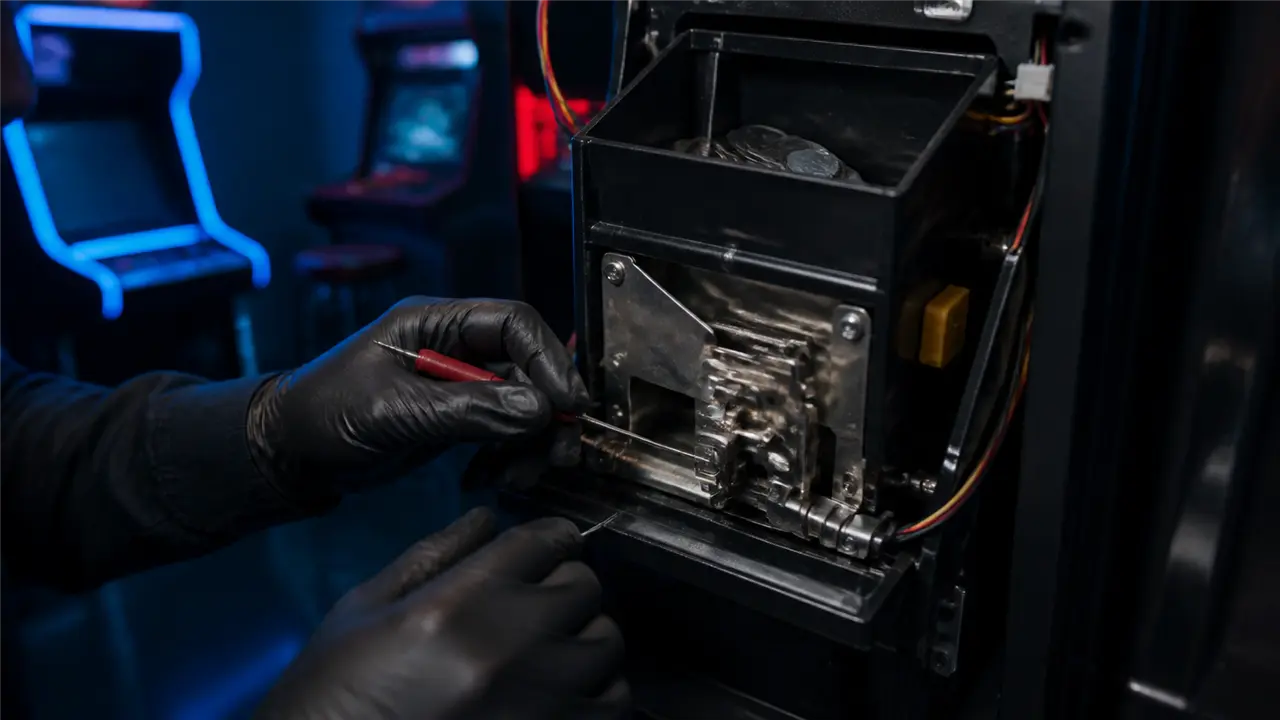
While optical isolation defeats electronic spoofing, it does not prevent a criminal from physically pulling a bill back out of the validator. To combat stringing and fishing, we must rely on precision mechanical engineering and anti-fraud sensor logic within the bill acceptor mechanism itself.
We exclusively utilize commercial-grade bill validators equipped with dual-stage optical and mechanical anti-stringing mechanisms. As a bill is drawn into the validator, it passes through a series of multi-spectrum optical sensors that read the ink patterns and verify the currency. Once validated, the motor drives the bill into the cash box stacker.
At the entrance to the stacker, our specified validators feature a set of serrated mechanical baffles or “crocodile teeth.” These physical barriers operate on a one-way spring mechanism. As the bill moves inward, the baffles press down smoothly. However, the moment any backward tension is applied—such as a thief pulling on an attached string—these serrated teeth bite down directly onto the bill and the string.
If the criminal pulls harder, the sharp baffles will literally shred the currency rather than let it be extracted. Furthermore, modern validators include a rear optical sensor specifically designed to detect string or tape. If the validator reads a valid bill but the rear sensor detects a continuous physical obstruction crossing the optical path, the firmware instantly triggers a localized fault state. The validator will reverse the motor, spit the bill back out before issuing any credit, and flash an error code.
For high-risk environments, we install secondary physical cash box enclosures crafted from 2mm thick cold-rolled steel, ensuring that once a bill passes the drop slot, it cannot be accessed even with specialized fishing tools.
Firmware Level Dual Frequency Pulse Duration Validation
Hardware isolation is only the first half of the anti-spoofing equation. The second half is intelligent firmware filtering. When a criminal uses a generic pulse generator, they often bombard the machine with rapid-fire signals hoping the CPU will register a few of them. We defeat this brute-force method through strict pulse duration validation implemented in the core game firmware.
A legitimate bill acceptor does not send instantaneous electrical blips. It sends highly regular, timed pulses. For instance, a standard protocol might dictate that one credit pulse consists of the signal line being pulled low for exactly 50 milliseconds, followed by a high state for exactly 50 milliseconds.
Our custom game boards run an active polling loop that measures the precise width of every incoming pulse at the microsecond level. If an incoming pulse lasts for only 5 milliseconds—a clear sign of an induced static spark or a high-frequency spoofer—the firmware classifies it as an invalid transient spike and drops it completely. No credit is issued.
Conversely, if the signal line is held low for 200 milliseconds, the firmware recognizes this as a possible short circuit or a jamming attempt and similarly rejects the input. We require both the low duration and the high duration of the pulse wave to fall within a tight 10% tolerance window of the factory specification.
This dual-frequency validation algorithm ensures that only mechanical devices operating at the correct baud rate and pulse width can trigger a credit sequence. When combined with the optical isolator, it creates a system where spoofed signals are both electrically damped and logically rejected.
Integrating Pulse Isolation with Global [Arcade Machine Security](/arcade-machine-security-anti-cheat-hardware-defense-guide/) Architecture
Pulse isolation cannot exist in a vacuum. A secure commercial arcade cabinet requires a holistic approach to security architecture. We treat the entire cabinet as a secured environment, evaluating every potential point of entry for malicious intent.
Beyond the bill acceptor and coin mech inputs, we secure the payout systems. Coin hoppers and ticket dispensers are equally vulnerable to reverse-pulse attacks where criminals attempt to force the machine into a continuous payout loop. We apply the same 2500V optical isolation and strict firmware validation to all payout control lines.
The physical wiring harnesses themselves are a target. We utilize shielded, steel-braided cabling for all currency handling peripherals, routing them away from the cabinet edges and air vents where criminals might attempt to insert wire hooks or EMP antennas. All access doors feature dual independent microswitches. If a cash box door is opened or tampered with, the machine instantly cuts power to the payout hoppers and locks the game interface, throwing a high-priority alert to the operator’s management backend.
This comprehensive integration is why serious route operators trust our manufacturing process. We build equipment designed to survive the realities of street operation. For a detailed breakdown of our factory capabilities and how we maintain these standards across massive production runs, review our commercial arcade game machines manufacturing standards.
Factory Grade Testing and QA Standards at Our Panyu Facility
Security is not a theoretical concept at Arcade Manufacturer; it is a proven metric. Inside our 15,000 square meter Panyu manufacturing base, every custom arcade machine undergoes a grueling Quality Assurance testing protocol specifically focused on anti-cheat mechanisms.
In our dedicated electronic stress lab, we subject our isolation boards to direct EMP blasts using high-voltage electrostatic discharge (ESD) guns. We bombard the bill acceptor bezels, the coin entries, and the control panels with bursts ranging from 8,000V to 15,000V. Our engineers actively monitor the CPU state and credit memory during these attacks. If a single phantom credit is logged, the PCB revision is rejected and sent back to the drawing board.
We perform extensive stringing and physical abuse tests on the currency acceptors. We test with various tapes, monofilament fishing lines, and adhesive strips to ensure the mechanical baffles engage correctly and the optical string-detectors trigger the appropriate fault states. We simulate years of physical wear and tear in a matter of weeks to ensure that the springs and plastic gears in the bill validators do not degrade and lose their anti-stringing capabilities over time.
This uncompromising testing regimen ensures that when an operator deploys our equipment in a high-traffic, low-supervision environment, the machine will defend itself autonomously. We refuse to cut corners on security hardware because we understand that a single breached machine can wipe out a month of profit for an operator.
Operator Protocols for Route Protection and Loss Prevention
While we provide military-grade hardware and software protection, human vigilance remains a crucial element of arcade security. We advise all our operator partners to implement strict loss prevention protocols in tandem with our hardware solutions.
First, regular maintenance of the bill acceptors is mandatory. Dust, dirt, and ambient smoke can cloud the optical sensors inside the validator. When these sensors are dirty, their ability to detect subtle transparent strings or tape is compromised. We recommend wiping down the internal sensor arrays with specialized cleaning cards or isopropyl alcohol every 30 to 60 days, depending on the venue environment.
Second, operators must utilize the advanced data logging features built into our custom game boards. Our systems track every dropped pulse, every localized bill validator error, and every instance of the machine entering a security lock-out state. By reviewing these logs during routine cash collections, operators can identify which specific locations are experiencing high volumes of attempted theft.
If a machine logs twenty stringing-attempt errors in a single weekend, the operator knows exactly where to reposition security cameras or assign floor staff. We also strongly advise operators to permanently ban known fraudsters from their venues, as organized groups will continuously probe different machines looking for a weak point.
For operators looking to upgrade their route security, or for distributors needing custom game cabinets built from the ground up with these integrated protections, my team in Guangzhou is ready to collaborate. We offer 100% source code buyout options for custom software and full hardware design transparency.
Contact me directly to discuss your hardware specifications, request technical diagrams of our isolation boards, or schedule a video walkthrough of our QA testing lab. WhatsApp/WeChat: +86 17620842078 Telegram: https://t.me/JLwyc Email: miba515527@gmail.com
Frequently Asked Questions About Bill Acceptor Security
How does an optical isolator prevent arcade credit theft? An optical isolator separates the external bill acceptor wiring from the internal main logic board using a physical gap bridged only by light. This prevents high-voltage spikes and electronic pulse spoofers from injecting fake credit signals into the machine’s processor.
Can your machines stop traditional bill stringing and fishing attacks? Yes. We equip our cabinets with commercial-grade bill validators featuring physical serrated mechanical baffles and optical string-detection sensors. If backward tension is detected, the baffles bite down to trap or shred the bill, and the firmware instantly halts the credit process.
Why is firmware pulse duration validation necessary if hardware isolation is used? Hardware isolation blocks high voltage and protects the circuitry, but it cannot differentiate between a legitimate electrical pulse and a low-voltage spoofed pulse. Our firmware measures the exact microsecond duration of every signal, ignoring signals that are too fast or too slow to be generated by legitimate mechanical insertion.
Do you manufacture custom arcade cabinets with integrated anti-cheat systems? Yes. At our Panyu manufacturing facility, we build bespoke commercial arcade cabinets, fish tables, and slot machines. All our products feature split-ground power supplies, TVS diode arrays, and 2500V optical isolation boards engineered to defeat modern route theft.
What is the best way to maintain bill acceptor security over time? Regular cleaning of the optical sensors inside the validator is essential to maintain string-detection accuracy. Additionally, operators should routinely check the machine’s internal software logs to identify and monitor locations experiencing high volumes of rejected bills or security fault codes.