- Bridging The Gap Between Physical Arcade Machines And Cloud Infrastructure
- Core Architecture Of Our Industrial IoT Arcade Controllers
- Advanced Communication Protocols From Serial To Cloud
- Reliability And Fail Safe Mechanisms In Unattended Environments
- Calculating The ROI Of Industrial Grade IoT Boards
- Our Panyu Factory Manufacturing And QA Process
- Direct Factory Engineering Contact and Procurement
- Frequently Asked Questions
Operators entering the remote live arcade sector quickly realize that slapping a standard Raspberry Pi into a commercial coin pusher is a recipe for disaster. When your remote live arcade setup experiences missed coin drops, ghost inputs, or communication failures during peak traffic, the financial losses stack up minute by minute. The root cause usually traces back to consumer-grade microcontrollers struggling to handle harsh electrical environments and high-frequency pulse signals from bill acceptors and coin hoppers.
I am Engineer Wang, Lead Hardware Architect at Guangzhou Miba Animation Technology Co., Ltd. Over the past twelve years, I have seen operators lose thousands of dollars simply because their control boards could not translate raw physical pulses into clean, low-latency digital cloud commands. In our 15,000-square-meter Panyu manufacturing base, we design and manufacture industrial IoT arcade controller boards engineered explicitly for 24/7 commercial operation. Our hardware bridges the gap between legacy arcade cabinets and modern cloud infrastructure, delivering zero-packet-loss teleoperation. If you are building a fleet of live-streamed arcade machines and need rock-solid hardware stability, let us dive into the engineering behind our complete turnkey solutions.
Request Our Controller Board Hardware Specification Sheet And Video Demo via WhatsApp
Bridging The Gap Between Physical Arcade Machines And Cloud Infrastructure
The transition from a traditional street location arcade machine to a globally accessible remote live gaming terminal requires a flawless translation layer. Physical machines operate on raw electrical signals—voltage spikes, mechanical relay clicks, and optical sensor interruptions. Cloud platforms, on the other hand, speak in structured data packets delivered over TCP/IP.
Our industrial IoT controller boards act as the ultimate translator between these two worlds. When a player on a mobile app in Europe presses the “Drop Coin” button, that digital command must traverse the internet, hit our custom circuit board in an Asian server room, and fire a precise 12V pulse to a physical solenoid in under 80 milliseconds. Achieving this requires more than just basic programming. It demands a specialized architecture designed to filter out electromagnetic interference, isolate high-voltage power spikes, and maintain uninterrupted bidirectional communication.
If you are interested in the broader network architecture that makes this possible, you can review our guide on the remote live arcade turnkey system iot low latency streaming architecture. Today, however, we are focusing on the physical printed circuit board (PCB) and its embedded logic.
Core Architecture Of Our Industrial IoT Arcade Controllers
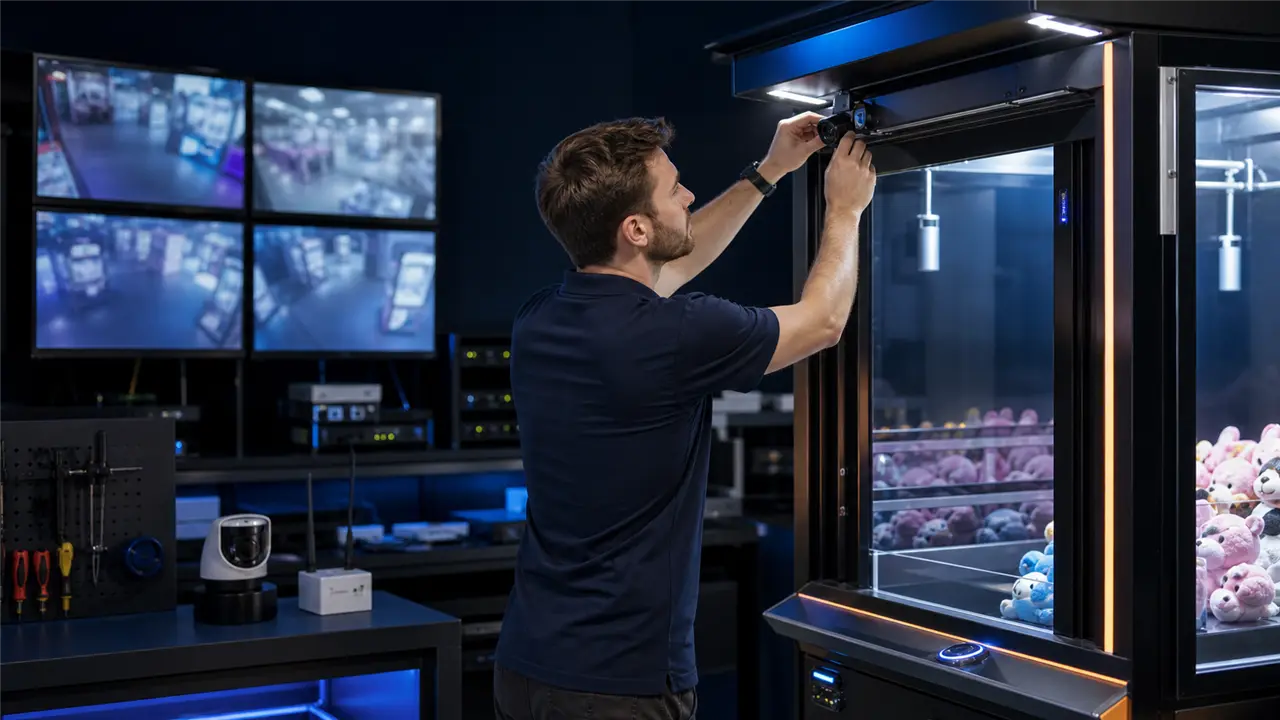
To guarantee uptime and accuracy, we build our IoT controller boards around robust industrial standards. We do not use hobbyist components. Every resistor, capacitor, and microchip on our board is selected for its thermal tolerance and electrical resilience.
MCU And ARM Processor Selection For Millisecond Precision
At the heart of our IoT boards lies a dual-processor architecture. We utilize a high-performance ARM Cortex-M series microcontroller (MCU) to handle real-time physical I/O tasks, paired with an application processor for network cryptography and protocol translation.
The MCU runs a deterministic Real-Time Operating System (RTOS). This ensures that when a pulse signal is generated by a coin hopper, the interrupt is serviced immediately without being delayed by network background tasks. In a standard Linux-based hobby board, the operating system might pause hardware polling to handle a background process, resulting in a missed coin pulse. In the arcade business, a missed pulse means unbalanced accounting and angry players. Our ARM-based architecture guarantees microsecond-level polling accuracy, ensuring every single pulse is captured, validated, and recorded.
Optical Isolation And Pulse Signal Conversion Mechanics
Arcade cabinets are electrically noisy environments. Large DC motors in coin pushers, high-current solenoids in claw machines, and switching power supplies create massive voltage transients. If a 24V motor feedback spike reaches the delicate 3.3V logic pins of a network controller, the board will instantly fry.
To prevent this, our controllers feature complete optical isolation (optocouplers) on every input and output channel. An optocoupler uses an internal LED and a phototransistor to transmit signals using light, completely separating the physical machine’s power domain from the IoT logic domain.
When converting a standard 12V pulse from a coin acceptor into a digital signal, the pulse triggers the optocoupler’s LED. The phototransistor detects this flash and sends a clean 3.3V signal to the MCU. This galvanic isolation ensures that even if a catastrophic short circuit occurs in the cabinet’s wiring harness, the IoT controller and network infrastructure remain entirely unharmed.
Hardware Debounce Filters Eradicating Ghost Inputs
Mechanical microswitches and relays inherently “bounce” when they close, creating multiple rapid electrical connections before settling. A naive controller will read a single button press as multiple inputs, causing double-dropping or rapid-firing glitches.
While software debouncing is common, it consumes CPU cycles and can introduce latency. Our boards implement passive hardware debounce filters using precision RC (resistor-capacitor) networks and Schmitt trigger inverters on every digital input. This analog filtration physically smooths the incoming voltage wave, ensuring that only a single, clean square-wave logic transition reaches the MCU. This eliminates “ghost inputs” entirely at the hardware level, providing a pristine data stream for the game logic.
Schedule A Virtual Tour Of Our Panyu QA Lab To See Our Oscilloscope Testing
Advanced Communication Protocols From Serial To Cloud
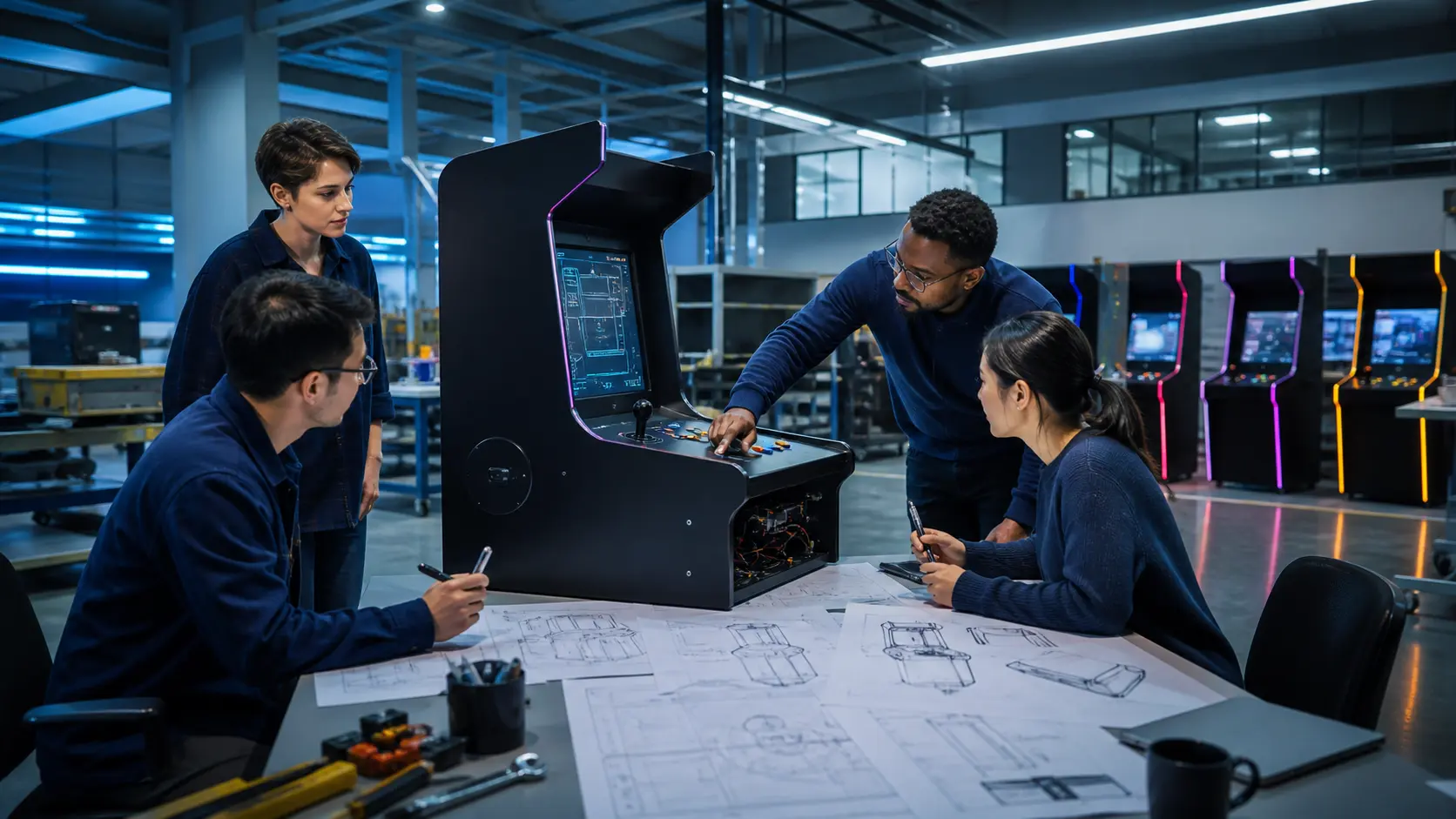
Once the physical pulses are safely converted into digital data, the board must transmit this telemetry to the server. Our boards are designed to handle both legacy industrial protocols and modern web standards simultaneously.
RS232 And RS485 Industrial Bus Integration
Many high-end peripheral devices—such as advanced bill validators, ticket dispensers, and secondary motor controllers—communicate via serial protocols rather than simple pulse lines. Our boards feature native, isolated RS-232 and RS-485 interfaces.
RS-485 is particularly vital for our large-scale deployments, as it allows multiple boards or peripherals to be daisy-chained over long distances (up to 1200 meters) with high immunity to electrical noise. The MCU continuously polls these serial buses, parsing proprietary protocols from peripheral manufacturers and mapping their status codes into standard internal data structures.
MQTT And WebSocket Translation For Real Time Telemetry
For the uplink to the cloud, the application processor translates the internal data structures into lightweight, secure network packets. We heavily utilize MQTT (Message Queuing Telemetry Transport) for background telemetry and WebSockets for low-latency player commands.
MQTT is ideal for status reporting—such as monitoring the coin hopper level, internal cabinet temperature, and daily revenue meters. It guarantees message delivery even on unstable cellular connections. WebSockets, conversely, provide a persistent, full-duplex pipeline for real-time control. When the player taps the screen, the WebSocket delivers the command to the board in milliseconds.
This dual-protocol approach is crucial for optimizing the remote coin pusher machine hardware modification webrtc streaming experience, ensuring the video feed and the physical hardware remain perfectly synchronized.
Reliability And Fail Safe Mechanisms In Unattended Environments
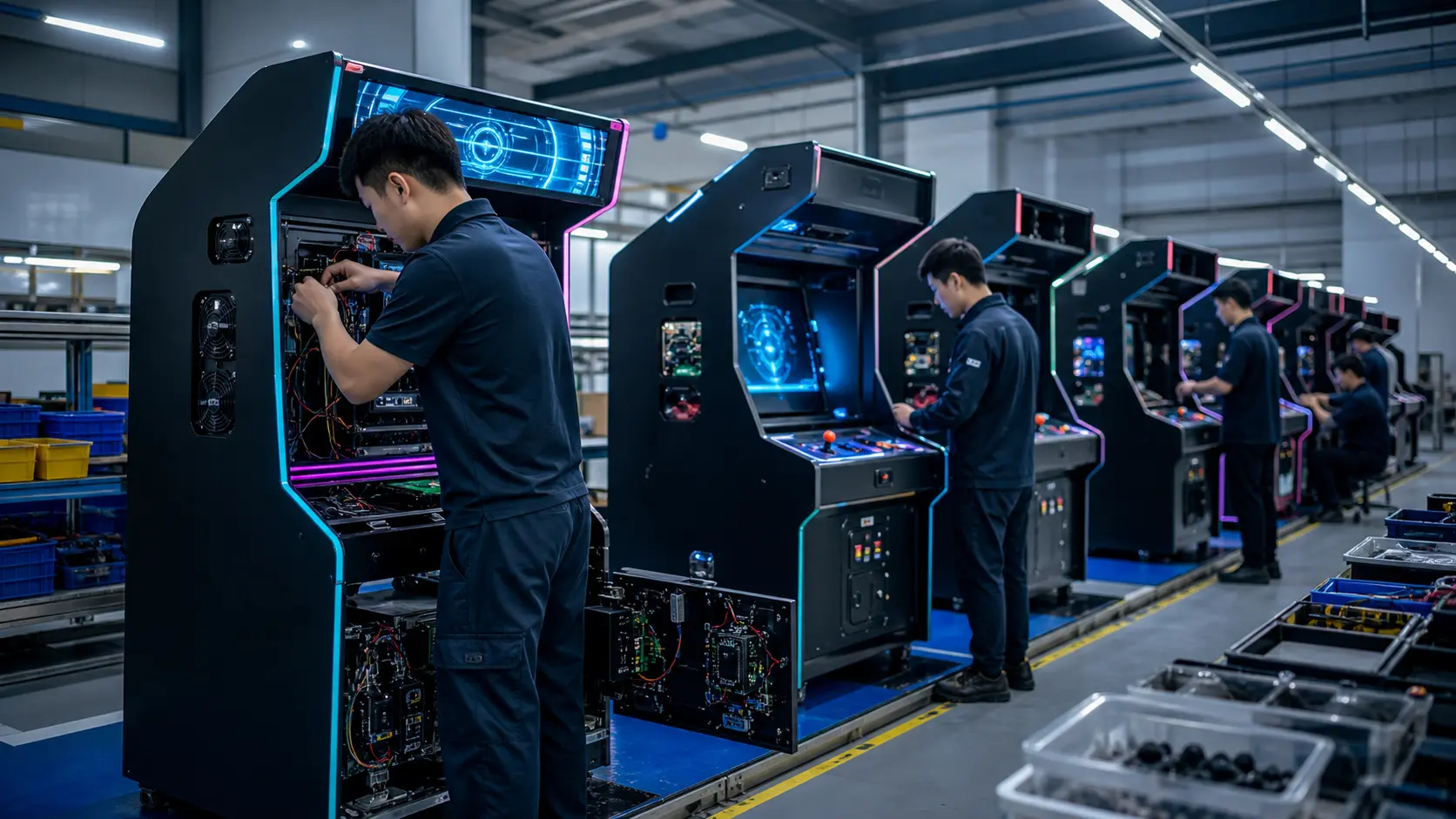
Remote arcade venues operate 24 hours a day without on-site technical staff. If a machine crashes or a coin jams, manual intervention is costly. Therefore, our hardware is designed with autonomous recovery and defense mechanisms.
Watchdog Circuits Preventing System Freeze
Software bugs, network outages, or cosmic rays can occasionally cause a processor to freeze. To combat this, we implement external hardware watchdog timer circuits.
The MCU must send a heartbeat signal to the external watchdog chip every 500 milliseconds. If the processor freezes and fails to send the heartbeat, the watchdog circuit physically cuts and restores power to the processor, triggering a hard reboot. The entire recovery process takes less than three seconds, minimizing downtime and ensuring the machine reconnects to the server automatically.
Fail Safe Lockouts And Hardware Defense Interlocks
Security is paramount in commercial gaming. Hackers often attempt to manipulate the hardware by injecting false pulses or using high-frequency electromagnetic pulses (EMP) to rack up free credits.
Our controllers are hardened against these attacks. We incorporate industrial-grade EMP transient voltage suppression (TVS) diodes capable of clamping transient surges in under 5 picoseconds. Furthermore, the MCU logic includes fail-safe lockouts: if an abnormal pulse rate is detected (e.g., 100 coin pulses per second, which is physically impossible for a mechanical acceptor), the board instantly cuts power to the peripheral and alerts the server.
For a deeper dive into how we protect operator revenues, read about our complete arcade machine security anti-cheat hardware defense systems.
Calculating The ROI Of Industrial Grade IoT Boards
Operators sometimes hesitate to invest in proprietary industrial hardware when cheap development boards exist. Let us look at the real-world Return on Investment (ROI).
Consider a remote venue with 50 coin pusher machines.
- Using consumer-grade boards, operators typically experience a 3% hardware failure rate per month due to electrical stress, plus an average of 10 ghost-coin discrepancies per machine daily. At a conservative value of $0.10 per coin, ghost inputs cost $50 per day across the venue, or $1,500 per month.
- Furthermore, downtime from frozen consumer boards might require 2 hours of lost playtime per incident.
By deploying our industrial IoT controllers, operators achieve 99.99% hardware uptime and absolute pulse accuracy. The complete elimination of ghost inputs and phantom credits pays for the hardware upgrade within the first 60 days of operation. After that, the robust hardware simply acts as a pure profit multiplier, keeping machines online and players engaged.
Our Panyu Factory Manufacturing And QA Process
At Guangzhou Miba Animation Technology Co., Ltd, we do not just assemble parts; we control the entire manufacturing pipeline. Our 50-person R&D and engineering team designs the PCB layouts in-house.
During production, every controller board undergoes rigorous Quality Assurance (QA). The boards are placed in thermal chambers to simulate extreme operating temperatures. We use automated test jigs to bombard the input pins with thousands of irregular pulses, verifying that the debounce filters and optical isolators perform flawlessly under stress. Finally, each board is subjected to high-voltage dielectric withstand testing (Hipot testing) to guarantee the optical isolation barriers exceed international safety standards.
When you partner with us, you are not buying experimental hobby tech. You are procuring industrial-grade arcade infrastructure directly from the source factory, complete with full technical support, 100% source code integration options, and our 12-hour direct video debugging guarantee.
Direct Factory Engineering Contact and Procurement
Whether you are retrofitting an existing fleet of 50 coin pushers or engineering a ground-up unattended hybrid arcade room, do not trust consumer-grade boards to protect your venue revenue. Contact me directly to discuss your hardware specifications, request engineering schematics, or schedule a live video bench test from our Panyu manufacturing base.
Engineer Wang (Lead Hardware & Game System Architect)
- WhatsApp / Phone: +86 17620842078
- Telegram: https://t.me/JLwyc
- Email: miba515527@gmail.com
- Factory Address: Panyu Manufacturing Base, Guangzhou, China
Frequently Asked Questions
What is the maximum pulse frequency your IoT board can handle? Our ARM-based controllers can accurately read up to 10,000 pulses per second, far exceeding the mechanical limits of any commercial bill validator or coin hopper, ensuring zero missed drops.
Can the controller board integrate with third-party mobile apps? Yes. We offer complete API and SDK documentation, allowing seamless integration via MQTT and WebSockets into your existing mobile applications or custom front-end software.
How does optical isolation protect my server infrastructure? Optical isolation uses light to transmit signals across a physical gap on the circuit board. If a catastrophic electrical short occurs in the arcade machine, the high voltage cannot cross this gap, completely shielding the network module and your cloud infrastructure from damage.
Do you provide white-label branding on the hardware? Absolutely. As an OEM/ODM source factory, we can design custom PCB shapes, silkscreen your company logo onto the boards, and customize the firmware to broadcast your unique device identifiers.
What happens if the internet connection drops during gameplay? Our controllers have on-board NVRAM. If the network drops, the board safely pauses the physical hardware, caches all current credit data and physical states locally, and automatically resynchronizes with the cloud server the moment the connection is restored, ensuring zero financial loss.