- The Revenue Bleed of Fragmented Arcade Supply Chains
- Industrial Hardware Architecture Built for Continuous Profit
- Uncompromising Anti Cheat Security and Floor Protection
- Software Customization and Mathematical RTP Precision
- Financial Projections and CAPEX Payback Analysis
- The Panyu Factory Acceptance Testing QA Protocol
- Troubleshooting Common Arcade Floor Faults
- Frequently Asked Questions
As an arcade floor operator or global distributor, you already know the pain of bridging the gap between offshore hardware factories and outsourced game developers. When a machine freezes on a Friday night during peak foot traffic, the hardware vendor blames the software team, the software team blames the power supply, and you are left bleeding revenue. My name is Engineer Wang, Lead Hardware and Game System Architect at Guangzhou Miba Animation Technology Co., Ltd. (Arcade Manufacturer). Over my 12 years engineering gaming hardware in our 15,000-square-meter Panyu manufacturing base, I have seen fragmented supply chains destroy operator ROI. That is why our turnkey approach fuses industrial-grade cabinet manufacturing with custom 2D and 3D game development and a mathematically proven 92-96% RTP draw. We eliminate the middlemen to deliver unified hardware and software bundles, completely backed by full source code buyout options, ensuring your machines remain stable, highly profitable, and entirely under your control.
Ready to secure your floor with zero-downtime turnkey cabinets? *Contact Engineer Wang directly for immediate floor layout consultation and direct factory pricing.* For factory-direct procurement and comprehensive engineering specs, consult our master guide on turnkey arcade cabinet manufacturing and B2B procurement.
- WhatsApp: `+86 17620842078`
- Telegram: `https://t.me/JLwyc`
- Email: `miba515527@gmail.com`
The Revenue Bleed of Fragmented Arcade Supply Chains
Most operators do not realize how much money they lose simply because their PCB boards and their game software were designed on different continents. When you purchase sheet metal from one supplier, monitors from another, and lease game software from a third-party studio, you are building a house of cards.
The Protocol Mismatch Problem
The most common point of failure on any casino or arcade floor is the communication layer between the game board and the peripheral devices. We frequently analyze broken machines from competitors where the bill validator protocol (like Pulse or ccTalk) loses synchronization with the game logic board during voltage fluctuations. This results in missing credits or, worse, phantom credits being awarded to the player. In our ecosystem, the 50-person R&D team works down the hall from the assembly line. Our JAMMA harnesses and bespoke I/O boards are coded to handshake perfectly with our proprietary game engines. We write the firmware, we design the PCB routing, and we code the game software. If a bill validator jams, the software knows exactly how to handle the interrupt gracefully without requiring a hard reboot.
Unified Turnkey Delivery
Our turnkey arcade machine manufacturing model means you receive a plug-and-play asset. You uncrate it, plug it into a 110V/220V outlet, and it immediately starts earning. We handle the 3D rendering of the cabinet, the CNC sheet metal punching, the acrylic vacuum forming, the LED routing, the PCB population, and the Unity or Unreal Engine software development. This unified pipeline cuts your time-to-market by up to 40% and drastically reduces the total cost of ownership over the cabinet’s lifespan.
Industrial Hardware Architecture Built for Continuous Profit
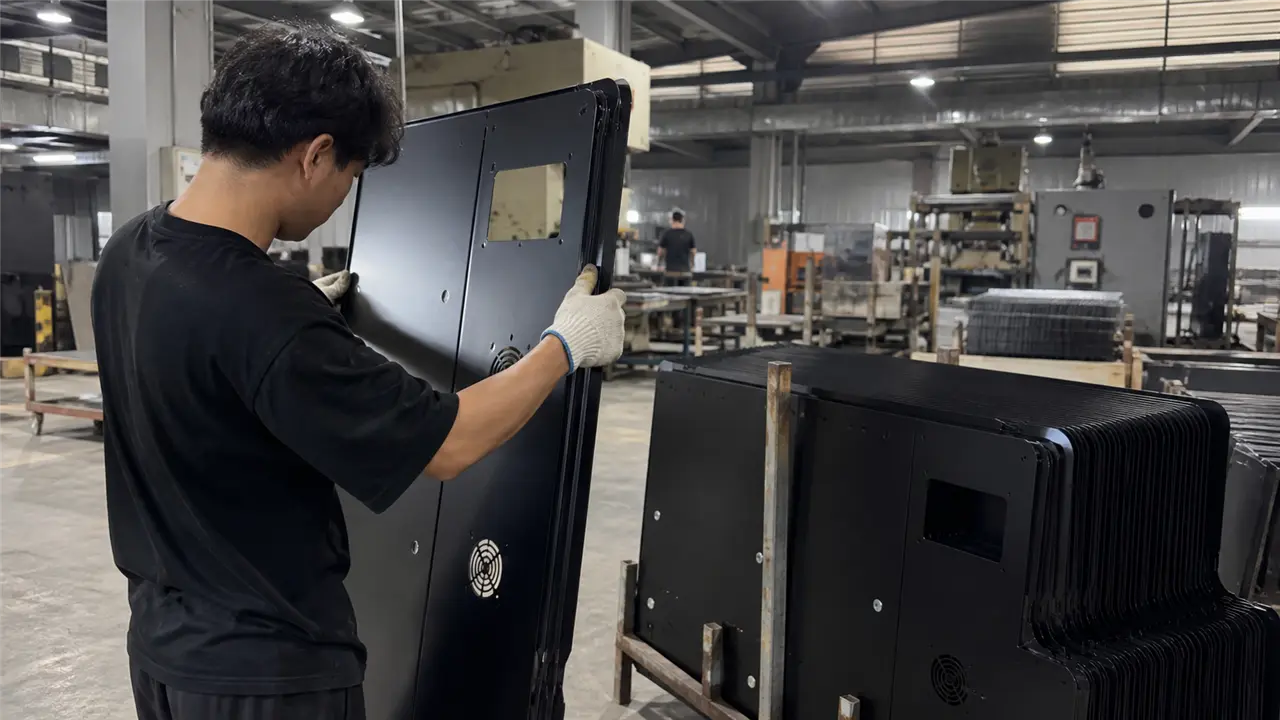
An arcade machine is not a consumer PC in a wooden box. It is an industrial revenue-generating asset that must survive aggressive players, spilled drinks, extreme temperature variations, and constant operation 24 hours a day, 7 days a week.
Heavy Gauge Sheet Metal and Cabinet Integrity
Wooden cabinets warp, rot, and provide zero electromagnetic shielding. At our Panyu facility, we utilize 1.2mm to 1.5mm cold-rolled steel for our cabinet chassis. Every joint is precision-welded and finished with an anti-static, anti-corrosive powder coating baked at high temperatures. This not only gives the machine a premium, casino-grade aesthetic but also acts as a Faraday cage, protecting the sensitive internal logic boards from external electromagnetic interference. The control panels are constructed with reinforced steel and layered with scratch-resistant polycarbonate overlays, ensuring the joysticks and heavy-duty microswitches remain perfectly anchored even after millions of actuations.
Power Supply Stability and Voltage Regulation
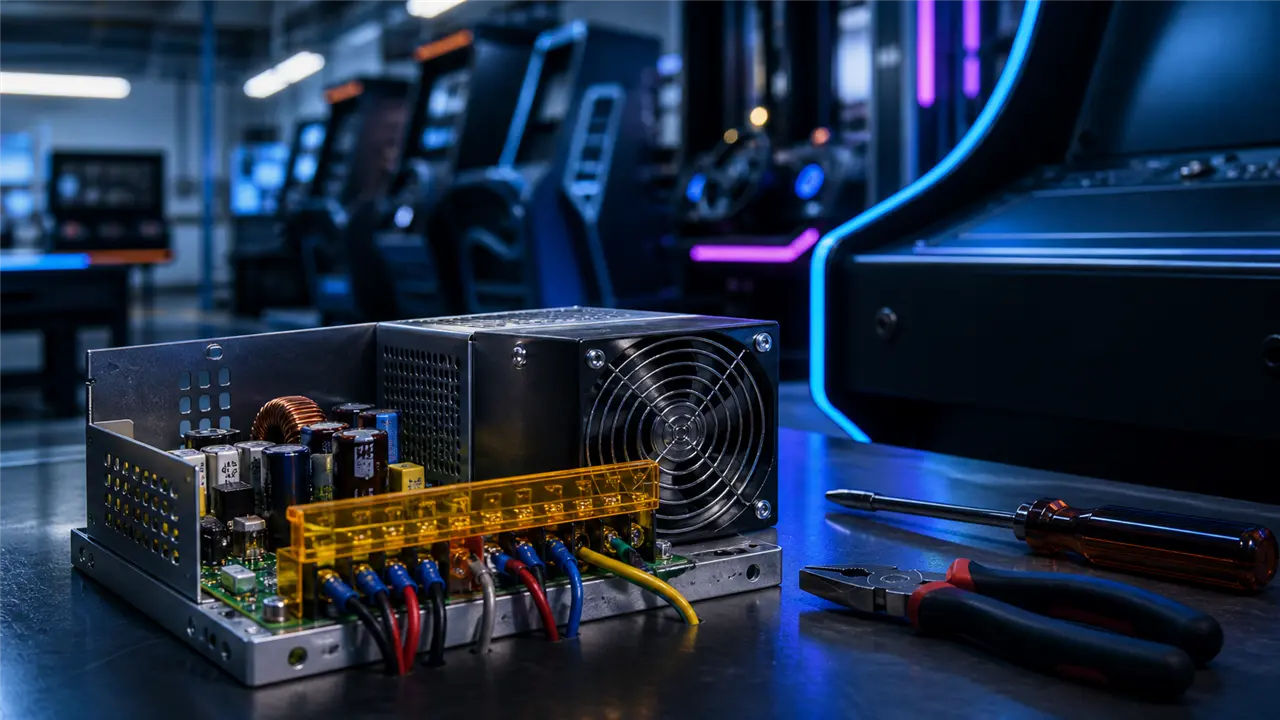
Power is the lifeblood of your machine. A cheap power supply unit (PSU) introduces ripple voltage that degrades the capacitors on the motherboard over time, leading to random resets. We mandate the use of industrial-grade power supplies with active Power Factor Correction (PFC) and ripple noise suppression below 50mV. Our internal power distribution features independent rails for the logic board (5V/12V), the audio amplifier (12V/24V), and the dynamic LED lighting systems. By isolating these power domains, a sudden current draw from the subwoofer amplifier during an in-game explosion will never cause the CPU to brownout.
High Refresh Rate Displays and Touch Matrix
Player retention is heavily dependent on visual feedback. We source A-grade commercial LCD and OLED panels capable of sustaining 50,000 hours of continuous operation without color degradation or burn-in. For fish shooting games and interactive slots, we implement 10-point capacitive touch overlays with a response time under 5 milliseconds. The display controllers are physically shielded and grounded to the main chassis to prevent static discharge from player fingertips from resetting the touch controller IC.
Uncompromising Anti Cheat Security and Floor Protection
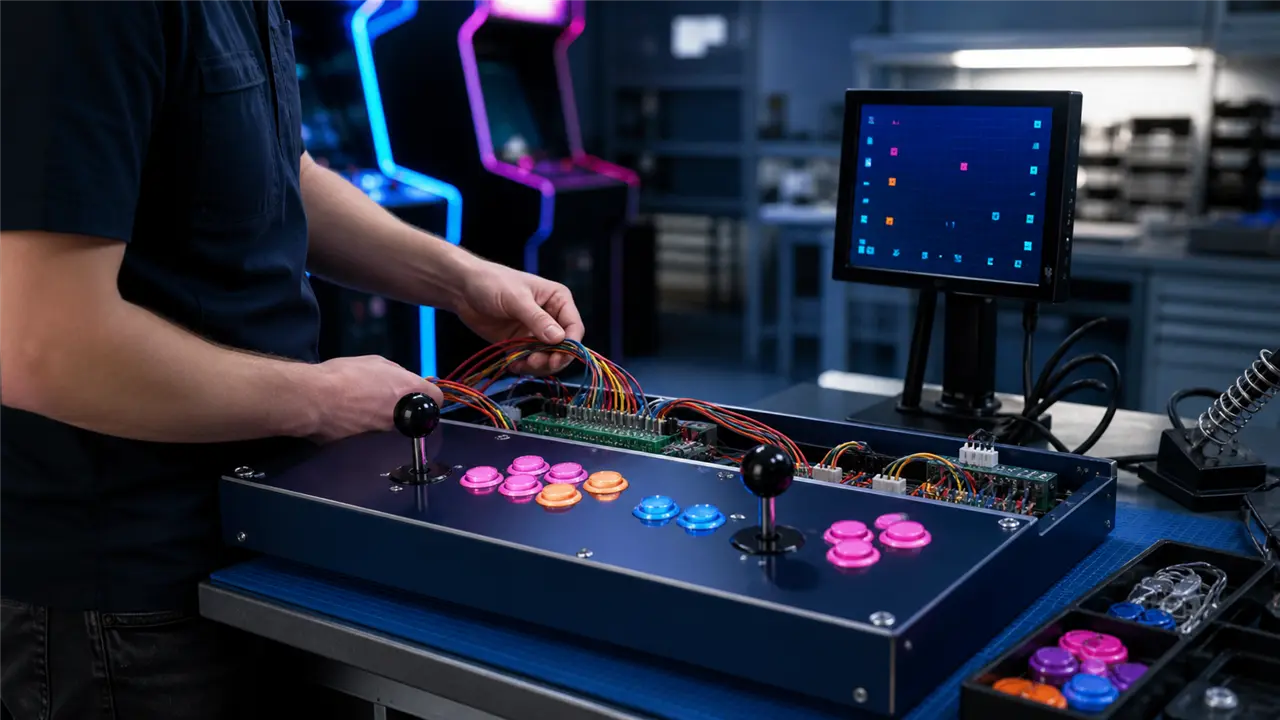
Every dollar stolen by a cheater is a dollar subtracted from your net profit. As operators, your biggest fear is organized syndicates using EMP jammers or wire-tapping devices to manipulate the coin mechanisms and steal credits. I have spent years reverse-engineering these cheat devices to build impenetrable countermeasures.
EMP Resistance and Transient Surge Clamping
EMP (Electromagnetic Pulse) generators are readily available on the black market. Cheaters use them to induce a massive voltage spike in the coin acceptor or bill validator wires, tricking the motherboard into registering false credits. Our custom I/O boards are fortified with high-speed optocouplers and transient voltage suppression (TVS) diodes. When an EMP surge hits, the TVS diodes clamp the voltage spike in under 5 picoseconds, shunting the destructive energy to earth ground before it can cross the isolation barrier. Your logic board never sees the spike, and the game continues running smoothly.
Encrypted Peripheral Communications
Legacy machines rely on simple 5V pulse signals for coin drops. A smart thief can splice into these wires and simulate pulses with a custom micro-controller. To combat this, we implement encrypted serial communication (such as RS485 or AES-128 encrypted USB protocols) between the bill validators, ticket dispensers, and the main game board. Even if a thief accesses the wiring harness, the signals they intercept are meaningless encrypted data streams.
Dynamic Watchdog Timers
Software freezing is inevitable when running complex graphics engines for months without a reboot. We embed hardware watchdog timers on all our logic boards. If the main game thread fails to ping the watchdog every 500 milliseconds, the hardware automatically cuts power and initiates a cold reboot, bringing the machine back online in under 30 seconds. This self-healing architecture means you never have to dispatch a floor attendant simply to turn a machine off and on again.
Software Customization and Mathematical RTP Precision
While the hardware attracts the player, the game software and its underlying mathematics dictate the longevity of your revenue stream. Off-the-shelf game boards are black boxes. You cannot verify their payout logic, and you cannot customize their appearance.
Volatility and Return to Player Mathematics
The core of any successful arcade, slot, or fish game is its mathematical model. If a game is too tight, players feel cheated and never return. If it is too loose, your profit margins vanish. Our in-house mathematical engineers design complex RNG (Random Number Generator) algorithms and probability matrices that allow operators to dial in the Return to Player (RTP) percentage with absolute precision, typically between 92% and 96%. We implement dynamic volatility scaling. This means the system continuously monitors the global coin-in versus coin-out ratio. If the pool is heavily saturated, it triggers bonus rounds and high-multiplier events to create thrilling player experiences while meticulously maintaining the target profit margin over the mathematical lifecycle.
High Fidelity Graphics and Unity Engine Mastery
Our software team builds visually stunning 2D and 3D environments utilizing Unity and Unreal Engine. Whether you require a hyper-realistic deep-sea fishing game, an anime-themed slot interface, or a high-octane coin pusher simulation, we deliver casino-grade graphics. We optimize our asset pipelines to run flawlessly on embedded Linux or Windows IoT platforms, ensuring locked 60 FPS (Frames Per Second) performance. Stuttering graphics destroy the illusion of fairness; our optimized code ensures buttery smooth gameplay even during intense particle effect explosions.
Full Source Code Buyout for White Label Brands
For large distributors and franchise operators, we offer full source code buyout options. This is a game-changer. Instead of paying perpetual licensing fees or royalties, you own the intellectual property. You can re-skin the graphics, translate the UI into any local language, tweak the payout algorithms, and recompile the game under your own brand name. We provide comprehensive technical documentation, API hooks, and compilation environments. This allows you to build a proprietary ecosystem of games that your competitors cannot replicate.
Looking to develop your own branded game ecosystem with complete IP ownership? *Reach out to my team in Guangzhou to discuss source code licensing and custom development.*
- WhatsApp: `+86 17620842078`
- Telegram: `https://t.me/JLwyc`
- Email: `miba515527@gmail.com`
Financial Projections and CAPEX Payback Analysis
Smart arcade operators do not buy machines; they invest in revenue-generating assets. By choosing a turnkey manufacturer like us, you eliminate the massive markup of regional distributors and the costly downtime associated with disjointed systems. Let us break down a generalized Return on Investment (ROI) and Capital Expenditure (CAPEX) recovery model for a typical 8-player fish shooting cabinet deployment.
| Metric | Industry Standard Fragmented Build | Arcade Manufacturer Turnkey Solution |
|---|---|---|
| **Initial Hardware CAPEX** | $4,500 | $3,800 (Direct Factory Pricing) |
| **Software License / Game Board** | $1,200 (Ongoing) | Included in Turnkey / Source Code Option |
| **Weekly Average Coin-In (Gross)** | $3,000 | $3,500 (Higher engagement via optimized math) |
| **Target RTP Setting** | 90% (Rigid, often inaccurate) | 94% (Dynamic, player-retention focused) |
| **Weekly Net Revenue (After Payouts)** | $300 | $210 (Sustainable, loyal player base) |
| **Estimated Weekly Downtime Cost** | $150 (Hardware/Software conflicts) | $0 (Self-healing watchdog architecture) |
| **Effective Weekly Profit** | $150 | $210 |
| **CAPEX Payback Period** | 38 Weeks | 18 Weeks |
*Note: These figures are baseline projections. High-traffic locations utilizing our dynamic RTP algorithms frequently see payback periods compressed to under 10 weeks due to intense player loyalty and zero technical downtime.*
The Panyu Factory Acceptance Testing QA Protocol
Before a single cabinet is crated for export, it must survive our rigorous Factory Acceptance Testing (FAT) protocol. We do not believe in beta testing our products on your arcade floor.
1. Thermal Stress Chamber The fully assembled logic boards are baked in a thermal chamber at 60°C (140°F) while running 3D benchmarking software for 48 hours. Any component prone to thermal failure is weeded out.
2. Vibration and Drop Simulation The cabinets are subjected to high-frequency vibration tables to simulate the rigors of ocean freight and aggressive player handling. We verify that every harness connector remains locked and every heavy CRT or LCD panel remains perfectly aligned.
3. Power Fluctuation Injection We artificially introduce brownouts, voltage spikes, and unstable frequencies into the main power line. We monitor the power supplies to ensure they cleanly bridge the gaps or execute safe shutdowns without corrupting the NVRAM bookkeeping data.
4. Anti-EMP Assault Our security engineers repeatedly fire high-voltage EMP wands directly at the coin slots, bill validators, and screen bezels. A machine only passes FAT if zero phantom credits are registered.
5. Continuous Coin-In Simulation Automated robotic rigs drop coins and feed bills into the validators for 72 straight hours to test the mechanical durability of the anti-jamming mechanisms.
Troubleshooting Common Arcade Floor Faults
Even with military-grade engineering, physical components wear out over years of heavy use. We design our cabinets for rapid field serviceability. Every component is modular, and every wiring harness is color-coded and labeled. Here is how our architecture simplifies troubleshooting.
| Symptom | Typical Root Cause | The Turnkey Engineering Solution |
|---|---|---|
| Machine stuck in boot loop | Corrupt OS or failing RAM | Embedded dual-boot recovery partition. Swap a single unified RAM/CPU module via a quick-release bracket. |
| Bill validator rejects all notes | Dirty optical sensors or outdated firmware | Toolless removal of the validator head. Remote firmware OTA (Over The Air) updates pushed directly from your management portal. |
| Screen flickering or horizontal lines | Degraded video cable or grounding issue | Shielded, industrial-locking HDMI/VGA cables. Unified chassis grounding prevents ground loops from inducing video noise. |
| Unexplained credit accumulation | EMP attack or wire tampering | Opto-isolated I/O boards clamp the surge. The system logs a security event and safely halts the game, protecting your bankroll. |
| Touchscreen unresponsive in corners | Digitizer drift | Auto-calibrating firmware embedded in the touch controller IC dynamically adjusts to environmental capacitance changes. |
Related Engineering References and Floor Operational Guides
- For our comprehensive factory production standards, review our China arcade machine manufacturer sourcing framework.
- To inspect our physical facility, see our Guangzhou arcade game factory sourcing guide.
- Analyze component BOM pricing with our arcade machine manufacturing cost breakdown.
- Compare direct cabinet pricing in our fish table wholesale manufacturer pricing guide.
Frequently Asked Questions
Question 1 How do you provide complete API documentation if we purchase the source code?
Absolutely. When you opt for a full source code buyout, we deliver the complete Unity or Unreal Engine project files, all graphical assets, the math engine source code, and comprehensive API documentation for interfacing with our proprietary hardware I/O boards. Our R&D engineers will even provide initial remote training to your development team to ensure a smooth transition.
Question 2 Can your factory handle custom cabinet designs and unique [sheet metal fabrication](/arcade-cabinet-sheet-metal-fabrication-industrial-standards/)?
Yes. We have our own CNC laser cutting and bending machines in our Panyu facility. We can take your napkin sketch, create 3D CAD models, simulate airflow and ergonomics, and produce a functional steel prototype in under 15 days. Whether you need a towering slot cabinet or a sleek, low-profile table unit, we control the entire fabrication process.
Question 3 How do you ensure the mathematical RTP is accurate and not just theoretical?
Our math models are rigorously simulated using Monte Carlo methods over billions of simulated spins or shots before deployment. Furthermore, our operator backend provides real-time analytics. You can view the actual coin-in versus coin-out data down to the minute, verifying that the empirical performance matches the theoretical RTP curve precisely.
Question 4 Are your machines compatible with standard SAS protocols or third-party card systems?
Yes. Our logic boards and software are designed with modular protocol layers. We fully support SAS 6.02, allowing seamless integration with major casino management systems. We also provide direct wiring and software handshakes for popular card swipe systems like Embed, Intercard, and Semnox, ensuring pulse-to-serial conversion is flawless.
Question 5 What is the lead time for a standard container order of turnkey cabinets?
Because we control both the sheet metal fabrication and the software imaging, our lead times are exceptionally short. A standard 40-foot HQ container (holding approximately 40 to 60 upright cabinets, depending on the model) can typically be manufactured, tested, and loaded within 15 to 20 business days from the receipt of the initial deposit.
Do not let fragmented supply chains compromise your arcade floor revenue. Partner with a true manufacturer. *Connect with Engineer Wang today for technical schematics, customized software demos, and factory-direct pricing.*
- WhatsApp: `+86 17620842078`
- Telegram: `https://t.me/JLwyc`
- Email: `miba515527@gmail.com`
- Location: Panyu Manufacturing Base, Guangzhou, China