Hi, I am Engineer Wang, lead hardware and game systems architect at Guangzhou Miba Animation Technology (known globally as Arcade Manufacturer). In my 12 years overseeing the factory floor and dispatch docks at our Panyu manufacturing base, I have witnessed every possible scenario of international sea-freight transport. Overseas arcade operators and amusement venue owners invest significant capital into custom sheet metal cabinets, tempered glass control panels, ultra-high-definition curved touchscreens, and precision bill acceptors. Yet, the single greatest point of vulnerability between our factory floor and your game room is not component quality or circuit design. It is the 30 to 45 days your equipment spends inside a steel shipping container crossing the open ocean.
Equatorial ocean transit subjects electronic gaming machines to extreme temperature cycling (from 15°C to over 55°C inside a locked container), relentless saltwater humidity exceeding 95% RH, and multi-axis mechanical shock loads exceeding 15G during container crane handling and rough sea swells. Without engineered industrial packaging, machines arrive at destination docks with shattered curved glass, unseated PCB connectors, and internal condensation that rusts power transformers and shorts mainboards on initial power-up. For factory-direct procurement and comprehensive engineering specs, consult our master guide on complete commercial arcade machines factory guide.
In this technical logistics guide, I pull back the curtain on how our Panyu factory engineers export packaging. I share our exact structural crating blueprints, moisture barrier calculations, and container load-balancing protocols to guarantee that every cabinet arrives in factory-calibrated, plug-and-play condition.
Planning an equipment shipment from Guangzhou or need structural packaging specifications for your maritime insurance underwriter? Connect with our engineering and logistics team or message me (Engineer Wang) directly on WhatsApp at `+86 17620842078` or Telegram at `https://t.me/JLwyc` for video demonstrations of our packaging and drop-testing procedures.
| Engineering Packaging Metric | Our Panyu Factory Export Standard | Generic Workshop / Freight Broker Standard |
|---|---|---|
| **Outer Protective Enclosure** | 18mm heat-pressed engineered plywood crate with steel corner caps | Thin 9mm particleboard or open slatted wood skeleton crate |
| **Cushioning & Shock Absorption** | 30mm high-density EPE closed-cell foam with custom screen cutouts | Recycled EPS brittle white styrofoam or thin bubble wrap |
| **Moisture & Condensation Barrier** | Hermetically sealed aluminum foil vacuum bag with active desiccant | Single-layer plastic stretch film prone to sweating and condensation |
| **Desiccant Volume Calculation** | DIN 55473 certified calculation: min 16 desiccant units per m³ | Casual handful of silica gel packets tossed on the cabinet floor |
| **Handling & Shock Monitoring** | Dual-axis DropWatch impact sensors and TiltWatch tilt indicators | No external monitoring; zero carrier accountability for drops |
| **Pallet Base & Forklift Access** | 4-way entry reinforced pallet base with 100mm floor clearance | 2-way entry softwood skids prone to cracking under forklift forks |
The Physics of Ocean Freight Hazards: Why Standard Packaging Fails
> Export packaging for ocean freight arcade machines requires vacuum-sealed VCI anti-corrosion barrier foil, active DIN 55473 desiccant units calculated per cubic meter, 50mm high-density EPE shock absorption foam, and full-perimeter ISPM-15 fumigated plywood crates. This industrial standard guarantees zero salt-fog corrosion, wiring oxidation, or chassis deformation during 30-day transpacific maritime container transit.
Our maritime packaging protocols protect precision-engineered chassis; for detailed metal stamping and wiring standards, consult our master guide to arcade machine manufacturing and turnkey cabinet sourcing.
To engineer effective export packaging, operators must understand the physical forces acting upon a container vessel between the Port of Nansha or Huangpu in Guangzhou and destination container yards like Los Angeles, Rotterdam, or Dubai:
┌─────────────────────────────────────────────────────────────────────────────┐ │ OCEAN FREIGHT STRESS VECTORS ON CABIN RECORD │ ├───────────────────────────────────┬─────────────────────────────────────────┤ │ 1. CONTAINER SWEAT (Rain Effect) │ Day/Night cycling causes condensation on │ │ │ steel container ceilings, dropping 95% │ │ │ RH saline moisture directly onto crates.│ ├───────────────────────────────────┼─────────────────────────────────────────┤ │ 2. HYDRODYNAMIC SHIP MOTIONS │ 6 degrees of motion: Pitch, Roll, Yaw, │ │ │ Sway, Surge, and Heave generating up to │ │ │ 2.5G continuous harmonic resonance. │ ├───────────────────────────────────┼─────────────────────────────────────────┤ │ 3. QUAYSIDE GANTRY IMPACT LOADS │ High-speed ship-to-shore gantry cranes │ │ │ dropping containers onto chassis pins │ │ │ generate transient shocks up to 15G-20G.│ └───────────────────────────────────┴─────────────────────────────────────────┘
1. The Container Rain Phenomenon
During maritime transit across tropical waters, the ambient temperature inside a closed steel shipping container reaches 50°C to 60°C during daylight hours. High moisture content inside the container air evaporates. When night falls and ambient seawater cools the container walls, the air reaches its dew point. Condensation forms on the steel ceiling and walls, creating “container sweat” or container rain that showers corrosive, saline water down onto the cargo below. Standard cardboard boxes and unsealed wooden crates absorb this water, becoming soggy, losing structural stack strength, and allowing moisture to corrode internal PCB traces and bill validator optics.
2. Multi-Axis Harmonic Vibration and Resonant Frequencies
Container ships experience six degrees of freedom: roll, pitch, yaw, heave, sway, and surge. As the ship’s massive low-speed diesel engine runs at 80 to 100 RPM, it transmits continuous low-frequency vibrations throughout the hull structure. If an arcade cabinet is packed with loose or rigid cushioning, these vibrations match the natural resonant frequency of internal components. Screws back out of terminal strips, heavy toroidal power transformers shear their mounting brackets, and memory DIMMs shake loose from mainboard edge connectors.
3. High-G Impact Shocks During Intermodal Transfer
The most severe shocks occur when the container is hoisted off the vessel by quay cranes and dropped onto truck chassis or rail flatcars. Rough container handling regularly generates transient shock pulses ranging from 10G to 20G with duration spikes under 20 milliseconds. If a curved glass display or delicate mechanical coin hopper is not protected by dampening foam with proper deceleration stroke, brittle components fracture instantly.
The Multi-Layer Protective Packaging Architecture
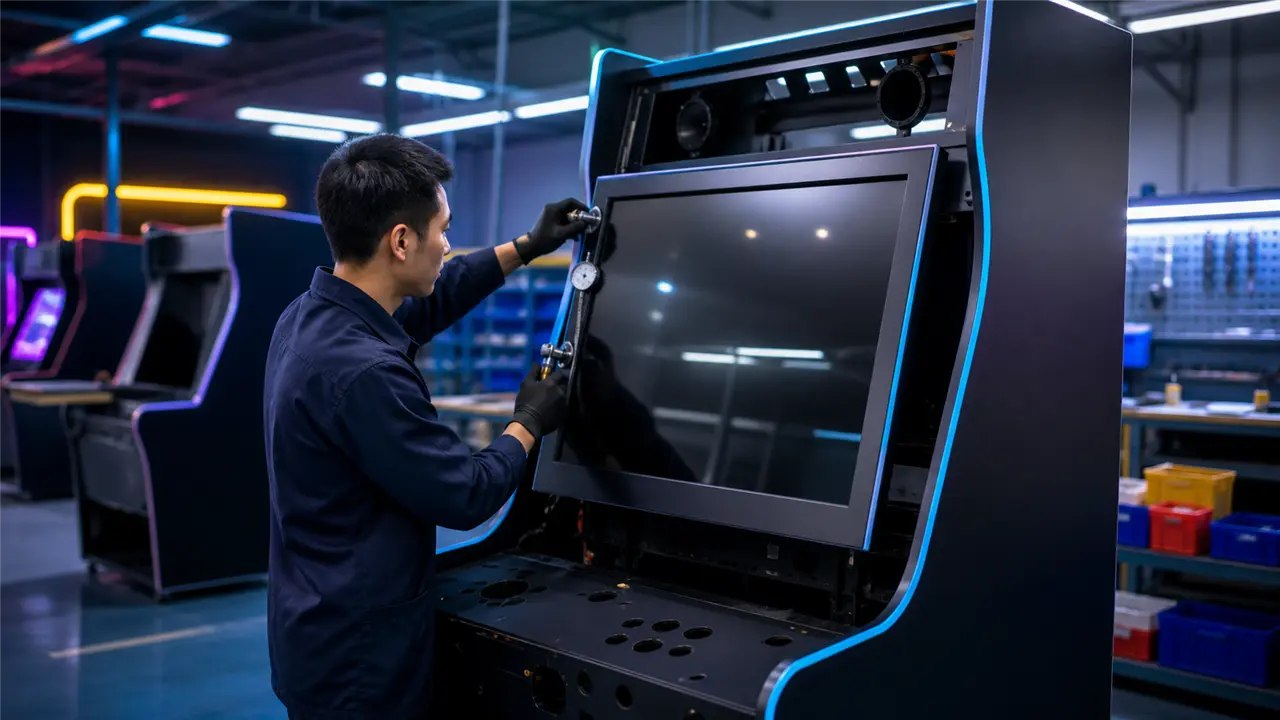
To eliminate these maritime transport risks, our manufacturing protocol mandates an engineered, multi-tier packaging envelope for every machine leaving our Panyu facility.
┌─────────────────────────────────────────────────────────────────────────────┐ │ MULTI-TIER PROTECTIVE CRATING BLUEPRINT │ ├─────────────────────────────────────────────────────────────────────────────┤ │ [TIER 1: DIRECT SURFACE] Anti-static film + 5mm high-density EVA corner caps│ │ │ │ │ ▼ │ │ [TIER 2: BARRIER FOIL] Heat-sealed multi-ply aluminum foil moisture shroud│ │ │ + DIN 55473 activated clay desiccant packs │ │ ▼ │ │ [TIER 3: DAMPENING CORE] 30mm closed-cell expanded polyethylene (EPE) foam │ │ │ custom-die-cut to lock monitor bezels in place │ │ ▼ │ │ [TIER 4: OUTER SHELL] 18mm engineered plywood crate with galvanized │ │ steel corner brackets and integral 4-way pallet │ └─────────────────────────────────────────────────────────────────────────────┘
Tier 1: Anti-Static Surface Protection
The cabinet exterior is first cleaned and wrapped in non-abrasive, anti-static polyethylene film (*LDPE*). All painted powder-coat surfaces, chrome trim, and acrylic marquee signboards are protected from friction hazing. High-stress corners (such as the upper display hood and bill acceptor coin door) receive custom 5mm high-density EVA protective corner bumpers.
Tier 2: The Hermetic Aluminum Foil Moisture Barrier
To isolate the electronic hardware from container rain and ocean humidity, the entire cabinet is encased in a heavy-duty, multi-laminate barrier bag composed of polyester, aluminum foil, and polyethylene (*PET/AL/PE*).
- Unlike ordinary clear plastic stretch wrap, our multi-ply foil bag exhibits a Water Vapor Transmission Rate (WVTR) of less than 0.05 grams per square meter per 24 hours.
- Before heat-sealing the foil envelope with an industrial pneumatic jaw sealer, technicians calculate the required desiccant charge according to DIN 55473 standards:
$$U = \frac{1}{100} \cdot (A \cdot W_{v} \cdot t + D \cdot m)$$
- Where $U$ is the number of desiccant units, $A$ is the surface area of the barrier bag, $W_v$ is moisture permeability, $t$ is voyage duration (days), and $D \cdot m$ accounts for hygroscopic packaging materials inside the bag.
- For a standard upright slot machine cabinet inside a 2.5 m² barrier bag traveling a 45-day ocean transit, we insert a minimum of 16 Desiccant Units (equivalent to 512 grams of activated bentonite clay). This maintains internal relative humidity strictly below 30% RH throughout the voyage, completely preventing rust on steel components and mold on wiring harnesses.
- A high-volume industrial vacuum nozzle evacuates excess air, reducing internal air volume by 60% before hermetic sealing.
Tier 3: 30mm Closed-Cell EPE Cushioning Foam
Surrounding the sealed moisture barrier, we install a continuous 30mm envelope of high-density Expanded Polyethylene (EPE) closed-cell foam (density: 28 kg/m³).
- Unlike brittle white styrofoam (expanded polystyrene or EPS), which crumbles under repeated impacts, EPE foam is elastic and retains its dynamic shock-absorption properties across multiple impact cycles.
- For curved-screen cabinets (such as 43-inch J-curve slot displays), our CNC foam-cutting table produces custom contour-matched foam blocks that lock the fragile curved display panel in place, distributing quayside drop forces across the entire structural metal chassis rather than allowing point-load stress on the glass perimeter.
Tier 4: Heavy-Duty 18mm Engineered Plywood Crate
The exterior crate is constructed from 18mm formaldehyde-free industrial engineered plywood.
- Fumigation Exemption: Engineered plywood is manufactured under intense industrial heat and pressure, legally exempting it from international phytosanitary quarantine restrictions under ISPM-15. Unlike raw solid timber crates, engineered plywood crates require no quarantine heat-treatment stamps and will never be refused entry or quarantined by customs authorities in the US, EU, or Australia.
- Galvanized Steel Edge Reinforcement: All outer corners and edges are armored with 0.8mm galvanized steel angle brackets secured with pneumatic drive screws.
- Integrated 4-Way Pallet Base: The crate base features an integrated pallet structure built with 90mm x 90mm solid composite blocks, providing 100mm of vertical clearance. This allows international terminal forklifts and pallet jacks to enter from all four sides, eliminating the risk of forklift tines puncturing crate side walls.
| Technical Packaging Component | Material Specification | Engineering Function |
|---|---|---|
| **Outer Wall Plywood** | 18mm multi-ply engineered hardwood plywood | Structural puncture resistance against quayside cargo impacts |
| **Cushioning Foam** | 30mm EPE closed-cell polyethylene (28 kg/m³) | Dynamic shock dampening; limits drop deceleration to < 20G |
| **Moisture Barrier Film** | Multi-layer laminated PET/AL/PE foil | WVTR < 0.05 g/m²/24h; total isolation from ocean humidity |
| **Active Desiccant** | DIN 55473 activated bentonite clay packs | Absorbs internal residual moisture; maintains RH < 30% |
| **Impact Sensor** | DropWatch 50G bidirectional impact detector | Triggers red indicator if crate suffers drops exceeding 50G |
| **Tilt Indicator** | TiltWatch Plus 360-degree gravity sensor | Permanently records if crate is tipped past 80 degrees |
For further technical insights into ocean container packing, see our dedicated analysis of arcade machine export crating standards and sea freight logistics, read how venue owners source arcade machines directly from China factories, and explore how we engineer OEM arcade cabinet factory sheet metal chassis to survive violent ocean transit.
Need our complete packaging engineering CAD drawings or want to verify crate dimensions and weights for your freight forwarder? Request our full packaging documentation package through our Custom Development Portal or reach out directly to our shipping department.
Real-Time Transit Accountability: DropWatch and TiltWatch Indicators
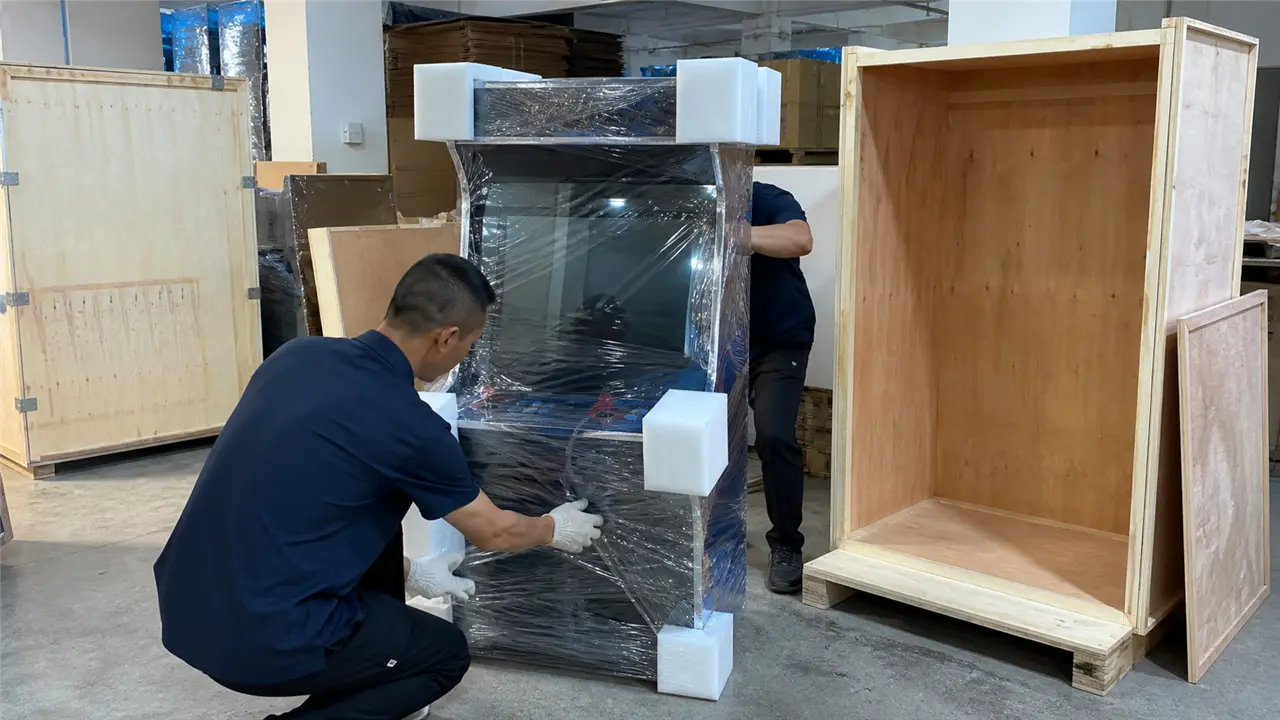
To ensure complete accountability throughout the ocean carrier and intermodal trucking chain, every export crate from our Panyu factory is fitted with tamper-evident transit sensors:
┌─────────────────────────────────────────────────────────────────────────────┐ │ TAMPER-EVIDENT TRANSIT SENSOR SUITE │ ├─────────────────────────────────────────────────────────────────────────────┤ │ [1. DROPOWATCH IMPACT DETECTOR] │ │ Mounted on the exterior crate face. Contains a precision-calibrated spring- │ │ weighted mechanism that releases a bright red dye into the display window │ │ if the crate experiences a vertical or horizontal drop shock exceeding 50G.│ ├─────────────────────────────────────────────────────────────────────────────┤ │ [2. TILTWATCH PLUS GRAVITY SENSOR] │ │ Mounted adjacent to the shipping label. Detects whether the crate was tilted│ │ beyond 80 degrees, laid on its side, or inverted during vessel loading. │ │ The non-reversible indicator proves improper carrier stowage. │ └─────────────────────────────────────────────────────────────────────────────┘
The Legal Value for the Operator
When your shipment arrives at your venue or local warehouse: 1. Immediate Inspection Before Signing Bill of Lading: Inspect the DropWatch and TiltWatch windows before the delivery driver departs. If the sensors are intact (white/silver), you have verified that the container suffered no severe impacts or tipping. 2. Immediate Carrier Claim Documentation: If an indicator has triggered red, do not refuse the shipment. Note *”DropWatch / TiltWatch Activated – Subject to Hidden Damage Inspection”* directly on the carrier’s Delivery Receipt (POD). Take high-resolution photos of the triggered sensor and the shipping label in the presence of the driver. Under maritime insurance rules, this photographic evidence establishes clear carrier liability, enabling immediate payout of cargo insurance claims without endless legal disputes.
Container Loading and Load-Balancing Protocols in Panyu
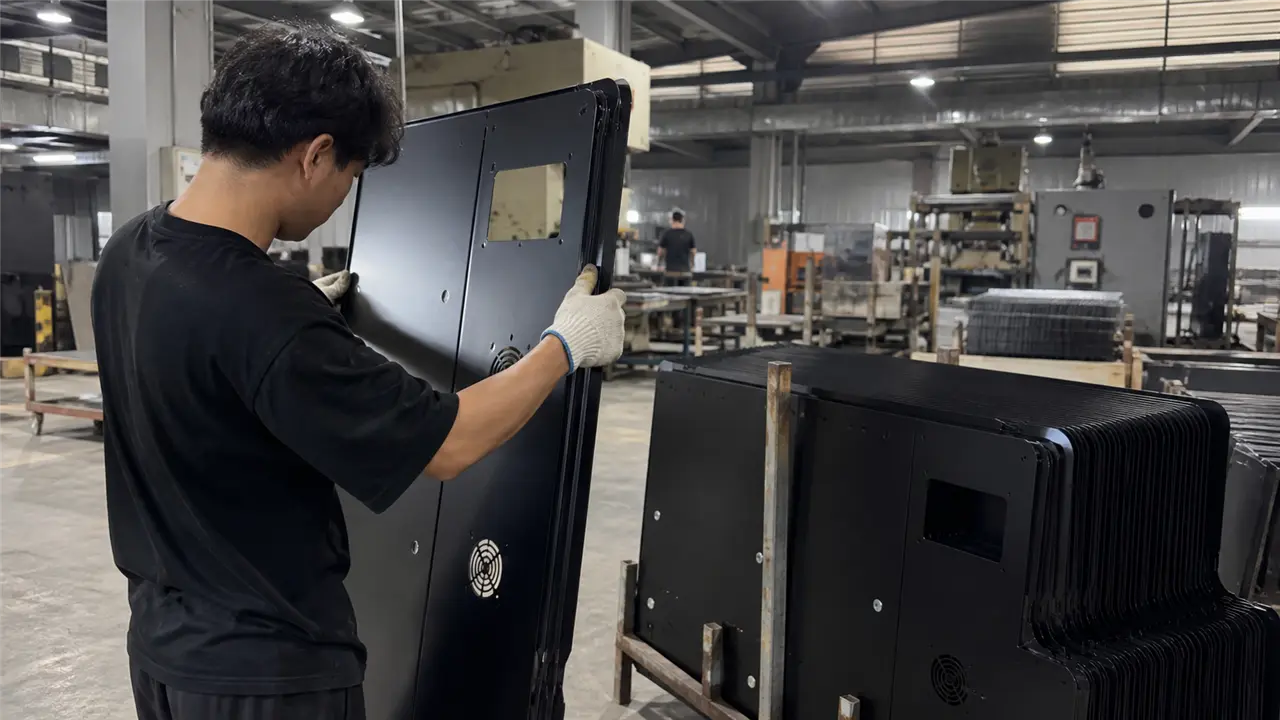
Properly packaging the individual crate is only half the battle. Preventing cargo shift inside the ocean container requires strict containerization discipline:
┌─────────────────────────────────────────────────────────────────────────────┐ │ 20GP / 40HQ CONTAINER LOADING SCHEMATIC │ ├─────────────────────────────────────────────────────────────────────────────┤ │ • WEIGHT DISTRIBUTION: Heaviest cabinets (Fish Tables / Pushers) positioned │ │ directly over container floor cross-members, alternating center-line. │ │ • DUNNAGE AIRBAGS: Commercial kraft paper air dunnage bags inflated to 3 PSI│ │ in all longitudinal and lateral voids exceeding 150mm. │ │ • CARGO SECURING: 50mm polyester ratchet lashings (breaking strength 5,000kg)│ │ anchored to container D-rings at every tier. Floor nailed stop-blocks. │ └─────────────────────────────────────────────────────────────────────────────┘
1. Center of Gravity Alignment: Heavy equipment (such as 8-player fish table steel bases weighing 350 kg) is positioned centrally over the container floor cross-beams. Weight is balanced evenly across the longitudinal axis to prevent the container from listing during crane hoists. 2. Industrial Dunnage Airbags: Voids between crates and container sidewalls are filled with heavy-duty commercial kraft paper dunnage airbags inflated to 3.0 PSI. This provides dynamic pneumatic pressure that prevents crates from sliding or shifting during ocean pitching. 3. 5,000 kg Rated Polyester Ratchet Lashing: At every row, crates are lashed to the container wall D-rings using 50mm heavy-duty polyester ratchet straps with a minimum breaking strength of 5,000 kg. Kiln-dried timber stop-blocks are anchored into the container floor planks with 100mm steel drive spikes directly in front of the final row at the container door threshold.
Frequently Asked Questions
Can I reuse your export plywood crates for domestic route moves?
Yes. Our crates are built with heavy-duty 18mm engineered plywood and steel corner brackets assembled with removable pneumatic drive screws rather than permanent clinch nails. By carefully unscrewing the top lid and front panel, operators can reuse the crates, internal EPE foam blocks, and pallet bases for subsequent route machine relocations, casino floor rotations, or seasonal machine storage.
How do I handle customs inspection if border agents open the hermetic foil bag?
In the event of an intensive customs physical exam (such as a US CBP VACIS exam or intensive exam), border agents may slice open the aluminum foil bag to inspect serial numbers on the machine logic board. We attach a clear, multilingual warning notice on the exterior of the foil bag instructing customs officers to reseal any inspection cuts using heavy-duty moisture-barrier tape. We also include two spare packs of industrial foil patching tape inside the crate document pouch.
What should I do if a crate arrives with external damage?
First, take clear, high-resolution photographs of the damage, the shipping label, and the status of the DropWatch and TiltWatch sensors before opening the crate. Note the damage explicitly on the trucker’s Proof of Delivery (POD) document. Open the crate in the presence of the delivery agent if possible, and document any internal contact points. Contact our export desk immediately; we will assist you and your customs broker in filing an expedited claim with the marine cargo insurance underwriter.
json
Commercial Risk-Reversal Guarantees for Direct Factory Procurement
To eliminate overseas purchasing hesitation and guarantee zero capital risk, our Panyu factory backs every commercial order with four ironclad commitments: 1. Low-Risk Sample Prototyping: We support 1-unit custom sample trial orders before committing to 20GP/40HQ container runs, allowing you to test physical chassis build quality, coin mech reliability, and game RTP firsthand. 2. Third-Party FAT Audits Welcome: We welcome third-party inspection teams from SGS, Intertek, or TÜV to conduct comprehensive onsite Factory Acceptance Testing on our assembly floor before container loading. 3. 100% Clean IP and Source Code Ownership: All custom software development contracts include full uncompiled Unity/C++ source code buyout with zero backdoors, perpetual commercial licenses, and clean IP indemnification. 4. 12-Hour Remote Engineering SLA: Direct WhatsApp and WeChat priority technical support groups linked directly to Engineer Wang’s hardware lab for live video debugging, schematic reviews, and replacement component dispatch.
Ready to coordinate your equipment shipment from Guangzhou or want to verify crate dimensions and weights for your freight forwarder? Contact me (Engineer Wang) directly via WhatsApp/WeChat at `+86 17620842078`, message our Telegram logistics desk at `https://t.me/JLwyc`, or email `miba515527@gmail.com`. We will ensure your hardware leaves our Panyu factory with the highest level of ocean protection in the amusement manufacturing industry.