- Commercial [Arcade Machine Manufacturing](/arcade-machine-manufacturing-cost-bom-breakdown/) Reality and Market Anatomy
- Industrial Machine Cabinet Engineering and Structural Integrity
- Electrical Architecture Power Regulation and Thermal Stability
- Display Engineering and Player Interface Integration
- Factory Acceptance Testing and Rigorous Quality Assurance Protocols
- Global Logistics Crating and International Customs Compliance
- Strategic B2B Procurement Checklist and Commercial Partnership Roadmap
- Frequently Asked Questions
Commercial [Arcade Machine Manufacturing](/arcade-machine-manufacturing-cost-bom-breakdown/) Reality and Market Anatomy
The industrial commercial arcade machine manufacturing sector operates on strict electrical safety, mechanical durability, and uninterrupted continuous runtime standards. A true commercial-grade cabinet integrates high-ripple-rejection power supplies, explosion-proof tempered glass, and 1.5mm cold-rolled steel enclosures designed for 24/7 high-load operation in high-traffic venues, ensuring maximized operator profitability and robust anti-cheat defense.
In my 12 years engineering arcade hardware architectures here in Panyu, I have witnessed the stark contrast between authentic industrial manufacturing and superficial middleman assembly. When venue owners invest in commercial gaming floors, the underlying hardware infrastructure dictates the lifespan of the revenue stream. We operate a 15,000-square-meter facility with 50 dedicated engineers on the CNC and QA floors, and our core philosophy revolves around delivering Turnkey complete cabinets. This is not about trading loose buttons or wire harnesses—it is about delivering fully integrated, revenue-generating machines engineered for continuous, high-stress public use.
The global market relies heavily on four core commercial machine categories, each presenting distinct engineering challenges and mathematical payout characteristics. The first category involves the large-scale aquatic shooting arenas. For an in-depth look at our structural execution in this category, review our commercial fish table game machine cabinet engineering. These tables accommodate 4, 6, 8, or 10 players simultaneously, demanding exceptional structural reinforcement to bear the weight of multiple adults leaning against the control panels, alongside aggressive multi-channel I/O handling for simultaneous rapid-fire button inputs.
The second core pillar consists of the traditional and modern upright slot and skill-based cabinets. Operators focusing on these high-velocity revenue models must understand the underlying math and hardware synergy; you can explore our skill game machine and 8 liner cabinet manufacturing. These machines require ultra-low latency input recognition and absolute security against coin stringing or pulse jamming.
Third, we design and manufacture heavy-duty mechanized pusher platforms. The kinetic friction, motor torque, and coin-fall edge calibration on these units are precise engineering sciences. I highly recommend examining our commercial coin pusher machine wholesale manufacturing documentation for insights into our proprietary cam-driven oscillation systems.
Finally, the communal stadium gaming sector is dominated by our large-scale multiplayer electronic roulette systems. These encompass massive central mechanical wheels synchronized with individual player betting terminals. Detailed structural blueprints are available in our multiplayer electronic roulette machine cabinet engineering breakdown.
Understanding the dichotomy between direct factory sourcing and purchasing through middleman brokers is vital for any serious route operator or distributor. Brokers often recycle scrap cabinets, patching them with substandard ATX computer power supplies and fragile 0.8mm iron sheets. These recycled builds inevitably suffer catastrophic failure within the first three months of operation due to thermal throttling, PCB burnout, or physical vandalism. Conversely, our direct-from-factory Turnkey complete machines guarantee a 60-day Return on Investment (ROI) trajectory because they simply do not break down. We engineer for a Mean Time To Failure (MTTF) of over 40,000 hours. We control the electrical stability from the ground up, ensuring that every logic board is fed clean, regulated voltage regardless of venue power grid fluctuations.
Industrial Machine Cabinet Engineering and Structural Integrity
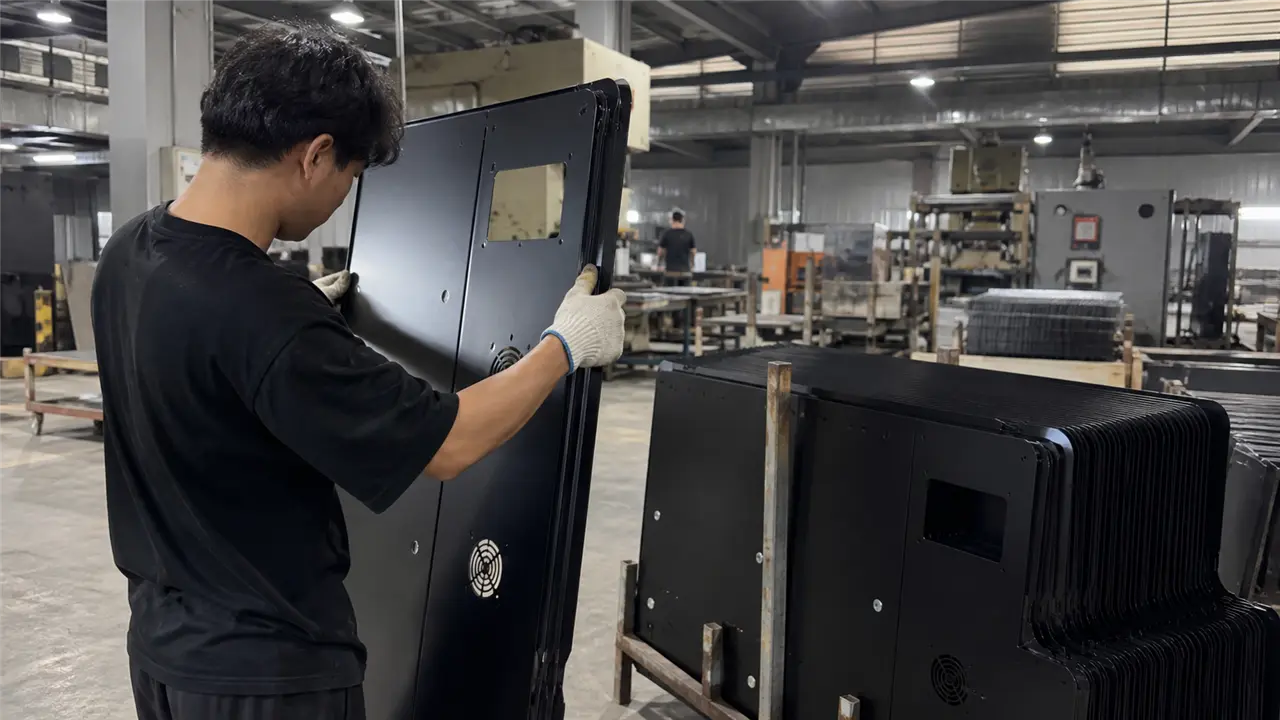
The physical foundation of a commercial arcade machine dictates its survival on a bustling game room floor. The material choice is non-negotiable. We strictly utilize 1.5mm SPCC cold-rolled steel for our primary enclosures. SPCC cold-rolled steel offers superior tensile strength and structural rigidity compared to the inferior 0.8mm thin iron sheet or moisture-absorbing particleboard commonly peddled by low-end assemblers. When an angry player kicks or bashes a cabinet after a loss, particleboard splinters and 0.8mm iron buckles, permanently destroying the machine’s aesthetic and compromising the internal electronics. Our 1.5mm SPCC framework acts as a rigid exoskeleton, absorbing impact energy and maintaining the absolute dimensional tolerance required for precision mechanical coin validators and hoppers.
Ergonomic cabinet profiles represent another critical layer of our structural engineering. We do not use generic, one-size-fits-all blueprints. Every cabinet type is mathematically contoured for the specific player posture it demands. Our Upright cabinets are angled to reduce neck strain while maintaining optimal screen viewing distances to minimize glare. For seated environments, our Slant Top cabinets feature a 15-degree control panel inclination, providing forearm support during prolonged gaming sessions. In the realm of multi-station communal builds, such as our 10-player fish tables, the radial geometry is calculated to grant each player maximum elbow room while centralizing the focal point on the high-definition curved display. For distributors requiring specific spatial dimensions, our OEM division excels in tailored structural design; please consult our custom arcade cabinet builder OEM and ODM engineering capabilities.
Surface finishing is just as crucial as the underlying steel. A raw steel cabinet will rapidly succumb to oxidation in humid environments or coastal regions. We employ an AkzoNobel dual-layer electrostatic powder coating process. The electrostatic application ensures 100% uniform coverage, penetrating every corner and welded seam, creating a hard, scratch-resistant polymer shell that repels moisture, fingerprints, and chemical cleaning agents.
Protecting the primary visual interface requires uncompromising material selection. Standard glass shatters into lethal shards upon impact. Acrylic and polycarbonate scratch easily and discolor under UV light. We exclusively install 6mm explosion-proof tempered glass over our monitors. This glass undergoes rigorous thermal tempering, increasing its surface compression. It can withstand direct blows from heavy objects without fracturing, and in the extreme event of a breakage, it safely crumbles into blunt granules. The 6mm thickness also adds significant acoustic insulation, dampening internal fan noise and creating a premium tactile feel.
Electrical Architecture Power Regulation and Thermal Stability
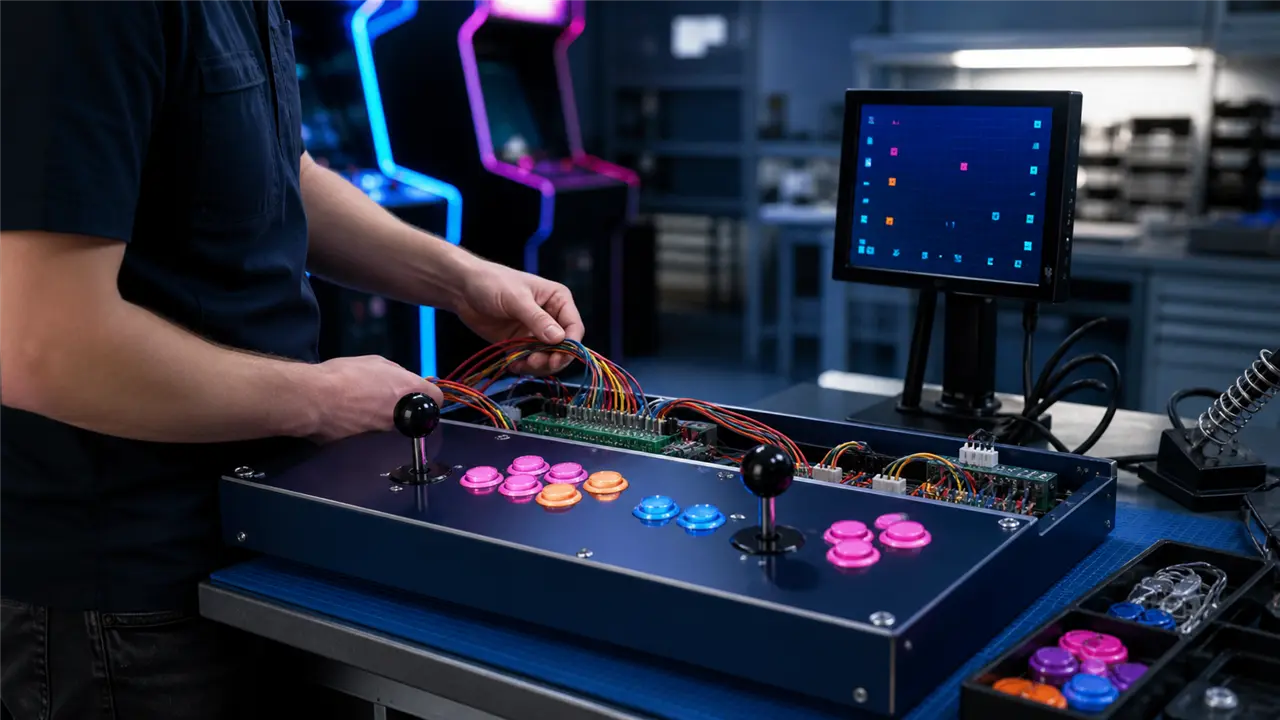
The silent killer of commercial arcade operations is electrical instability. The logic boards, specifically the complex CPU and GPU clusters running modern 3D graphics and sophisticated RNG (Random Number Generator) algorithms, require absolute voltage precision. We strictly specify Mean Well industrial low-ripple power supplies for all our Turnkey cabinets. These power supplies guarantee less than 50mV of voltage ripple, ensuring that the delicate logic gates on the game boards are never subjected to dirty power. Cheap ATX power supplies suffer from massive voltage sag under load, leading to spontaneous reboots, corrupted RAM states, and catastrophic player disputes over lost credits.
Beyond the power supply itself, the internal wiring architecture demands rigorous segregation. We enforce strict physical segregation of high-voltage AC mains lines from low-voltage DC logic and communication buses. Running a 110V/220V line adjacent to a 5V logic signal induces electromagnetic interference (EMI) that can trigger false coin drops or scramble serial communication with the bill acceptor. We utilize flame-retardant harnesses constructed from high-strand-count copper, sheathed in self-extinguishing PVC. Every critical communication pathway, particularly the connections to the coin mechs and mechanical meters, relies on optical isolation. Optocouplers provide a physical gap in the electrical circuit, translating signals via light, thereby entirely preventing high-voltage surges from traveling backward into the delicate game board. To understand how this electrical architecture plays into our broader defensive posture against malicious tampering, study our anti-cheat hardware defense systems.
Thermal dynamics dictate the operational lifespan of the internal components. A modern commercial arcade cabinet acts as a localized heat generator. In a 24/7 continuous arcade room operation, stagnant internal air leads to immediate thermal throttling of the game board processors and drastically reduces the lifespan of the LCD backlight arrays. We implement a positive-pressure dust filtration thermal management system. High-CFM (Cubic Feet per Minute) industrial intake fans draw ambient air through washable, fine-mesh particulate filters, pushing cold air into the base of the cabinet. This creates a slightly higher air pressure inside the cabinet than outside, forcing hot air to exhaust passively out of the top rear vents while preventing dust from entering through unsealed seams. A dust-free internal environment prevents static buildup and ensures optimal heat sink efficiency on the mainboards.
Display Engineering and Player Interface Integration
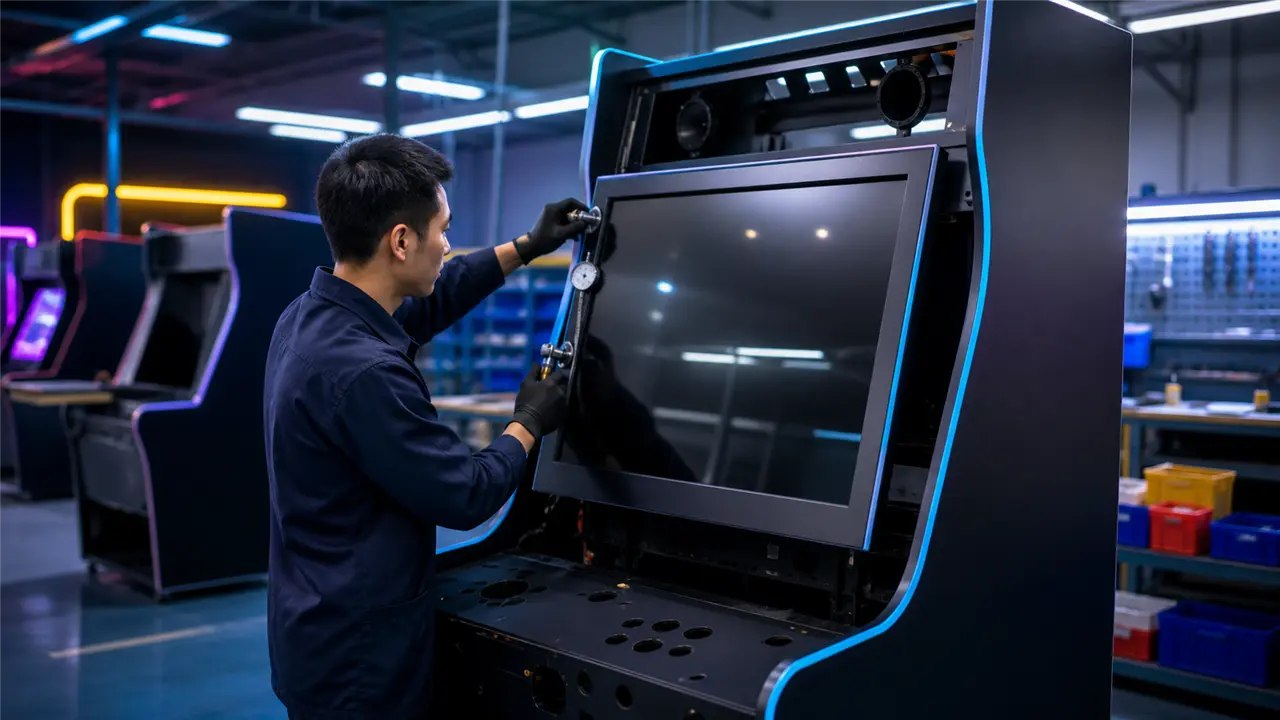
The display is the primary vehicle for player engagement and revenue generation. We refuse to compromise on visual fidelity or long-term reliability. We strictly adhere to commercial display standards, sourcing original BOE and LG 4K curved and flat high-refresh panels. These are not consumer-grade television screens repackaged in a steel box. Consumer TVs are designed for a few hours of viewing per day; our commercial panels are engineered for 100,000 hours of continuous runtime without image retention or backlight degradation. They feature ultra-wide viewing angles, essential for communal games, and specialized anti-glare surface treatments to combat the harsh overhead lighting typical of bustling arcade venues. For touch-enabled systems, we integrate industrial 10-point capacitive touch overlays, calibrated to register inputs instantly even through the 6mm protective glass, completely immune to interference from surface moisture or dust.
The physical player interface—the buttons and joysticks—absorbs the most brutal physical punishment of any component. We specify heavy-duty anti-shatter firing buttons molded from impact-resistant polycarbonate. The critical component, however, is the hidden microswitch. We utilize microswitches rated for a mechanical endurance of over 10,000,000 actuation cycles. These switches utilize silver-alloy contacts to prevent carbon arcing and ensure instantaneous electrical closure with zero debounce latency. We further enhance the player experience through synchronized RGB ambient lighting, integrating digitally addressable LED strips that pulse and react dynamically to in-game events, drawing foot traffic across the venue floor.
Cash handling is the lifeblood of the machine. The bill acceptor and hopper integration must be flawless, secure, and globally adaptable. Our cabinets are engineered for physical and protocol compatibility with industry-leading validators, specifically ICT, CashCode, and Pyramid. We provide standardized mounting brackets, reinforced cash box vaults, and universally compatible MDB, Pulse, or ccTalk wiring harnesses. The ccTalk protocol, in particular, offers encrypted serial communication between the bill acceptor and the game board, rendering standard pulse-generation cheat devices completely ineffective. The hoppers we utilize feature optical coin counting sensors and robust anti-jamming reverse motor logic to ensure continuous, uninterrupted payout operations.
Factory Acceptance Testing and Rigorous Quality Assurance Protocols
A machine is only as good as the testing it survives before it leaves our facility. Our Panyu QA lab operates under draconian protocols to guarantee that every Turnkey complete cabinet performs flawlessly upon arrival.
The cornerstone of our QA process is the 72-hour full-load burn-in stress testing protocol. Every completed machine is powered on and subjected to continuous, automated input simulation for three consecutive days and nights in a climate-controlled chamber under thermal strain. We push the ambient temperature to 45°C (113°F) to ensure the positive-pressure cooling system maintains safe operating temperatures for the logic boards and power supplies. Any component exhibiting thermal deviation, voltage sag, or graphical artifacting is immediately rejected and sent back to the engineering floor for forensic analysis.
Electrical safety testing is equally rigorous. We perform high-voltage insulation withstand tests (Hipot testing) to verify the integrity of all wiring harnesses and grounding points. We apply a 1500V potential between the AC mains and the steel chassis to ensure zero leakage current, guaranteeing absolute safety for the players and venue staff. Furthermore, we conduct ESD (Electrostatic Discharge) anti-spark surge injection tests. We actively attack the control panel, coin slots, and metal seams with a high-voltage ESD gun, simulating the static shocks common in dry, carpeted venues or malicious attempts to crash the system. Our optical isolation and robust grounding architecture must absorb and dissipate these strikes without disrupting the game logic.
We operate with total transparency. For our international B2B clients, we execute live video FAT (Factory Acceptance Test) inspection procedures. I will personally walk you through the inner workings of your batch on a live video call, demonstrating the voltage readouts, testing the coin mechs, and verifying the software configurations before a single crate is sealed. For major corporate procurements, our facility is maintained in a state of permanent readiness for third-party SGS/TÜV factory audit inspections. We welcome independent verification of our ISO-compliant manufacturing processes. For a detailed breakdown of what these inspections entail, see our onsite FAT inspection checklist.
Global Logistics Crating and International Customs Compliance
Manufacturing a flawless machine is only half the battle; delivering it intact across thousands of miles of ocean freight is the other. Our export packaging protocol is an engineered system designed to combat maritime hazards.
We begin with moisture vapor barriers. Every cabinet is hermetically sealed within a high-density polyethylene vacuum bag containing industrial desiccants to entirely eliminate the risk of saltwater corrosion or condensation during transit. We then apply heavy corner foam—custom-molded, high-density EPE (Expanded Polyethylene) blocks that cushion the vulnerable edges and screens against forklift impacts and container drops. The final layer of defense is the exterior shell: fully enclosed ISPM-15 compliant plywood crates. These crates are heat-treated and certified for international export, heavily reinforced with cross-bracing to support stacking weight in the hull of a cargo ship. A deeper dive into this protective architecture can be found in our ocean freight packaging protocol.
Navigating the bureaucratic maze of international customs requires precise documentation. Commercial arcade machines must be properly categorized to avoid catastrophic delays. We ensure strict adherence to the HS Code 9504.30.00 customs classification (Video game consoles and machines, other than those of subheading 9504.20, operated by coins, banknotes, bank cards, tokens or by any other means of payment). Using incorrect codes to attempt tax evasion is a foolish tactic employed by shady brokers that inevitably leads to punitive tariffs, hefty fines, and import customs seizures. We provide immaculate Commercial Invoices, Packing Lists, and Certificates of Origin to ensure smooth clearance. For a comprehensive overview of global tax implications, review our import tariffs and customs classification guide.
Optimizing freight costs directly impacts your bottom line. We provide strategic consultation on FCL (Full Container Load) versus LCL (Less than Container Load) ocean freight cost optimization. While LCL might seem cheaper for a small test order of 2 or 3 machines, the volumetric weight calculations, warehouse handling fees, and increased risk of damage from sharing a container with unknown goods often negate the savings. We engineer our cabinet dimensions specifically to maximize the packing density within standard 20ft and 40ft High Cube containers, encouraging clients to consolidate their orders into FCL shipments for the lowest per-unit landed cost and the highest level of cargo security.
Strategic B2B Procurement Checklist and Commercial Partnership Roadmap
Entering the commercial arcade sector or expanding an existing route requires a calculated, step-by-step approach to hardware procurement. We have distilled our 12 years of experience into a definitive 8-step venue owner decision tree, designed to scale operations logically from a 1-unit pilot sample to a massive 40-unit floor rollout.
1. Identify the Target Demographic and Venue Architecture (Adult skill gaming, family entertainment, or stadium betting). 2. Select the Appropriate Cabinet Profile (Upright, Slant Top, or Fish Table) based on floor space and player dwell time. 3. Define the Software and Payout Mathematics (RTP percentages, progressive jackpots, server-based vs. standalone). 4. Specify the Bill Acceptor and Cash Handling Hardware based on local currency and security requirements. 5. Order a Single Turnkey Pilot Sample to verify build quality, player reception, and software stability in your specific market. 6. Execute Live FAT Video Inspection with our engineering team prior to sample dispatch. 7. Analyze Pilot ROI Data over a 30-to-60-day period. 8. Scale to FCL Mass Production for a full 40-unit floor rollout, leveraging economies of scale.
For clients requiring entirely unique hardware tailored to their specific brand identity, our OEM/ODM bespoke engineering timeline moves rapidly from concept to reality. The process begins with raw ideation and dimension requirements, transitioning into precise CAD/SolidWorks structural drafting within 7 days. Once the 3D renders are approved, we laser-cut and fold the first sheet metal prototype within 14 days. Following rigorous mechanical and thermal testing of the prototype, we can transition to full-scale mass production within 30 days. We provide complete Turnkey manufacturing, meaning you receive a fully wired, software-loaded, and tested machine ready for immediate deployment.
This is the standard of industrial arcade manufacturing. If you are exhausted by dealing with unreliable brokers, dealing with broken acrylic, and suffering through weekly PCB failures, it is time to upgrade your hardware infrastructure. We build machines designed to generate revenue relentlessly.
To initiate a project, discuss CAD blueprints, or schedule a live video factory tour of our Panyu facility, reach out directly.
Connect with Engineer Wang:
- WhatsApp/WeChat: +86 17620842078
- Telegram: https://t.me/JLwyc
- Email: miba515527@gmail.com
Frequently Asked Questions
Why should I choose 1.5mm SPCC steel over cheaper materials for my arcade cabinets? Cheaper materials like 0.8mm iron or particleboard warp, crack, and fail under the physical stress of a commercial arcade environment. 1.5mm SPCC cold-rolled steel provides immense structural rigidity, protecting the sensitive internal electronics from vandalism, maintaining alignment for coin mechanisms, and ensuring a lifespan of over a decade.
How do your machines handle voltage fluctuations and prevent logic board burnout? We strictly utilize industrial-grade Mean Well power supplies known for their ultra-low voltage ripple (under 50mV) and robust voltage regulation. We also physically segregate high-voltage AC lines from low-voltage DC communication lines and use optoisolators to prevent electrical surges from reaching the main processing boards.
What is the correct HS Code for importing commercial arcade machines? The globally recognized classification for coin-operated commercial arcade machines is HS Code 9504.30.00. Accurately declaring this code is critical for legal customs clearance and avoiding severe penalties, confiscations, or unexpected punitive tariffs during the import process.
Can you customize the cabinet design and software for my specific market? Yes, we offer comprehensive OEM and ODM Turnkey services. Our engineering team can take your concept from SolidWorks CAD drafting to a physical sheet metal prototype in approximately 14 to 21 days, integrating specific bill acceptors, bespoke software math models, and custom AkzoNobel powder coat finishes.
What testing procedures do your machines undergo before shipping? Every completed machine is subjected to our rigorous Factory Acceptance Testing (FAT) protocol, which includes a 72-hour full-load burn-in test under thermal strain, high-voltage insulation withstand testing, and ESD surge injection. We also conduct live video inspections with clients before sealing the export crates.