- Why Standard Coin Pushers Fail In Remote Live Streaming Scenarios
- Upgrading The Mechanical Foundation For Continuous Duty
- Precision Optical Sensing For Coin Drop Validation
- WebRTC AV Encoding And High Frame Rate Camera Integration
- Industrial IoT Controller Board Integration
- Commercial ROI And Venue Profitability For Live Arcades
- Factory FAT Process And Turnkey Delivery
- Frequently Asked Questions
As the lead hardware and IoT architect at Guangzhou Miba Animation Technology Co., Ltd., I speak daily with arcade operators, investors, and game developers globally who are eager to transition their traditional physical venues into 24/7 online goldmines. The concept of remote live arcade gaming—where players use a mobile application to control a real, physical machine situated in a warehouse thousands of miles away—is absolutely explosive. The market is vast, and the player engagement metrics far exceed those of pure virtual games because the physics, the metal-on-metal clinking, and the tangible reality of the coins simply cannot be fully replicated in a 3D engine.
However, many ambitious operators quickly encounter catastrophic, business-ending failures when they attempt to build this infrastructure using off-the-shelf components. You absolutely cannot simply point a cheap consumer webcam at a standard arcade cabinet, hook up a basic relay board, and expect it to run flawlessly without constant on-site human intervention. Real, sustainable profitability in the remote arcade sector requires industrial-grade hardware modification, highly optimized sub-80ms WebRTC streaming, and a relentless, obsessive focus on 24/7 mechanical reliability.
In our 15,000-square-meter Panyu manufacturing base, we engineer commercial coin pusher machine units completely from the ground up for continuous unattended operation. This comprehensive technical breakdown will walk you through the precise hardware modifications, sensor upgrades, software integration, and network architecture required to transform a standard physical coin pusher into a high-yield remote live arcade asset. If your current remote setup suffers from coin jams, video lag, uncounted payouts, or frequent motor burnouts, you are burning capital every single second. Let us fix that structural flaw.
Why Standard Coin Pushers Fail In Remote Live Streaming Scenarios
When a player interacts with a machine via an application, they subconsciously expect the instantaneous responsiveness of a digital video game combined with the tactile thrill of physical hardware. Standard cabinets are explicitly designed for retail environments with human attendants who can clear jams, reset errors, or refill coin hoppers. In a remote environment, every mechanical fault requires dispatching a technician to the warehouse floor. This destroys your profit margin, ruins the player experience, and leads to immediate app uninstalls.
The Nightmare Of Pulse Delay And Video Latency
Standard coin mechanisms and traditional IP cameras introduce entirely unacceptable delays. If a player taps the “drop” button on their phone and the physical coin falls a full second later, the illusion of control shatters instantly. The game feels rigged, disconnected, and frustrating. Worse, if the video stream lags behind the physical action, players will abandon the platform immediately. Standard H.264 IP security cameras often have a 2-second or even 3-second delay due to deep buffer queues designed for surveillance, not interactive gaming. This latency profile is entirely unusable for skill-based gaming where timing is everything.
Mechanical Fatigue From Continuous Unattended Operation
A physical retail arcade venue might operate for 10 to 12 hours a day, giving the hardware time to cool down and recover. But a remote live arcade turnkey system runs 24 hours a day, 7 days a week, 365 days a year, serving players across different global time zones. The standard AC synchronous motors used in cheap coin pushers will overheat, warp their plastic gearboxes, and permanently seize up within weeks under this relentless duty cycle. Our engineering protocol mandates replacing these consumer-grade components with heavy-duty industrial robotics parts right on the assembly line.
The Hidden Cost Of Coin Jams And Maintenance
In a traditional setup, a jammed coin is a minor inconvenience; a staff member opens the glass and clears it in ten seconds. In a remote farm with five hundred machines, a ten percent jam rate means you need a dedicated army of floor technicians running frantically from cabinet to cabinet. Furthermore, when a machine is jammed, it is offline, generating zero revenue while still consuming bandwidth, server resources, and electricity. We must engineer the physics of the machine to prevent jams before they happen.
Upgrading The Mechanical Foundation For Continuous Duty
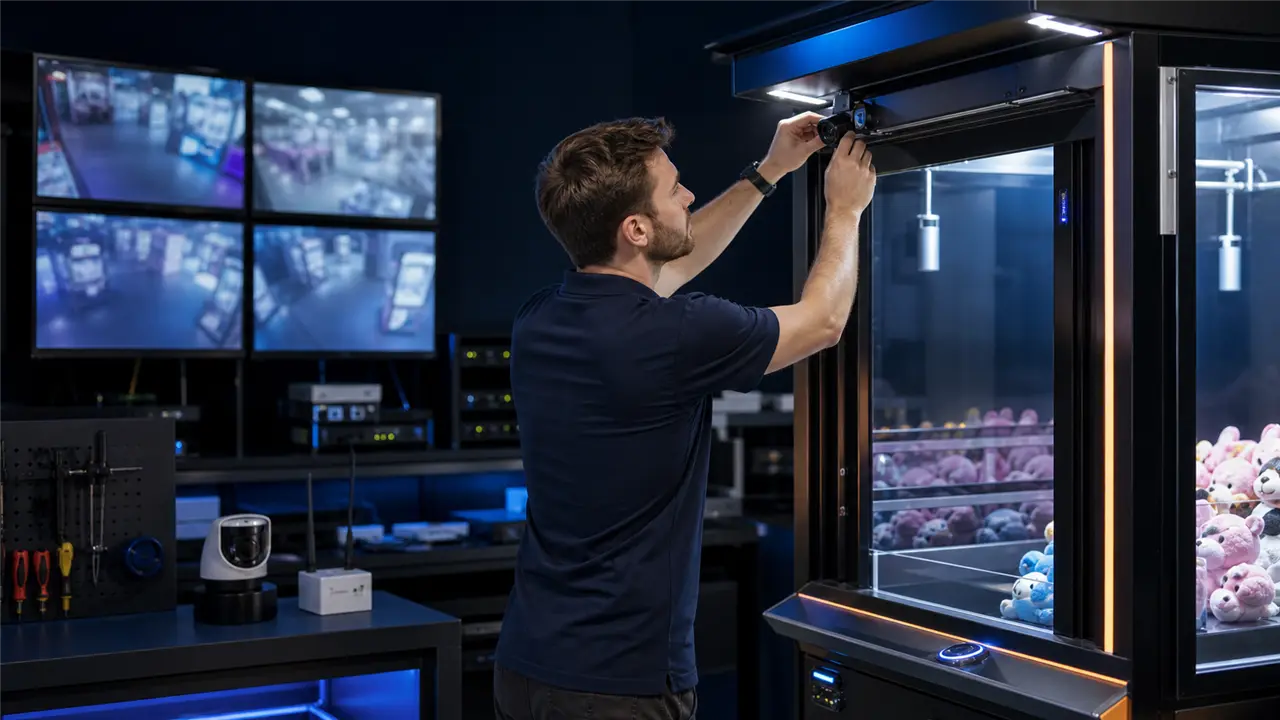
To guarantee near-zero downtime, our factory process involves stripping the cabinet down to its bare metal chassis and completely rebuilding the propulsion, coin circulation, and power distribution systems. We are not a spare parts supplier selling you replacement motors; we are an enterprise-grade solutions provider delivering a complete, bulletproof machine that generates revenue while you sleep.
High-Torque Wiper Motors And Heavy-Duty Gearboxes
In our final assembly line, we ruthlessly discard standard 15W AC motors and replace them with custom-wound 40W to 60W high-torque DC planetary gear motors. These motors feature 40Cr forged steel gears rather than standard nylon or cheap pot metal, ensuring they can push massive, heavy piles of metal coins without stalling, hesitating, or stripping teeth.
We incorporate active heat dissipation and thermal cutoff switches directly into the motor housing. If the ambient temperature inside the densely packed server-farm-style cabinet rises, the dual-bearing cooling fans dynamically adjust their RPM, ensuring the pusher platform maintains a perfectly consistent oscillation frequency. This consistency is vital for the game’s mathematical probability models to function correctly.
Automated Coin Recycling And High-Capacity Hoppers
A remote machine must be entirely self-sustaining. Standard arcade machines drop winning coins into a lower player tray for manual physical collection. In our remote builds, we redesign the entire lower chassis to incorporate an automated, gravity-fed coin recycling elevator.
Winning coins fall onto an acoustic dampening ramp—reducing warehouse noise—and are funneled directly into high-speed, jam-resistant optical hoppers. These hoppers continuously feed the overhead drop mechanism via a proprietary enclosed escalator system, creating a closed-loop ecosystem. A single heavily trafficked machine might cycle tens of thousands of physical coins daily without a human hand ever touching the internal mechanism.
Upgraded Power Supply Units For Uninterrupted Operation
To power the upgraded motors, lighting, cameras, and IoT boards, standard arcade power supplies are woefully inadequate. They suffer from voltage ripple and thermal throttling. We install industrial-grade Mean Well switching power supplies with massive headroom. Clean, ripple-free DC power ensures that the optical sensors do not register false positives due to electrical noise, and the controller boards never experience brownouts during high-load coin payout events. Wiring harnesses are upgraded to 16AWG pure copper with flame-retardant silicone insulation to prevent electrical fires in unattended environments.
Precision Optical Sensing For Coin Drop Validation
Payout accuracy is the absolute bedrock of player trust and operator profitability. If a player rightfully wins 50 coins but the mechanical system only registers 45, you will immediately face customer service tickets, chargebacks, and severe reputational damage on social media. Conversely, if a glitch causes the machine to overpay, your profit margins bleed out. Mechanical switches are entirely inadequate for this high-stakes task.
Replacing Mechanical Microswitches With Infrared Arrays
Mechanical microswitches suffer from physical bounce, mechanical wear, and spring fatigue. A heavy cascade of dozens of coins will easily overwhelm a physical switch lever, leading to dropped counts. We completely eliminate mechanical payout switches. Instead, we utilize high-speed infrared optical sensor arrays positioned precisely at the payout chute bottleneck.
These industrial sensors scan the payout channel at 10,000 times per second. When a coin, or a tightly packed cluster of coins, breaks the infrared beam, the sensor registers the leading and trailing edges instantly, regardless of the coin’s velocity. This guarantees 99.99% accuracy in payout auditing.
Pulse Signal Conversion And Anti-Cheating Filtration
The raw electrical signals output by the optical sensors must be rapidly and securely interpreted. We route these signals directly through our proprietary IoT arcade controller board. This board features advanced hardware-level debounce filters and signal conditioning algorithms that definitively differentiate between a legitimate coin drop and environmental noise.
If a malicious actor attempts to use a high-frequency EMP device or a spark generator to induce false payouts in your warehouse, our board’s rigorous optical isolation and transient voltage suppression architecture will clamp the destructive surge in under 5 picoseconds. It instantly discards the fraudulent pulse data and triggers a high-priority security alert to your central server dashboard, effectively rendering traditional arcade cheating methods useless.
WebRTC AV Encoding And High Frame Rate Camera Integration
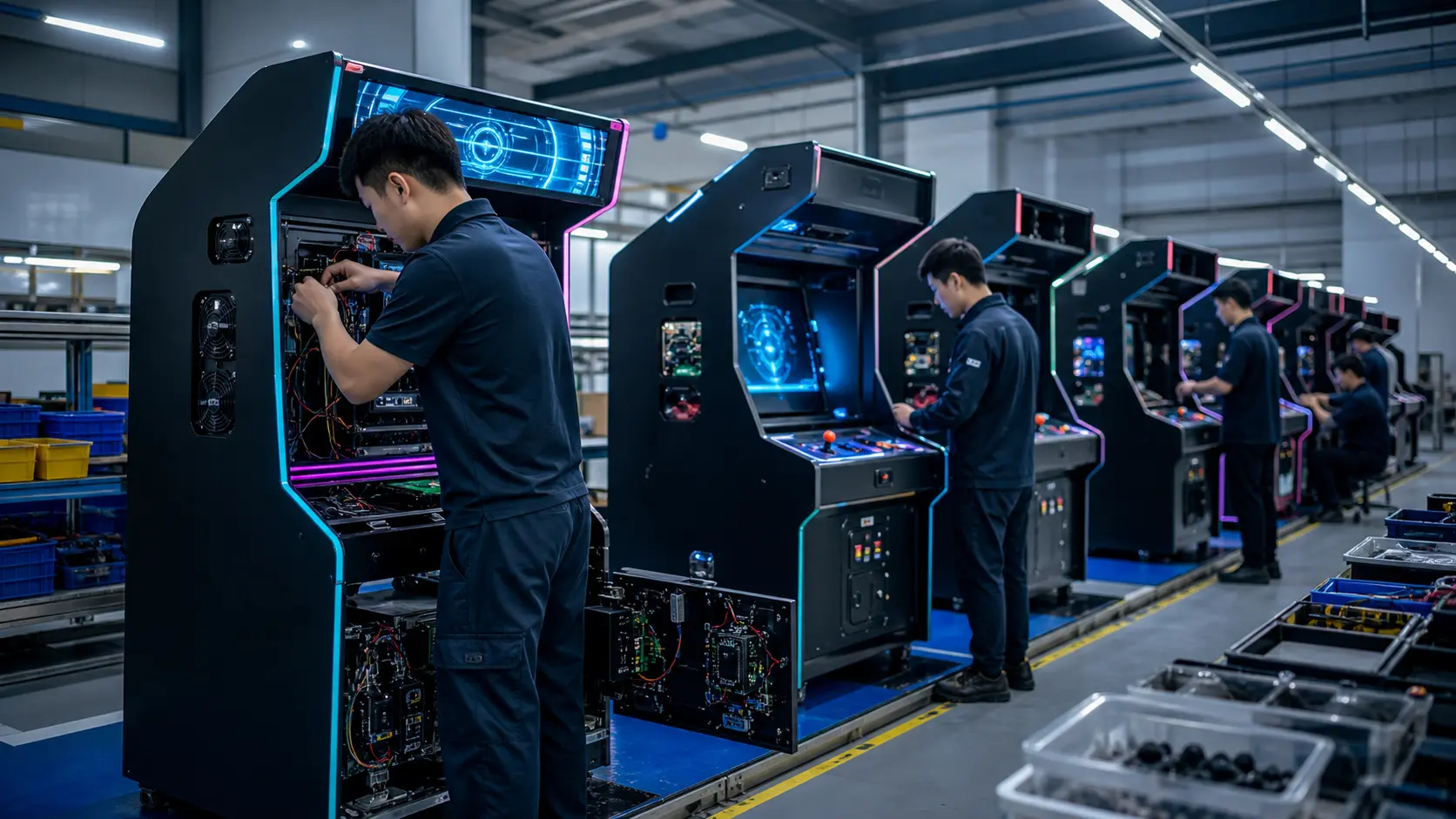
The video stream is the only tether connecting the player to your physical hardware. It must be pristine, wide-angle, highly saturated, and incredibly fast. We do not rely on third-party security IP cameras, which are inherently flawed for this application. We build our own embedded encoding pipelines tailored specifically for remote arcade dynamics.
Achieving Sub-80ms Glass-To-Glass Latency
We utilize dedicated hardware encoders equipped with deeply customized WebRTC network stacks. By completely bypassing legacy RTMP protocols and utilizing UDP-based WebRTC, we eliminate the massive buffering overhead that causes lag.
The raw video is captured directly from the image sensor, instantly encoded in highly efficient H.265 or H.264 formats, and transmitted across the internet to the player’s mobile screen in under 80 milliseconds. This “glass-to-glass” latency is significantly faster than human reaction time. This ensures that when the player presses the digital drop button, they perceive the physical coin dropping instantaneously.
Camera Mounting Angles For Optimal Player Engagement
Lighting and camera positioning require precise optical engineering, not just guesswork. We rigidly mount industrial-grade 1080p 60fps global shutter cameras directly inside the customized cabinet frame. A global shutter exposes the entire sensor simultaneously, completely eliminating the nauseating “jello” or tearing effect seen in fast-moving objects captured by cheaper rolling shutter cameras.
We typically deploy a dual-camera or triple-camera setup for maximum engagement: one ultra-wide-angle lens capturing the entire playfield, pusher shelf, and side gutters, and a secondary macro lens tightly focused on the payout chute or specific bonus targets. A third optional camera can be mounted top-down for precision targeting verification in skill-based pusher configurations.
Polarized Lighting To Eliminate Glare
The brilliant LED lighting required to make the game look appealing often creates severe glare on the internal glass and the reflective metal coins, blinding the camera sensor. We integrate custom polarized LED lighting panels combined with precisely matched polarized lens filters. This cuts through the reflections, ensuring the video feed remains incredibly crisp, highly saturated, and visually stunning, which directly increases average session length and player spend.
Industrial IoT Controller Board Integration
The absolute brain of our entire remote operation is the proprietary IoT controller board. This represents the critical bridge where the physical reality of the machine merges with the digital architecture of the cloud server. This allows software algorithms to dictate physical actions and hardware sensors to report detailed telemetry back to the database.
Bridging Physical Hardware To Cloud Architecture
Our enterprise IoT board connects via secure, encrypted WebSocket or MQTT protocols directly to your game server backend. When the server authenticates a player’s action (e.g., a button press), it sends a tiny command payload to the board. The board instantly translates this digital command into a high-current electrical pulse that fires the precise coin drop solenoid or wiper arm mechanism.
This entire digital-to-physical round trip takes milliseconds. Furthermore, the board acts as a continuous telemetry monitor, tracking motor current draw, cabinet temperature, hopper jam status, voltage fluctuations, and precise coin counts in real-time, feeding this data into your analytics dashboard.
Remote Diagnostics And Power Cycling
In a massive remote arcade farm operating hundreds of units, you cannot afford to manually check every machine. Our deeply integrated IoT architecture allows for unprecedented remote diagnostics and self-healing capabilities.
For instance, if a coin jam is detected because the hopper motor’s electrical current spikes abnormally, the controller board can automatically attempt to briefly reverse the motor to clear the physical jam before sending an alert. If a camera module freezes or drops frames, the controller board can perform a hard hardware-level power cycle on that specific USB port or PoE line, rebooting the camera in seconds without taking the entire arcade machine offline. This self-healing automation drastically reduces your Operational Expenditure (OPEX) and maximizes uptime.
Commercial ROI And Venue Profitability For Live Arcades
Investing in our industrial-grade, highly modified machines transforms what is typically a risky capital expenditure into a highly predictable, mathematically sound revenue generation engine. Buying cheap, unmodified machines will inevitably cost you exponentially more in downtime, technical labor, and lost player trust than you save on the initial purchase price. We have seen operators fail within three months because their consumer-grade hardware literally melted under continuous operational stress.
Labor Cost Reduction And Continuous Revenue Streams
By utilizing our heavily modified, self-sustaining machines, a single skilled technician can easily oversee a warehouse farm of 100 remote coin pushers. The machines run flawlessly across global time zones, generating substantial revenue from players in Europe, the Americas, and Asia while your local, physical competitors are closed for the night.
The Return on Investment (ROI) for our turnkey modified cabinets is incredibly aggressive. Assuming standard user acquisition costs and traffic models, operators frequently recoup their full hardware investment within 60 to 90 days of deployment. Most importantly, when you work with Guangzhou Miba Animation, we offer 100% source-code buyout options for the entire software stack. You own the hardware, you own the code, and you keep 100% of the ongoing profits without paying punitive revenue shares or exorbitant licensing fees to third-party developers.
Factory FAT Process And Turnkey Delivery
We do not ship prototypes; we ship proven, battle-tested industrial equipment. Before any machine is permitted to leave our 15,000-square-meter facility in Panyu, Guangzhou, it must pass a grueling Factory Acceptance Test (FAT).
We stress-test the motors at maximum load for 72 continuous hours. We flood the optical sensors with varying, extreme light conditions to test their interference rejection algorithms. We artificially simulate severe network latency, packet loss, and jitter to ensure the WebRTC stream degrades gracefully and recovers instantly rather than crashing the player’s app. We even simulate power brownouts to ensure the IoT board recovers gracefully without losing count data.
We deliver complete, ready-to-deploy machines. You provide the warehouse space, the electrical power, and the high-speed internet connection; we provide the complete hardware and software revenue engine. If you are serious about scaling your remote live arcade business with true enterprise-grade engineering, we need to talk today.
Ready to build your remote arcade empire? Contact Engineer Wang directly for a custom ROI projection, technical whitepapers, and a remote video demonstration of our factory floor. WhatsApp/WeChat: +86 17620842078 Telegram: https://t.me/JLwyc Email: miba515527@gmail.com
Frequently Asked Questions
What is the minimum internet upload speed required per remote machine? For a dual-camera 1080p 60fps setup using our advanced H.265 hardware encoders, we strongly recommend a dedicated 4 Mbps to 6 Mbps upload bandwidth allocation per cabinet. This headroom ensures zero packet loss, stable bitrates, and maintains the critical sub-80ms glass-to-glass latency during peak network congestion.
Can you customize the machine appearance and branding for our specific mobile app? Absolutely. We are a true OEM/ODM source factory. We can fully customize the cabinet’s exterior metalwork, acrylic panels, programmable LED lighting profiles, and internal playfield graphics to match your application’s branding perfectly, ensuring a seamless aesthetic experience for the player.
How exactly does the automated coin recycling system prevent physical jams? Winning coins drop into an acoustically dampened, geometrically optimized funnel that prevents bottlenecking. This feeds directly into a high-torque optical hopper equipped with auto-reversing jam detection. The hopper uses a motorized escalator to continuously replenish the overhead coin drop mechanism, creating a closed loop that eliminates the need for manual refilling.
Do you provide the software backend as well as the physical hardware? Yes. We offer complete, turnkey solutions. This includes the heavily modified physical machines, the proprietary IoT controller boards, the scalable WebRTC streaming server architecture, and fully customized mobile applications (iOS/Android). We also offer 100% source-code buyout options so you have total control over your digital assets.