- The Hidden Cost of Poor Arcade Payment Integration
- Pulse Systems Versus Serial Protocols in Arcade Machines
- Factory Grade Shielding and Signal Cross Talk Prevention
- Securing the Coin Hopper and Payout Mechanisms
- ROI and Financial Impact for Arcade Operators
- Our Factory Acceptance Testing and QA Checklist
- Arcade Troubleshooting Table for Payment Systems
- Frequently Asked Questions
Nothing kills a Friday night rush faster than a jammed bill validator or a coin hopper spitting out unearned tokens due to an EMP exploit. When venue operators ask me why their arcade machines are losing money despite high foot traffic, I always point them to the cabinet payment hardware. I am Engineer Wang, Lead Hardware & Game System Architect at Guangzhou Miba Animation Technology Co., Ltd. (Arcade Manufacturer). With over 12 years of hands-on experience and a 15,000m² manufacturing base in Panyu, our team has seen every trick in the book—from pulse fishing to high-frequency electromagnetic interference. Cheap wiring harnesses lead directly to signal cross talk, false credits, and a destroyed RTP (Return to Player) model. This article breaks down our factory-grade arcade bill validator integration protocols, ensuring your payment peripherals are shielded, your math models hold their 92-96% draw, and your CAPEX turns into profit without fail.
Are you looking to secure your venue with exploit-proof arcade cabinets? Message me directly on WhatsApp at +86 17620842078 or Telegram at https://t.me/JLwyc to request a video demo of our EMP-resistant payment hardware integrations. For factory-direct procurement and comprehensive engineering specs, consult our master guide on arcade game machine manufacturing and custom cabinet sourcing.
The Hidden Cost of Poor Arcade Payment Integration
When arcade operators purchase machines from budget assemblers, they rarely look behind the coin door. The reality is that the method used to connect the bill acceptor and coin hopper to the main game board dictates the security of your entire operation. A poor arcade bill validator integration is a vulnerability that players will eventually find and exploit.
The most common vulnerability is a lack of optical isolation on the pulse lines. In a standard cheap setup, the ground wire of the bill validator shares the same path as the high-voltage logic board ground. When a malicious player uses an EMP jammer or a modified piezoelectric lighter near the coin slot, the high-voltage surge travels directly back through the unshielded wires. Because the game board reads voltage spikes as valid credit pulses, the machine will register hundreds of dollars in fake credits within seconds. This destroys your mathematical RTP advantage. A game designed to hold a 5% house edge will suddenly report a massive loss, and the operator is left paying out tickets, cash, or prizes for credits that were never legitimately purchased.
Furthermore, we see signal cross talk occurring in poorly bundled wiring harnesses. When the DC motor of a coin hopper spins up to dispense coins, it creates electromagnetic noise. If the low-voltage communication lines from the bill validator are bundled alongside the hopper power lines without adequate shielding or twisting, the electrical noise from the motor can induce false pulses on the credit line. The game might award an extra credit every time a coin is dispensed. In our Panyu QA lab, our protocol mandates strict separation of power and logic lines to eliminate this cross talk entirely.
Pulse Systems Versus Serial Protocols in Arcade Machines
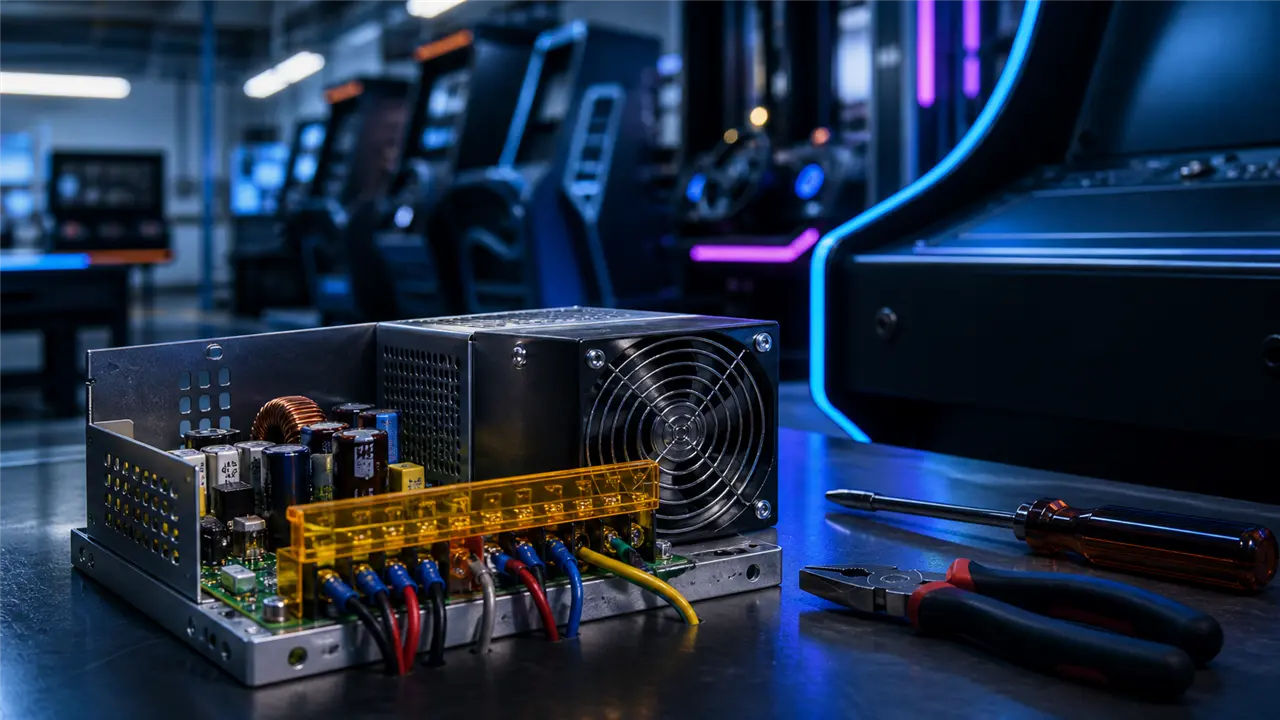
To understand how we secure our arcade cabinets at the factory level, you must understand the difference between pulse integration and serial communication protocols. Both are widely used in the global amusement market, but they require vastly different engineering approaches to make them secure against theft.
Pulse integration relies on a simple concept where the bill validator sends a specific number of electrical pulses to the game board for every unit of currency inserted. For example, inserting a five-dollar bill might send five distinct 50-millisecond 5V pulses to the IO board. While pulse systems are nearly universal and easy to repair, they are extremely susceptible to interference. If a wire is exposed, a thief can literally tap a battery against the wire to rack up credits.
Serial protocols, such as ccTalk, ID003, or RS232, transmit data as a continuous stream of digital packets rather than simple voltage drops. When a player inserts a ten-dollar bill into an MEI or ICT validator utilizing serial communication, the validator sends an encrypted packet of data containing the denomination, the bill security status, and a checksum. The game board must verify this checksum before awarding credits. Serial communication is inherently more secure against EMP attacks and manual pulse fishing because random electromagnetic noise cannot accidentally recreate a perfectly formatted, checksum-validated data packet.
However, moving to serial protocols requires advanced PCB design and software support on the game board. At Arcade Manufacturer, we offer both solutions depending on client budget and regional requirements, but our engineering team always applies military-grade isolation techniques regardless of the chosen protocol.
Factory Grade Shielding and Signal Cross Talk Prevention
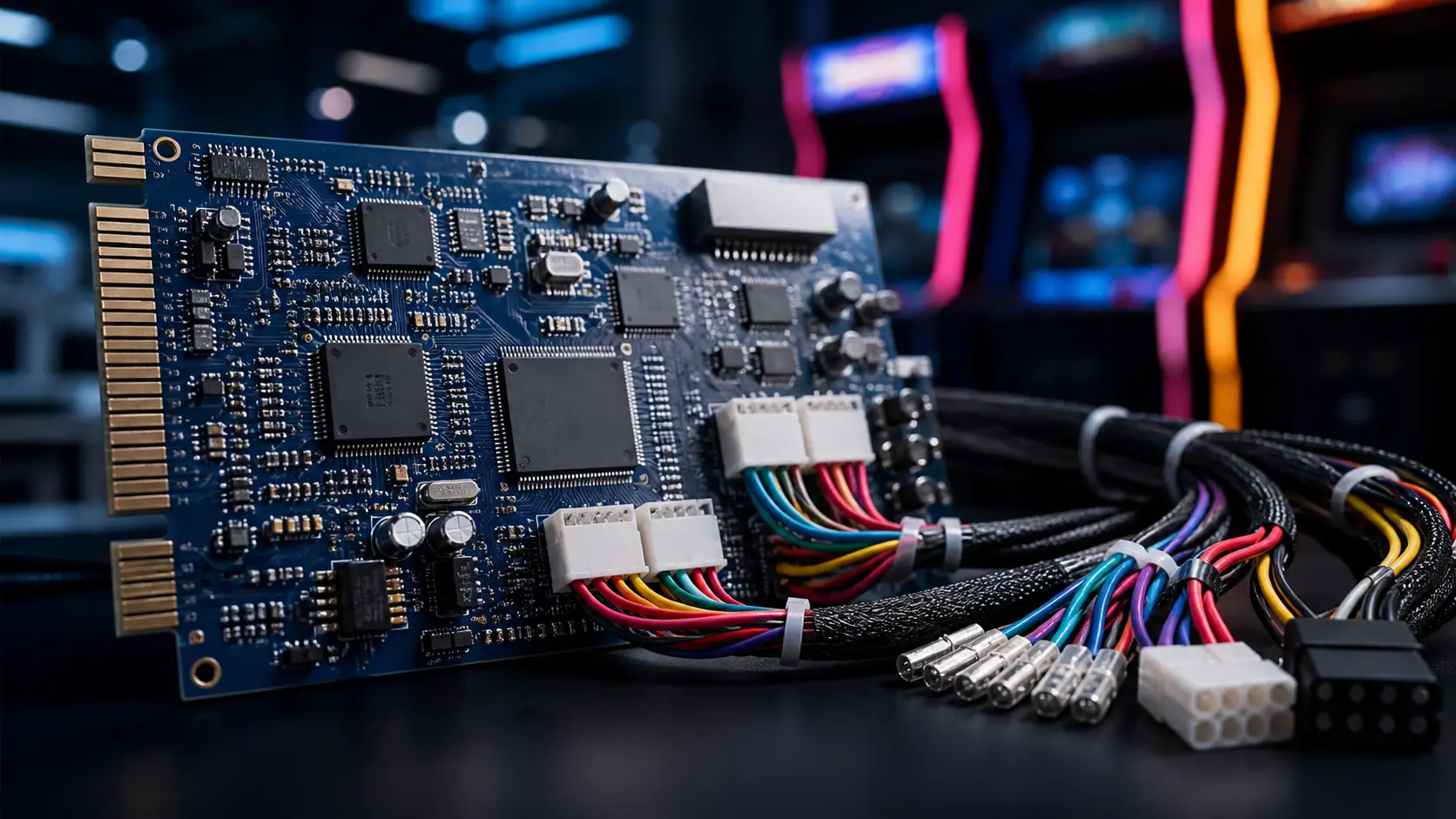
In our Panyu manufacturing facility, we implement a multi-layered defense strategy for arcade bill validator integration to ensure operator profitability and zero downtime during peak operating hours. We do not rely on hope; we rely on physics and electrical engineering.
Our first line of defense is the implementation of high-speed optocouplers on all input and output lines. We use industrial-grade PC817 or similar optical isolation ICs between the external payment peripherals and the core game board microprocessor. An optocoupler transmits the credit signal using light across a physical gap inside the chip. Because there is no direct electrical connection between the bill validator line and the CPU logic line, a massive voltage surge from an EMP device will simply burn out the cheap, replaceable optocoupler rather than frying the expensive main game board or registering false credits.
Next, we address the wiring harnesses. We utilize twisted-pair cabling with braided copper shielding for all logic connections extending from the bill acceptor and coin hopper. The twisted pair geometry inherently cancels out electromagnetic interference from adjacent high-current wires. We physically route the low-voltage logic harnesses on the opposite side of the cabinet chassis away from the switching power supplies and hopper motors.
Ground loops are another critical point of failure. A ground loop occurs when there are multiple paths to ground, creating an antenna effect that picks up stray electrical noise. We enforce a star grounding topology inside every metal cabinet. All peripheral grounds tie back to a single, heavy-duty grounding terminal, which is bonded directly to the earth ground of the AC mains. This ensures that any static discharge from a player or malicious RF interference is shunted safely to the earth, protecting the integrity of the credit signal.
Ready to upgrade your arcade floor with custom-developed, secure game boards and cabinets? Request our technical whitepaper on anti-cheat hardware architecture by emailing miba515527@gmail.com today.
Securing the Coin Hopper and Payout Mechanisms

The coin hopper is the bank vault of your arcade machine. It physically holds your profit margins in the form of tokens or quarters. An unsecured hopper is just as dangerous as an unsecured bill validator, and factory-level coin hopper integration requires specific mechanical and electrical safeguards.
One common exploit is hopper stringing or fishing, where a player uses a thin wire to manipulate the optical exit sensor of the hopper, tricking the machine into thinking it hasn’t dispensed the correct amount of coins. To combat this, we use dual-sensor verification and physical anti-fishing baffles in the coin chute. If the hopper motor turns but the sensors do not detect a coin exiting in the correct sequence, or if the sensor is blocked for an extended period, our system instantly cuts power to the hopper motor and throws an error code on the operator screen. This prevents the hopper from continuously running and dumping its entire contents into the payout tray.
Motor overload protection is another standard feature in our hardware design. If a bent coin jams the hopper disc, the DC motor will draw excessive current, which can burn out the motor windings or blow the control transistor on the IO board. We integrate PTC resettable fuses and current-sensing circuitry. If the current draw spikes above a safe threshold, the system halts the motor, briefly reverses it to attempt to clear the jam, and then tries again. If it fails three times, it safely shuts down and alerts the attendant, saving the operator the cost of a replacement hopper.
Furthermore, we integrate solid-state relays with zero-crossing detection to control the high-current hopper motors. This prevents the massive inductive kickback voltage that occurs when a DC motor is abruptly turned off. Without this flyback protection, that voltage spike can ripple through the power supply and cause a CPU reset or signal cross talk on the bill validator lines.
ROI and Financial Impact for Arcade Operators
Venue operators must understand that spending a few extra dollars on proper arcade bill validator integration pays for itself immediately upon deployment. When you operate a machine with a 95% RTP, every false credit stolen represents pure profit lost. Let us examine the commercial viability and return on investment of our factory-grade hardware versus typical budget assembly.
| Metric | Budget Unshielded Assembly | Miba Factory Grade Integration |
|---|---|---|
| Hardware Cost | Low | Moderate |
| EMP Vulnerability | Extremely High (Loss of $100+ per attack) | Zero (Optically isolated and shielded) |
| Friday Night Downtime | High (Frequent bill jams and board resets) | Near Zero (Stable voltage and filtered logic) |
| Expected Machine Lifespan | 1 to 2 Years | 5 to 8 Years |
| Maintenance Call Costs | High ($150+ per technician visit) | Low (Self-diagnosing error codes) |
| Actual RTP Yield | Inconsistent (Stolen credits inflate payout) | Mathematically Stable (Maintains 92-96% draw) |
| Estimated Operator ROI | Slow (Profits bleed to theft and downtime) | Fast (3 to 6 months payback period) |
By eliminating theft via EMP and preventing logic board damage, our machines ensure that the money inserted by the player remains in your cash box. The upfront CAPEX (Capital Expenditure) might be slightly higher for a properly shielded harness and isolated IO board, but the OPEX (Operational Expenditure) is drastically reduced. You save on replacement parts, technician labor, and most importantly, you preserve the integrity of your game’s mathematical model.
Our Factory Acceptance Testing and QA Checklist
Before any arcade cabinet or custom game board leaves our Panyu manufacturing base, it must pass a rigorous Factory Acceptance Testing (FAT) protocol. We do not let clients discover hardware bugs on their casino or arcade floors. We catch them in our lab. Here is a look at our standardized testing protocol for payment peripherals.
1. Power Supply Ripple Verification We measure the 5V and 12V rails using a digital oscilloscope to ensure voltage ripple remains below 50mV under full hopper motor load. 2. High Frequency Interference Stress Test We subject the coin door and bill validator bezel to localized electromagnetic interference generated by testing wands to verify that no false credits are logged. 3. Optocoupler Isolation Validation We induce a 1000V spike on the external validator pulse line to confirm that the optical isolator successfully sacrifices itself while protecting the main CPU. 4. Serial Protocol Handshake Audit For ccTalk and RS232 integrations, we capture the data packets to ensure checksums are being calculated and validated properly with zero packet loss. 5. Coin Hopper Jam Simulation We intentionally insert deformed test coins to trigger the motor jam sequence, verifying that the auto-reverse and over-current protection mechanisms engage within 500 milliseconds. 6. Anti Fishing Sensor Calibration We attempt to block the optical exit sensors with transparent and opaque materials to ensure the anti-cheat logic throws the correct error codes. 7. Ground Continuity Check We verify that the resistance between the coin door, cabinet chassis, and AC earth ground is less than 0.1 ohms to prevent ground loops. 8. Temperature Cycle Testing We run the payment peripherals in a 45°C environmental chamber for 24 hours to ensure continuous reliable operation without thermal throttling. 9. Bill Acceptance Rate Audit We feed a mixture of crisp, wrinkled, and slightly soiled currency to verify the validator maintains a first-pass acceptance rate of over 95%. 10. Drop Box Security Inspection We test the physical locking mechanisms and anti-pry bars on the cash box enclosures to ensure physical security matches electronic security. 11. Software State Recovery We simulate sudden power loss during a payout event to verify that the game software correctly remembers the owed credits upon reboot. 12. Final Operator Sign Off We record a continuous video of the final testing phase, which is sent directly to the buyer for approval before the unit is packaged for shipping.
Arcade Troubleshooting Table for Payment Systems
Even with military-grade hardware, operators may occasionally face environmental issues or wear-and-tear. I have compiled this quick-reference troubleshooting table based on my 12 years of resolving field issues for our global clients.
| Symptom | Probable Cause | Engineer Wang Factory Solution |
|---|---|---|
| Bill validator rejects all bills | Dirty optical sensors or misaligned bezel | Open the validator head, clean sensors with isopropyl alcohol. Verify 12V power supply rail is not dipping. |
| Game registers multiple credits for one coin | Pulse line bouncing or missing pull-up resistor | Check the wiring harness for proper shielding. Add a 10k pull-up resistor or replace the debouncing capacitor on the IO board. |
| Coin hopper motor runs continuously | Shorted control transistor or blocked optical sensor | Inspect hopper exit path for debris. If clear, replace the TIP120/TIP122 Darlington transistor on the main control board. |
| Machine credits up during a static shock | Poor earth grounding or ground loop | Verify the green/yellow earth wire is securely bolted to the metal coin door and the AC wall outlet is properly grounded. |
| Bill validator accepts bills but no credits appear | Blown optocoupler or broken logic wire | Use a multimeter to check continuity on the credit pulse wire. If wire is good, replace the PC817 optocoupler IC on the game board. |
| Serial validator displays communication error | Baud rate mismatch or loose data cable | Enter the operator menu and verify the baud rate (e.g., 9600 bps) matches the dip switch settings on the validator. Reseat RX/TX cables. |
Related Engineering References and Floor Operational Guides
- For our comprehensive factory production standards, review our China arcade machine manufacturer sourcing framework.
- To inspect our physical facility, see our Guangzhou arcade game factory sourcing guide.
- Analyze component BOM pricing with our arcade machine manufacturing cost breakdown.
- Compare direct cabinet pricing in our fish table wholesale manufacturer pricing guide.
Frequently Asked Questions
Which bill validator protocol is better for high volume arcades?
For high-volume locations where security is paramount, serial protocols like ccTalk or RS232 are vastly superior. They provide encrypted, two-way communication that reports exact denominations, error states, and cash box full alerts directly to the operator dashboard, whereas pulse systems are strictly one-way and easier to manipulate.
How do you prevent EMP devices from resetting the game board?
We prevent EMP resets by implementing strict galvanic isolation. We use isolated switching power supplies (such as Mean Well LRS series), optical isolators on all input lines, and heavy-gauge chassis grounding. The electromagnetic energy is routed harmlessly to earth ground before it can reach the sensitive CPU logic.
Can I upgrade my existing arcade machines with your isolated IO boards?
Yes. Our custom game boards and JAMMA interface harnesses are designed with standard form factors. You can swap out a cheap, vulnerable IO board with our optically isolated, factory-grade boards to immediately secure your existing fleet of cabinets without needing to replace the entire machine.
What causes a coin hopper to short out and how do you fix it?
Coin hoppers usually short out due to motor jams causing excessive current draw, or inductive voltage spikes when the motor stops. We fix this at the design level by using heavy-duty solid-state relays, flyback diodes to clamp voltage spikes, and PTC resettable fuses that cut power before permanent damage occurs.
How quickly can a venue operator expect a return on investment with your hardware?
Because our hardware prevents direct cash theft via exploits and eliminates the costly Friday night downtime caused by cheap components, most operators see a full return on their CAPEX difference within 3 to 6 months. A machine that stays online and protects its 95% RTP draw generates consistent, predictable revenue.
Are you ready to stop losing money to hardware exploits and cheap wiring? Partner with a true factory that understands the engineering behind profitable arcade operations. Contact Engineer Wang directly via WhatsApp at +86 17620842078 or email miba515527@gmail.com to schedule a video tour of our Panyu manufacturing base and discuss your custom arcade project.