- Technical Comparison Matrix Table Proprietary Source Code Ownership vs Turnkey White-Label SaaS vs Third-Party API Game Aggregators
- Game Engine Selection and Graphics Rendering Pipelines in Unity and WebGL
- Dynamic RTP Calibration Odds Volatility Modeling and GLI 19 RNG Compliance
- Multi Tenant White Label Lobby Architecture and Hot Updatable Sub Game Microservices
- Telegram Mini App Development TON Blockchain Wallets and Viral Bot Ecosystems
- Provably Fair Cryptographic Algorithms for Crash Games and Physical Plinko Drops
- Source Code Due Diligence Uncompiled Code Deliverables and IP Handover Protocols
- Frequently Asked Questions
Welcome to the definitive architectural, operational, and commercial blueprint for custom casino game development white label software and source code acquisition. For iGaming startup founders, casino group technical directors, and high-volume software distributors, evaluating the precise entry vehicle into the real-money or social sweepstakes ecosystem is the single most critical infrastructural decision. This comprehensive guide exhaustively unpacks the strategic differentials between embarking on custom proprietary development, launching through a turnkey white-label licensing SaaS platform, or executing an outright source code buyout to achieve total intellectual property sovereignty. We will rigorously explore the profound technological implications of each model, specifically targeting high-performance environments that require seamless cross platform html5 sweepstakes games integration, custom sweepstakes slot source code manipulation, and the rapidly ascending paradigm of telegram mini app casino games.
When operators decide to buy turnkey online casino source code or invest heavily in custom crash game development, they are not merely purchasing software; they are inheriting an underlying mathematics engine, an architectural scalability ceiling, and a regulatory compliance posture. The iGaming landscape has evolved far beyond monolithic server architectures. Today, competitive advantage is forged in the granular details of sub-game microservices deployment, dynamic asset loading in Unity and WebGL, cryptographic provably fair validation, and ultra-low latency websocket communication for real-time multiplayer engagements. Furthermore, operators looking to control their own destiny require uncompiled custom slot game unity source code to bypass aggressive third-party revenue share models and instantiate bespoke mathematical volatility profiles tailored to specific regional demographics. For factory-direct procurement and comprehensive engineering specs, consult our master guide on custom arcade game software studio engineering.
This deep-dive technical exposition will dissect the core rendering engines, server-side backends, random number generation topologies, and structural code due diligence necessary to launch a globally competitive platform. From understanding the rigorous requirements of GLI 19 compliance to deploying decentralized Telegram bot ecosystems on the TON blockchain, we provide the ultimate technical roadmap for securing total platform dominance.
Technical Comparison Matrix Table Proprietary Source Code Ownership vs Turnkey White-Label SaaS vs Third-Party API Game Aggregators
Choosing the optimal deployment architecture fundamentally dictates a platform’s long-term profitability, structural flexibility, and scalability. The following matrix rigorously compares the three predominant deployment models across crucial architectural, operational, and financial dimensions.
| Metric | Proprietary Source Code Buyout | Turnkey White Label SaaS | Third Party API Aggregator |
|---|---|---|---|
| **Architecture Topology** | Fully isolated sovereign infrastructure. Hosted on dedicated bare metal or private cloud VPCs. Maximum security and horizontal scaling control. | Multi-tenant shared infrastructure. Cloud instances managed by the provider. Vulnerable to noisy neighbor resource starvation during peak loads. | Headless integration via REST/WebSocket. The operator manages the front-end lobby while games stream from remote vendor servers. |
| **Code Modifiability** | Total access to uncompiled Unity/C# and Node.js/Go backend code. Infinite capacity for bespoke game logic and custom crash game development. | Zero source code access. Superficial front-end branding via CSS or predefined CMS templates. No mechanical game alterations possible. | No code access. The operator simply consumes an iframe or direct stream URL with predefined parameters. |
| **Revenue Mechanics** | 100% Gross Gaming Revenue retention. Zero ongoing royalty obligations. High initial capital expenditure but unmatched long-term ROI. | High ongoing GGR revenue share (typically 10-25%) paid to the provider, plus monthly maintenance and licensing fees. | Significant revenue share (10-20%) paid per vendor, often complicated by minimum monthly guarantees and complex tiering. |
| **Regulatory Compliance** | Operator holds the intellectual property and must secure proprietary RNG certifications (e.g., GLI 19, BMM Testlabs) under their own corporate entity. | Provider holds the overarching license and certifications. The operator essentially operates as a sub-licensee under the master umbrella. | The aggregator handles game certifications. Operator only needs a platform license to accept bets and process KYC/AML. |
| **Asset Deployment** | Total control over CDN pipelines, asset bundling strategies, and dynamic WebGL memory management for localized markets. | Constrained to the provider’s global CDN structure. Limited ability to optimize loading times for specific high-latency geographical zones. | Provider manages all asset delivery. Operator is entirely dependent on the third-party infrastructure reliability. |
| **Database Ownership** | Operator owns the absolute root database. Direct access to raw transactional data, player behavioral metrics, and unencrypted audit logs. | Provider holds the master database. Operator accesses filtered player data via API or back-office dashboard. Total vendor lock-in. | Aggregator only tracks transactional bet/win data. Operator owns the player wallet but lacks deep in-game behavioral analytics. |
| **Ecosystem Integration** | Limitless API integrations. Ability to natively embed Telegram mini app casino games, custom crypto gateways, and bespoke CRM toolchains. | Restricted to the provider’s pre-integrated suite of payment gateways and marketing tools. New integrations require provider approval. | Highly flexible wallet integration (Seamless Wallet API) but limited ability to alter the in-game UI/UX experience. |
| **Exit Strategy Valuation** | Massive enterprise valuation multiple. The source code and infrastructure are tangible assets that can be acquired by larger conglomerates. | Low valuation multiple. The primary asset is merely the player database, as the underlying technology remains the property of the SaaS provider. | Moderate valuation based solely on active player base and brand equity, heavily discounted by the dependency on external API contracts. |
Game Engine Selection and Graphics Rendering Pipelines in Unity and WebGL
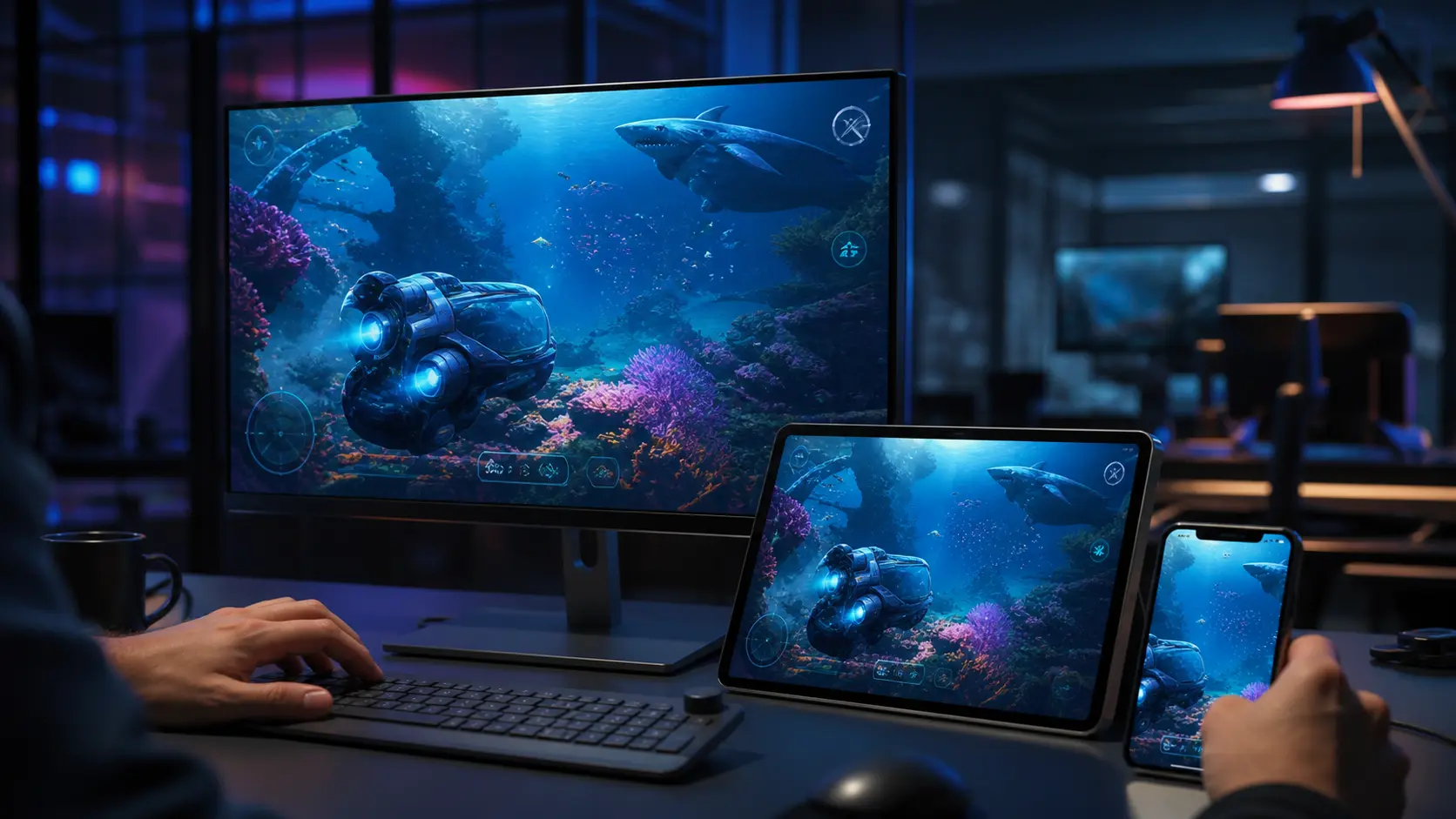
The foundation of any high-tier custom casino game development initiative rests upon the judicious selection of the front-end rendering engine and the architectural design of its graphics pipeline. In the contemporary iGaming sector, the demand for cross platform html5 sweepstakes games necessitates a rendering framework capable of delivering near-native performance across a vastly fragmented ecosystem of mobile browsers, desktop environments, and embedded web views. Unity and pure WebGL frameworks (such as PixiJS or Phaser) represent the two dominant paradigms, each carrying profound implications for memory management, payload optimization, and visual fidelity.
When operators decide to buy turnkey online casino source code or invest in custom slot game unity source code, they are leveraging an engine that has essentially monopolized the high-fidelity 3D and complex 2D slot market. Unity’s Universal Render Pipeline (URP) allows technical artists to author highly optimized shaders that scale dynamically based on the target device’s GPU capabilities. In a slot game context, where particle systems for big wins and complex spine animations for character symbols run concurrently, Unity’s underlying C# scripting and entity component system (ECS) provide deterministic execution. However, compiling Unity to WebGL for browser-based play requires rigorous asset optimization. Developers must implement addressable asset systems, allowing the core engine (often weighing 3-5MB compressed) to load first, followed by granular asynchronous downloading of specific game assets, audio banks, and high-resolution textures only when they are required by the game state. This minimizes the initial time-to-interactive (TTI) metric, which is crucial for player retention in mobile environments.
Conversely, for ultra-lightweight deployments such as custom crash game development or classic table games where 3D physics are not heavily utilized, pure WebGL frameworks offer unparalleled payload efficiency. Tools like PixiJS directly interface with the browser’s WebGL API, bypassing the overhead of a massive monolithic engine. This results in initial bundle sizes under 1MB, ensuring instantaneous loading even on degraded 3G networks. In these environments, the rendering loop is tightly coupled with the WebSocket binary frame updates from the server. The front-end acts merely as a dumb terminal, interpolating position, rotation, and scale data pushed from the authoritative backend tick rate. This approach is highly favored in the development of lightweight cross platform html5 sweepstakes games, where the primary objective is maximum accessibility across low-end Android devices prevalent in emerging markets.
The architectural choice between Unity and pure WebGL also profoundly affects the deployment of custom sweepstakes slot source code. Unity projects require a more sophisticated build pipeline, often involving automated CI/CD processes running on Jenkins or GitHub Actions to compile separate builds for Android (APK/AAB), iOS, and WebGL. Furthermore, memory management in Unity WebGL is historically challenging; developers must carefully manage the garbage collector (GC) to avoid micro-stutters during gameplay. WebGL frameworks, executing in pure JavaScript or TypeScript, rely heavily on the browser’s V8 engine optimizations and require strict object pooling patterns to maintain a steady 60 frames per second (FPS). Ultimately, acquiring source code gives the technical director the absolute freedom to rewrite rendering pipelines, strip unnecessary engine modules, and achieve bespoke performance profiles that off-the-shelf white-label solutions simply cannot match.
Dynamic RTP Calibration Odds Volatility Modeling and GLI 19 RNG Compliance

The absolute core of any real-money or sweepstakes gaming operation is its mathematical integrity. The engine that dictates the Return to Player (RTP), models the variance (volatility), and guarantees cryptographic randomness is the most critical asset in custom casino game development. Off-the-shelf turnkey white-label software typically obscures these mathematical mechanics behind a compiled black box, offering operators only superficial configuration options (e.g., selecting between 94%, 96%, or 98% RTP profiles). However, possessing the custom sweepstakes slot source code grants the operator profound, low-level control over the par sheets, probability weightings, and the underlying Random Number Generator (RNG) algorithms, which are strictly regulated by standards such as GLI 19.
Dynamic RTP calibration and odds volatility modeling require sophisticated server-side architectures. In a proprietary setup, the slot machine’s mathematics are defined by intricate virtual reel strips and weight tables. When a player presses ‘Spin’, the server-side logic requests a cryptographic payload from the RNG service. This RNG service must utilize a hardware entropy source (such as `dev/urandom` on Linux or a dedicated Hardware Security Module) mixed with environmental noise to produce a totally unpredictable 256-bit integer. This raw random number is then mapped through a modulo operation to select the specific stops on the virtual reels. In high-volatility custom slot game unity source code, the weight tables are heavily skewed towards non-winning combinations or low-tier wins, while containing exceptionally rare but massive multiplier nodes. Conversely, low-volatility models distribute wins evenly, keeping the player’s bankroll stable over longer sessions.
GLI 19 compliance (Gaming Laboratories International) mandates rigorous architectural separation and auditability. To achieve certification, the RNG must be a strictly isolated microservice that does not contain any game logic or player state data. It must solely respond to secure RPC calls with mathematically pure random numbers. Furthermore, the source code must demonstrate that the RNG cannot be influenced by the player’s bet size, current balance, or past winning history. The state of the RNG must be periodically re-seeded and extensively logged in immutable audit trails. When purchasing turnkey online casino source code, technical due diligence must rigorously inspect the RNG implementation. Is it using a cryptographically secure pseudo-random number generator (CSPRNG) like Fortuna or Yarrow? Are the mapping algorithms mathematically sound, avoiding modulo bias that could slightly skew the distribution of outcomes over millions of spins?
Beyond standard RNG, custom crash game development introduces unique volatility modeling challenges. The crash multiplier curve is not generated via a par sheet but through a continuous mathematical decay function powered by an initial server seed. The server must calculate the specific crash point instantly upon game initialization and then securely hash this point. The front-end client simply interpolates the visual graph upward until it hits the predetermined crash value. Designing the mathematical model for a crash game requires balancing the house edge (typically 1-3%) with the psychological excitement of seeing a multiplier scale exponentially. Total ownership of the source code allows data scientists to meticulously tweak the decay variables, inject custom jackpot trigger mechanics, and ensure that the statistical distribution of crash points perfectly aligns with the target demographic’s risk appetite and behavioral economics.
Multi Tenant White Label Lobby Architecture and Hot Updatable Sub Game Microservices

For large-scale B2B software distributors and multi-brand casino operators, a monolithic backend architecture is an unacceptable bottleneck. The modern standard for custom casino game development white label software demands a highly scalable, multi-tenant microservices architecture orchestrated via Kubernetes or Docker Swarm. This architectural paradigm allows a single core infrastructure to simultaneously power dozens of distinct casino brands, sweepstakes platforms, and telegram mini app casino games ecosystems, each with their own unique databases, API gateways, and customized front-end lobbies, while sharing the identical underlying game engines and transaction ledgers.
The multi-tenant architecture relies heavily on domain-driven design and rigid data partitioning. When a request hits the API gateway, a tenant resolution middleware analyzes the incoming domain, origin header, or unique API key to identify the specific operator. All subsequent database queries, Redis cache lookups, and Kafka event streams are strictly segregated using tenant IDs. This ensures complete data isolation; Player A on Casino Brand X has absolutely no overlap with Player B on Casino Brand Y, even though both are executing transactions on the identical underlying custom sweepstakes slot source code backend. Furthermore, the lobby microservice dynamically serves different configurations, localized JSON language packs, and bespoke CSS styling based on the resolved tenant, rendering an entirely unique brand experience from a unified codebase.
A critical requirement in this ecosystem is the implementation of hot-updatable sub-game microservices. In legacy monolithic platforms, updating a single slot game or deploying a new iteration of a custom crash game required a full platform restart, leading to unacceptable downtime and lost gross gaming revenue. A modern, service-oriented architecture isolates every individual game or game category into its own independent containerized process. These sub-game microservices communicate with the central player wallet and accounting ledger via high-speed, asynchronous message brokers like RabbitMQ or Apache Kafka, utilizing robust two-phase commit protocols or saga patterns to ensure transactional integrity even in the event of a microservice crash during a spin.
Possessing the uncompiled source code empowers technical teams to implement seamless CI/CD deployment pipelines. New cross platform html5 sweepstakes games can be pushed to the registry and automatically deployed as new pods within the Kubernetes cluster. The load balancer dynamically routes traffic to the newly spun-up game instances without dropping a single active websocket connection. This hot-swappable architecture allows for a continuous integration of new mathematics models, UI tweaks, and promotional overlays without disrupting the 24/7 operation of the master platform. When evaluating a source code buyout, inspecting the Dockerfiles, Kubernetes manifests, and gRPC communication protocols is paramount to verify that the platform truly supports granular, zero-downtime microservice orchestration, rather than simply masquerading a decoupled monolith.
Telegram Mini App Development TON Blockchain Wallets and Viral Bot Ecosystems
The integration of iGaming into decentralized messaging platforms represents the most explosive growth vector in contemporary custom casino game development. Specifically, the Telegram Mini App ecosystem, tightly coupled with the TON (The Open Network) blockchain, has revolutionized user acquisition, dramatically lowering the cost per acquisition (CPA) by bypassing traditional app store restrictions and leveraging inherent viral mechanics. Developing telegram mini app casino games requires a profound architectural pivot from traditional browser-based deployments, demanding specialized authentication flows, headless UI/UX optimization, and deep cryptographic wallet integrations.
A Telegram Mini App (TMA) is essentially a web application loaded within Telegram’s internal web view interface. However, the development lifecycle differs significantly from standard cross platform html5 sweepstakes games. Authentication is seamlessly handled via the Telegram `initData` payload. When a user launches the casino bot, the Telegram client cryptographically signs a string containing the user’s ID, username, and premium status. The backend server verifies this signature using the bot’s private token, instantly authenticating the user without requiring a password, KYC form, or email verification. This frictionless onboarding is a massive conversion catalyst. The source code architecture must be specifically designed to parse and validate this `initData` securely, mitigating any risks of replay attacks or payload tampering.
Integrating the TON blockchain elevates the Telegram casino ecosystem from a mere social game to a fully decentralized financial platform. Custom casino game development in this space involves building non-custodial wallet connections using libraries like TON Connect. Players can instantly deposit Toncoin (TON), USDT, or bespoke project tokens directly from their internal Telegram Wallet or external applications like Tonkeeper. The backend architecture must feature robust blockchain indexers that monitor specific smart contract addresses for incoming transactions. Once a deposit is confirmed on the TON ledger, the player’s internal off-chain casino balance is credited instantly. Conversely, withdrawals are executed by the server signing a transaction and broadcasting it to the TON network via remote procedure calls (RPC). Total ownership of the source code allows developers to write custom smart contracts, implement automated liquidity pools, and launch proprietary utility tokens that power the internal game economy.
Furthermore, leveraging viral bot ecosystems requires sophisticated backend mechanics. Telegram bots are not just entry points; they are automated CRM systems. The backend must integrate deeply with the Telegram Bot API to send localized push notifications, automated bonus drops, and interactive inline keyboards directly into the user’s chat interface. This involves building asynchronous task queues (e.g., using Celery or BullMQ) to handle massive broadcast campaigns to millions of subscribers simultaneously without hitting API rate limits. Additionally, implementing referral systems and multi-tier affiliate hierarchies within the Telegram bot logic is crucial for organic growth. When acquiring turnkey online casino source code with Telegram capabilities, operators must rigorously verify the scalability of the bot worker processes, the security of the webhook endpoints, and the robustness of the TON blockchain synchronization layers.
Provably Fair Cryptographic Algorithms for Crash Games and Physical Plinko Drops
In the modern landscape of high-stakes custom casino game development, particularly within the crypto-casino demographic, traditional RNG certifications (like GLI) are often deemed insufficient by a deeply skeptical, mathematically literate player base. The paradigm has shifted towards “Provably Fair” cryptography—a deterministic, zero-trust system that allows players to independently verify that the game’s outcome was generated prior to their bet and was not manipulated during execution. Implementing provably fair algorithms is absolutely mandatory for custom crash game development, Plinko drops, dice, and custom sweepstakes slot source code targeting the Web3 ecosystem.
The architecture of a provably fair system relies on cryptographic hashing functions, predominantly SHA-256 or HMAC-SHA256. Before a round begins, the server generates a cryptographically secure random sequence known as the `Server Seed`. Crucially, the server does not reveal this seed; instead, it hashes the seed (often multiple times in a hash chain) and publicly displays the resulting `Server Seed Hash` to the players. This hash acts as an immutable mathematical commitment. The server cannot change the underlying `Server Seed` without completely altering the publicized hash, thereby locking in the game’s predetermined outcome.
To introduce player entropy and ensure the server cannot simply generate a seed that benefits the house based on current wagers, a `Client Seed` is introduced. This is an arbitrary string provided by the player or generated by their browser. Finally, a `Nonce` (a sequential number incrementing with each bet) is utilized to prevent duplicate outcomes. The final game result is generated by concatenating the unhashed `Server Seed`, the `Client Seed`, and the `Nonce`, and passing this string through a deterministic algorithmic function. For instance, in custom crash game development, the resulting hexadecimal hash is converted into a floating-point number, which is then mapped against a specific mathematical formula (often involving the house edge variable) to calculate the exact crash multiplier.
Total ownership of the uncompiled source code is the only way to genuinely implement and audit these provably fair mechanics. When evaluating a source code buyout, a technical director must meticulously trace the cryptographic pipeline. Are the server seeds being generated securely? Is the hash chain logic robust and resistant to brute-force reverse engineering? Most importantly, does the platform provide an intuitive, open-source verification script (often written in Python or JavaScript) that players can run locally to mathematically prove the integrity of their past bets? In complex games like Plinko, the provably fair algorithm must deterministically map a single cryptographic hash to a precise sequence of left/right physical bounces down the pegboard. This requires a profound integration between the backend cryptographic engine and the front-end Unity or WebGL physics simulation, ensuring absolute synchronicity between the mathematical calculation and the visual representation.
Source Code Due Diligence Uncompiled Code Deliverables and IP Handover Protocols
Executing a multi-million dollar buyout of custom casino game development white label software or buying turnkey online casino source code requires an uncompromising, highly structured technical due diligence process. Acquiring source code is not simply transferring a zip file; it involves inheriting a complex web of dependencies, build pipelines, cryptographic key management strategies, and intellectual property liabilities. Failure to execute a rigorous IP handover protocol can leave an operator with millions of lines of uncompilable code, hidden backdoors, or critical architectural flaws that severely bottleneck future scalability.
The first phase of source code due diligence is an exhaustive architectural audit and repository inspection. The buyer’s technical team must demand read-only access to the vendor’s Git repositories (GitHub, GitLab, or Bitbucket) prior to final financial settlement. The audit must verify that all code deliverables are genuinely uncompiled and deeply documented. For custom slot game unity source code, this means access to the raw `.cs` scripts, uncompressed `.prefab` assets, high-resolution `.psd` graphic files, and raw `.spine` animation data. For the backend, it means full access to the Golang, Node.js, or Java services, database schemas (SQL DDL and migration scripts), and infrastructure-as-code (IaC) templates such as Terraform configurations or Helm charts. A massive red flag during this phase is the presence of compiled `.dll` files, obfuscated binaries, or heavy reliance on undocumented third-party APIs that the vendor controls, which effectively negates the entire purpose of a source code buyout.
The second critical component is a comprehensive security audit and dependency vulnerability assessment. The codebase must be scanned using advanced Static Application Security Testing (SAST) and Dynamic Application Security Testing (DAST) tools. Auditors must look for hardcoded cryptographic keys, SQL injection vulnerabilities, cross-site scripting (XSS) vectors in the front-end cross platform html5 sweepstakes games, and any potential backdoors or administrative overrides that could allow the original vendor to manipulate player balances or alter RNG outcomes post-handover. Furthermore, the dependency tree (npm, NuGet, pip, Maven) must be rigorously analyzed to ensure there are no copyleft licenses (such as GPL) that could legally compel the buyer to open-source their proprietary modifications. The ideal codebase operates primarily on permissive licenses like MIT or Apache 2.0.
Finally, the IP handover protocol must be legally and technically airtight. This involves transferring ownership of all cloud infrastructure (AWS, GCP, Azure) accounts, domain names, SSL certificates, and third-party developer accounts (Apple App Store, Google Play Console). The vendor must provide comprehensive, up-to-date documentation detailing the complete CI/CD deployment pipeline, disaster recovery protocols, and database restoration procedures. A mandatory transitional period should be enforced, during which the vendor’s lead engineers actively assist the buyer’s technical team in successfully compiling the system from scratch, deploying it to a fresh staging environment, and running automated integration tests. Only when the buyer’s team can autonomously modify a line of game logic, build the executable, and deploy it successfully to production without any vendor intervention should the final financial escrow be released.
Frequently Asked Questions
Question What is the technical distinction between a White Label Casino and a Turnkey Source Code solution?
A white-label solution is a multi-tenant SaaS deployment where the operator merely rents the software, utilizing superficial frontend branding while the provider retains absolute control over the server logic, game engines, and underlying intellectual property. A turnkey source code solution implies a complete buyout where the operator receives all uncompiled backend and frontend repositories (such as custom slot game unity source code). This grants the operator total autonomy to modify RNG algorithms, self-host the infrastructure on sovereign servers, and fully own the intellectual property without paying ongoing revenue shares or licensing fees.
Question How difficult is it to integrate Telegram Mini App Casino Games into an existing platform?
Integrating Telegram mini app casino games requires constructing a highly specialized authentication bridge. Traditional casino platforms rely on email/password or OAuth logins, whereas Telegram requires the backend to securely parse and cryptographically validate the Telegram `initData` payload using the bot’s secret token. Additionally, the frontend must be deeply optimized for the Telegram Web App embedded browser, requiring aggressive payload reduction, responsive UI adjustments, and seamless integration with the TON blockchain wallet API for frictionless cryptocurrency deposits and withdrawals directly within the chat interface.
Question What exactly is GLI 19 compliance, and why is it critical for custom casino game development?
GLI 19 (Gaming Laboratories International Interactive Gaming Systems) is an extremely rigorous technical standard that dictates how online casino software must be architected. It mandates strict separation of the Random Number Generator (RNG) microservice from core game logic, requires the use of cryptographically secure pseudo-random algorithms, and enforces comprehensive, immutable audit logging of every financial transaction and game state change. Achieving GLI 19 certification is absolutely mandatory for operators seeking to acquire licenses in tier-1 regulated jurisdictions (such as Malta, UK, or heavily regulated US states) and proves the mathematical integrity of the platform.
Question Can we develop Cross Platform HTML5 Sweepstakes Games without using the Unity engine?
Yes, absolutely. While Unity is the industry standard for complex 3D graphics and heavy particle systems, lightweight cross platform html5 sweepstakes games are frequently built using pure WebGL frameworks like PixiJS, Phaser, or Cocos Creator. These frameworks interface directly with the browser’s graphics API using JavaScript or TypeScript, resulting in significantly smaller bundle sizes (often under 2MB) and vastly superior initial load times. This architectural approach is highly recommended for platforms targeting emerging markets with low-bandwidth mobile networks and lower-end Android devices.
Question What are the core mechanics behind Provably Fair algorithms in Custom Crash Game Development?
Provably fair mechanics utilize cryptographic hashing (like SHA-256) to guarantee transparency. The server generates a random ‘Server Seed’ and publicly commits to its hash before the betting round begins. Players contribute a ‘Client Seed’. The game’s outcome (e.g., the exact crash multiplier) is deterministically calculated by combining the unhashed Server Seed, the Client Seed, and a sequential Nonce. Because the player has the hashed server seed in advance, they can use open-source verification scripts post-game to mathematically prove that the crash point was genuinely predetermined and not manipulated by the server during the active flight phase.
Question When executing a buyout, what uncompiled files are essential in the Custom Sweepstakes Slot Source Code?
A comprehensive IP handover must include absolutely all raw, uncompiled assets. For the frontend, this includes all `.cs` (C#) scripts, `.prefab` layout files, raw `.png` or `.psd` graphic layers, `.mat` (materials), and `.anim` or Spine animation data files. For the backend, it demands all uncompiled logic (e.g., `.go`, `.ts`, or `.java` files), database schema definitions (SQL scripts or ORM models), Dockerfiles, and Kubernetes YAML configurations. If any core logic is delivered as a compiled `.dll`, a minified JavaScript blob, or obfuscated bytecode, the buyer does not truly possess the source code.
Question How does a hot-updatable microservices architecture benefit high-volume casino operations?
In a legacy monolithic architecture, deploying a new game, patching a bug, or updating promotional configurations requires restarting the entire server application, resulting in platform-wide downtime, disconnected websocket sessions, and massive lost revenue. A hot-updatable microservices architecture, orchestrated via Kubernetes, encapsulates every distinct game engine, payment gateway, and lobby module into isolated, containerized pods. New versions can be deployed, scaled, and routed dynamically via advanced load balancers without disrupting any active player sessions on other games, achieving a true zero-downtime continuous integration (CI/CD) deployment pipeline.
Question What specific due diligence steps must be taken to secure IP sovereignty during a Source Code handover?
Technical due diligence must extend far beyond a simple code review. It necessitates rigorous Static and Dynamic Application Security Testing (SAST/DAST) to uncover hidden backdoors or critical vulnerabilities. A comprehensive dependency audit is required to ensure no viral copyleft licenses (like GPL) exist that could compromise the proprietary nature of the code. Legally, the handover protocol must include the complete transfer of all associated cloud infrastructure accounts, domain registrars, SSL certificates, and CI/CD pipeline access. Finally, a mandatory technical transition period should ensure the buyer’s engineering team can successfully compile and deploy the software onto fully sovereign, bare-metal infrastructure without any reliance on the vendor’s remote servers.
To elaborate on the architectural topology, a proprietary source code buyout allows the operator to bypass the traditional virtualized environments often enforced by white-label providers. Instead of relying on shared hypervisors, an operator can deploy custom casino game development solutions directly onto bare-metal Kubernetes clusters (e.g., using Talos Linux or custom Rancher deployments). This raw metal approach eliminates hypervisor overhead, drastically reducing latency for ultra-high-frequency interactions typical in custom crash game development. When thousands of players are simultaneously broadcasting WebSocket messages to cash out during a crash game’s exponential curve, even a 5-millisecond delay introduced by a shared cloud environment can result in widespread player dissatisfaction and perceived unfairness. Total source code ownership permits kernel-level optimizations, such as tuning TCP congestion algorithms (BBR) and maximizing epoll/kqueue event loop efficiency in the Node.js or Golang backend.
Furthermore, regarding revenue mechanics and compliance, the integration of custom sweepstakes slot source code in a completely sovereign environment transforms the financial model. Rather than relinquishing a constant gross gaming revenue (GGR) share, the operator absorbs the upfront capital expenditure of server infrastructure and mathematical audits. This model necessitates a robust internal DevOps team to manage the scaling of the cross platform html5 sweepstakes games. The regulatory compliance burden also shifts entirely. The operator must independently engage with certification labs (GLI, BMM) and construct immutable audit logs. In a white-label scenario, these logs are managed by the provider; in a buyout scenario, the operator must design secure, append-only databases (like Amazon QLDB or heavily secured PostgreSQL instances with cryptographic signing) to prove to regulators that historical spin data has not been retroactively altered.
When delving deeper into the Telegram mini app casino games ecosystem, the architectural requirements become even more specialized. Standard web applications expect persistent cookies and local storage. Telegram Mini Apps, however, often operate in ephemeral WebViews that may aggressively clear local states. Thus, the backend must rely heavily on rapid token generation (JWTs signed with asymmetric elliptic curve cryptography) exchanged during the initial `initData` payload verification. This requires an ultra-fast caching layer, typically a Redis cluster, distributed across multiple availability zones to handle the massive concurrent read/write operations generated by a viral bot ecosystem. Furthermore, integrating TON blockchain wallets requires robust RPC node management. Operators cannot simply rely on public TON RPC endpoints, which are prone to rate-limiting and latency spikes during high network congestion. A true enterprise deployment necessitates hosting dedicated, fully synchronized TON archive nodes to guarantee instantaneous deposit and withdrawal processing for high-rolling VIP players.
Expanding upon the Graphics Rendering Pipelines, the choice between Unity and WebGL profoundly impacts the asset delivery pipeline, a critical factor for player retention in bandwidth-constrained regions. When a technical director evaluates custom slot game unity source code, they must meticulously examine the implementation of Unity’s Addressable Asset System. Unlike legacy Resources folders, Addressables allow the game client to download specific bundles (e.g., a specific bonus round animation or a high-resolution localized texture pack) directly from a geographically proximate Edge CDN (Content Delivery Network) only at the exact moment it is needed. This asynchronous loading strategy is paramount for custom casino game development targeting mobile users. If a white-label provider forces a monolithic 50MB initial download, player churn will be catastrophic before the game even initializes.
In the realm of pure WebGL development for cross platform html5 sweepstakes games, developers often employ advanced texture compression techniques like Basis Universal or KTX2. These formats allow textures to remain compressed not just on disk, but entirely in the GPU’s VRAM. This drastically reduces the memory footprint, preventing browser crashes on low-end mobile devices—a frequent issue with poorly optimized turnkey online casino source code. Furthermore, rendering custom crash game development interfaces requires precise canvas manipulation. The exponential curve must be drawn smoothly at 60 or 120 FPS, independent of the underlying network latency. This is achieved by separating the visual rendering loop (driven by `requestAnimationFrame`) from the network logic loop. The client predicts the curve’s trajectory based on the initial server timestamp and speed parameters, smoothly interpolating the visuals while asynchronously validating the actual crash point via incoming WebSocket binary frames.
Deepening the analysis of Dynamic RTP Calibration, it is crucial to understand the intricate relationship between hit frequency, volatility, and player psychology. Possessing the custom sweepstakes slot source code allows mathematical engineers to implement adaptive volatility mechanics. For instance, an operator could design a system where a player’s prolonged losing streak subtly shifts the mathematical weights towards a higher hit frequency of small wins, extending their session time without violating GLI 19 compliance, provided the overall theoretical RTP remains mathematically constant over billions of simulated spins. This requires an incredibly sophisticated backend architecture capable of tracking individual player session states in real-time and dynamically selecting the appropriate pre-certified par sheet.
Regarding the provably fair cryptographic algorithms in custom crash game development, the implementation of the hashing chain is often misunderstood. A robust system generates millions of hashes in reverse order. The server starts with a completely random master seed (Seed_N) and hashes it repeatedly (e.g., 10 million times) to reach Seed_0. Seed_0 is publicized before the platform launches. For the first game, the server uses Seed_1 to determine the outcome and then reveals Seed_1. Players can easily verify this by hashing Seed_1 once; if the result is Seed_0, the integrity is mathematically proven. For the second game, the server uses Seed_2, and so on. This deterministic chain ensures that the server operator cannot alter the predetermined sequence of crash points without breaking the cryptographic linkage that players are continuously monitoring. Total access to the source code is the only way to independently audit this hashing logic and guarantee absolute transparency to a demanding Web3 player base.
To further illuminate the Multi-Tenant White Label Lobby Architecture, the implementation of API gateways is a critical juncture. In a high-volume custom casino game development environment, the API gateway acts as the single entry point for all front-end clients, whether they are standard web browsers playing cross platform html5 sweepstakes games or embedded Telegram mini app casino games. This gateway must handle TLS termination, aggressive rate limiting to thwart DDoS attacks, and rapid JWT (JSON Web Token) authentication validation. Tools like Kong or custom Golang-based gateways are frequently utilized due to their immense throughput capabilities. When a player initiates a spin on a custom sweepstakes slot source code deployment, the gateway instantly routes the request to the correct tenant’s specific game microservice, while simultaneously enriching the request headers with geolocation data and tenant identifiers for downstream processing.
The hot-updatable sub-game microservices architecture also fundamentally changes how database transactions are handled. In a traditional monolithic setup, a single massive SQL database often handles both player wallets and game state logic, leading to massive deadlocks and performance degradation during peak traffic. A modern, distributed architecture employs the Saga pattern for distributed transactions. When a game microservice calculates a win, it does not directly update the master player wallet. Instead, it publishes an immutable event (e.g., `WinCalculated_Event`) to a Kafka topic. The central wallet microservice subscribes to this topic, processes the financial transaction, and emits a `WalletUpdated_Event`. This event-driven architecture ensures absolute decoupled scalability. If the wallet service temporarily goes offline, the game services can continue accepting bets, queueing the financial events in Kafka until the wallet service recovers and processes the backlog. This level of architectural sophistication is rarely found in cheap turnkey online casino source code and requires a profound engineering investment.
Finally, regarding Source Code Due Diligence and IP Handover Protocols, a critical aspect often overlooked is the transfer of proprietary internal tooling. A comprehensive custom casino game development suite includes not just the player-facing games, but also the extensive back-office management dashboards, CRM (Customer Relationship Management) integrations, and mathematical simulation engines used to verify RTP over billions of spins. If a buyer acquires the custom slot game unity source code but fails to secure the proprietary simulation software, they will be completely incapable of verifying new mathematical models or adjusting volatility profiles for different demographics.
Furthermore, the handover protocol must explicitly address the transfer of domain knowledge. Uncompiled code, no matter how clean, is useless without understanding the original architects’ design philosophy. The escrow agreement must stipulate rigorous onboarding sessions where the vendor’s senior engineers physically or virtually walk the buyer’s DevOps team through the entire CI/CD pipeline, explaining the intricacies of the Kubernetes cluster configurations, the specific nuances of the custom crash game development physics engine, and the exact procedures for rolling back a failed microservice deployment. The absolute sovereignty over the source code is only achieved when the buyer’s internal team possesses the complete technical capability to compile, modify, deploy, and scale the infrastructure independently, without any lingering reliance on the original developer’s proprietary knowledge or centralized servers.
Engineer Wang WhatsApp/WeChat: +86 17620842078 Telegram: https://t.me/JLwyc Email: miba515527@gmail.com Guangzhou Miba Animation Technology Co., Ltd.