- Core Structural Engineering of Industrial Fish Tables
- Visual Hardware Displays and Processing Synergy
- Electrical Stability and Mean Well Power Architecture
- Venue Selection and Revenue Density Optimization
- Operational ROI Calculation for Fish Table Arcades
- Securing Your Assets from Electronic Threats
- Understanding the Global Arcade Ecosystem
- The Engineering Philosophy of Engineer Wang
- Direct Contact for B2B Factory Sourcing
- Frequently Asked Questions
Welcome to the production floor. I am Engineer Wang, the Lead Hardware and Game System Architect here at our 15,000-square-meter manufacturing base in Panyu, Guangzhou, China. Over the past twelve years, I have seen every possible failure point in arcade venues around the world. Operators frequently come to us with stories of catastrophic hardware failures, cracked screens, blown power supplies, and compromised game boards that cost them thousands of dollars in a single busy Friday night. They are tired of sourcing from trading companies who sell them fragile, residential-grade equipment masquerading as commercial machines. Today, we are going to dive deep into the industrial engineering behind true commercial fish table game machine cabinets, explore how hardware dictates your venue selection, and break down a rigorous 45-day ROI calculation for game room operators.
When you procure from Guangzhou Miba Animation Technology Co., Ltd. (Arcade Manufacturer), you are not buying spare parts. We do not focus on selling you standalone joysticks, microswitches, or loose wire harnesses. We are the source factory for complete, turnkey, heavy-duty commercial arcade machines and custom game software with 100% source code ownership. Let us dissect what makes a top-tier fish table cabinet an unstoppable revenue engine.
Core Structural Engineering of Industrial Fish Tables
The foundation of any profitable arcade machine is its physical chassis. A fish table is not a delicate electronic device; it is a battleground where multiple players interact with high intensity, spill drinks, lean on the glass, and sometimes express their frustration physically. When designing these systems from the ground up in our Panyu factory, we always assume the worst-case scenario. We imagine a crowded Saturday night in a high-energy venue where players are deeply emotionally and financially invested in the game. In these environments, the hardware must be completely unyielding. Any flex in the chassis, any weakness in the glass, or any instability in the control panel will immediately translate into a broken machine and a disastrous loss of weekend revenue for the operator. We engineer out these failure points before the first sheet of metal is ever cut.
Cold Rolled Steel Chassis Fabrication
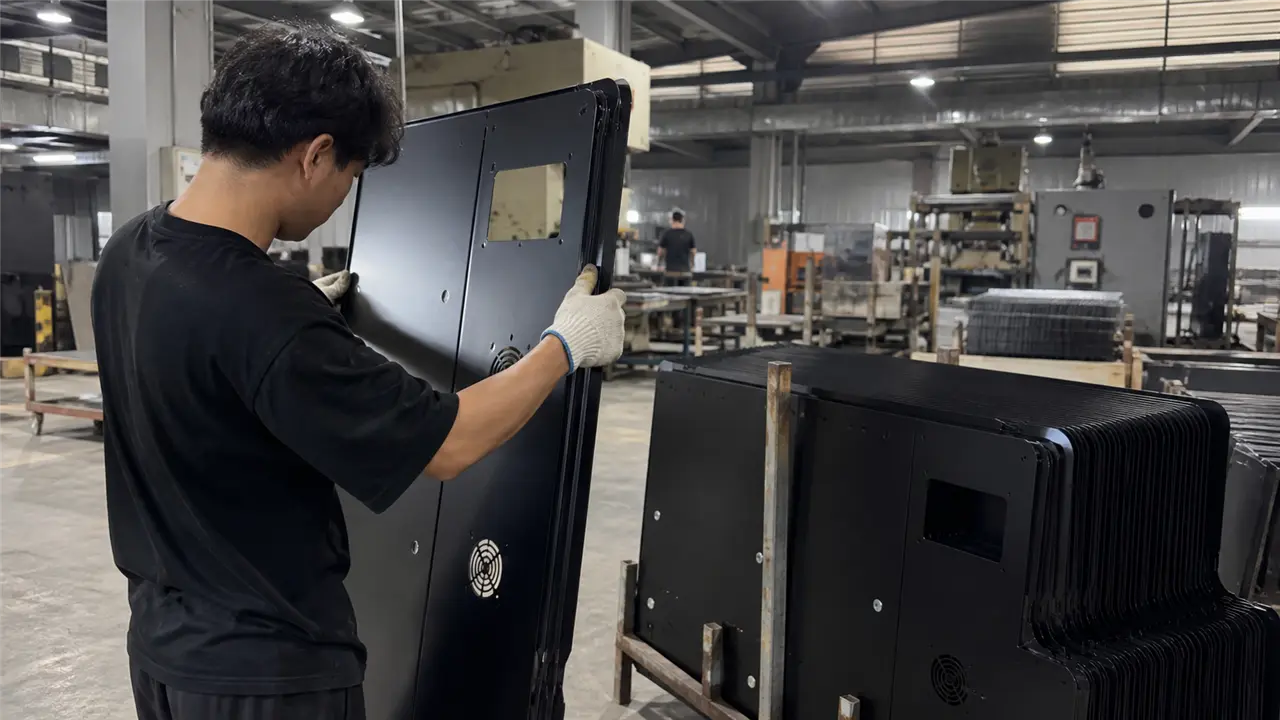
Forget cheap plastic or thin aluminum frames. Our fish table cabinets are constructed using 1.5mm cold-rolled steel. The reason we insist on cold-rolled steel is its superior tensile strength and resistance to deformation under stress. When a heavy player leans completely onto the edge of the machine, a lesser frame will bend, putting fatal pressure on the internal screen display. Our 1.5mm steel framework creates a rigid exoskeleton that absorbs and distributes mechanical stress away from the delicate internal electronics.
Furthermore, we treat the steel with an industrial-grade powder coating process baked at high temperatures. Many of our clients operate in humid coastal environments or tropical climates where moisture and salt in the air can corrode unprotected metal within months. Our electrostatic powder coating provides a rust-proof, scratch-resistant barrier that keeps the cabinet looking pristine even after years of relentless commercial abuse. This durability is a cornerstone of our commercial arcade game machines manufacturing standards that ensures your investment remains secure. The welding process is handled by precision robotic arms under strict quality control, ensuring every joint can withstand immense torsional forces. We do not use pop rivets for critical structural junctions; we use high-tensile bolts and continuous welds. This dedication to structural integrity means that our cabinets often outlast the internal game boards, allowing operators to simply swap out the logic board and screen after five years while keeping the same indestructible metal chassis.
Tempered Top Glass Impact Resistance
The screen is the window to your game revenue, and protecting it is our highest structural priority. We utilize 10mm to 12mm thick premium tempered glass for the top surface. This is not standard window glass. Tempered glass undergoes a thermal treatment that increases its strength up to five times that of normal glass. In the event of a catastrophic impact, it shatters into small, blunt granular chunks rather than jagged shards, minimizing liability and preventing player injury.
Before any cabinet leaves our Panyu QA lab, our protocol mandates extreme impact testing. We simulate heavy objects dropping directly onto the center of the glass to ensure it will not yield. We drop solid steel ball bearings from specified heights directly onto the center mass of the glass pane. Only batches that pass this rigorous testing are allowed to move to the assembly line. Additionally, the glass features an anti-glare, anti-reflective coating that enhances visibility under the harsh neon and fluorescent lighting typical of modern game rooms. A clear, reflection-free view keeps players engaged longer, driving up your average revenue per user. The optical clarity of the glass is rated at 98% light transmission, meaning the brilliant colors of the 4K display underneath are never muted or washed out.
Precision Routing and Player Ergonomics
The layout of the control panel is critical. We use precision CNC routing to cut the steel and acrylic panels, ensuring millimeter-perfect alignment for every joystick and button. The ergonomic angle of the control deck is designed to reduce wrist fatigue for players who sit at the machine for six to eight hours straight. The distance between player stations is meticulously calculated to provide enough elbow room so that competitive players do not physically clash, while maintaining the high-density footprint required for optimal venue profitability.
We also focus extensively on the tactile feedback of the controls. The joysticks and buttons are rated for over ten million actuations. When a player strikes the fire button repeatedly during a boss fight, the return spring must be incredibly responsive. The microswitches we employ are engineered for low-latency registration, ensuring that every button press is transmitted to the game board in a matter of milliseconds. This level of precision is what separates a frustrating amateur machine from a highly addictive commercial earning tool. We angle the button decks slightly downward at exactly 7.5 degrees, a measurement derived from hundreds of hours of ergonomic testing to ensure maximum comfort for extended play sessions.
Visual Hardware Displays and Processing Synergy
A fish table is inherently a visual experience. The quality of the display directly correlates with the perceived value of the game and the willingness of players to invest their money.
Selecting Between 55 65 and 85 Inch 4K Commercial Displays
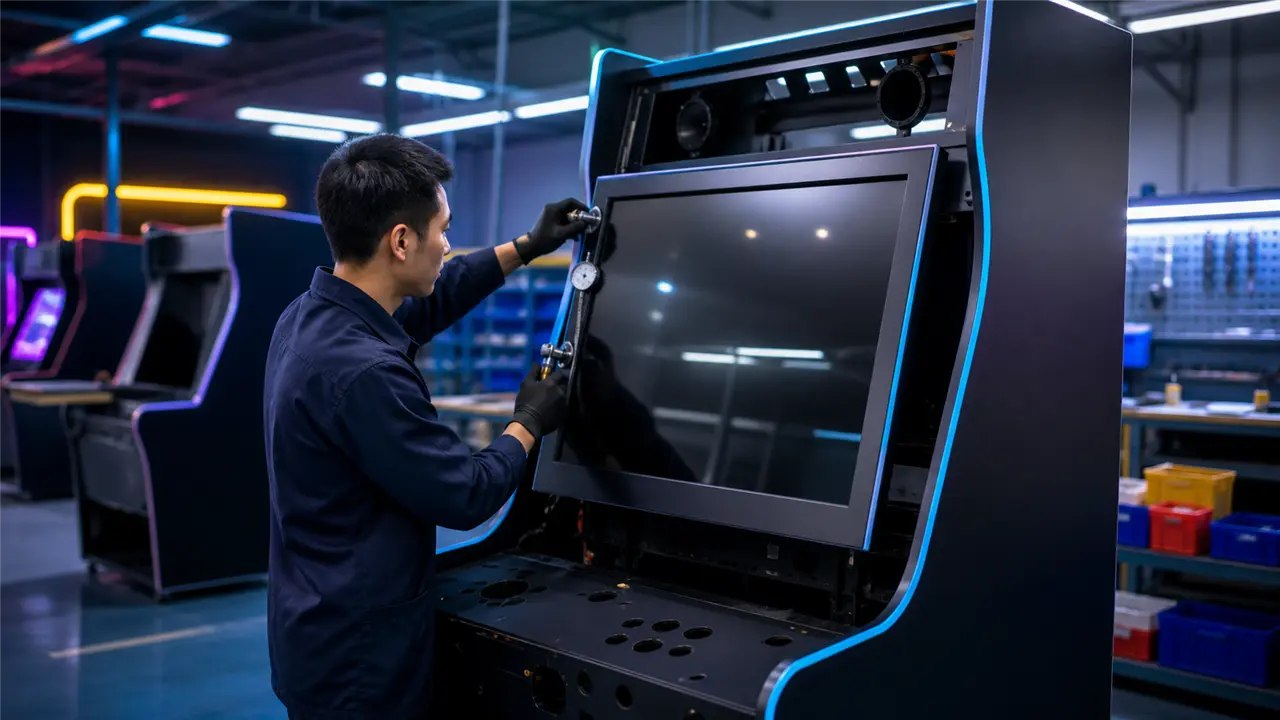
The heart of the cabinet is the LCD panel. We exclusively source A+ grade commercial display panels from leading manufacturers like LG and Samsung. These are not consumer TVs; they are industrial monitors rated for 24/7 continuous operation without screen burn-in or color degradation. The brightness is typically rated at 500 nits or higher, ensuring the game graphics punch through ambient room lighting.
For a standard 4-player to 6-player configuration, a 55-inch 4K screen provides excellent pixel density and a compact footprint. When you scale up to an 8-player setup, the 65-inch screen becomes the industry standard, offering a massive digital canvas that commands attention in any venue. If you are interested in this specific setup, you can read our comprehensive 8-player fish table sourcing overview. For flagship, centerpiece attractions, we build mega-cabinets utilizing 85-inch displays for 10-player configurations. These massive screens output vivid, high-contrast imagery with deep blacks and blindingly bright colors, drawing players from across the room. We calibrate the color profiles of these displays in the factory to ensure that the underwater themes of fish table games are represented with breathtaking vibrancy. The high refresh rates of these commercial panels guarantee that fast-moving targets do not suffer from motion blur, providing a perfectly crisp aiming experience for the players.
Thermal Airflow Management and Heat Dissipation
Running massive 4K commercial screens alongside heavy-duty game boards generates significant thermal output. Heat is the ultimate enemy of electronic components. It degrades capacitors, slows down processing units, and causes random reboots.
Our engineering team has designed a highly efficient thermal airflow architecture within the chassis. We implement dual or quad 120mm industrial ball-bearing exhaust fans strategically positioned at the highest thermal concentration points. Cold air is drawn in from the bottom intake vents, flows directly over the power supply and game board motherboard, and the hot air is rapidly expelled from the upper exhaust ports. We also integrate washable dust filters on all intake vents to prevent the accumulation of insulating dust over the logic boards, ensuring your machine runs cool and stable round the clock.
Electrical Stability and Mean Well Power Architecture
No matter how good the game software is, dirty power will kill your machine. In many developing regions or older buildings, the electrical grid delivers highly unstable voltage with frequent spikes and dips.
Power Delivery Networks
We refuse to compromise on power delivery. Every fish table we manufacture is equipped with genuine Mean Well power supplies, widely recognized as the gold standard in industrial power conversion. The Mean Well LRS series provides exceptionally low ripple noise and incredibly stable voltage output. If the venue experiences a voltage surge, the power supply’s built-in over-voltage and short-circuit protections instantly clamp the transient spike, sacrificing a cheap internal fuse rather than allowing the surge to destroy the expensive main game board.
Our internal wiring harnesses are constructed using heavy-gauge, pure copper wires wrapped in flame-retardant insulation. Every wire is clearly labeled, color-coded, and securely terminated with locking connectors. This prevents vibrations from shaking cables loose over time and makes field maintenance incredibly straightforward for your technicians.
Anti Spill Integration and Short Circuit Defense
Players drink while they play. Spills are inevitable. A spilled soda can instantly short out an entire control panel if the hardware is not designed to handle it. We integrate custom-molded silicone liquid catchers beneath the joystick and button arrays. Furthermore, our proprietary drink cup holders are seamlessly integrated into the cabinet chassis and feature internal drainage channels that route any spilled liquid safely out of the bottom of the cabinet, completely bypassing the electronic components. This simple but brilliant engineering detail saves operators thousands of dollars in replacement parts and lost revenue downtime.
Venue Selection and Revenue Density Optimization
Buying the best machine is only half the equation; deploying it in the right environment is what generates profit. Venue selection and spatial planning are critical skills for any successful arcade operator.
Footprint vs Player Count Metrics
When designing your venue floor plan, you must calculate your revenue density per square foot. A 4-player cabinet takes up a relatively small footprint and is perfect for corners or narrow hallways in bars, convenience stores, and truck stops. However, in a dedicated arcade or sweepstakes parlor, floor space is your most valuable asset.
The 4 6 8 10 Player Configuration Battle
Upgrading to an 8-player or 10-player fish table significantly increases the revenue potential of a single square meter of floor space. A 10-player table requires roughly 1.5 times the floor space of a 4-player table but offers 2.5 times the player capacity. The social dynamics of a larger table also increase the competitive nature of the game, driving higher bet volumes as players race to capture the boss fish. Our recommendation is always to anchor your main floor with at least two 8-player or 10-player cabinets to serve as the primary draw, surrounding them with smaller 4-player or 6-player satellite machines to capture overflow traffic during peak hours.
Operational ROI Calculation for Fish Table Arcades
The 45 Day Break Even Formula
Let us look at the mathematics of profit. Many prospective operators ask me how quickly they can recoup their capital expenditure. With the right location and our industrial-grade hardware, the return on investment (ROI) is staggering. I always tell my clients that investing in a premium machine upfront eliminates the devastating hidden costs of downtime.
Assume you purchase an 8-player premium fish table from our factory. The total landed cost, including the machine, ocean freight, customs duties, and local inland delivery, is approximately $4,500.
In a moderately busy location, a single player might spend $50 per session. With 8 seats available, let us conservatively estimate an average occupancy of just 3 players at any given time during a 10-hour operating day.
- 3 players * $50/hour = $150 hourly gross coin-in.
- $150 * 10 hours = $1,500 daily gross coin-in.
Most operators set the game software math model to a 20% to 30% hold percentage (RTP of 70% to 80%). Let us use a conservative 20% hold.
- $1,500 daily coin-in * 20% hold = $300 daily gross profit.
- Deduct roughly $100 per day for overhead (rent, electricity, staff, licensing, and minor maintenance).
- Net daily profit = $200.
At $200 net profit per day, the $4,500 capital investment is fully recovered in exactly 22.5 days. Even if we factor in slower weekdays, seasonal dips in foot traffic, and halve the revenue projections, you are looking at a 45-day complete break-even period. After day 45, that machine is generating pure, unadulterated profit. This is the power of high-quality commercial game boards combined with unyielding hardware.
Furthermore, because our machines are built to last for five to seven years of continuous commercial use, that single $4,500 investment will go on to generate hundreds of thousands of dollars in lifetime value for your venue. Contrast this with buying a cheap, $1,500 knockoff machine that breaks down on week three, causing you to refund angry players and wait weeks for replacement parts while the floor space sits dead and unprofitable. In this industry, cheap hardware is the most expensive mistake an operator can make.
Securing Your Assets from Electronic Threats
Profit attracts thieves. As your revenue grows, so does the risk of targeted attacks by syndicates using electronic cheating devices. Standard machines are highly vulnerable to EMP (Electromagnetic Pulse) jammers, which induce high-voltage spikes into the coin acceptor or bill validator, tricking the motherboard into registering thousands of fake credits. A single successful EMP attack can drain a machine of its entire day’s earnings in a matter of seconds.
Our factory takes security extremely seriously. Every machine can be upgraded with our military-grade security infrastructure. We install industrial EMP pulse interference shielding that features <5ps transient surge clamping, instantly neutralizing any electromagnetic attack before it reaches the logic circuits. The wiring for our bill acceptors and card readers utilizes optical isolation modules, creating a physical gap in the electrical pathway that high-voltage pulses simply cannot cross.
We also offer AI-driven dynamic password scrambling for the admin backend. In many arcades, rogue employees or managers figure out the static admin passwords and alter the game’s hold percentage or print free credits for themselves or their friends. Our dynamic systems change the required access credentials constantly, linking access strictly to authorized master controllers. To truly understand how we protect your money and lock down your digital assets, you must read our deep dive into anti-cheat defense systems. We do not just build machines; we build vaults that protect your cash. When you operate a Miba machine, you sleep soundly knowing your hardware is actively fighting off theft attempts 24 hours a day.
Understanding the Global Arcade Ecosystem
To fully grasp why our engineering principles are so rigid, you must understand the diverse global environments our machines operate within. We ship containers to bustling urban entertainment centers in North America, high-density sweepstakes cafes in Europe, and remote island resort arcades in the Caribbean. Each of these locations presents unique environmental and operational challenges. A machine in Miami faces intense humidity and salt air, demanding our electrostatic powder coating. A machine in a busy downtown Chicago bar faces massive physical abuse from inebriated patrons, demanding our 1.5mm cold-rolled steel and 12mm tempered glass. A machine in a developing region with an unstable power grid relies heavily on our Mean Well power architecture to survive daily voltage fluctuations. We do not build machines for perfect conditions; we build machines to thrive in the harshest commercial realities.
The Engineering Philosophy of Engineer Wang
In my twelve years as Lead Hardware Architect, my philosophy has remained constant: over-engineer the foundation. You can always update the software, change the game graphics, or swap out a button, but if the core chassis or the primary display fails, the machine is dead. The cost of a service call, the lost revenue during downtime, and the damage to the venue’s reputation far outweigh the few dollars saved by using cheaper materials during manufacturing. This is why we refuse to compromise. This is why we use industrial-grade components. And this is why the most successful route operators in the world trust our factory to supply their most critical earning assets.
Direct Contact for B2B Factory Sourcing
You are not dealing with a middleman. You are dealing directly with the source factory engineers who design the circuit boards, weld the steel, and write the mathematical algorithms. We are not a trading company simply putting our sticker on someone else’s product. We own the manufacturing line, we own the QA process, and we own the source code.
If you are serious about upgrading your venue, expanding your route, or developing a custom game with 100% source code handover, we need to talk. We offer comprehensive Turnkey Venue Solutions, meaning we can layout your entire arcade floor plan, manufacture all the machines, provide the central management software, and offer remote technical support.
Reach out to me, Engineer Wang, directly for a video tour of our Panyu QA lab, a live FAT (Factory Acceptance Test) demonstration via video call, and wholesale tier pricing. We welcome international clients to visit our factory in person to witness the scale and professionalism of our operation. Let us build your next highly profitable arcade empire together.
- WhatsApp / WeChat: +86 17620842078
- Telegram: https://t.me/JLwyc
- Email: miba515527@gmail.com
Frequently Asked Questions
What makes cold rolled steel better for fish table cabinets Cold-rolled steel provides far superior structural integrity, rigidity, and resistance to impact deformation compared to plastic, wood, or standard aluminum. It ensures the internal electronics and heavy glass remain supported and safe.
How do you prevent machines from overheating during 24 hour operation We utilize a strategic thermal airflow design incorporating dual or quad 120mm industrial ball-bearing exhaust fans, optimized intake vents with washable dust filters, and internal spacious routing to ensure massive 4K screens and game boards remain well within safe operating temperatures.
What is the typical ROI timeframe for an 8 player fish table Depending on the venue’s foot traffic and player demographics, an operator using our premium machines can typically expect a full return on investment (ROI) within 22 to 45 days, based on conservative hold percentages and daily active hours.
Can I customize the game software and cabinet artwork Absolutely. As a source manufacturer and software development studio, we offer complete OEM/ODM bespoke cabinet customization, UI/UX graphic design, and customized mathematical models with 100% source code buyout options.
How does the machine defend against EMP jammers and cheaters Our machines are equipped with industrial-grade EMP pulse interference shielding, <5ps transient surge clamping, optical isolation modules for bill acceptors, and AI-driven dynamic password algorithms to completely block external electronic cheating attempts.