- Evaluating Teleoperation Hardware and Gantry Mechanisms
- WebRTC Video Pipeline Integration at the Factory Level
- IoT Control Boards and Microcontroller Architecture
- Cloud Queue Servers and API Middleware
- Failover Architecture and Redundant Systems
- Technical Specifications and Hardware Parameters
- Low Latency Teleoperation Hardware and WebRTC Pipeline Engineering
- Venue Fleet Management and Remote Maintenance Workflows
- Low Latency Teleoperation Hardware and WebRTC Pipeline Engineering
- Venue Fleet Management and Remote Maintenance Workflows
- Frequently Asked Questions
The explosion of remote teleoperation arcade applications demands robust hardware capable of continuous 24/7 engagement under severe network conditions. Operators expanding their digital amusement footprint require highly reliable physical cabinets integrated seamlessly with sub-80ms WebRTC streaming pipelines and industrial IoT control logic to maintain seamless player experiences.
Selecting a direct manufacturing partner in China eliminates intermediary markups while granting operators unprecedented access to core hardware customizations. A specialized live streaming claw machine factory provides the foundational architecture required for remote play, outfitting cabinets with dual-camera telemetry, STM32 microcontrollers, and optocoupled motor relays out of the box. By sourcing directly from established production bases, buyers ensure that every mechanical component from stepper motors to crane gantries is engineered for the rigors of unattended cloud arcade environments. This direct relationship guarantees rapid iteration cycles for bespoke API integrations, firmware updates, and modular hardware replacements.
To explore how custom-engineered teleoperation cabinets can elevate your digital arcade revenue stream, contact Engineer Wang at Guangzhou Miba Animation Technology Co., Ltd. (Panyu Manufacturing Base) via WhatsApp at +86 17620842078 for a personalized technical demonstration and factory tour.
Evaluating Teleoperation Hardware and Gantry Mechanisms
The physical gantry and claw mechanics serve as the heart of any remote arcade operation. Unlike traditional street-location machines that experience sporadic use, live streaming claw machines operate constantly. This necessitates the implementation of industrial-grade stepper motors with high-torque capacity and precise step angles to ensure that remote player commands translate into immediate, predictable physical movements without mechanical drift. Advanced manufacturing facilities utilize precision-milled aluminum tracks and self-lubricating bearings to reduce maintenance overhead and prevent jamming during high-volume remote sessions. The integration of closed-loop stepper systems provides real-time position feedback to the IoT board, ensuring that the cloud software always accurately reflects the gantry’s physical location.
WebRTC Video Pipeline Integration at the Factory Level
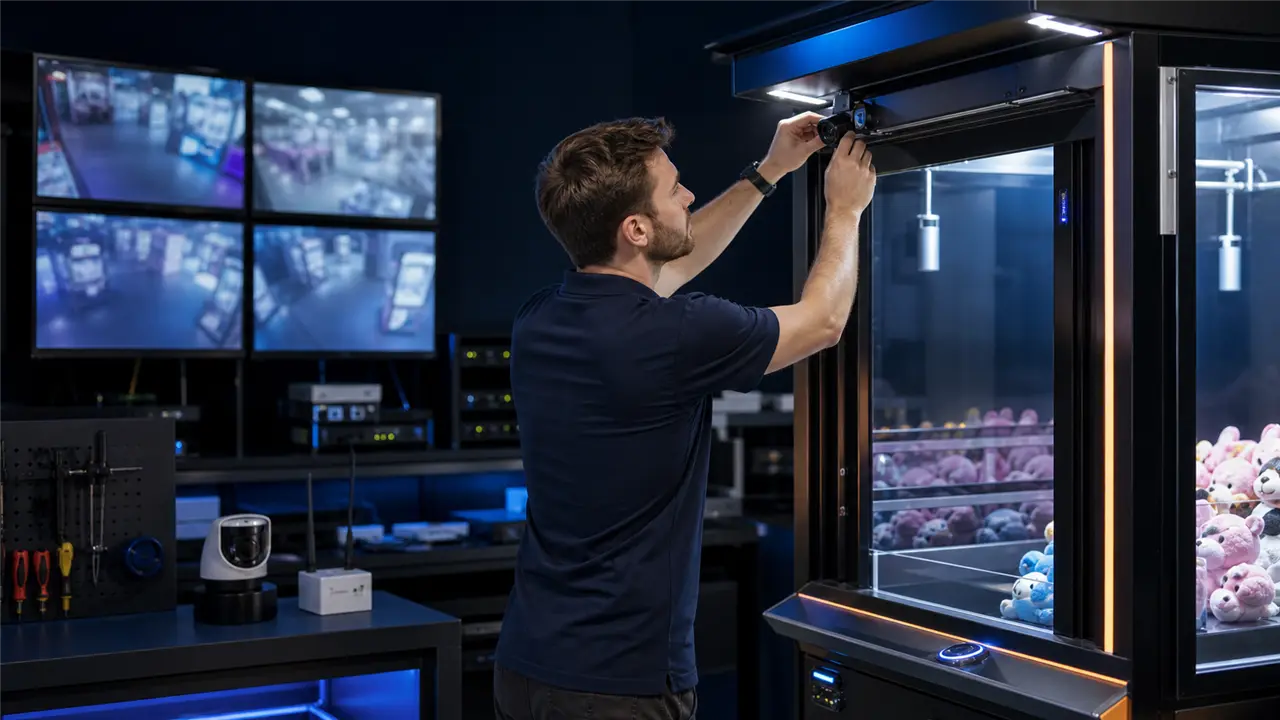
Sub-80ms video latency is the critical threshold for a viable remote claw machine business. Forward-thinking factories embed dedicated video encoding hardware directly into the cabinet chassis. This typically involves mounting wide-angle, low-light optimized IP cameras connected via gigabit Ethernet interfaces to an onboard hardware encoder. By processing H.264 or H.265 streams at the edge, the cabinet offloads heavy video processing from the main IoT controller. The factory-configured WebRTC pipeline ensures that video telemetry is pushed seamlessly to cloud queue servers, allowing players worldwide to view multiple camera angles (front and side) simultaneously with negligible delay, preserving the illusion of being physically present in the arcade.
IoT Control Boards and Microcontroller Architecture
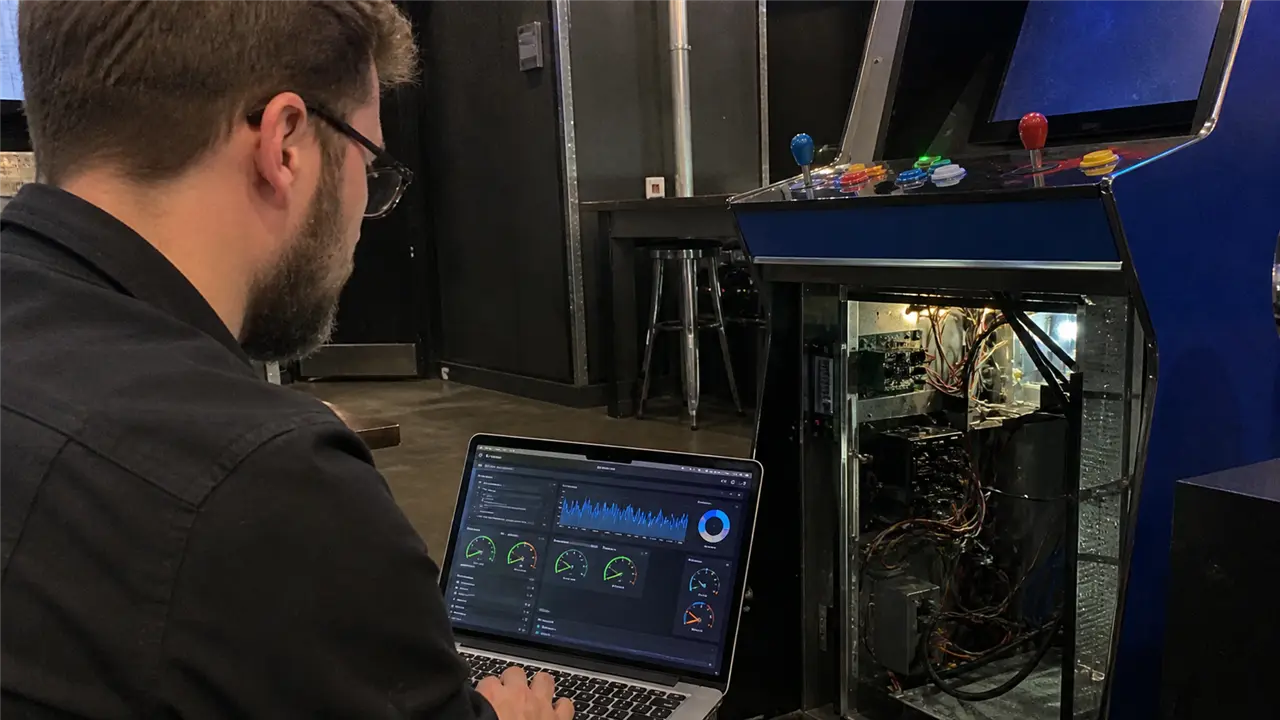
A live streaming claw machine factory must equip its cabinets with specialized IoT gateways rather than standard jamma boards. The industry standard utilizes high-performance microcontrollers such as the STM32 series or ESP32 variants, engineered to bridge cloud command protocols (like MQTT or WebSocket) with the cabinet’s physical actuators. These control boards feature optocoupled relay outputs to isolate high-voltage motor circuits from sensitive logic components, preventing catastrophic electrical failures during power surges. The IoT architecture must support remote Over-The-Air firmware updates and continuous health monitoring, transmitting telemetry regarding voltage levels, motor temperatures, and drop sensor activations back to the operator’s central dashboard.
Cloud Queue Servers and API Middleware
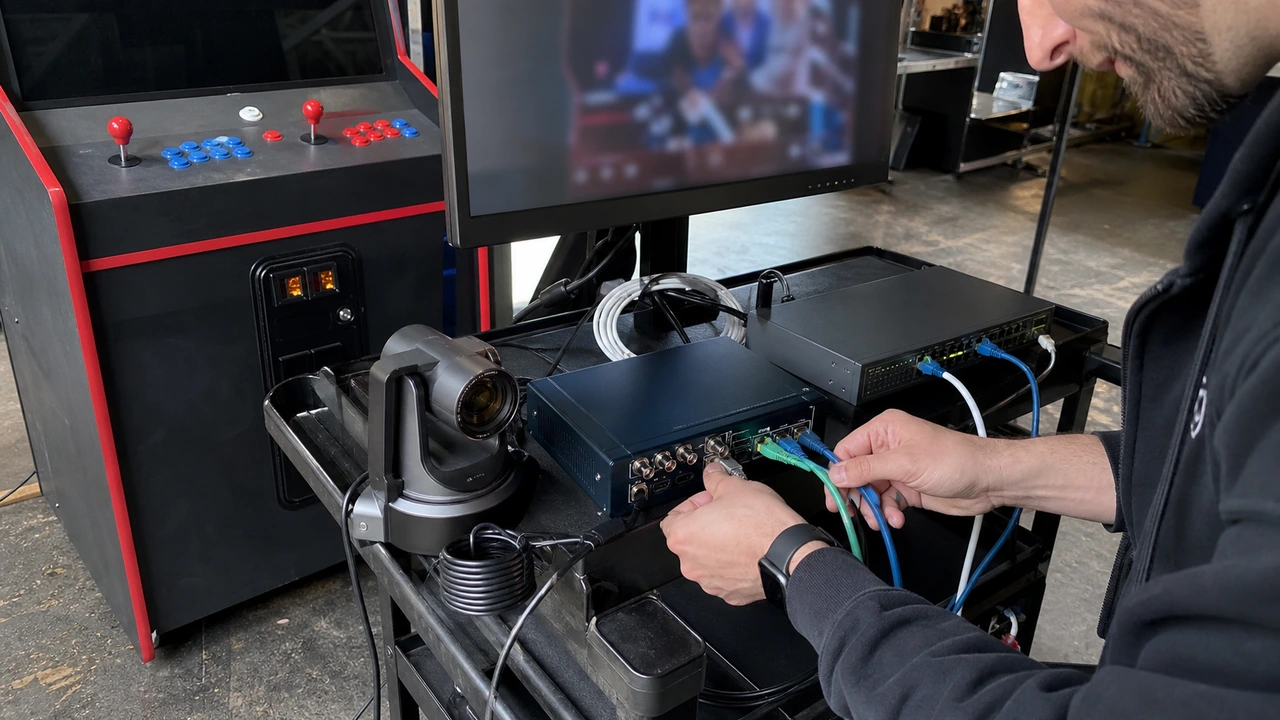
Direct integration between factory hardware and operator software is facilitated through robust API middleware. Factories that understand the B2B teleoperation market provide cabinets with documented serial communication protocols (RS485/RS232) and RESTful API endpoints. This allows operators to easily connect the physical machines to their proprietary cloud queue servers. The queue system manages player sessions, handling real-time command routing, coin deduction, and prize dispensing confirmation. The seamless handshake between the factory’s hardware API and the operator’s backend infrastructure ensures that multiple users can queue for a single machine without race conditions or input command loss.
Failover Architecture and Redundant Systems
Uninterrupted uptime is paramount for remote arcades. Premium live streaming claw machine factories build redundancy directly into the cabinet’s power and network infrastructure. Dual power supplies ensure that a single component failure does not take the machine offline. Industrial 4G/5G cellular backup routers are often integrated alongside standard fiber optic ethernet connections, providing immediate failover if the primary network drops. Furthermore, the IoT board is programmed with local watchdog timers that automatically reboot the logic controllers if a software freeze is detected, minimizing the need for manual on-site technician intervention and preserving operational revenue.
Technical Specifications and Hardware Parameters
| Component | Specification Parameter | Implementation Description |
|---|---|---|
| Control Logic | STM32 / ESP32 Dual Core | High-frequency processing for IoT telemetry and motor control. |
| Video Encoding | Hardware H.264/H.265 | Dedicated DSP for sub-80ms WebRTC streaming directly from IP cameras. |
| Motor Drives | Closed-Loop Stepper Systems | High-torque precision movement with real-time positional feedback. |
| Isolation | Optocoupled Relays | Electrical isolation between logic circuits and high-voltage actuators. |
| Communication | RS485 / Dual Ethernet | Industrial serial bus for internal components and dual WAN for network redundancy. |
| Power Delivery | Dual Switching PSUs | Redundant power architecture with automatic failover capabilities. |
Low Latency Teleoperation Hardware and WebRTC Pipeline Engineering
Operating real physical arcade machines over the public internet requires overcoming severe latency, packet jitter, and mechanical response delays. To achieve a seamless real-time player experience where control inputs feel instantaneous (<80ms glass-to-glass latency), the system architecture integrates edge IoT hardware with optimized streaming pipelines:
1. Sub-80ms WebRTC Streaming Infrastructure: Video feeds captured by dual wide-angle 1080p 60FPS industrial IP cameras (front view and side depth view) are encoded using hardware-accelerated H.264 / NVENC pipelines directly at the local venue edge server. Video frames are streamed over WebSockets/WebRTC using dynamic jitter buffering, ensuring adaptive bitrate streaming across mobile 4G/5G networks without buffering stutters. 2. Industrial Edge IoT Gateway Boards: Each bank of claw machines or coin pushers is controlled by an industrial STM32F4/ESP32-S3 microcontroller board equipped with isolated GPIO relays, optical encoder counters, and RS-485 serial communication. The gateway parses player control packets (joystick directional vectors, drop buttons) and triggers stepper motor drivers within 5 milliseconds of network packet reception. 3. Mechanical Gantry and Stepper Motor Precision: High-precision NEMA 23 stepper motors and optocoupled limit switches replace standard AC motors. This allows fine-grained micro-stepping positioning, enabling precise claw hovering, dynamic claw grip voltage adjustments (3-stage voltage control: grab, lift, transport), and optical prize drop detection with zero false drops. 4. Cloud Queue and Session Failover Architecture: When multiple concurrent players enter a machine’s live room, the cloud backend maintains a strict FIFO queue with automated spectator view synchronization. If a player experiences network disconnection during an active round, the edge gateway executes an automated safe-return sequence, resetting the claw gantry to home position and safely refunding tokens to the player’s account.
| System Subsystem | Hardware / Protocol Specifications | Operational Target Metric | Business Benefit |
|---|---|---|---|
| Edge Video Encoding | H.264 / HEVC Hardware Encoder, RTSP to WebRTC | < 60 ms glass-to-glass delay | Real-time visual feedback for precise claw drops |
| Teleoperation Gateway | STM32 ARM Cortex-M4 + Optoisolated Relays | < 5 ms GPIO execution latency | Instantaneous joystick response without input lag |
| Stepper Motor Control | NEMA 23 Stepper, 1/16 Microstepping Driver | ±0.5 mm positioning accuracy | Professional claw control and smooth camera telemetry |
| Prize Detection Sensor | Dual-Beam Infrared Optical Barrier | 99.99% detection accuracy | Automated prize payout verification and inventory sync |
| Network Failover | Dual-WAN Edge Router with 4G/5G Auto-Failover | 99.95% venue uptime SLA | Uninterrupted 24/7 route operation without onsite staff |
Venue Fleet Management and Remote Maintenance Workflows
Managing an unattended remote live arcade facility with dozens of physical machines requires centralized telemetry and automated self-healing mechanisms:
- Automated Mechanical Health Diagnostics: Daily self-test routines run automatically during low-traffic hours (e.g. 04:00 AM local time), testing X/Y/Z gantry travel boundaries, claw grip solenoids, and camera autofocus clarity.
- Smart PDU Remote Power Cycling: Every machine is connected to a cloud-managed PDU (Power Distribution Unit), allowing route operators to remotely reboot frozen motherboards or reset gantry controllers directly from their mobile smartphone dashboard.
- Real-Time Prize Inventory and Dispenser Tracking: Optical weight sensors and RFID tags track prize compartment levels, sending automated restocking notifications to local fulfillment teams when plush toy or prize box levels drop below 15%.
Low Latency Teleoperation Hardware and WebRTC Pipeline Engineering
Operating real physical arcade machines over the public internet requires overcoming severe latency, packet jitter, and mechanical response delays. To achieve a seamless real-time player experience where control inputs feel instantaneous (<80ms glass-to-glass latency), the system architecture integrates edge IoT hardware with optimized streaming pipelines:
1. Sub-80ms WebRTC Streaming Infrastructure: Video feeds captured by dual wide-angle 1080p 60FPS industrial IP cameras (front view and side depth view) are encoded using hardware-accelerated H.264 / NVENC pipelines directly at the local venue edge server. Video frames are streamed over WebSockets/WebRTC using dynamic jitter buffering, ensuring adaptive bitrate streaming across mobile 4G/5G networks without buffering stutters. 2. Industrial Edge IoT Gateway Boards: Each bank of claw machines or coin pushers is controlled by an industrial STM32F4/ESP32-S3 microcontroller board equipped with isolated GPIO relays, optical encoder counters, and RS-485 serial communication. The gateway parses player control packets (joystick directional vectors, drop buttons) and triggers stepper motor drivers within 5 milliseconds of network packet reception. 3. Mechanical Gantry and Stepper Motor Precision: High-precision NEMA 23 stepper motors and optocoupled limit switches replace standard AC motors. This allows fine-grained micro-stepping positioning, enabling precise claw hovering, dynamic claw grip voltage adjustments (3-stage voltage control: grab, lift, transport), and optical prize drop detection with zero false drops. 4. Cloud Queue and Session Failover Architecture: When multiple concurrent players enter a machine’s live room, the cloud backend maintains a strict FIFO queue with automated spectator view synchronization. If a player experiences network disconnection during an active round, the edge gateway executes an automated safe-return sequence, resetting the claw gantry to home position and safely refunding tokens to the player’s account.
| System Subsystem | Hardware / Protocol Specifications | Operational Target Metric | Business Benefit |
|---|---|---|---|
| Edge Video Encoding | H.264 / HEVC Hardware Encoder, RTSP to WebRTC | < 60 ms glass-to-glass delay | Real-time visual feedback for precise claw drops |
| Teleoperation Gateway | STM32 ARM Cortex-M4 + Optoisolated Relays | < 5 ms GPIO execution latency | Instantaneous joystick response without input lag |
| Stepper Motor Control | NEMA 23 Stepper, 1/16 Microstepping Driver | ±0.5 mm positioning accuracy | Professional claw control and smooth camera telemetry |
| Prize Detection Sensor | Dual-Beam Infrared Optical Barrier | 99.99% detection accuracy | Automated prize payout verification and inventory sync |
| Network Failover | Dual-WAN Edge Router with 4G/5G Auto-Failover | 99.95% venue uptime SLA | Uninterrupted 24/7 route operation without onsite staff |
Venue Fleet Management and Remote Maintenance Workflows
Managing an unattended remote live arcade facility with dozens of physical machines requires centralized telemetry and automated self-healing mechanisms:
- Automated Mechanical Health Diagnostics: Daily self-test routines run automatically during low-traffic hours (e.g. 04:00 AM local time), testing X/Y/Z gantry travel boundaries, claw grip solenoids, and camera autofocus clarity.
- Smart PDU Remote Power Cycling: Every machine is connected to a cloud-managed PDU (Power Distribution Unit), allowing route operators to remotely reboot frozen motherboards or reset gantry controllers directly from their mobile smartphone dashboard.
- Real-Time Prize Inventory and Dispenser Tracking: Optical weight sensors and RFID tags track prize compartment levels, sending automated restocking notifications to local fulfillment teams when plush toy or prize box levels drop below 15%.
Frequently Asked Questions
What network conditions are required for optimal remote play?
Optimal remote play demands a stable fiber optic connection at the facility with dedicated bandwidth. The factory hardware supports WebRTC protocols designed for sub-80ms latency, requiring minimal jitter and packet loss to ensure synchronized video and control inputs.
How does the IoT board handle dropped connections during play?
If a player’s connection drops, the STM32 IoT controller immediately halts gantry movement. The session state is preserved on the cloud queue server for a brief reconnect window before the machine automatically resets to the home position for the next queued user.
Can we integrate custom APIs with the factory hardware?
Yes, reputable factories provide comprehensive API documentation and serial protocol specifications. This allows your software team to seamlessly integrate custom cloud queue servers, payment gateways, and CRM platforms directly with the physical machine’s telemetry.
For enterprise-grade teleoperation hardware tailored to your unique software stack, reach out to Engineer Wang at Guangzhou Miba Animation Technology Co., Ltd. (WhatsApp: +86 17620842078, Telegram: https://t.me/JLwyc, Email: miba515527@gmail.com). Their Panyu Manufacturing Base specializes in deploying high-performance remote live arcade solutions globally.