- The Evolution from Dual Screen Cabinets to Continuous Curved Displays
- Optical Engineering for 1500R Curvature and 4K Resolution
- Projected Capacitive Touch Sensor Calibration and Noise Immunity
- Sheet Metal Fabrication and Universal Mounting Systems
- Addressable LED Halo Synchronization via DMX512 Protocol
- Power Distribution and Electrostatic Discharge Mitigation
- Slot Accounting System Protocol and Peripheral Integration
- Frequently Asked Questions
The commercial gaming floor is undergoing a massive structural transformation driven by player ergonomics and visual immersion requirements. Legacy dual-screen flat cabinets have reached their peak in terms of player engagement metrics. Today, the casino industry demands monolithic, continuous display surfaces. An OEM 43 inch 4K curved touchscreen slot cabinet factory focuses its engineering resources on blending high-resolution optical arrays with ruggedized electro-mechanical chassis systems. The J-curve and C-curve form factors, typically engineered with a 1500R radius, encapsulate the player’s peripheral vision, maximizing time-on-device (TOD) and driving higher coin-in averages.
Manufacturing these sophisticated enclosures is not merely a matter of bending a monitor and attaching it to a metal box. It requires deep integration of thermal dynamics, signal processing, precision sheet metal fabrication, and real-time serial communication protocols. Every slot machine cabinet that leaves a tier-one manufacturing facility must operate continuously for tens of thousands of hours under severe environmental conditions, surviving aggressive physical interactions, extreme static discharges, and fluctuating power delivery. For a comprehensive architectural overview and turnkey procurement frameworks, review our master guide on turnkey arcade cabinet manufacturing. For factory-direct procurement and comprehensive engineering specs, consult our master guide on turnkey arcade cabinet manufacturing and B2B procurement.
By examining the fundamental architecture of modern 43-inch curved slot cabinets, hardware developers and casino operators can understand the precise engineering tolerances required to support premium game mathematics and interactive bonus rounds. This article explores the critical components involved in engineering these high-yield gaming terminals. To explore detailed technical specifications and deployment considerations, see our operational guide on How Operators Procure Wholesale Casino Redemption. To explore detailed technical specifications and deployment considerations, see our operational guide on How Engineers Wire Industrial 56-Pin JAMMA. To explore detailed technical specifications and deployment considerations, see our operational guide on How Factory Builders Fabricate Custom 8. To explore detailed technical specifications and deployment considerations, see our operational guide on How Venue Owners Deploy Bartop Skill.
The Evolution from Dual Screen Cabinets to Continuous Curved Displays
For decades, standard slot machine form factors relied on dual 22-inch or 27-inch flat LCD panels. The lower screen managed the base game mechanics, while the upper screen displayed the progressive jackpot meters and static paytables. The physical bezel separating these two monitors created a visual barrier, disrupting the flow of modern cinematic game animations. As game studios shifted toward volumetric 3D rendering and unified game states where the base game seamlessly expands into the top box area, the physical bezel became an unacceptable constraint.
The introduction of the 43-inch portrait orientation curved display solved the bezel problem while introducing profound new engineering challenges. Bending a rigid TFT-LCD glass substrate without causing light bleed, color inversion, or structural micro-fractures requires highly specialized vacuum lamination techniques. A standard C-curve maintains a uniform 1500R curvature radius, meaning the screen forms a segment of a circle with a radius of 1,500 millimeters. This specific radius matches the optimal focal distance of a player sitting at a standard casino chair, ensuring that all edges of the screen are equidistant from the player’s eyes.
The J-curve variant adds another layer of complexity. Instead of a uniform bend, the J-curve features a pronounced curve at the bottom (acting as a dynamic button deck and base game area) transitioning into a flatter, towering upper section. Designing the sheet metal bezel and the rear support bracket for a J-curve monitor requires finite element analysis (FEA) to ensure that the stress distributed across the glass and the backlight unit (BLU) remains well within safe operational limits.
For engineers and platform developers looking to prototype their next hit title on commercial-grade hardware, partnering with a competent OEM factory is critical. Reach out to Engineer Wang to discuss your custom cabinet requirements and hardware integration specs via WhatsApp +86 17620842078, Telegram https://t.me/JLwyc, or Email miba515527@gmail.com
Optical Engineering for 1500R Curvature and 4K Resolution
Driving a 43-inch continuous display necessitates an upgrade in visual fidelity. Standard 1080p resolution stretched across a 43-inch diagonal surface yields an unacceptably low pixel density (approximately 51 Pixels Per Inch), resulting in visible aliasing and jagged edges. Modern OEM slot cabinets utilize 4K Ultra High Definition (UHD) panels with a resolution of 3840×2160. This quadruples the pixel density, enabling razor-sharp text, intricate 3D particle effects, and hyper-realistic digital artwork.
The TFT-LCD panels utilized in these cabinets are based on In-Plane Switching (IPS) or Advanced Hyper-Viewing Angle (AHVA) technologies. These panel types are mandatory because they prevent color shifting when viewed from off-axis angles—a common scenario when players shift in their seats or when casino patrons walk past the bank of machines.
To combat the intense ambient lighting found on standard casino floors, the LED backlight arrays must be engineered for high luminance. Consumer displays typically peak at 250 to 300 nits. In contrast, an OEM 43 inch 4K curved touchscreen slot cabinet factory specifies industrial-grade backlights pushing 500 to 700 nits. This sustained brightness requires advanced thermal dissipation strategies. The heat generated by the high-density LED strips along the edges of the curved panel must be wicked away by extruded aluminum heat sinks attached to the rear chassis of the monitor.
The mathematical formula governing the thermal resistance ($\theta$) of the heat sink design can be modeled as: $$ \theta_{SA} = \frac{T_S – T_A}{P_D} $$ Where $T_S$ is the sink temperature, $T_A$ is the ambient temperature inside the cabinet, and $P_D$ is the power dissipated by the LED backlight and the display controller board. Maintaining $T_S$ below 60°C ensures that the liquid crystals within the panel do not suffer from isotopic transition, which would manifest as permanent dark spots on the screen.
Projected Capacitive Touch Sensor Calibration and Noise Immunity
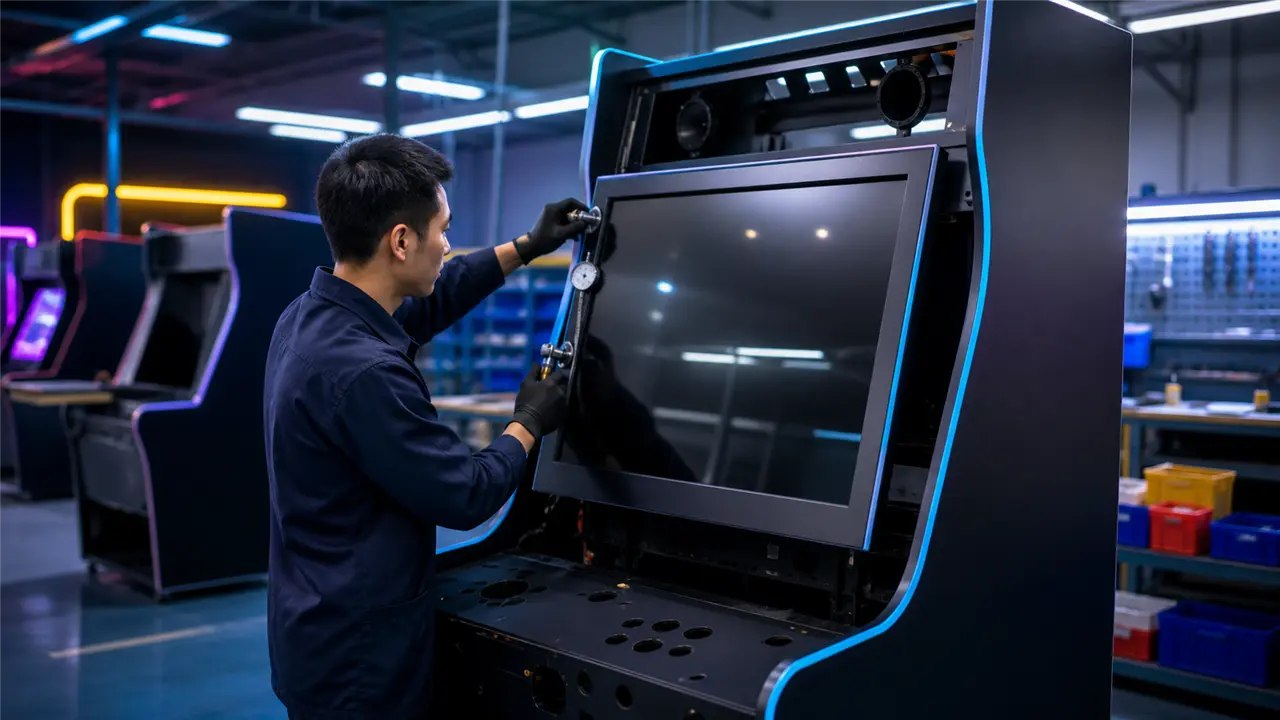
Interactive bonus rounds, digital button decks, and direct on-screen wagering require flawless touch responsiveness. Infrared (IR) touch bezels, while robust, struggle with curved surfaces and are susceptible to false touches from spilled liquids or resting objects. The industry standard has entirely shifted to Projected Capacitive (PCAP) touch technology.
A 43-inch PCAP overlay consists of a cover glass layer, optical clear adhesive (OCA), and an Indium Tin Oxide (ITO) sensor matrix. The ITO forms a grid of microscopic X and Y electrodes. When a human finger—a conductive body—approaches the screen, it alters the mutual capacitance between the intersecting electrodes. The touch controller IC scans this matrix hundreds of times per second to calculate the precise X and Y coordinates.
Scaling PCAP to a 43-inch curved surface amplifies signal-to-noise ratio (SNR) challenges. The massive surface area acts as an antenna, picking up electromagnetic interference (EMI) from the internal power supplies, the bill validator motors, and the high-frequency switching of the LED controllers. To counteract this, OEM factories implement advanced frequency hopping algorithms within the touch controller firmware. If the controller detects noise on its primary scanning frequency, it dynamically shifts to a cleaner frequency band.
Furthermore, palm rejection algorithms are mathematically rigorous. When a player leans against the lower J-curve portion of the screen with their wrist while tapping with their fingers, the system must differentiate between the large, static capacitive signature of the wrist and the sharp, transient signature of the fingertip. The firmware utilizes blob detection algorithms and temporal filtering to mask out the wrist input, ensuring that only intentional button presses are registered by the game logic.
Sheet Metal Fabrication and Universal Mounting Systems
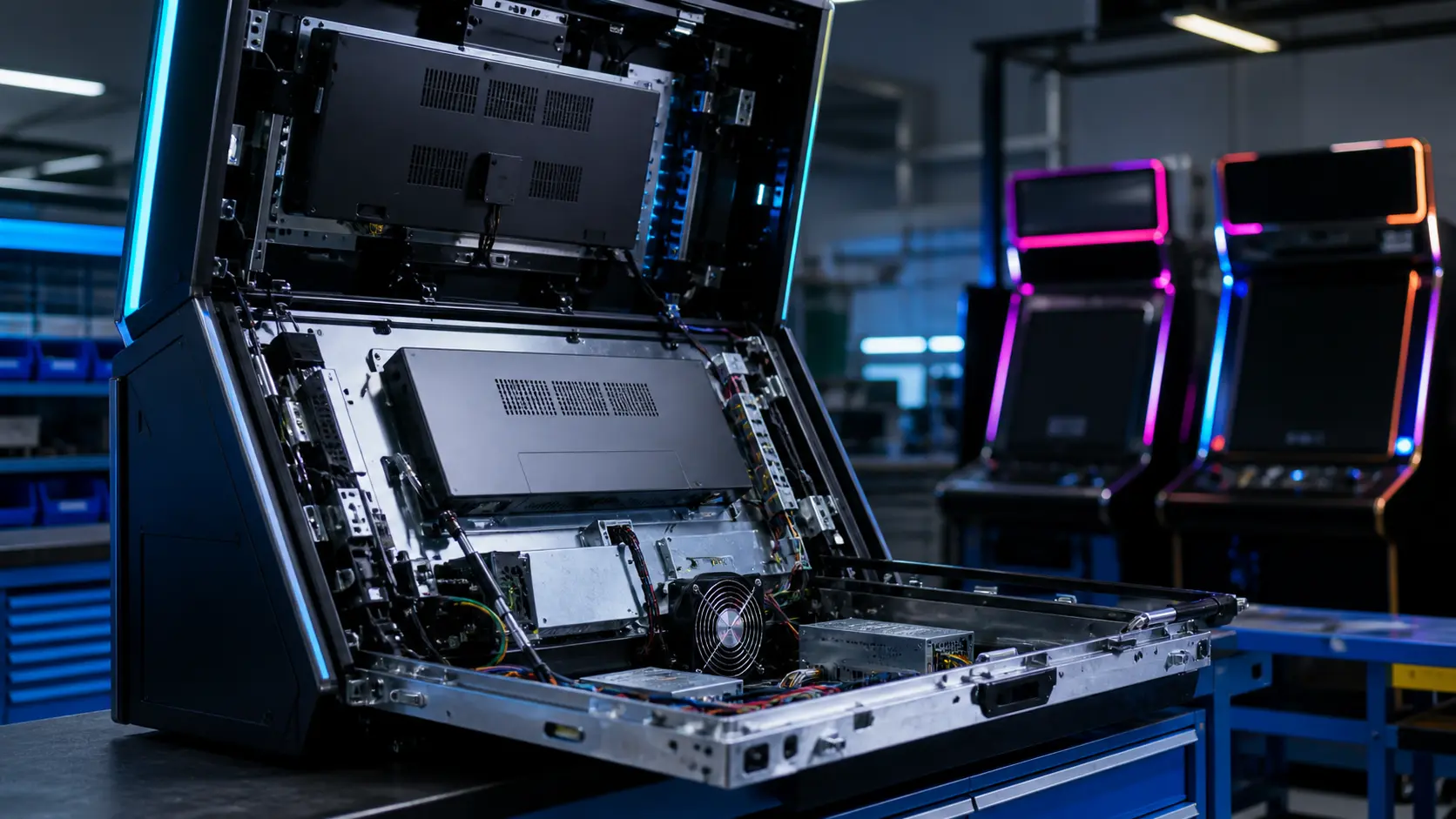
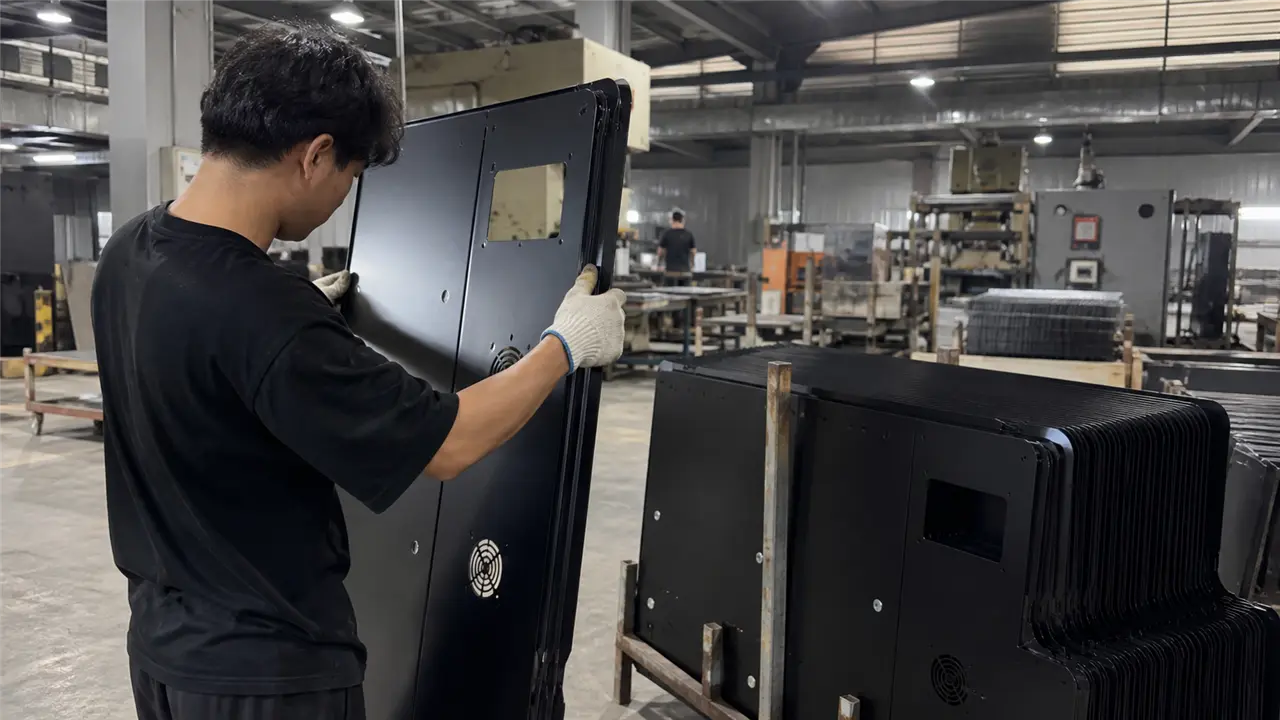
The underlying skeleton of the slot cabinet must provide immense structural rigidity while offering modularity for various casino operators. The primary chassis is fabricated using cold-rolled steel (SPCC) with a thickness ranging from 1.5mm to 2.0mm. Precision laser cutting and CNC press brakes are utilized to fold the intricate internal geometries required for mounting motherboards, power supplies, and peripheral brackets.
An OEM 43 inch 4K curved touchscreen slot cabinet factory must design the internal mounting plates to be universally compatible with the industry’s top platforms. Whether an operator is deploying an Aristocrat Helix/MarsX style layout, an IGT mainframe, or a Scientific Games / Konami mainboard, the standoff patterns and airflow channels must align perfectly.
The peripheral bays are standardized to accept universally mandated hardware. The bill validator slot is engineered to house leading models such as the MEI Cashflow SC series or the JCM iVIZION. These units demand precise alignment with the external bezel to ensure that currency and TITO tickets slide smoothly into the internal bill stacker without jamming. Similarly, the thermal ticket printer bay must accommodate units like the TransAct Epic 950 or the Ithaca 9000, ensuring the ticket ejection chute aligns flawlessly with the illuminated front bezel.
The surface finish of the cabinet exterior undergoes rigorous industrial powder coating. This electrochemical process bonds pulverized plastic and pigment to the grounded steel chassis, baking it into a highly scratch-resistant and chemically inert layer. This protects the cabinet from the corrosive effects of spilled beverages, aggressive cleaning solvents, and general wear and tear on the casino floor.
If you are developing a proprietary game board and need a robust, universal cabinet chassis to house it, collaborating with a seasoned hardware manufacturer is the most efficient path to market. Connect with Engineer Wang via WhatsApp +86 17620842078, Telegram https://t.me/JLwyc, or Email miba515527@gmail.com to request detailed CAD dimensions and universal mounting bracket specifications.
Addressable LED Halo Synchronization via DMX512 Protocol
Aesthetic attraction is the primary driver of initial player acquisition. A modern curved slot cabinet is outlined by synchronized halo edge lighting that frames the massive display. These lighting arrays rely on individually addressable RGB LEDs, specifically the WS2812B or the APA102 ICs, mounted on flexible PCB strips embedded within diffused acrylic channels.
Unlike standard RGB strips where all LEDs display the same color simultaneously, addressable LEDs allow for complex chase patterns, color gradients, and dynamic visual explosions. Controlling these LEDs requires a dedicated lighting controller board capable of communicating with the main game logic in real time.
The industry standard for triggering these lighting states is the DMX512 protocol or proprietary serial data streams (RS-485 / RS-232). When a player hits a scatter symbol or triggers a progressive jackpot, the game logic sends a hexadecimal command packet to the lighting controller.
A standard DMX512 packet consists of a break, a mark after break (MAB), a start code, and up to 512 bytes of channel data transmitted at 250 kbit/s. The lighting controller parses this data and translates it into the specific pulse-width modulation (PWM) signals required by the LED strips.
To ensure minimal latency between a game event (such as a massive win tally) and the corresponding lighting explosion, the serial communication architecture must be highly optimized. Many modern casino platforms are adopting WebSocket based architectures where the local game client communicates with a background lighting daemon via `ws://localhost`, bypassing the overhead of traditional serial port polling. The OEM factory must ensure that their proprietary lighting controller boards are equipped with standard USB or COM interfaces and provide robust C++ or Python API wrappers for game developers to integrate seamlessly.
Power Distribution and Electrostatic Discharge Mitigation
The electrical architecture of a 43-inch 4K curved slot cabinet is a complex web of isolated power rails and strict grounding topologies. The heart of the system is the primary switching power supply unit (PSU). These PSUs must carry stringent UL, CE, and RoHS certifications. A typical cabinet requires a high-wattage PSU (often 500W to 800W) to distribute stable 12V and 24V DC power to the mainboard, the massive 43-inch monitor backlight, the peripheral devices, and the LED controllers.
Mean Time Between Failures (MTBF) calculations for these power supplies must exceed 100,000 hours. The factory implements active Power Factor Correction (PFC) to ensure that the cabinet draws power efficiently from the casino floor’s grid, minimizing harmonic distortion that could interfere with neighboring machines.
Electrostatic Discharge (ESD) is a critical enemy of casino hardware. In dry, carpeted environments, players can easily build up static charges exceeding 15,000 volts. When a player touches the metal bezel, the button deck, or the touchscreen, this stored energy can discharge directly into the cabinet. Without proper mitigation, an ESD event can reset the mainboard, corrupt the RAM, or permanently destroy the sensitive touch controller ICs.
An OEM 43 inch 4K curved touchscreen slot cabinet factory employs comprehensive ESD shielding based on the IEC 61000-4-2 standards. This involves tying every isolated metal component, including the monitor chassis, the button deck deckplate, and the coin/bill entry bezels, back to a central, heavy-gauge earth ground terminal. Transient Voltage Suppression (TVS) diodes are placed on all exposed data lines, particularly the USB cables connecting the PCAP touch controller and the serial cables connecting the bill validator. These diodes act as bypass valves, shunting massive voltage spikes to ground within picoseconds before they can reach the silicon logic gates.
Slot Accounting System Protocol and Peripheral Integration
A slot machine does not operate in a vacuum. It is a node on the casino’s highly secured, localized network. The de facto standard for this communication is the Slot Accounting System (SAS) protocol, originally developed by IGT and now managed by the Gaming Standards Association (GSA).
SAS operates over a 9-bit serial connection (RS-232), utilizing a primary/secondary polling architecture where the casino’s central host system constantly queries the Electronic Gaming Machine (EGM). Integrating SAS compliance requires the cabinet’s internal wiring harnesses to support dedicated COM ports on the mainboard routed directly to the backplane communication hub.
The SAS protocol manages critical functions such as:
- Electronic Funds Transfer (EFT) and Advanced Funds Transfer (AFT) for cashless wagering.
- Ticket-In, Ticket-Out (TITO) validation, ensuring that the barcode printed by the internal thermal printer matches the exact cryptographic hash generated by the server.
- Real-time accounting meters tracking Coin-In, Coin-Out, Total Drop, and Jackpots.
- Security events, logging every instance the cabinet door is opened (door switch monitoring) or the bill stacker is removed.
To physically support these operations, the cabinet’s internal architecture relies on multiple micro-switches securely mounted on the main door hinge, the belly door, and the logic box. These switches are wired in series to a secure I/O board. If power is cut to the machine, battery-backed RAM (NVRAM) and physical security mechanics ensure that the state of the machine is perfectly preserved, guaranteeing mathematical integrity and regulatory compliance.
The physical installation of the cabinet also plays a role in security. The thick steel base plate of the cabinet features pre-drilled, standardized anchor points. Installers bolt the cabinets directly into the casino floor to prevent the machine from tipping forward (especially critical given the top-heavy nature of massive 43-inch monitors) and to deter physical theft or violent tampering.
For gaming distributors, route operators, and software studios ready to deploy commercial-grade 43-inch 4K curved slot cabinets, direct factory sourcing provides the ultimate competitive advantage. You bypass middleman markups while gaining direct access to the electrical engineers who design the internal topography. To secure factory-direct pricing, request engineering samples, or discuss custom sheet metal modifications, contact Engineer Wang today. Connect via WhatsApp +86 17620842078, Telegram https://t.me/JLwyc, or send a detailed spec sheet to Email miba515527@gmail.com
Frequently Asked Questions
What is the difference between a J-Curve and a C-Curve slot cabinet? A C-Curve cabinet features a monitor with a uniform, continuous radius (typically 1500R) from top to bottom, creating an even concave surface. A J-Curve cabinet features a pronounced, tighter curve near the bottom of the screen (resembling the letter J), providing a flatter upper viewing area and an angled lower section that acts as an ergonomic button deck and interactive base game area.
How does the OEM factory ensure the 43-inch touchscreen does not register false inputs? The factory utilizes Projected Capacitive (PCAP) touch sensors driven by industrial-grade touch ICs (like EETI or Ilitek). These controllers are flashed with specialized firmware featuring advanced frequency hopping to avoid electromagnetic interference from internal components, and rigorous palm-rejection algorithms to ignore static, large-area contacts such as a player’s resting wrist.
Can these OEM slot cabinets support TITO and SAS protocols? Yes. The universal sheet metal chassis is designed with precision cutouts and mounting brackets specifically for industry-standard peripherals like JCM/MEI bill validators and Epic/Ithaca thermal ticket printers. The internal wiring harness provides dedicated, noise-isolated serial (RS-232) lines for flawless SAS 6.02 protocol integration with the casino host system.
What thermal management systems are used for the 43-inch 4K displays? Because the 4K displays utilize high-luminance LED backlights (500-700 nits) to combat casino glare, they generate significant heat. The OEM factory integrates extruded aluminum heat sinks along the LED rails and strategically places high-CFM, low-noise exhaust fans at the top of the cabinet to maintain optimal thermal dissipation and prevent LCD isotopic degradation.