Operating commercial arcade fleets across distributed geographies presents a massive logistical hurdle. Operators facing revenue leakage, credit fraud, and disjointed daily cash reconciliation processes require robust, hierarchical backend infrastructure to regain operational dominance. By transitioning from localized cash counting to a strictly centralized multi-tier agent platform, commercial arcade route operators can instantly lock down their revenue streams, isolate terminal liabilities, and deploy automated settlement logic across hundreds of global venues simultaneously.
The immediate solution to unchecked agent settlement disputes, terminal fraud, and severe credit leakage is deploying a deeply integrated Multi-Tier B2B Agent System. This architecture structurally separates operational risk from master equity by strictly bounding credit issuance, defining exact revenue-share ratios per hierarchy layer, and automatically reconciling shift ledgers in real time. Rather than relying on physical coin hoppers or disjointed localized databases, a cloud-driven agent hierarchy guarantees zero-trust operational security from the master admin down to the floor cashier. Ready to see how enterprise-grade arcade backend architecture works in practice? Schedule a live technical demo with our development team to explore these administrative dashboards today. For a comprehensive architectural overview and turnkey procurement frameworks, review our master guide on turnkey online gaming software source code. For factory-direct procurement and comprehensive engineering specs, consult our master guide on custom arcade game software studio engineering.
Technical Comparison of Backend Accounting Infrastructure
Scaling arcade operations requires outgrowing legacy accounting models. The table below illustrates the stark operational differences between traditional methods and purpose-built arcade software architecture.
| Feature / Architecture Layer | Manual Accounting & Local Ledgers | Generic Retail POS / SaaS Platforms | Dedicated Turnkey Multi-Tier Agent System |
|---|---|---|---|
| **Hierarchy Depth** | Single layer (Owner to Employee) | Two layers (Admin, Cashier) | N-Tier (Master, Super Agent, Venue, Cashier) |
| **Credit Issuance Control** | Physical tokens or cash trust | Pre-paid generic gift cards | Upstream credit borrowing with hard lockouts |
| **Real-Time Revenue Share** | End-of-month manual Excel calculation | Basic flat commission structures | Instant programmatic wallet splitting per game |
| **Risk Mitigation** | Physical locks on hardware cabinets | Standard user access logs | Automated mathematical anomaly detection |
| **Game Math / RTP Tuning** | Static DIP switches on PCBs | Unavailable | Dynamic yield algorithms pushed over-the-air |
| **Audit Trails** | Paper ledgers, high human error | E-commerce transaction logs | Cryptographically hashed game round records |
Architecture of Multi-Tier B2B Agent Permission Hierarchies
For large-scale route operators and distributors, flat user roles are insufficient. A structured, mathematically sound agent hierarchy is required to scale credit distribution while absolutely minimizing counterparty risk at the venue level. This hierarchy dictates the flow of credits downwards and the flow of financial settlement upwards, acting as the primary enforcement mechanism for arcade machine security across the entire geographical footprint.
The system relies on strict parent-child wallet relationships. A parent node can allocate virtual credits to a child node, but the child node can never generate credits out of thin air. This mathematically guarantees that the total credits circulating in the economy never exceed the authorized issuance at the Master level.
- TIER 0: MASTER ADMIN
- (Global Superuser, Infinite Credit Genesis, Global Settings)
- (Credit Allocation / Global Rules)
- TIER 1: SUPER AGENT (DISTRIBUTOR)
- (Regional Management, 20% Revenue Share, Downstream Limits)
- TIER 2: VENUE AGENT (OWNER)
- (Site Management, 30% Share)
- (Shift limits)
- v—————+ +————-v
- TIER 3: CASHIER POS (STAFF) | | TIER 2: VENUE AGENT (OWNER)
- (Player Top-up, No Settings) | | (Site Management, 30% Share)
- Player Credits
- [ ARCADE TERMINALS ] [ ARCADE TERMINALS ]
Tier 0: Master Admin This is the root genesis node. The Master Administrator has absolute control over global RTP (Return to Player) baseline settings, master currency valuation, and white-labeling configurations. The Master creates Tier 1 Super Agents and defines their maximum credit drawing limits and base revenue share percentages.
Tier 1: Super Agent Typically a regional distributor or route operator. They purchase or receive credit allocations from the Master. They are responsible for recruiting and managing individual arcade venues (Tier 2). They have visibility into the performance of their entire sub-tree but cannot alter global game math.
Tier 2: Venue Agent The individual arcade owner or location manager. Their dashboard focuses strictly on terminal health, shift management, and player dispute resolution. They manage the physical locations where the hardware defense systems are installed, ensuring that the cabinets remain online and connected to the backend.
Tier 3: Cashier POS The lowest privileged tier, designed specifically for rapid player interactions. Cashiers can only perform daily cash reconciliation tasks, sell credits to players, redeem tickets, and view their current shift ledger. They have no access to game configurations, revenue share data, or historical performance metrics.
Real-Time RTP Tuning and Fraud Monitoring Engines
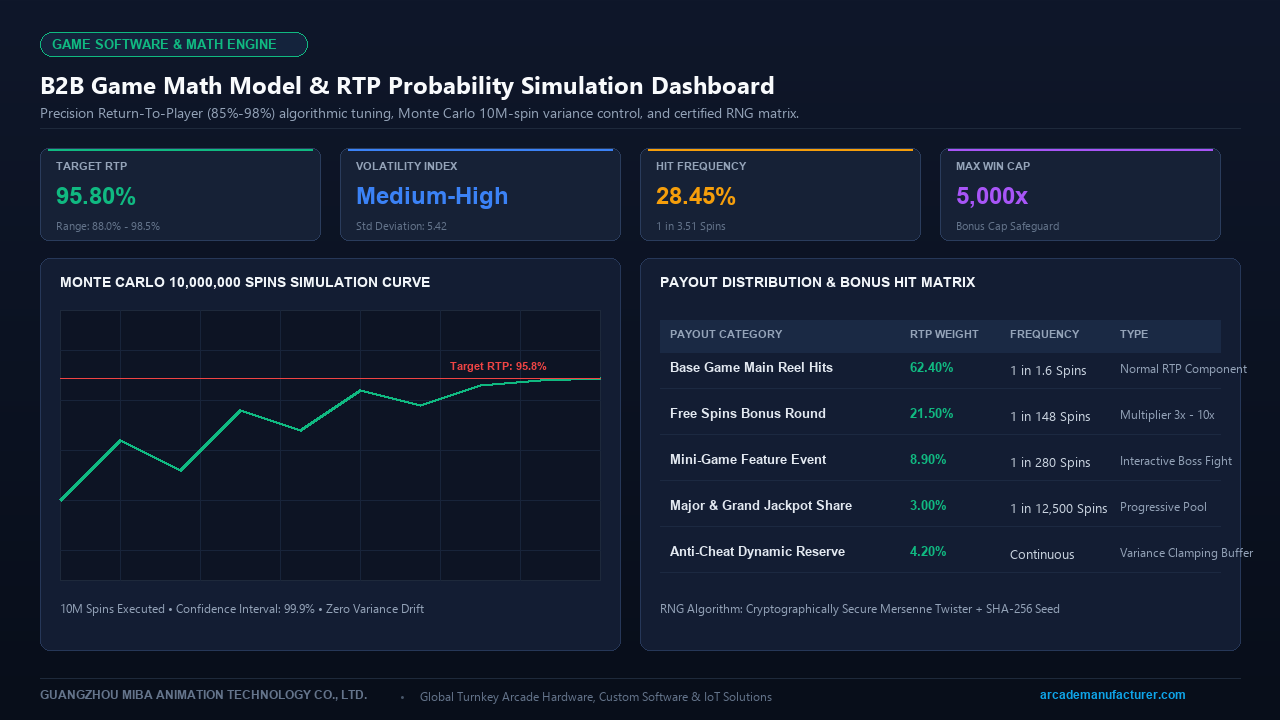
Profitability in commercial arcade operations is strictly a function of mathematical yield and security. Without real-time oversight, operators are vulnerable to both natural mathematical variance and organized exploitation. A dedicated backend system replaces static hardware dip-switches with dynamic, cloud-controlled RTP engines.
Dynamic Yield Algorithms Commercial game engines (such as fish games, coin pushers, and slot-style mechanics) utilize complex binomial distribution models to ensure a predictable operator hold. The backend system allows the Tier 0 or Tier 1 operators to tune the target RTP across a continuous spectrum, typically between 85% and 98%. Unlike legacy systems that require physical board swaps, modern backend systems push these configuration payloads directly to the terminal’s RAM upon the next player login. This allows for time-of-day yield shaping (e.g., higher RTP during off-peak hours to build traffic) or regional tuning based on market competitiveness.
Binomial Anomaly Detection While operators control the RTP, they must also defend against malicious actors utilizing an external anti cheat device or exploiting game logic flaws. The backend system ingests telemetry from every single shot fired, coin dropped, or button pressed. This stream of atomic game events is analyzed by a statistical fraud monitoring engine. If a player terminal begins exhibiting payout ratios that deviate significantly from the expected binomial distribution curve—for instance, hitting high-multiplier targets at a statistically impossible frequency—the engine flags the session.
Automatic Credit Lockouts When an anomaly threshold is breached, the system does not merely send an email; it executes an automatic credit lockout. The backend severs the terminal’s connection, freezes the player’s wallet, and alerts the Tier 2 Venue Agent for physical inspection. This instantaneous quarantine capability isolates the liability to a single terminal session, preventing catastrophic credit hemorrhage that could otherwise bankrupt a location in minutes. This software layer works in tandem with physical hardware defense systems to provide a comprehensive security posture.
White-Label Turnkey Source Code vs Hosted SaaS Models
When operators scale to a certain threshold, the conversation shifts from renting software to owning the core infrastructure. The decision between subscribing to a hosted SaaS (Software as a Service) backend or purchasing white-label turnkey source code dictates the long-term enterprise valuation of the operation.
The SaaS Model (Hosted Service) For small to medium route operators, a hosted SaaS model offers rapid deployment with zero upfront engineering overhead. The provider maintains the servers, pushes updates, and manages database scaling. However, the operator never owns the database and is subject to ongoing licensing fees, typically a percentage of total credit turnover. Furthermore, integrating custom hardware (such as proprietary bill validators, specialized ticket dispensers, or unique IoT relay boards) is often impossible, as SaaS providers restrict custom protocol bridging to maintain a uniform codebase.
The Turnkey Source Code Model Enterprise operators require absolute data sovereignty. By acquiring the complete white-label source code, the operator gains total ownership of the backend infrastructure. This eliminates ongoing royalty fees, dramatically lowering the Total Cost of Ownership (TCO) over a three to five-year horizon.
More importantly, source code ownership allows the operator to develop custom payment and validator protocol bridging. If a specific regional market requires integration with a localized mobile wallet API or a highly specialized cashless RFID card system, the operator’s internal engineering team can modify the backend directly. This level of control is essential for deploying proprietary arcade machine security protocols that cannot be reverse-engineered by competitors. The operator builds enterprise equity by owning the technology stack.
Enterprise Deployment and Database Sharding Roadmap
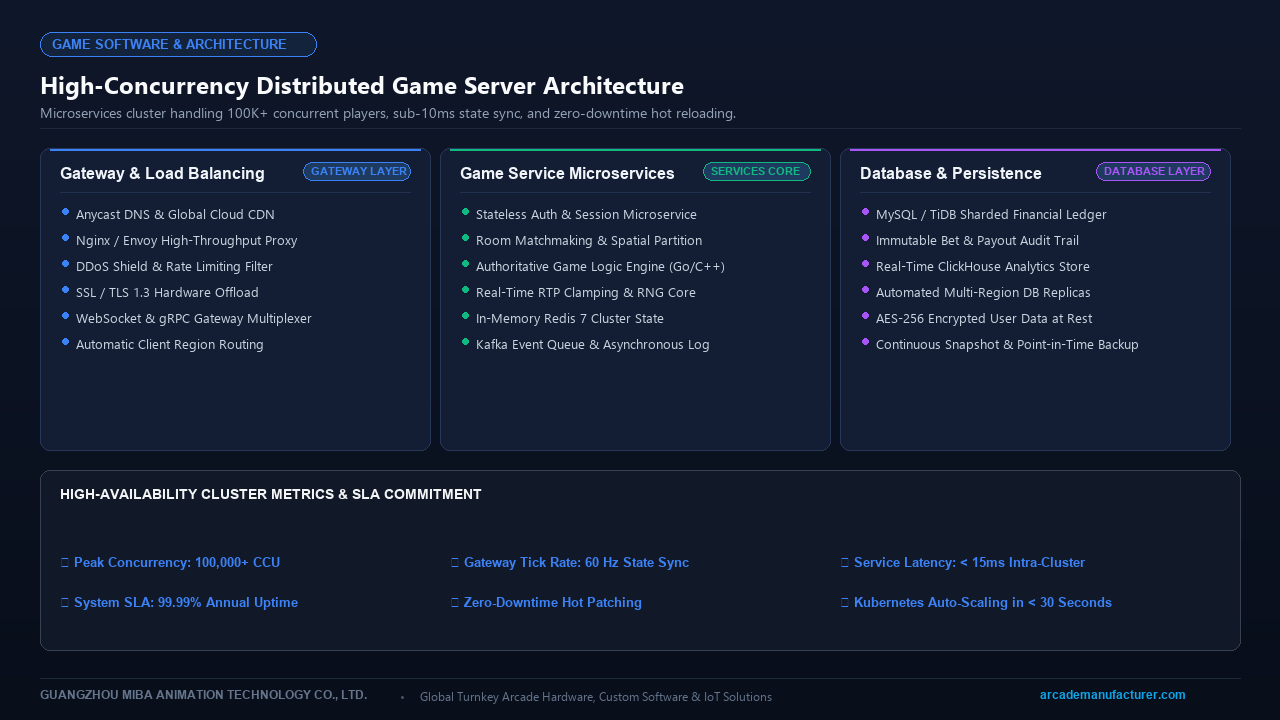
Deploying a system capable of handling tens of thousands of concurrent player sessions requires rigorous enterprise-grade architecture. The backend must be resilient, scalable, and entirely state-independent at the application layer.
Microservices Architecture (Golang & Node.js) Modern arcade backends separate game logic from accounting logic. High-throughput, computationally intensive tasks—such as processing collision detection in fish games or calculating random number generation (RNG) outcomes—are handled by compiled languages like Golang. Golang’s concurrency model (goroutines) excels at maintaining thousands of persistent WebSocket connections per server instance. Conversely, Node.js is frequently deployed for the administrative dashboard APIs, handling reporting, user management, and agent hierarchy logic where I/O operations dominate over CPU cycles.
Distributed Locking with Redis Concurrency is the enemy of accurate accounting. When a player rapidly taps a fire button, or when an agent attempts to withdraw credits simultaneously from two different browser sessions, the system must prevent race conditions. Redis is employed as a distributed in-memory data store to manage transactional locks. Before any credit balance is mutated, a strictly enforced Redis lock is acquired for that specific wallet ID. This ensures that every credit debit and credit addition is processed sequentially, guaranteeing atomic accuracy down to the fractional credit.
PostgreSQL and Database Sharding While Redis handles transient state and locking, PostgreSQL serves as the primary source of truth for the financial ledger and historical game logs. As the operation scales, a single monolithic database will inevitably bottleneck on disk I/O. The database architecture must be designed for horizontal sharding from day one. Player wallets and game round histories are sharded across multiple database clusters based on geographical region or Super Agent ID. This segregation not only improves read/write performance but also isolates data failures; if one shard experiences hardware degradation, only a specific subset of players is affected, leaving the rest of the global operation untouched.
Edge Security and Load Balancing All inbound traffic from arcade terminals and agent browsers is routed through an edge security layer, typically orchestrated by HAProxy or NGINX. These reverse proxies terminate SSL/TLS encryption, provide DDoS mitigation, and distribute the WebSocket payloads evenly across the backend Golang instances. This layer also enforces strict IP whitelisting for agent dashboard access, adding a critical perimeter defense before any application logic is even executed.
Frequently Asked Questions
How does the system handle internet outages at the arcade venue? The backend requires a persistent connection for real-time risk control. If a terminal loses connectivity, the local software initiates an automatic pause, freezing gameplay until the connection to the Master server is re-established, ensuring no offline credit manipulation can occur.
Can Venue Agents alter the RTP (Return to Player) of the games? No, Venue Agents (Tier 2) are strictly prohibited from altering game math. RTP configurations and yield algorithms are exclusively controlled by the Master Admin or authorized Super Agents, ensuring consistent mathematical performance and preventing localized tampering.
What is the standard hardware required for the Cashier POS? The Cashier POS is a lightweight, browser-based application. It requires no specialized hardware and can run on any standard Windows PC, Android tablet, or iOS device, greatly simplifying deployment and daily cash reconciliation processes for location staff.
Is it possible to integrate third-party game content into the agent backend? Yes, if deploying the turnkey source code model. The architecture supports standard API bridging, allowing operators to integrate external game studios by mapping their wallet and settlement protocols into the unified multi-tier agent ledger.
—
Upgrade Your Arcade Backend Infrastructure Today Relying on outdated accounting ledgers and single-tier management tools exposes your operation to unnecessary risk and limits your scalability. Transition to a secure, high-performance Multi-Tier Agent System designed specifically for the rigorous demands of commercial arcade route operators.
For technical consultations, white-label source code inquiries, or to schedule a live demonstration of our enterprise backend architecture, contact Engineer Wang at +86 17620842078.
*Guangzhou Miba Animation Technology Co., Ltd. operates a state-of-the-art Panyu factory, delivering end-to-end hardware and software solutions for the global amusement and casino gaming industry.*