- Physical Console Wiring Modification and Optocoupler Isolation
- Eight Direction Joystick Pulse Conversion Architecture
- Turbo Firing Button Pulse Injection and Debounce Filtering
- Multi Station Address Bus Architecture RS485 and CAN Bus
- Coin In and Coin Out Pulse Synthesis
- Hardware Watchdog and Power Cycle Relay Integration
- Frequently Asked Questions
Transitioning physical arcade hardware into a cloud-native teleoperation environment requires absolute precision at the circuit board level. Our Panyu 15,000m² manufacturing base engineers turnkey solutions that bypass traditional mechanical switches and integrate industrial IoT architectures directly into the game board’s logic layer.
I am Engineer Wang, Lead Teleoperation and Hardware Systems Architect at Guangzhou Miba Animation Technology Co., Ltd. (Arcade Manufacturer). In this technical teardown, we will examine the precise hardware modifications required to convert standard 6-player and 8-player commercial fish tables into scalable, latency-free remote live gaming nodes. We do not focus on selling loose spare parts; we build complete machine solutions and industrial IoT arcade controller board arrays for professional operators.
Physical Console Wiring Modification and Optocoupler Isolation
The first step in any remote live fish table machine custom deployment is the complete removal of the physical console wire harness. Traditional microswitches rely on mechanical contacts that bounce, degrade, and are highly susceptible to static discharge.
In our modified server-farm architecture, we replace these mechanical switches with high-speed solid-state relays (SSRs). The input from the cloud (triggered by the player’s mobile app) is routed through our edge gateway, which then drives the SSRs.
Crucially, we implement 2,500V optocoupler isolation between our control logic and the game board’s inputs. The game boards operate on 5V or 12V logic levels, and any ground loop or voltage spike injected into these pins can permanently damage the processor. Optoisolators use an internal LED and phototransistor to transmit the signal purely via light. This means there is zero electrical continuity between the IoT controller network and the arcade motherboard, ensuring bulletproof stability across the entire multi-station array.
Eight Direction Joystick Pulse Conversion Architecture
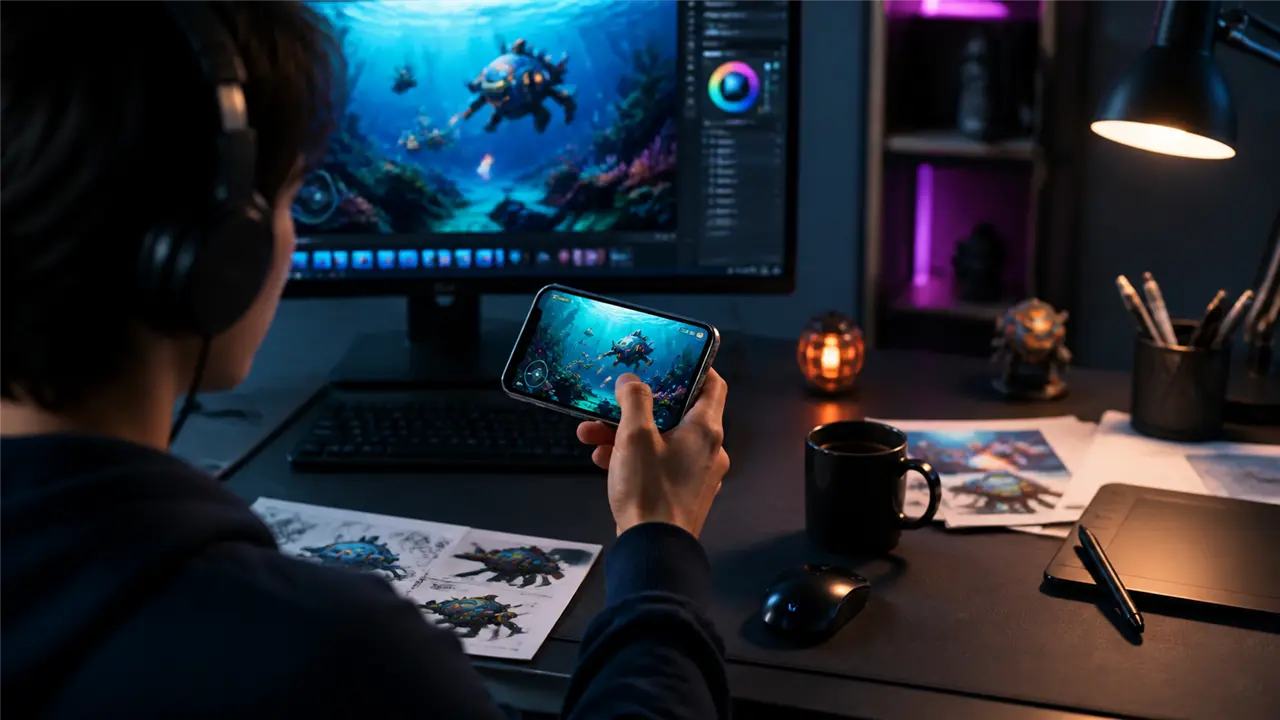
Translating digital joystick microswitches into high-speed MCU GPIO trigger pulses requires careful timing and logic mapping. A physical 8-way arcade joystick operates by triggering two adjacent microswitches simultaneously to register diagonal movement.
When a remote player drags the virtual joystick on their phone, the app calculates the exact vector angle. Our backend translates this angle into standard 8-way digital logic and transmits it via WebSockets. Upon receiving this payload, our edge gateway generates precise, synchronized GPIO pulses.
If the player aims “Up-Right”, the gateway must fire both the “Up” SSR and the “Right” SSR simultaneously with zero nanoseconds of skew. Any microsecond delay between the two signals might cause the game board to register a brief “Up” followed by an “Up-Right”, resulting in jerky, inaccurate aiming that frustrates the player. Our bare-metal ARM firmware ensures absolute timing synchronization across all directional channels.
Turbo Firing Button Pulse Injection and Debounce Filtering
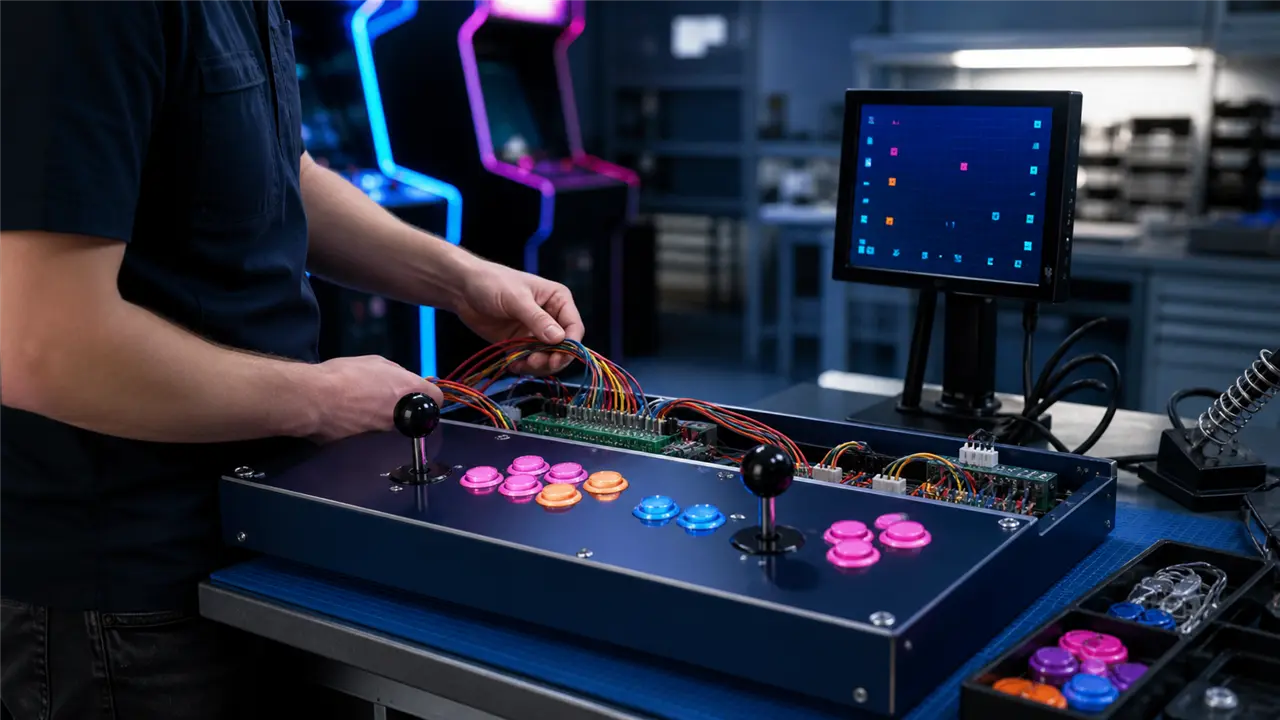
The “Fire” button in modern fish games is subject to intense abuse. Players expect high-speed turbo functionality. However, directly injecting high-frequency pulses into a game board designed for human hands can trigger buffer overflows or anti-cheat mechanisms.
Our remote live arcade turnkey system implements strict firmware-level debounce filtering. We inject pulses with a rigorously controlled duration, typically between 5ms and 15ms.
Furthermore, we enforce frequency throttling. If a network packet bursts, delivering 50 “fire” commands in 10 milliseconds, our controller queues these commands and metes them out at a safe, maximum sustainable rate that the game board can process without crashing. This ensures that every shot is registered accurately without compromising the stability of the host hardware.
Multi Station Address Bus Architecture RS485 and CAN Bus
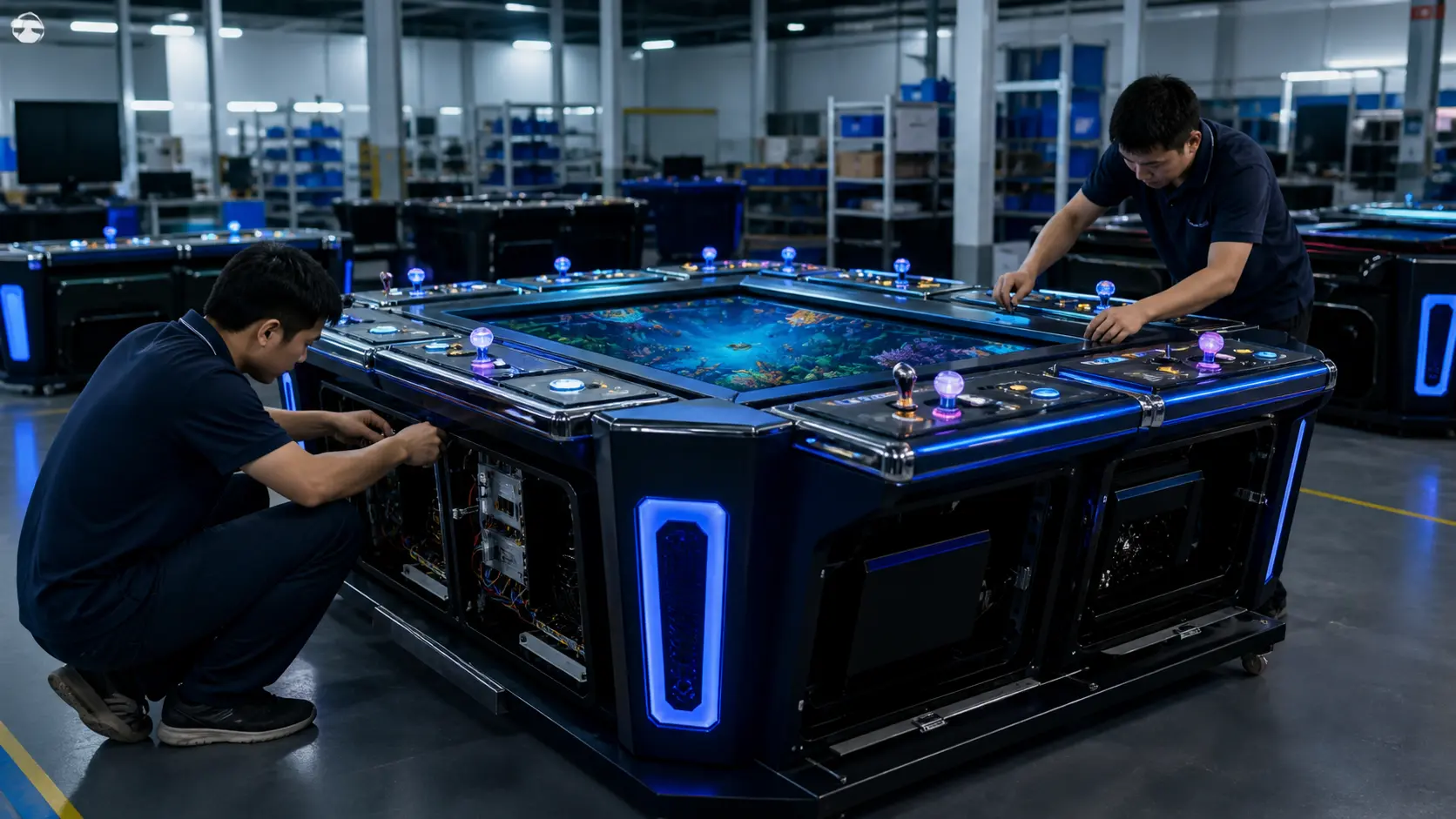
Managing an 8-player fish table requires coordinating 8 distinct input nodes. Running hundreds of individual wires from a central server to every pin on the JAMMA edge connector is a nightmare for maintenance and electrical noise.
Instead, we utilize a multi-drop RS-485 or CAN bus network. A centralized industrial ARM gateway receives all incoming WebSockets traffic from the cloud. This gateway acts as the master node. Connected to it via a single twisted-pair data cable are 8 slave nodes (one for each player station).
When the gateway receives a command for Player 5, it broadcasts a packet on the RS-485 bus addressed specifically to Node 5. Node 5 parses the packet and triggers the corresponding optocouplers. This bus architecture drastically reduces wiring complexity, immunizes the system against electromagnetic interference, and allows for rapid swapping of individual station nodes if a failure occurs.
Coin In and Coin Out Pulse Synthesis
Financial accuracy is the lifeblood of operator revenue. Mechanical coin acceptors and hopper dispensers are obsolete in the cloud model. We synthesize these signals electronically.
Our system simulates physical coin acceptor pulse trains with zero signal bounce. Standard arcade hardware expects a strict waveform: typically 100ms high voltage followed by 100ms low voltage. Our microcontrollers generate mathematically perfect square waves.
When a player credits their account online, the backend instructs the IoT gateway to synthesize, for example, 50 coin-in pulses. The gateway executes this pulse train flawlessly, ensuring the game board’s internal accounting precisely matches the cloud ledger. We apply the same precision to coin-out signals, ensuring every virtual cent is tracked and verified.
Hardware Watchdog and Power Cycle Relay Integration
Even the most robust commercial fish table game machine cabinet engineering occasionally encounters frozen motherboards. In a remote deployment, an operator cannot simply walk over and flip the switch.
Every station in our rack architecture features an integrated hardware watchdog timer and a heavy-duty power cycle relay. The edge gateway constantly monitors heartbeat signals from the game board (often tied to the video sync signal from the remote fish table WebRTC video streaming capture card).
If the heartbeat ceases, or if an integrated fish table anti jammer device engineering sensor detects anomalous electromagnetic interference, the watchdog automatically commands the power relay to cut the 12V supply to the motherboard for 5 seconds before restoring it. This self-healing mechanism guarantees maximum uptime without requiring costly human intervention.
We invite B2B operators to verify our engineering firsthand. We provide complete turnkey systems ready for immediate deployment and revenue generation.
For project consultations, factory video tours, and custom integrations, reach out to our engineering team
WhatsApp/WeChat: +86 17620842078 Telegram: https://t.me/JLwyc Email: miba515527@gmail.com
Frequently Asked Questions
Why is optocoupler isolation necessary for remote fish tables
Optocoupler isolation physically separates the electrical circuits of the IoT controller and the game board using light. This prevents ground loops, static spikes, and voltage mismatches from damaging the sensitive logic chips on the game motherboard, ensuring long-term stability.
Can your IoT controllers interface with proprietary 10 player boards
Yes. Our multi-drop RS-485 architecture is highly scalable. We can easily daisy-chain 10 slave nodes to the master gateway, perfectly matching the I/O requirements of customized 10-player fish game motherboards.
How do you ensure joystick accuracy without mechanical switches
We translate the analog/vector input from the player’s touchscreen into precise digital logic states. Our ARM microcontrollers generate these digital states (Up, Down, Left, Right, and exact diagonals) with microsecond synchronization, completely eliminating the mechanical bounce and inaccuracy inherent in physical microswitches.
What happens if the network connection drops while a player is firing
Our edge gateway firmware includes fail-safe logic. If the WebSocket connection from the cloud drops, the gateway immediately clears all active relay states (stops firing, centers joystick) to prevent the game board from registering stuck inputs while the player is disconnected.
Do you supply the complete modified game boards or just the controllers
We are a complete machine manufacturer. We supply fully integrated, rack-mounted solutions that include the original game board, our proprietary IoT controller arrays, power distribution, and video capture hardware, fully tested and ready to plug in.