Maximizing revenue per square foot remains the ultimate metric for venue owners and route operators in decentralized gaming environments. In locations where floor space commands a premium such as bars, taverns, convenience stores, truck stops, and laundromats, deploying full-size standalone cabinets is often geometrically and economically unfeasible. The engineering solution to this spatial constraint lies in the deployment of compact bartop skill game cabinets. These highly engineered countertop enclosures transform previously unmonetized bar counters and checkout areas into high-yield transaction nodes without compromising pedestrian traffic flow or core venue operations.
The architecture of a bartop skill game cabinet builder compact enclosure requires a rigorous balance between diminutive physical dimensions and uncompromising commercial-grade durability. Unlike consumer electronics, route operator hardware must withstand continuous public use, liquid spills, thermal stress from confined operating environments, and attempted tampering. By utilizing precision-fabricated cold-rolled steel enclosures, customized peripheral integration, and advanced thermal dissipation mechanics, manufacturers can deliver robust hardware platforms that rival the uptime and security of their full-size counterparts. For a comprehensive architectural overview and turnkey procurement frameworks, review our master guide on custom slot cabinet OEM factory. For further architectural integration standards, refer to How Operators Procure Wholesale Casino Redemption. For factory-direct procurement and comprehensive engineering specs, consult our master guide on complete commercial arcade machines factory guide.
Operators evaluating countertop hardware must analyze specific engineering parameters including weight distribution physics, mounting surface anchoring dynamics, and capacitive touch sensitivity under adverse environmental conditions. Understanding the interplay between compact bill validator integration, motherboard form factors, and field serviceability ensures that route technicians can maintain high machine availability metrics. This technical analysis explores the critical hardware design decisions that enable venue owners to leverage compact metal enclosures for maximum floor yield. For further architectural integration standards, refer to How Casino Machine Manufacturers Engineer OEM.
If your route operation requires engineered countertop solutions that maximize earning density, Engineer Wang and our hardware architecture team provide custom enclosure design and mass manufacturing. Reach out via WhatsApp at +86 17620842078, connect on Telegram at https://t.me/JLwyc, or email miba515527@gmail.com for technical specifications and prototype deployment.
Space Optimization and Form Factor Engineering
The primary design imperative for a countertop gaming machine revolves around minimizing the volumetric footprint while maintaining ergonomic accessibility for the player. Engineers define the operational envelope of a standard bartop cabinet within rigid dimensional constraints. A typical high-performance enclosure occupies a footprint of under 24 inches in width and 20 inches in depth, with a height carefully calibrated to maintain a low center of gravity. This specific geometric envelope ensures compatibility with standard bar counters which typically measure between 24 and 30 inches in depth.
Weight distribution physics plays a critical role in countertop cabinet design. Unlike floor-standing units anchored by gravity and wide bases, bartop enclosures must resist tipping forces applied by players interacting with the touch screen or button deck. To achieve static equilibrium, manufacturers utilize a heavy-gauge steel baseplate, often fabricated from 2.0mm or 2.5mm cold-rolled steel (CRS), which concentrates mass at the lowest possible elevation. The structural chassis is continuously welded to provide torsional rigidity, preventing flex when subjected to asymmetric loads. The calculation for the tipping moment $M_t = F_p \times H_p$ (where $F_p$ is the player force and $H_p$ is the height of force application) dictates that the center of gravity must fall well within the polygon of support provided by the cabinet base.
To further stabilize the hardware against dynamic lateral forces, engineers employ advanced anchoring mechanisms. For installations requiring non-destructive mounting, industrial-grade elastomeric feet with high coefficients of friction (typically synthetic rubber compounds with a Shore A hardness of 60-70) are utilized to grip smooth bar surfaces. For permanent route deployments, counter-lock anchoring systems are implemented. These involve specialized mounting brackets or internal baseplate apertures that allow lag bolts or machine screws to secure the chassis directly into the substrate. Additionally, VESA-compliant wall-mount brackets can be integrated into the rear chassis panel, allowing the unit to function as a wall-mounted terminal, entirely freeing the horizontal counter space.
The internal volume allocation within these compact constraints demands rigorous spatial planning. Component placement is optimized using 3D CAD modeling to eliminate wasted space while preserving mandatory clearance tolerances for airflow and peripheral mechanisms. The coin pulse acceptor and bill validator must be positioned for ergonomic user access while their internal cash boxes remain securely nested within the primary locking zone. The integration of Mini-ITX or custom embedded motherboards further reduces internal volume requirements, allowing for the precise alignment of power supply units (PSUs) and interface harnesses within the restricted chassis dimensions.
Display and Input Hardware Architecture
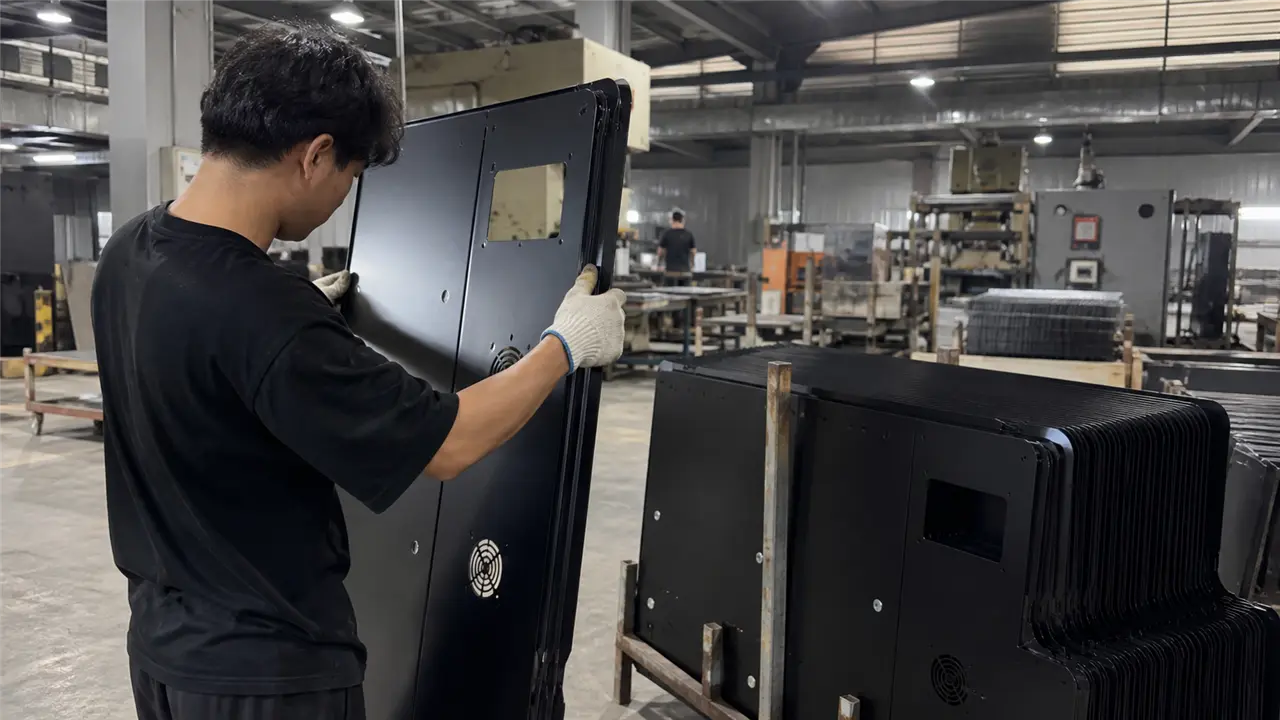
The human-machine interface (HMI) of a bartop skill game cabinet requires specialized display and input hardware tailored to the unique viewing angles and ergonomic constraints of countertop gaming. Standard configurations utilize industrial-grade liquid crystal displays (LCDs) ranging from 19 inches to 21.5 inches, mounted in either portrait or landscape orientation depending on the game software aspect ratio requirements.
These displays must feature wide-angle viewing technologies, such as In-Plane Switching (IPS), to accommodate players of varying heights standing or sitting at a bar. A standard minimum viewing angle specification is $178^\circ / 178^\circ$ (Horizontal/Vertical) with a typical contrast ratio of 1000:1 and a high brightness rating of 350 to 500 nits. This elevated luminance combats glare from overhead venue lighting and neon signs prevalent in tavern environments.
Touchscreen interaction relies on highly calibrated Projected Capacitive (PCAP) glass interfaces. The touch sensor matrix is chemically bonded to a vandal-resistant tempered cover glass, typically 3mm to 4mm in thickness. This cover glass achieves a Mohs hardness rating of 7, providing exceptional resistance to scratching from rings, keys, or coins. Crucially for bar environments, the PCAP controller firmware must be tuned for spill resistance and false-touch rejection. Advanced controllers differentiate between the dielectric signature of a human finger and conductive liquids, ensuring that a spilled beverage does not trigger erratic input signals or disrupt active gameplay.
Input hardware extends beyond the touchscreen to include mechanical pushbuttons and secure payment peripherals. Arcade-grade microswitch buttons (such as Sanwa or highly durable generic equivalents) are mounted on angled steel control decks, utilizing custom wiring harnesses with secure Molex connectors to prevent disconnection due to vibration.
Payment processing in a compact enclosure demands the integration of specialized, low-profile currency validators. Standard full-size bill acceptors are often incompatible with bartop dimensional constraints. Route operators rely on compact bill validators from manufacturers like Pyramid, ICT, or MEI, which feature shortened stacker mechanisms or stackerless designs. A compact 300-note or 500-note cashbox is strategically positioned to maximize capacity within the minimal depth profile. These validators interface with the mainboard via standard protocols such as pulse, ccTalk, or RS-232, ensuring seamless credit registration in high-transaction velocity environments.
For route operators seeking to deploy specialized hardware configurations or upgrade their current countertop fleet with advanced capacitive touch arrays and compact currency validators, our engineering department provides end-to-end integration support. Contact Engineer Wang directly on WhatsApp at +86 17620842078, reach out via Telegram at https://t.me/JLwyc, or send your specifications to miba515527@gmail.com for a comprehensive hardware consultation.
Thermal Dissipation and Security in Tight Enclosures
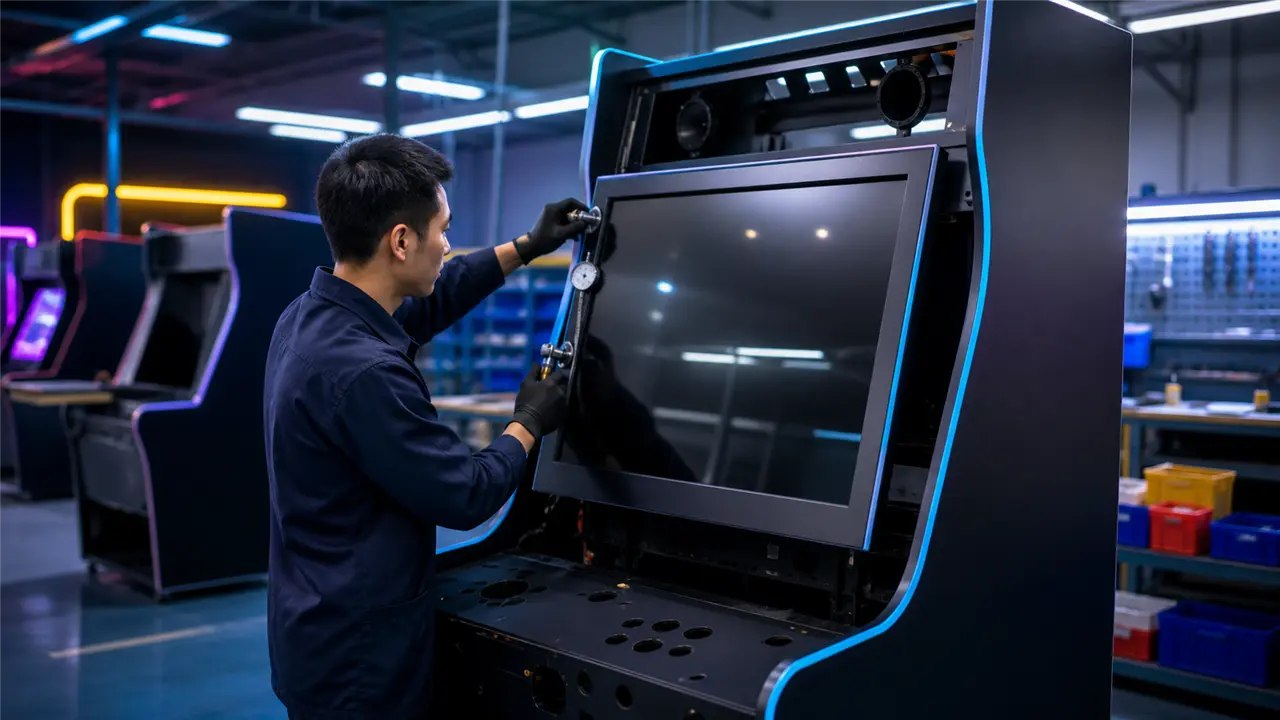
Operating high-performance processing units within a highly constrained, sealed metal volume presents profound thermodynamic challenges. Without adequate thermal management, the internal ambient temperature of a bartop enclosure can rapidly exceed the safe operating thresholds of electronic components, leading to CPU throttling, capacitor degradation, and catastrophic hardware failure.
The thermodynamics of a compact cabinet are governed by the equation for heat transfer $Q = \dot{m} C_p \Delta T$. To maximize heat extraction ($Q$), engineers must optimize the mass flow rate of air ($\dot{m}$) while strategically directing the airflow pathway. Active cooling solutions utilize low-profile, high-static-pressure fans, typically operating at 12V DC with dual ball bearings for extended lifespan (rated for 50,000+ hours MTBF). These fans are strategically positioned to create a directional air corridor. Cold air is drawn through filtered intake vents located near the base of the cabinet, forced across the motherboard heatsinks and PSU, and exhausted through upper rear louvers.
Internal baffle plates play a crucial role in heat isolation. By partitioning the internal volume, engineers can segregate high-heat components (such as the CPU and GPU) from temperature-sensitive peripherals (such as the LCD inverter and bill validator optical sensors). These sheet metal baffles prevent localized thermal pooling and ensure laminar airflow across critical heat-generating surfaces. The exhaust acoustics are also carefully managed; pulse-width modulation (PWM) controllers dynamically adjust fan RPM based on internal thermistor readings, ensuring silent operation during idle periods to maintain an unobtrusive presence in quieter venue environments.
Security engineering is equally critical in countertop designs. Because these units handle significant cash volume and are situated in unmonitored locations, the physical enclosure must act as a fortress. Cabinets are constructed from precision-bent 1.2mm to 1.5mm cold-rolled steel, utilizing interlocking seam designs that eliminate pry points and vulnerability gaps.
Locking mechanisms utilize high-security tubular cam locks or robust padlock hasps. For multi-location route management, key-alike lock options allow technicians to service hundreds of machines across different venues without managing an unwieldy key inventory. The vault area securing the cashbox features reinforced strike plates and internal steel gussets to resist aggressive leverage attacks. Furthermore, tamper-evident microswitches are wired to the I/O board; if the cabinet door is breached while powered, the system immediately registers an intrusion event, locking down software operations and triggering a localized audible alarm or remote network alert.
Route Operator Revenue and Maintenance Operations
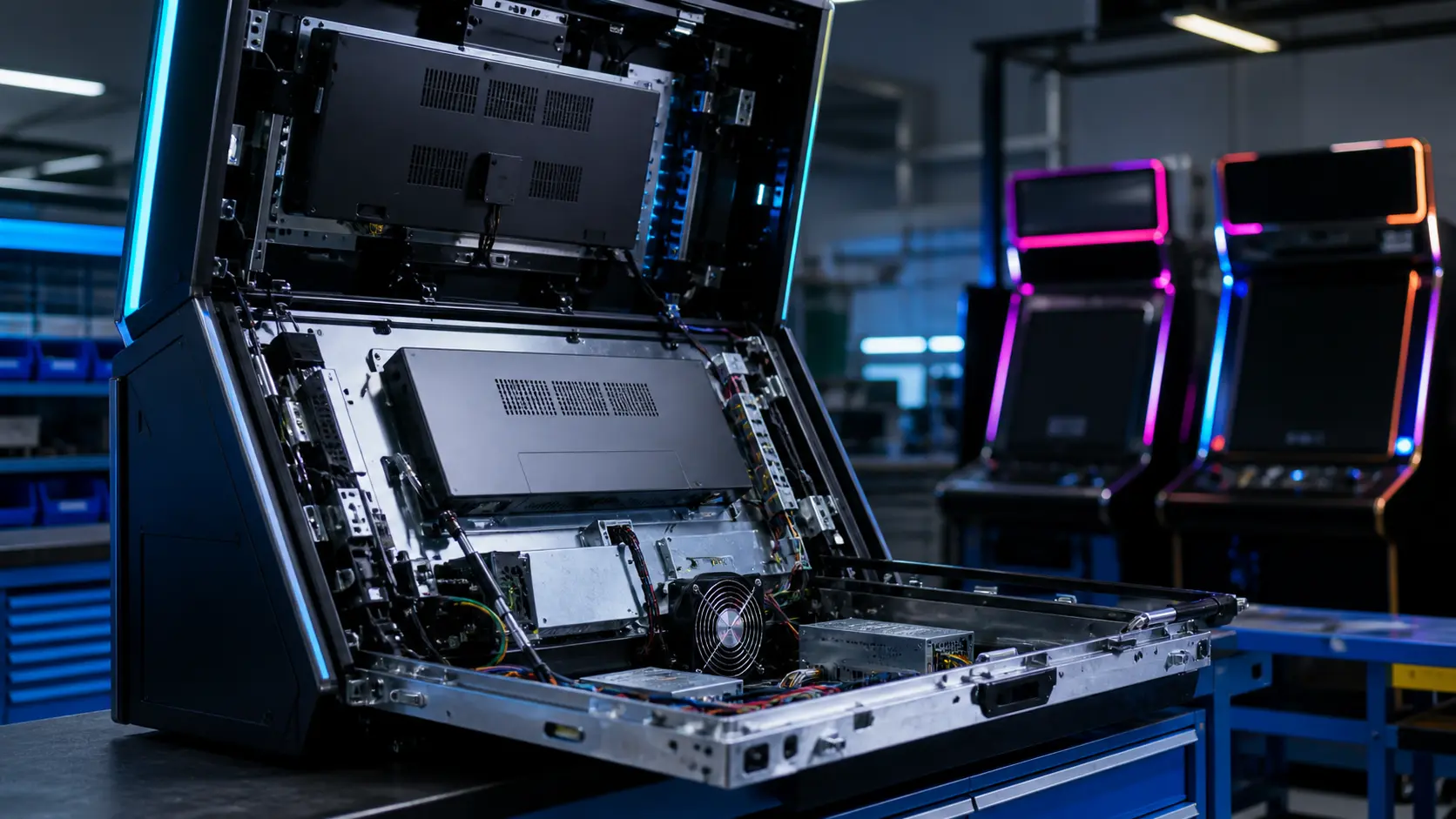
The financial viability of decentralized route gaming hinges not only on high machine turnover but also on minimized operational expenditure (OpEx). Routine maintenance, hardware failures, and cash collection must be executed with maximal efficiency to preserve profit margins. The engineering of a compact skill game cabinet directly impacts the speed and efficiency of field service operations.
To minimize mean time to repair (MTTR), modern countertop enclosures utilize quick-swap internal architecture. Motherboards and critical logic PCBs are mounted on slide-out metal rails or quick-release brackets. If a logic board fails, a field technician can unlock the cabinet, disconnect a centralized ATX harness, and swap the entire computing module in under 180 seconds, requiring no specialized soldering or deep diagnostic work on-site. This modularity ensures that the machine is returned to revenue-generating status immediately, while the defective component is returned to the centralized depot for repair.
External audit meters and robust telemetry systems are essential for revenue tracking and security auditing. While software-based accounting is standard, hardwired electromechanical meters are often mounted internally (viewable through a secure acrylic window or upon opening the main door) to provide an immutable record of coin-in, coin-out, and total credits played. This dual-accounting system prevents revenue skimming and ensures accurate profit-sharing calculations between the route operator and the venue owner.
Advanced route operations leverage remote telemetry dongles integrated into the cabinet’s internal network architecture. Utilizing 4G LTE cellular modems or secured Wi-Fi bridges, the cabinet transmits encrypted JSON payloads to a centralized management dashboard. These payloads contain real-time metrics including hopper levels, bill validator stacker status, CPU temperatures, and error codes. By analyzing this telemetry data, operators can implement predictive maintenance scheduling—dispatching technicians only when a machine is nearing coin capacity or displaying a preemptive hardware fault, thereby drastically reducing unnecessary site visits and optimizing fleet logistics.
The deployment of bartop skill game cabinets represents a highly lucrative intersection of mechanical engineering, component miniaturization, and route operator logistics. By converting unused counter space into high-density profit centers, venue owners maximize their real estate yield while operators expand their network footprint with minimal physical overhead.
Transform your route operations and maximize your venue floor yield with custom-engineered compact metal enclosures. For wholesale pricing, bespoke cabinet modifications, and technical integration guides, contact Engineer Wang. Reach our manufacturing team on WhatsApp at +86 17620842078, connect via Telegram at https://t.me/JLwyc, or email miba515527@gmail.com to secure your countertop hardware supply chain.
Frequently Asked Questions
What are the standard dimensions for a bartop skill game cabinet?
A professional-grade compact enclosure is typically designed to fit within a footprint of under 24 inches in width and 20 inches in depth. Heights vary based on the screen size (usually 19″ or 21.5″) but are optimized to maintain a low center of gravity and ensure ergonomic viewing angles for seated or standing players without obstructing the bartender’s line of sight.
How is the hardware secured against theft and vandalism in busy bar environments?
Security is achieved through heavy-duty construction using 1.2mm to 1.5mm cold-rolled steel with interlocking seams to eliminate pry points. The cabinets feature high-security tubular cam locks, reinforced internal cashbox vaults, and optional counter-lock anchoring systems that bolt the unit directly to the substrate. Tamper-evident microswitches also trigger alarms if unauthorized access is attempted.
Can compact metal enclosures handle the heat generated by modern gaming motherboards?
Yes, thermal dissipation is managed through rigorous internal aerodynamic engineering. Cabinets employ low-profile, high-static-pressure dual ball bearing fans to create a directional air corridor. Internal sheet metal baffles isolate high-heat components, and PWM controllers dynamically adjust fan speeds based on real-time thermistor readings to prevent CPU throttling while maintaining quiet operation.
Are these compact cabinets easy for technicians to service on location?
Absolutely. Designed with route operators in mind, these cabinets feature quick-swap internal architecture. Motherboards and critical PCBs are mounted on slide-out rails or quick-release brackets, allowing field technicians to replace failing modules in minutes. This modularity minimizes downtime and drastically reduces mean time to repair (MTTR).