- Physical Multiplayer Fish Table Modifications Versus Standard Street Cabinets
- Multi Station Hardware Multiplexing and Signal Routing
- Dual Stream Video Pipeline 4K HDMI Loop Out and Anti Fraud Cameras
- Sub 80ms WebRTC Glass to Glass Latency Architecture
- Cloud Sweepstakes Backend Integration and Dual Currency Ledger
- Industrial Machine Farm Infrastructure and Thermal Management
- Operator ROI Math Model Physical Venue Versus Cloud Farm Density
- Panyu Factory Turnkey Manufacturing and Testing Protocols
- Frequently Asked Questions
The physical arcade machine cloud teleoperation standard requires a robust synthesis of zero-latency video encoding, industrial-grade multi-channel GPIO pulse signal conversion, and high-availability power distribution frameworks. At our Panyu 15,000m² manufacturing base, we engineer turnkey remote live fish table environments that seamlessly transition traditional 8-player physical cabinets into high-density 24/7 cloud server farms, granting global operators uncompromised remote management and maximum revenue density.
Hello, I am Engineer Wang, Lead Teleoperation and Hardware Systems Architect at Guangzhou Miba Animation Technology Co., Ltd. (Arcade Manufacturer). Over my 12 years of designing and debugging both physical commercial fish table game machine cabinet engineering deployments and fish table game source code buyout architecture, I have witnessed operators struggle with disjointed capture cards, laggy remote desktop protocols, and unreliable input multiplexers. We have solved these bottlenecks. Our factory does not merely sell loose spare parts or single controllers. We provide end-to-end complete machine manufacturing, custom game development, and the industrial infrastructure necessary to build profitable remote live arcade operations.
This document dissects our proprietary factory-level deployment topology.
Physical Multiplayer Fish Table Modifications Versus Standard Street Cabinets
The physical demands of a remote fish table farm differ fundamentally from street-level retail arcades. A standard street cabinet prioritizes aesthetic appeal, fiberglass shells, and coin-op physical security. In a remote live server room, floor space density, thermal exhaust, and pure I/O reliability become the absolute priorities.
When we design a remote live arcade turnkey system, we strip away the heavy fiberglass aesthetics and focus on rack-mountable skeleton frames. Traditional 4, 6, 8, and 10-player fish tables feature localized wire harnesses routing microswitch signals directly to the main game board (IGS or custom PC). In our cloud architecture, these physical buttons and joysticks are entirely eliminated. Instead, we interface directly with the game board’s JAMMA or proprietary headers using our industrial ARM-based IoT gateways.
Every station requires exact pulse simulation. If a remote player triggers a high-speed turbo laser weapon, the input translation layer must simulate rapid button presses at precisely 15ms intervals without triggering the game board’s buffer overflow defenses. The transition from physical tactile switches to digital high-speed GPIO triggering demands aerospace-grade optocoupler isolation to prevent electrical crosstalk across the 8 distinct player stations.
Multi Station Hardware Multiplexing and Signal Routing
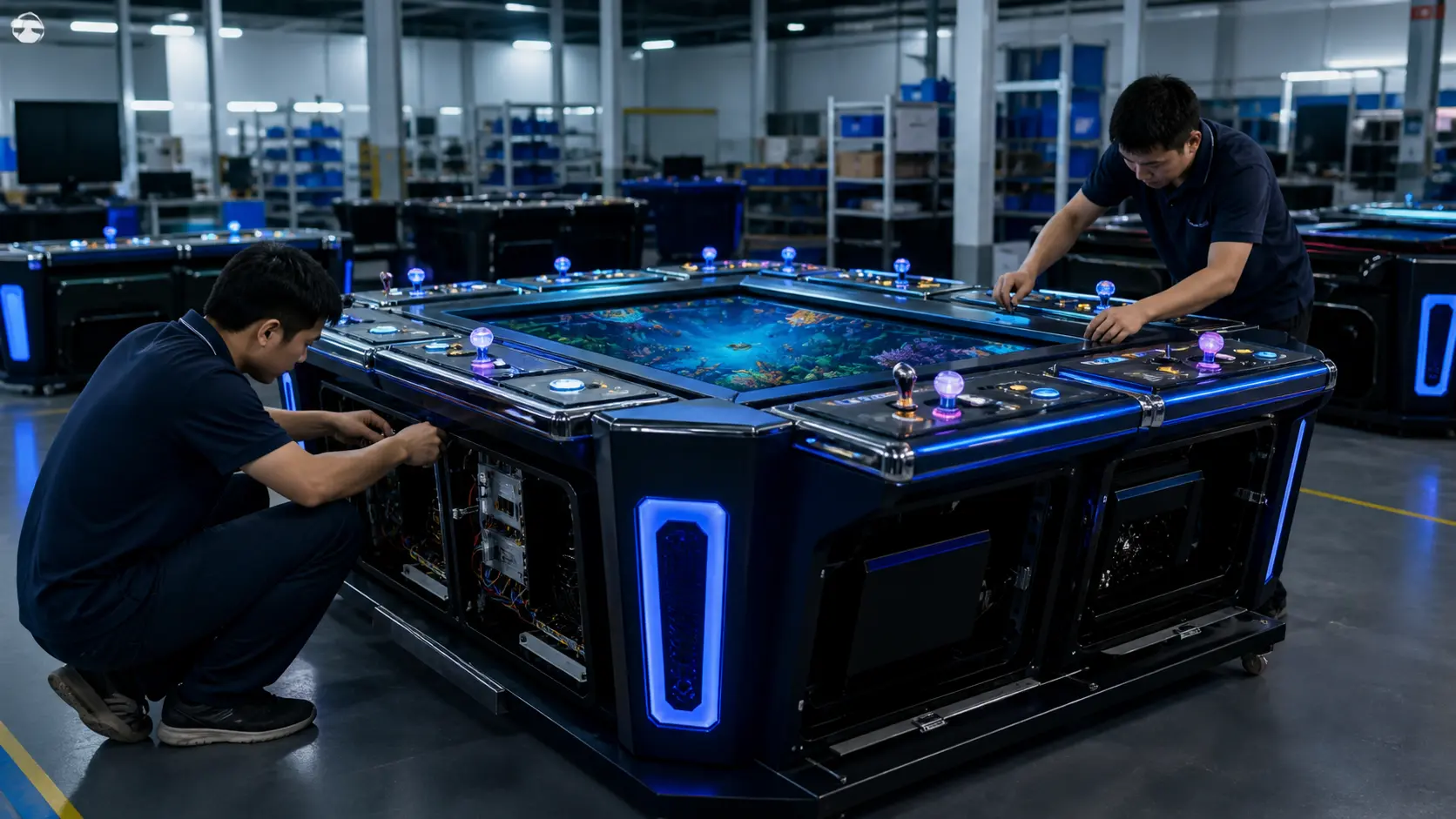
Mapping 8 concurrent remote player sessions to discrete physical game board inputs without crosstalk is a severe engineering challenge. You cannot simply bridge grounds and throw raw voltage pulses into the motherboard.
Our solution relies on a heavily optimized multiplayer remote fish table hardware modification architecture. We utilize a multi-drop RS-485 bus that connects an edge computing gateway to 8 discrete station control nodes. Each node acts as a dedicated slave device, parsing incoming WebSockets commands from the cloud and firing solid-state relays (SSRs) connected to the game board.
These SSRs provide up to 2,500V of optical isolation. When Player 3 on their mobile phone in Texas presses the “Fire” button, the cloud sends a JSON payload to our edge gateway in your server room. The gateway addresses Node 3 via RS-485. Node 3 triggers an optocoupler, which completes the circuit on the game board’s Player 3 Fire pin. The entire process takes less than 8 milliseconds.
This isolation is crucial. It ensures that a voltage spike or ground loop from one station never bleeds into adjacent stations, a common issue in poorly modified DIY remote cabinets that leads to phantom button presses and erratic player accounts.
Dual Stream Video Pipeline 4K HDMI Loop Out and Anti Fraud Cameras

Video latency and clarity directly impact the player’s willingness to bet. A blurry stream or a 500ms delay renders high-stakes fish hunting unplayable. Our factory integrates a rigorous remote fish table WebRTC video streaming pipeline designed for pure commercial performance.
We employ a dual-stream architecture. The primary stream captures the raw digital output of the fish game engine. We use industrial 4K 60fps HDMI capture cards with hardware loop-out capabilities. This intercepts the video signal directly at the GPU level before any monitor processing occurs. The capture card performs hardware H.264/H.265 encoding, offloading the processing burden from the central streaming server.
The secondary stream serves as an anti-fraud trust mechanism. We mount a wide-angle optical camera above the physical cabinet. This camera broadcasts a live view of the actual hardware running in the server room. Players can toggle between the direct HDMI feed (for pixel-perfect gameplay) and the optical camera feed (to verify the physical reality of the machine and the random number generation process). This transparency drastically increases player trust and long-term retention.
Sub 80ms WebRTC Glass to Glass Latency Architecture
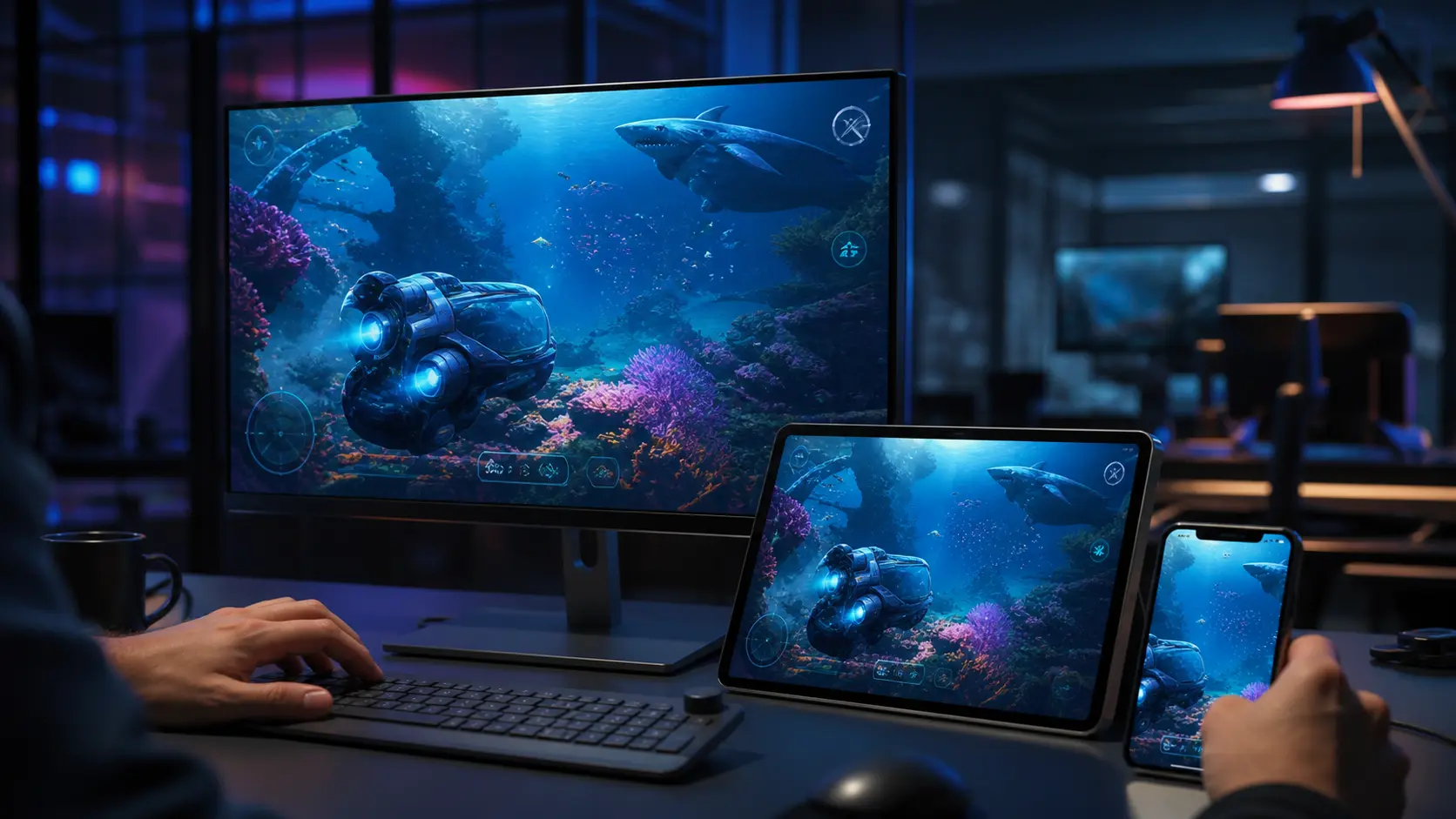
Traditional RTMP streaming introduces 2 to 5 seconds of latency, which is fatal for interactive arcade gaming. We mandate a strict sub-80ms WebRTC glass-to-glass latency architecture.
WebRTC utilizes UDP transport and peer-to-peer or selective forwarding unit (SFU) topologies to minimize packet overhead. Our streaming gateways are heavily customized at the kernel level to bypass standard network stack buffering. Video frames are captured, encoded, and pushed onto the wire with zero intermediate buffering.
Simultaneously, we maintain a persistent, bidirectional WebSocket connection for telemetry and input data. While WebRTC handles the heavy video payload via UDP, WebSockets provide a reliable TCP-backed channel for critical control signals, such as joystick coordinates, fire commands, and credit insertion. This dual-channel approach ensures that even if video packets drop during cellular network congestion, the player’s inputs and account balance remain strictly synchronized.
Cloud Sweepstakes Backend Integration and Dual Currency Ledger
Operating a profitable fish table farm requires seamless integration with existing agent hierarchies and point-of-sale systems. We provide a complete remote fish table room allocation backend that bridges the physical hardware with cloud-based accounting.
Our system supports dynamic seat allocation. If a physical 8-player table is full, the system automatically routes the next player to an available seat on an identical machine in the server farm. This virtual queuing maximizes hardware utilization.
Furthermore, we utilize a dual-currency ledger synchronization model. When an agent tops up a player’s account in the sweepstakes software, the cloud backend translates this fiat or virtual currency into precise hardware coin-in pulses. Our pulse synthesis algorithm mimics physical coin acceptors perfectly, feeding 100ms on / 100ms off pulse trains into the game board. When the player cashes out, the hardware hopper-out pulses are intercepted, verified against the internal game state, and credited back to the cloud ledger instantly.
Industrial Machine Farm Infrastructure and Thermal Management
Scaling from one machine to a farm of 50 machines demands rigorous industrial planning. We design the cloud fish table machine farm deployment with data center mentalities.
We discard standard PC power supplies and utilize heavy-duty Mean Well switching power supplies (LRS series) with active power factor correction. These provide exceptionally clean 12V and 5V rails, critical for preventing logic errors on the game boards.
Thermal exhaust is managed through hot-aisle/cold-aisle rack layouts. Fish game motherboards, particularly those running 3D Unity engines, generate significant heat. We design custom rack enclosures with high-static-pressure delta fans pushing air through the PCB arrays.
Additionally, every station is equipped with hardware watchdog self-healing circuits. If a game board freezes or issues a tilt alarm, the edge gateway detects the absence of heartbeat signals and automatically triggers a hard power-cycle relay. This automated recovery reduces operator intervention and minimizes downtime to mere seconds. We also integrate robust fish table anti jammer device engineering to protect the localized network from any localized electromagnetic interference.
Operator ROI Math Model Physical Venue Versus Cloud Farm Density
The financial shift from retail venues to cloud teleoperation is staggering. When we calculate the turnkey remote fish table deployment costs, the numbers overwhelmingly favor the cloud model.
Consider a physical venue. You are constrained by square footage, local licensing, security personnel, and operating hours. An 8-player fish table occupies roughly 4 square meters and might generate revenue 12 hours a day.
In our cloud server farm model, that same 8-player motherboard is stripped of its cabinet and mounted in a 2U rack space. You can stack 20 motherboards (160 player seats) in a single standard server rack. The system operates 24/7, accessible by players globally.
Assuming a conservative 30% utilization rate and standard sweepstakes hold percentages, our operators consistently report a full return on investment within 45 to 60 days. The elimination of physical cash handling, machine vandalism, and localized zoning restrictions creates an incredibly lucrative and scalable business model.
Panyu Factory Turnkey Manufacturing and Testing Protocols
We do not ship beta products. At our Panyu manufacturing base, every remote server rack undergoes brutal factory acceptance testing before export.
We load-test the WebRTC streaming clusters with simulated packet loss and high jitter to ensure the video degrades gracefully rather than freezing. We run automated scripts that inject 10 million consecutive pulse commands into the IoT gateways to verify that not a single coin-in or fire command is dropped.
We invite all serious operators and B2B buyers to contact us directly. We offer 12-hour video debugging sessions and full transparency into our manufacturing processes. We are not a trading company; we are the source factory.
For complete turnkey hardware configurations, custom game engine development, and immediate pricing, contact our engineering team directly
WhatsApp/WeChat: +86 17620842078 Telegram: https://t.me/JLwyc Email: miba515527@gmail.com
Frequently Asked Questions
How do you handle hardware freezes on the physical game boards remotely
We deploy independent hardware watchdog timers connected to our IoT edge gateways. If the game board stops sending heartbeat signals or the video stream freezes, the gateway triggers an isolated relay that physically cuts and restores the 12V power to that specific motherboard, rebooting it in seconds without manual intervention.
Can your system support both fiat currency and crypto wallet integration
Yes. The physical arcade board only understands electrical pulses. Our cloud sweepstakes backend handles the fiat, crypto, or virtual currency ledger. When a transaction clears online, the backend commands the edge gateway to generate the exact number of standard coin-in pulses required by the game board’s accounting settings.
What is the maximum number of simultaneous players one physical board can support in your cloud
A standard fish game motherboard supports 4, 6, 8, or 10 discrete player I/O ports. Our IoT controllers map 1:1 to these physical ports. We maximize utilization by instantly routing new online players to any vacant port across the entire server farm, effectively creating an infinite lobby for the players.
Do you provide the complete metal racks and power distribution units
Absolutely. As a complete machine manufacturer, we fabricate custom high-density server racks specifically designed for arcade motherboard form factors. These include integrated Mean Well industrial power supplies, active thermal exhaust systems, and pre-wired RS-485 communication buses.
How do we prevent players from using macro software to exploit rapid fire
Our IoT edge gateways feature firmware-level debounce filtering and frequency throttling. Even if a remote player uses software to send 1,000 clicks per second, our controller limits the physical pulse injection to the motherboard to a safe maximum frequency, preventing buffer overflows and maintaining game math integrity.