- Cryptographically Secure Virtual Card Shoe Physics and PRNG Shuffling
- Baccarat Drawing Rules Engine and Zero Latency Execution
- Trend Forecasting and Real Time Roadmap Generation
- Side Bet Mathematical Odds and House Edge Calibration
- Dragon Tiger Fast Action Variant Engineering
- Integrating Software with Stadium Terminal Cabinets
- Commercial ROI and Operator Revenue Maximization
- Contact Engineer Wang for Source Code and Turnkey Solutions
- Frequently Asked Questions
- Deep Dive Into Baccarat Matrix State Machine Architecture
- Industrial Hardware and Shielding for Game Fairness
- Advanced Data Analytics and Operator Dashboards
- Scalability from VIP Rooms to Stadium Arenas
The global casino landscape demands unparalleled precision when migrating traditional felt tables to digital terminals. Operators face extreme pressure to deliver absolute mathematical fairness, rapid game turnover, and bulletproof security. In my 12 years as the Lead Hardware and Game System Architect at Arcade Manufacturer, I have witnessed countless operators struggle with third-party white-label solutions that leak revenue through flawed random number generators or sluggish drawing logic. At our 15,000-square-meter Panyu manufacturing base, we refuse to compromise. We are not a mere assembly line for spare parts; we are a complete turnkey machine manufacturer and custom game software studio. Our 50-person development team engineers every layer of the technology stack, from the foundational cryptography of the software engine to the final sheet metal of the stadium cabinet.
When operators approach us for multi-terminal electronic table game systems, they are looking for industrial-grade stability. This article dissects the core software engineering principles behind our Baccarat and Dragon Tiger systems. We will explore the mathematics of virtual card shoes, the strict algorithms driving the third-card drawing rules, and the rigorous calibration of side-bet house edges. By bridging complex software mathematics with physical hardware deployment, we provide venue owners with a 100% source-code-buyout solution that guarantees profitability and player trust. If you are planning to upgrade your casino floor with verifiable technology, you need to understand the mechanics operating beneath the glass screens.
Cryptographically Secure Virtual Card Shoe Physics and PRNG Shuffling
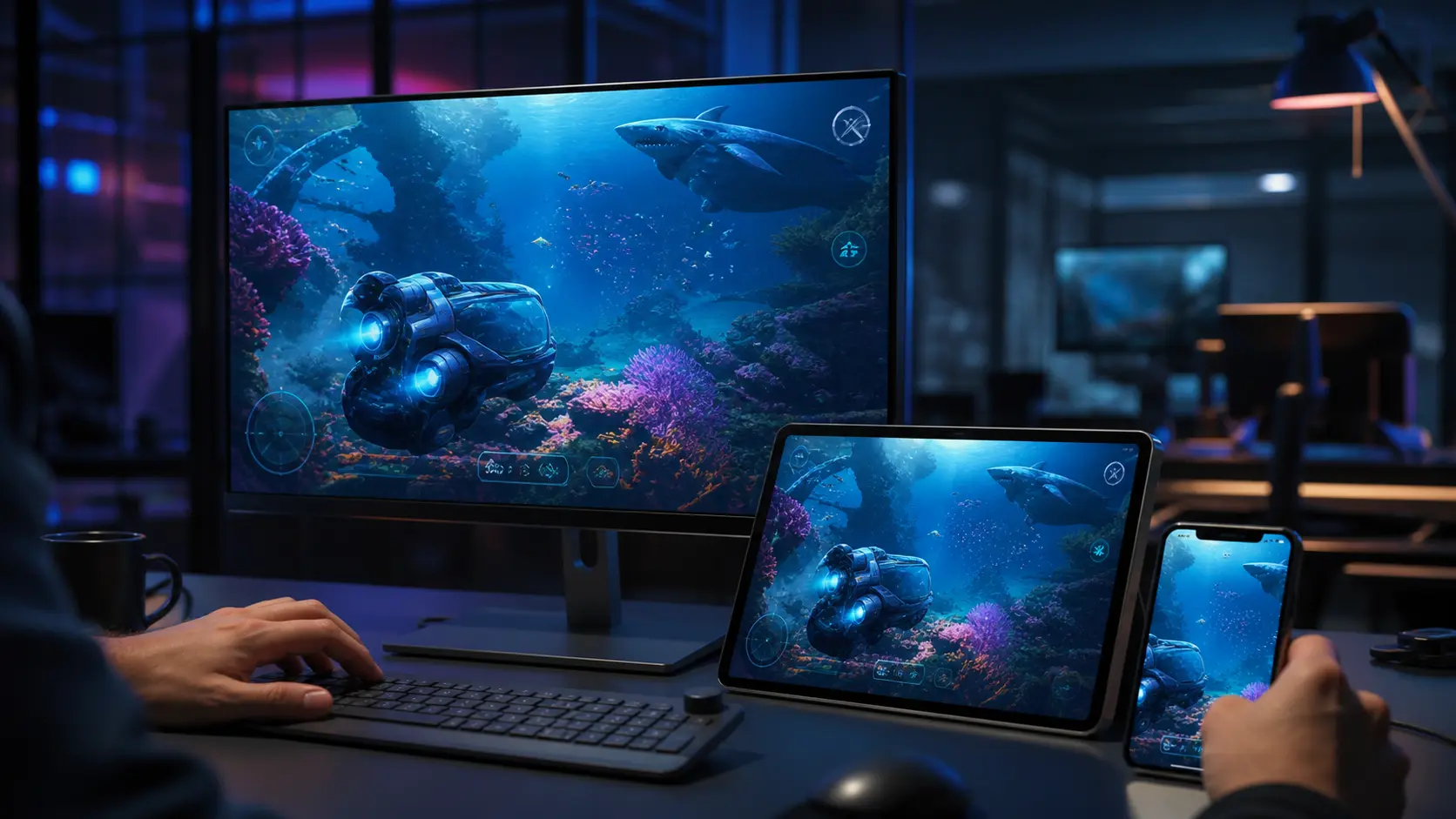
At the heart of any electronic card game lies the shuffling engine. Players in VIP rooms and stadium seating arenas are inherently suspicious of digital cards. To establish absolute trust, the software must perfectly emulate the physical constraints and randomness of a real-world card shoe. We implement an 8-deck continuous shuffle emulation using a cryptographically secure Pseudo-Random Number Generator, commonly backed by a hardware entropy source when deployed in our physical cabinets. To pair commercial baccarat software with custom metal player stations, examine our guide on commercial ETG baccarat cabinet hardware engineering.
Our baseline architecture utilizes a strict Fisher-Yates shuffle algorithm. This ensures that every possible permutation of the 416 cards is equally probable, completely eliminating the subtle biases found in naive modulo-based shuffling routines. When an operator boots up one of our electronic table game servers, the system initializes the shoe by first instantiating the ordered decks and then applying the Fisher-Yates permutation in constant time.
But true casino emulation goes beyond simple shuffling. We rigorously simulate the ritual of the cut card insertion and the burning of cards. At the start of a new shoe, the system virtually discards the first card and reads its face value. It then burns the corresponding number of subsequent cards before the first actual hand is dealt. Furthermore, a virtual cut card is placed near the bottom of the shoe—typically around the 350th card. When the drawing engine reaches this cut card, it triggers the end-of-shoe sequence, notifying the dealer interface or the automated system that only one final hand will be dealt before a reshuffle is required. This meticulous replication of physical procedures is critical for maintaining player confidence. Our cross platform html5 casino game engine architecture ensures these cryptographic operations run seamlessly across mobile apps and heavy-duty terminal screens without any performance degradation.
Baccarat Drawing Rules Engine and Zero Latency Execution
Baccarat is defined by its rigid, deterministic set of rules. Unlike Blackjack where player choice dictates the flow, Baccarat requires the software to instantly resolve whether a third card is drawn for the Player or the Banker. This is known as the Tableau or the Table of Play. Any delay in this calculation disrupts the rhythm of the game and reduces the hands-per-hour metric, directly impacting the operator’s bottom line.
Our drawing rules engine is a masterpiece of algorithmic efficiency. We implement the Tableau as a matrix-driven state machine rather than a cumbersome series of nested conditional statements. When the initial four cards are dealt, the engine calculates the modulo-10 sums in less than a millisecond. If a natural 8 or 9 occurs, the round concludes instantly. If not, the engine queries the Player’s total to determine the third card draw. The Banker’s drawing condition is mathematically more complex, depending entirely on the Banker’s current total and the exact value of the Player’s third card.
By pre-compiling these conditional matrices into the core memory of the game server, we achieve true zero-latency execution. The moment the betting window closes, the result is already computed on the backend; the frontend merely plays out the animations. This deterministic architecture is crucial for synchronization in stadium setups where hundreds of player terminals must reflect the same game state simultaneously. It is the same rigorous approach we apply across all our software, whether we are deploying Baccarat terminals or undertaking custom casino and arcade game software engineering for proprietary regional variants. Our Panyu QA lab mandates that the drawing resolution occurs in under 5 milliseconds under a load of 10,000 concurrent virtual players.
Trend Forecasting and Real Time Roadmap Generation

Asian players rely heavily on trend analysis and pattern recognition. The roadmaps are the lifeblood of Baccarat betting strategies. If an electronic table game software fails to accurately and instantly generate these complex grids, it will be rejected by the market. At Arcade Manufacturer, our software engine calculates the five canonical Asian roadmaps in absolute real-time as each hand concludes.
The foundation is the Bead Plate, a simple chronological recording of hands. From this, the algorithm derives the Big Road, which tracks consecutive wins by dropping down columns and shifting right upon a change in the winning side. The true mathematical complexity emerges when calculating the derived roads The Big Eye Boy, The Small Road, and The Cockroach Pig. These roads do not track who won, but rather the predictability and patterns of the shoe.
Our engine uses a multi-threaded calculation pipeline to analyze the Big Road matrix. For the Big Eye Boy, the algorithm compares the latest entry against the entry one column to the left. The Small Road compares against two columns to the left, and the Cockroach Pig compares against three columns. This requires the software to dynamically look back through the matrix history and resolve the pattern logic (Red for predictable patterns, Blue for chaotic patterns) instantly. Furthermore, we provide a Next-Hand Prediction Query feature. Players can press virtual Ask Player or Ask Banker buttons, and the engine instantaneously simulates the matrix updates to show what the derived roads would look like if that specific side wins the upcoming hand. This predictive rendering is a massive driver of player engagement and betting volume.
Side Bet Mathematical Odds and House Edge Calibration
While the main Player and Banker bets in Baccarat offer extremely low house edges, the true profit margins for operators lie in the side bets. Software engineering for casino mathematics requires absolute precision in probability modeling to ensure the house edge is maintained over millions of simulated hands. We provide complete mathematical odds calibration for a wide array of side bets.
Take the Dragon 7 bet in EZ Baccarat variants, which wins if the Banker wins with a three-card total of 7. Our monte-carlo simulation engine, running on our local servers, calculates the exact combinatorics of the 8-deck shoe to verify that the payout of 40 to 1 yields a theoretical house edge of approximately 7.61 percent. Similarly, the Panda 8 bet (Player wins with a three-card 8) is calibrated for a 25 to 1 payout, resulting in a house edge of roughly 10.19 percent.
We also engineer the logic for Super 6 (where a Banker win with a 6 pays 12 to 1), Player Pair, Banker Pair, and Tie wagers. Each of these mathematical models is deeply integrated into the game server’s configuration files. Operators buying our source code receive full access to the Return to Player (RTP) parameters. If a venue wants to run a promotional period with slightly adjusted side-bet payouts to drive foot traffic, our administration panel allows for real-time adjustments while visualizing the resulting shift in theoretical hold percentage. This level of granular control is what sets a true manufacturer apart from simple software resellers. We understand that operators need robust math models that perform predictably, a principle that applies whether you are running card games or exploring deploying casino grade roulette machines roi model in your venue.
Dragon Tiger Fast Action Variant Engineering
For venues demanding maximum turnover, Dragon Tiger is the ultimate solution. Stripped of the complex drawing rules of Baccarat, this game is a pure test of single-card comparison logic. The engineering focus here shifts from state-machine complexity to raw network pacing and high-frequency transaction processing.
Our Dragon Tiger software engine is optimized for a blistering 15-second betting round. The logic is elegantly simple Player (Dragon) versus Banker (Tiger), highest card wins, with Kings being the highest and Aces the lowest. The critical engineering challenge is managing the tie payout rules and the suit bets. In a standard tie, the house traditionally takes half the main wagers, creating a house edge of exactly 3.73 percent. Our system handles this fractional chip allocation seamlessly within the player wallets, ensuring no rounding errors occur across thousands of micro-transactions.
We also build in advanced suit bets and over/under side bets, calculating the precise combinatorics as cards are depleted from the 8-deck shoe. Because Dragon Tiger resolves so quickly, the user interface and backend communication must be perfectly synchronized. The animations for card dealing are accelerated, and the payout processing is batched to handle the sheer volume of bets per minute. This high-turnover architecture is highly adaptable and serves as the foundation for other rapid-play regional games we develop, such as those requested by clients seeking a teen patti game development company custom software solution.
Integrating Software with Stadium Terminal Cabinets
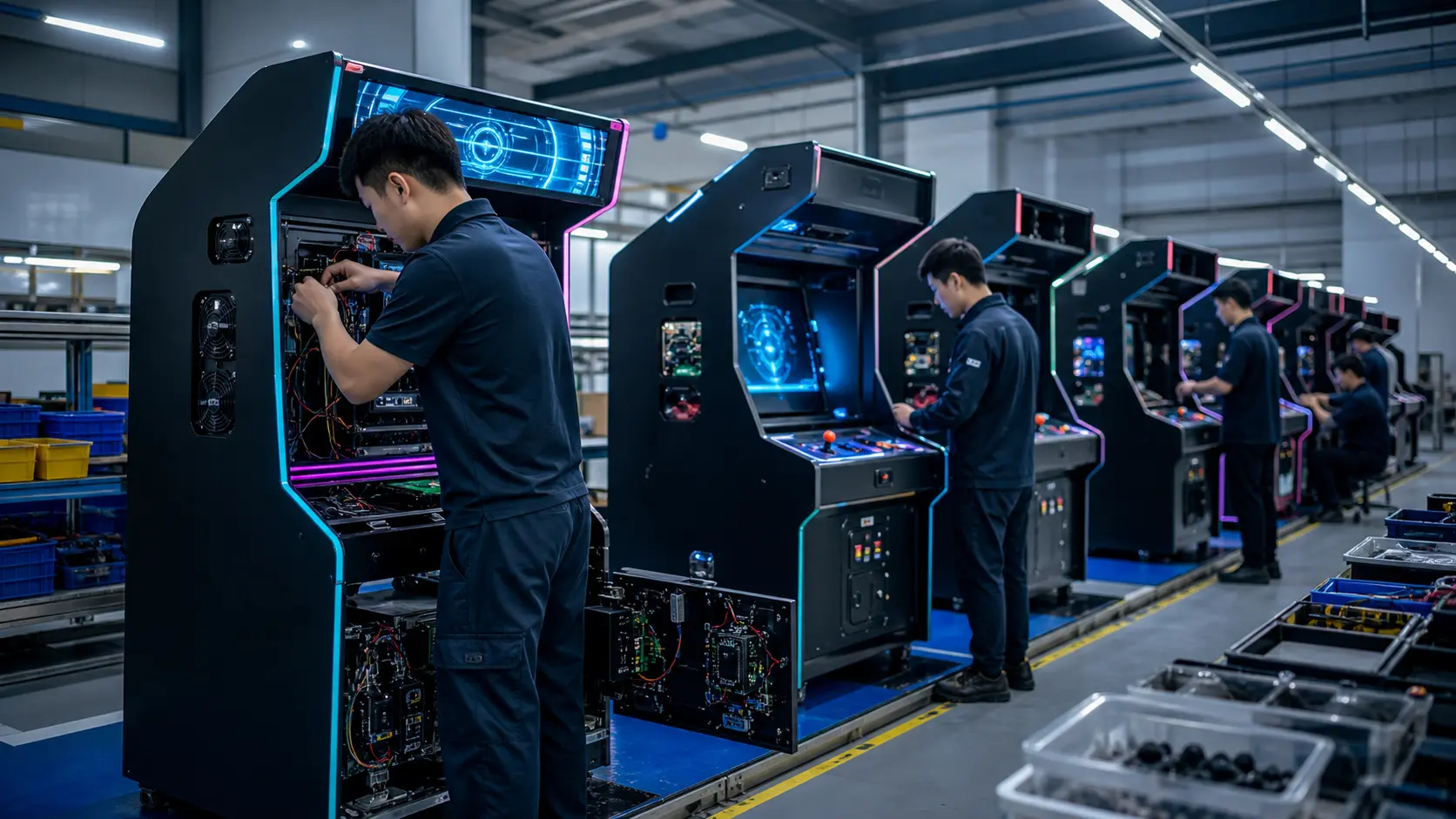
Software exists in a vacuum until it is deployed on industrial hardware. As a turnkey complete machine manufacturer, we design the software and the stadium seating cabinets in unison. Our Panyu factory produces heavy-gauge steel chassis, dual 27-inch capacitive touchscreens, and industrial IoT control boards that serve as the nervous system of the electronic table game arena.
The software engine communicates directly with the hardware layer. Bill validators and ticket printers interface with the game logic through encrypted serial protocols. When a player inserts a note, the credit update on the screen is instantaneous, bypassing standard operating system delays. We also implement physical anti-cheat mechanisms, such as EMP pulse interference shielding and RF signal jamming detectors, directly wired to the software’s alert system. If a hardware anomaly is detected, the game server immediately locks the terminal and alerts the floor manager.
This is the power of working with a source factory. We do not sell you software and point you to a different vendor for the hardware. We deliver the entire ecosystem. From the ergonomic angle of the armrests to the memory management of the drawing algorithm, everything is designed, built, and tested under one roof. Operators looking for full-scale deployments should explore our capabilities in turnkey electronic table game etg baccarat cabinet manufacturing to see how seamlessly our digital math models integrate with physical engineering.
Commercial ROI and Operator Revenue Maximization
The ultimate goal of deploying electronic table games is to maximize revenue per square foot. Traditional live tables require extensive labor costs, dealer training, and pit boss supervision, not to mention the inherent risks of chip theft or payout errors. By digitizing the game logic while maintaining the authentic feel of a live draw, operators drastically reduce overhead and increase the hands dealt per hour.
Our Baccarat and Dragon Tiger systems allow a single live dealer to broadcast to hundreds of terminals, or for the game to run entirely automated via our PRNG engine. The software meticulously tracks every bet, every win, and every side-bet engagement, feeding this data into a comprehensive back-office management system. Operators can view real-time heat maps of betting activity, allowing them to optimize terminal placement and promotional offers.
Because we offer 100% source code buyout, operators are never held hostage by ongoing revenue-share agreements or exorbitant licensing fees. You buy the system, you own the math, and you keep all the profits. We invite casino operators, slot route managers, and iGaming entrepreneurs to visit our Guangzhou factory for a live Factory Acceptance Test (FAT). You can inspect the source code architecture alongside the physical cabinet manufacturing line.
Contact Engineer Wang for Source Code and Turnkey Solutions
If you are frustrated by black-box software solutions that drain your profits or hardware that fails under casino floor conditions, it is time to upgrade to industrial-grade technology. We provide transparent mathematics, flawless game logic, and indestructible cabinets.
Let’s discuss your custom development needs, whether it involves tweaking the Dragon 7 payouts or deploying a 50-seat stadium arena.
- WhatsApp or WeChat: +86 17620842078
- Telegram: https://t.me/JLwyc
- Email: miba515527@gmail.com
In our Panyu QA lab, we prove our technology with rigorous stress testing and transparent mathematical audits. Partner with Arcade Manufacturer and secure the foundational technology your casino deserves.
Frequently Asked Questions
What PRNG algorithm is used for the virtual card shoe in your Baccarat software?
We utilize a cryptographically secure Pseudo-Random Number Generator combined with a constant-time Fisher-Yates shuffle algorithm. This ensures perfect emulation of an 8-deck shoe, complete with simulated cut cards and burn cards, guaranteeing absolute fairness and eliminating predictable patterns.
Can the third card drawing rules for Baccarat be customized?
While the standard Baccarat Tableau is mathematically rigid and globally recognized, our 100% source code buyout model allows operators to request custom modifications. If you require unique regional variants or specific side-bet triggers, our development team can adjust the state-machine logic within the core engine.
How does the software handle real-time roadmap generation for hundreds of terminals?
Our backend server pre-compiles the matrix data for the Big Road, Big Eye Boy, Small Road, and Cockroach Pig using a highly efficient multi-threaded pipeline. The server calculates the outcomes in under 5 milliseconds and pushes the lightweight JSON data to all connected stadium terminals simultaneously, ensuring zero latency across the casino floor.
Are the house edges for Dragon 7 and Panda 8 side bets fixed?
The base mathematical models for Dragon 7 (approx. 7.61% house edge) and Panda 8 (approx. 10.19% house edge) are pre-calibrated based on standard payouts. However, through our administrative backend, operators can adjust the payout ratios for promotional events, and the software will dynamically recalculate and display the new theoretical Return to Player (RTP).
Do you provide the physical cabinets along with the Dragon Tiger software?
Yes, we are a complete turnkey manufacturer. We build both the software engine and the physical stadium terminals in our 15,000-square-meter Panyu factory. This guarantees seamless integration between the game mathematics, the touchscreens, and the hardware peripherals like bill validators and anti-cheat shielding.
Deep Dive Into Baccarat Matrix State Machine Architecture
When we discuss the Baccarat drawing rules engine, it is vital to understand the underlying data structures that make zero-latency execution possible. In traditional software development, developers might rely on nested ‘if-else’ statements to evaluate the Tableau. However, when you scale this to a stadium environment where a single game server must resolve outcomes for up to 500 connected terminals simultaneously, the computational overhead of branching logic becomes a bottleneck.
At Arcade Manufacturer, our 50-person development team engineers the core logic using pre-computed state matrices. The entire Baccarat Tableau is represented as a two-dimensional array stored in the server’s cache memory. The rows represent the Banker’s current two-card total (ranging from 0 to 7), and the columns represent the Player’s third card value (ranging from 0 to 9, plus a state for ‘No Card Drawn’). When a hand is dealt, the engine calculates the initial totals. If the Player draws a third card, the engine performs a single memory lookup operation: BankerDrawAction = Matrix[BankerTotal][PlayerThirdCard]. This O(1) time complexity operation ensures that the decision to draw or stand is resolved in literally zero CPU cycles compared to conditional branching.
This matrix architecture is critical for our turnkey deployments. When we ship a complete machine to a venue, the embedded industrial PC powering the terminal relies on this hyper-efficient backend. This means the hardware does not need to be over-specced with expensive processors just to handle game logic. We pass these hardware savings directly to the operator, maximizing the commercial viability of the installation. Our mathematical odds calibration processes also interface directly with these matrices, allowing our Quality Assurance lab to run millions of simulated hands per second to verify the exact house edge for standard and side bets before the software ever leaves our Panyu factory.
Industrial Hardware and Shielding for Game Fairness
Software perfection is meaningless if the physical cabinet is vulnerable. The electronic table game industry is fraught with security challenges, ranging from physical tampering to sophisticated electromagnetic interference. As a source factory, our perspective on game fairness extends from the cryptographic PRNG algorithm right down to the thickness of the sheet metal.
In our Panyu manufacturing base, we employ a ‘Defense in Depth’ strategy for our stadium terminals and standalone cabinets. The first layer is environmental isolation. The industrial control boards running the game client are housed in a Faraday cage within the cabinet chassis. This prevents malicious actors from using EMP (Electromagnetic Pulse) devices to disrupt the memory chips or force a system reset during a high-stakes hand.
The second layer is peripheral security. The bill validators and ticket printers communicate with the main board using encrypted RS-232 serial protocols rather than vulnerable USB connections. If a connection is severed or tampered with, the terminal instantly goes into a hardware lockout state, preserving the player’s balance on the backend server and alerting the floor manager.
Finally, we address the human element of fairness. The touchscreen interfaces feature high-refresh-rate capacitive panels with specialized anti-glare and privacy filters. This prevents ‘shoulder surfing’ in crowded stadium environments. By engineering the hardware and software in tandem, we deliver a cohesive product where the cryptographic security of the virtual card shoe is matched by the physical security of the cabinet. This holistic approach is why operators trust Arcade Manufacturer for their most critical casino floor infrastructure.
Advanced Data Analytics and Operator Dashboards
The modern casino operates on data. While the players are focused on the roadmaps and the next hand, the operator must have a macroscopic view of the game’s performance. Our turnkey software suite includes a comprehensive back-office management system that transforms raw game data into actionable business intelligence.
Every time the virtual shoe deals a card, the system logs the transaction. We track not just the win/loss metrics, but also player betting behaviors, side bet engagement rates, and session durations. Our dashboard visualizes this data through intuitive heat maps and real-time graphs. Operators can instantly see which terminals are generating the most turnover and which side bets are the most profitable during specific times of the day.
This data is crucial for optimizing the casino floor. If the data shows that the Dragon 7 bet sees higher engagement during evening hours, the operator can configure the digital signage on the stadium displays to promote this side bet when the target demographic is active. Because we provide the complete source code and database architecture, operators have unrestricted access to their own data. They can integrate our backend with their existing casino management systems or loyalty programs via our robust API endpoints. We do not hold your data hostage; we empower you to use it to drive your business forward.
Scalability from VIP Rooms to Stadium Arenas
One of the greatest engineering challenges in electronic table games is designing a system that scales seamlessly from a single VIP terminal to a massive 200-seat stadium setup. Our software architecture is built on a distributed microservices model to ensure absolute scalability.
In a VIP room deployment, the game server, database, and client interface might run on a single, high-performance industrial PC. The latency is virtually non-existent, and the footprint is minimized. However, when deploying a stadium arena, the architecture shifts. We deploy a centralized, high-availability game server cluster that handles the PRNG, the drawing rules engine, and the roadmap generation. This cluster broadcasts the game state via low-latency WebSockets to hundreds of lightweight terminal clients.
The terminals themselves only handle the user interface, bet placement, and hardware peripheral management. This offloads the heavy computational lifting from the endpoints, ensuring that even if a terminal experiences a hardware failure, the main game state remains unaffected. When a terminal reboots, it instantly reconnects to the server and synchronizes its state with the ongoing hand. This resilient architecture ensures maximum uptime and continuous revenue generation for the operator. Our deep expertise in network topology and distributed systems makes us the premier choice for large-scale casino deployments.