- Warehouse Machine Farm Layout and High-Density Modular Framing
- Industrial Electrical Architecture for Continuous Full Load
- Thermal Management and Positive-Pressure Airflow Design
- Machine State Telemetry and Automated Watchdog Recovery
- Source Your Industrial Machine Farm Hardware from the Source
- Technical FAQ
Scaling a remote live arcade business from a few test units to a massive, profit-generating warehouse farm requires a radical shift in engineering philosophy. I am Engineer Wang, Senior Video & Infrastructure Systems Architect at Guangzhou Miba Animation Technology Co., Ltd. (Arcade Manufacturer). Based in our 15,000m² manufacturing facility in Panyu, China, our team designs and deploys industrial-grade hardware infrastructures capable of running 24/7/365 without human intervention. Today, we will explore the heavy-duty warehouse machine farm engineering and automated fleet management required to operate 20 to 100+ physical fish table units reliably.
When you transition to a cloud teleoperation model, physical footprint, thermal load, and system stability become your primary cost drivers. Operators who fail to design their server rooms properly face catastrophic hardware failures and unacceptable downtime. For operators looking to understand the broader context of building a custom system, I highly recommend reviewing our remote live fish table machine custom deployment overview.
Warehouse Machine Farm Layout and High-Density Modular Framing
Traditional physical arcade cabinets are designed to attract foot traffic on a brightly lit casino or arcade floor. They feature sprawling fibreglass molds, oversized monitors, and decorative LED marquees. In a cloud machine farm, these aesthetic components are dead weight and wasted space.
In our Panyu factory, we manufacture stripped-down, high-density server rack chassis specifically designed for remote deployment. We utilize modular aluminum extrusion framing and heavy-duty cold-rolled steel racks that allow us to stack and condense the internal components of a standard 85-inch fish table into a fraction of the cubic volume.
This footprint optimization allows an operator to pack significantly more game boards, IoT edge servers, and WebRTC streaming modules into a standard climate-controlled server room. We incorporate built-in cable management trays to segregate high-voltage power lines from sensitive low-voltage Ethernet and HDMI data cables, preventing electromagnetic interference (EMI). Furthermore, because multiple game boards operating in close proximity generate substantial vibration and noise, we install specialized acoustic baffling and anti-vibration rubber mounts to ensure the physical hardware remains completely stable. For insights into the video pipeline required for this density, read our remote fish table WebRTC video streaming architecture guide.
Industrial Electrical Architecture for Continuous Full Load
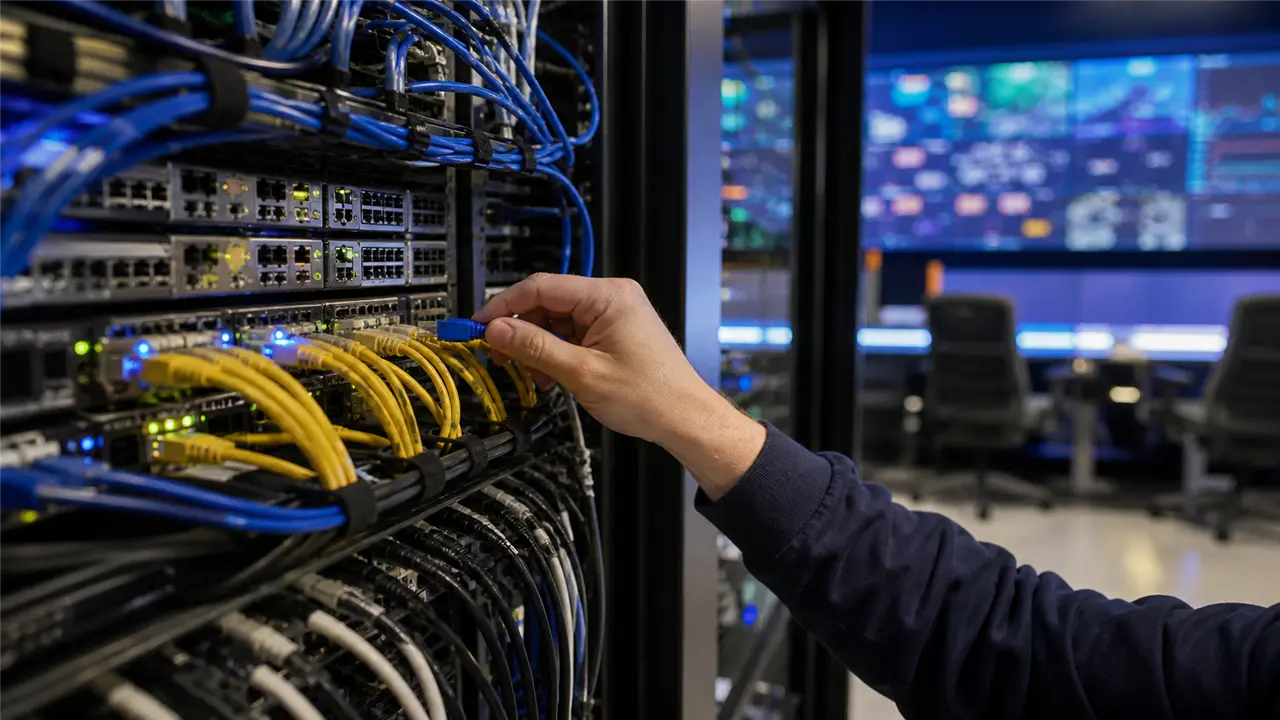
Power delivery is the lifeblood of any server farm. Consumer-grade power supplies and daisy-chained power strips will inevitably fail under the continuous full-load draw of dozens of arcade boards and hardware encoders.
Our standard operating procedure for a commercial machine farm deployment mandates a centralized, industrial-grade power distribution architecture:
- Centralized High-Efficiency Power Supplies: We utilize genuine Mean Well industrial switching power supplies (12V/24V) connected to a heavy-duty copper busbar system. This provides incredibly clean, low-ripple DC power to all game boards and IoT controllers.
- Individual Circuit Breakers: Every individual machine node is isolated on its own DC circuit breaker. If one game board experiences a short circuit or power surge, it trips locally without cascading failure across the entire server rack.
- Power Factor Correction (PFC): Our custom power distribution units (PDUs) include active power factor correction, reducing reactive power load on the facility and lowering the operator’s commercial electricity bill.
- Enterprise UPS Sizing: A sudden power loss can corrupt game databases and sever live WebRTC connections mid-game. We calculate and deploy enterprise Uninterruptible Power Supply (UPS) systems capable of providing at least 15 minutes of bridge runtime, allowing automated backup generators to engage or facilitating a graceful shutdown of the IoT fleet.
Deploying an electrical grid of this magnitude requires strict adherence to international safety standards. You can read more about our rigorous testing protocols in our commercial arcade game machines manufacturing standards.
Thermal Management and Positive-Pressure Airflow Design
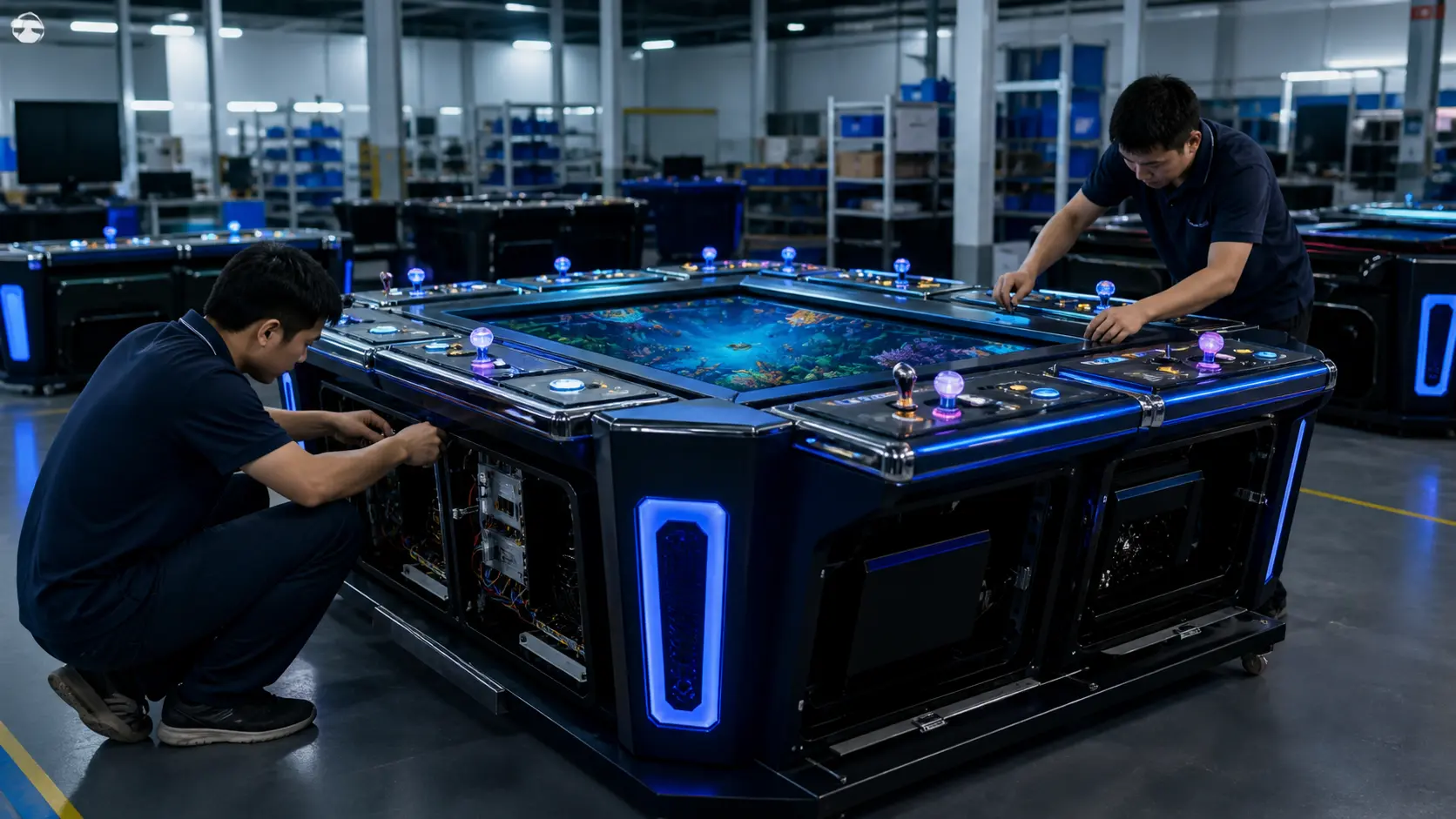
A densely packed rack of game boards and video encoders acts as a massive space heater. Arcade PC hardware is notoriously sensitive to thermal degradation; operating continuously above 35°C dramatically shortens the lifespan of CPUs, RAM, and internal storage.
Our thermal management strategy for cloud fish table farms borrows heavily from hyperscale data center designs:
- Hot-Aisle and Cold-Aisle Containment: We design the rack layouts so that cool air is drawn in from the front (cold aisle) and hot exhaust is aggressively vented out the back (hot aisle). This prevents the recirculating of heated air.
- Positive-Pressure Dust Filtration: Arcade environments can be dusty, but server rooms must be pristine. We engineer the rack enclosures with high-volume intake fans and HEPA-grade dust filters to maintain positive static pressure inside the cabinet. This ensures that any air leaking from seams is pushing dust outward, not drawing it in.
- Industrial Exhaust Fans: We install high-CFM (Cubic Feet per Minute), ball-bearing exhaust fans designed for 100,000-hour MTBF (Mean Time Between Failures).
- Automated Temperature Monitoring: Our IoT telemetry boards constantly monitor ambient and component-level thermals. If temperatures in a specific zone exceed 28°C, the system automatically ramps up fan speeds and alerts the facility manager.
Understanding the initial capital expenditure for this infrastructure is crucial. We break down the financial modeling in our turnkey remote fish table deployment costs analysis.
Machine State Telemetry and Automated Watchdog Recovery
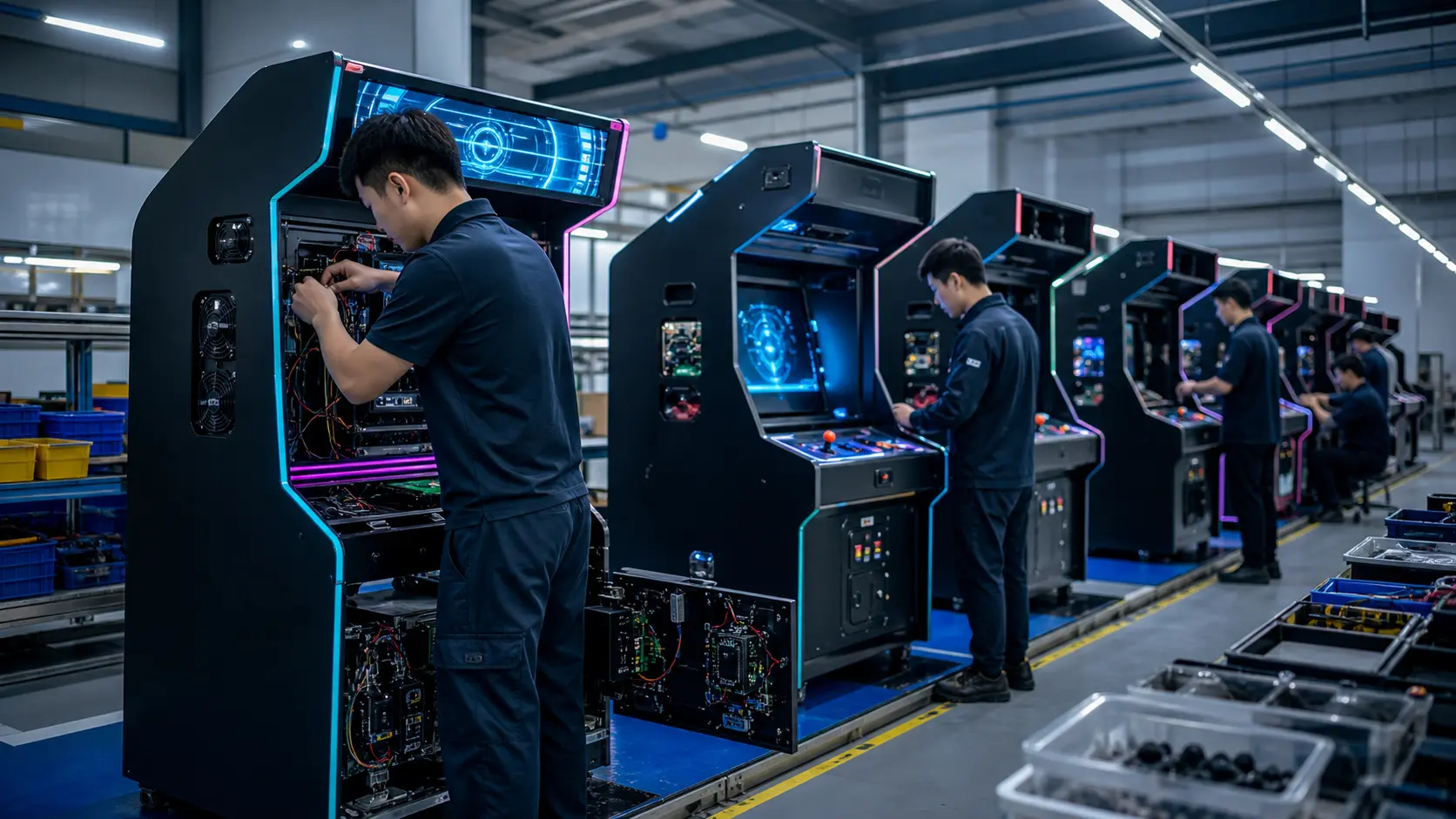
The ultimate goal of a cloud machine farm is zero-touch operation. When you are managing 100+ physical machines, you cannot afford to have technicians manually inspecting screens and rebooting locked-up boards. Our proprietary watchdog telemetry system serves as the automated brain of the server room.
We integrate advanced machine state telemetry that monitors every hardware node in real-time. This is not just a simple network ping test. Our system employs AI-assisted optical freeze detection that actively analyzes the HDMI loop-out video feed. If the AI detects a frozen animation frame persisting for more than 5 seconds, or if it optically reads a specific factory fault code (like the dreaded “Error 88”) on the display, it triggers an immediate automated response.
The automated recovery sequence executes as follows: 1. Fault Detection: The optical AI or SNMP network heartbeat detects a catastrophic hardware lockup. 2. Alert Generation: The system logs the exact timestamp and error code, triggering an SNMP alert to the central management dashboard. 3. Automated Power Cycle: The watchdog hardware communicates via low-level GPIO interfaces to actuate industrial relays, completely cutting the 12V DC power to the offending game board. 4. Reboot and Verification: After a 10-second drain period, power is restored, and the watchdog monitors the boot sequence to ensure the game returns to the standard attract mode before marking it as “online” in the player app.
This level of automation ensures that machine downtime is measured in seconds rather than hours, maximizing operator revenue and player satisfaction. If you are interested in the specific relay hardware that makes this possible, see our multiplayer remote fish table hardware modification deep dive.
Source Your Industrial Machine Farm Hardware from the Source
Operating a profitable remote live arcade farm requires industrial-grade infrastructure, not consumer electronics. Guangzhou Miba Animation Technology Co., Ltd. is the ultimate source factory for complete machine manufacturing, custom game development, and turnkey IoT remote solutions.
We do not just sell machines; we architect robust, automated server environments designed to scale infinitely and operate flawlessly. Whether you need bare-metal rack chassis, custom IoT telemetry controllers, or a complete warehouse deployment strategy, our engineering team is ready to deliver.
Contact Engineer Wang for Technical Consultation & Quotations:
- WhatsApp/WeChat: +86 17620842078
- Telegram: https://t.me/JLwyc
- Email: miba515527@gmail.com
Technical FAQ
html
“`
Why use industrial Mean Well power supplies instead of standard PC power supplies in a machine farm?
Industrial Mean Well power supplies provide much tighter voltage regulation, lower DC ripple, and active Power Factor Correction (PFC) designed for 24/7/365 continuous load. Standard PC ATX supplies will often degrade or fail completely when subjected to the constant high-amperage draw of commercial arcade game boards.
What is AI-assisted optical freeze detection in a remote arcade farm?
It is an automated monitoring system that actively scans the raw HDMI video output of each game machine. If the AI detects that the graphics have frozen or recognizes a specific error code on the screen, it instantly alerts the watchdog system to perform a hard hardware power cycle via GPIO relays without human intervention.
Why is positive-pressure airflow important for server racks housing arcade boards?
Positive-pressure airflow uses high-CFM intake fans pushing air through HEPA filters to maintain a higher air pressure inside the rack than outside. This ensures that cool, filtered air cools the components, and any air leakage at the seams pushes outward, preventing warehouse dust from accumulating on sensitive electronics.