- The Core Philosophy Behind Profitable Math Models
- The Mathematical Foundation of Arcade Game Economics
- Integrating Math Models with Secure Hardware Architecture
- The Factory RTP Calibration Process
- Specialized Math Models for Different Arcade Genres
- Independent Auditing and Regulatory Certification
- Maximizing Operator Return on Investment
- The Factory Acceptance Test and Quality Assurance Checklist
- Advanced Troubleshooting for Arcade Math Models and Payouts
- Frequently Asked Questions
- Accelerate Your Venue Profitability Today
As a venue operator facing peak Friday night crowds, the hardware of your arcade cabinet is only the outer shell. The true heartbeat that dictates whether you bleed capital or secure consistent revenue is the underlying mathematical model and Return to Player (RTP) calibration. I am Engineer Wang, Lead Hardware and Game System Architect at Guangzhou Miba Animation Technology Co., Ltd. Over the past 12 years inside our 15,000-square-meter Panyu manufacturing base, my 50-person R&D team and I have engineered, tested, and shipped thousands of highly profitable arcade machines across the globe. We know that operators do not just buy cabinets; they buy a mathematically proven revenue stream that must perform flawlessly under the most extreme real-world conditions.
In this exhaustive technical breakdown, we pull back the curtain on how a legitimate arcade manufacturer designs custom math models, calibrates RTP for maximum engagement, and implements robust anti-cheat hardware integrations. From random number generator certification to hardware-level EMP protection and ROI payback scenarios, we will equip you with the engineering truth needed to maximize your floor profitability and eliminate downtime. If you need a custom mathematical model tailored to your local market demographic, reach out directly via WhatsApp at +86 17620842078 or Telegram at https://t.me/JLwyc. For factory-direct procurement and comprehensive engineering specs, consult our master guide on commercial arcade game machines manufacturing factory.
The Core Philosophy Behind Profitable Math Models
At the heart of every successful fish game, coin pusher, slot hybrid, or redemption cabinet is a meticulously balanced math model. This is not about arbitrary difficulty spikes or artificially punishing players; it is about statistical volatility, predictable payout curves, and guaranteeing operator margin. When players feel a game is unfair, they walk away and never return. When a game is too loose, your venue becomes a charity. The mathematical sweet spot requires industrial-grade engineering and relentless factory calibration.
Why Operators Must Control Volatility and Variance
Volatility determines the frequency and size of player payouts. High volatility games offer massive jackpots but infrequent hits, suited for hardcore risk-takers seeking the thrill of a major win. Low volatility games provide constant micro-rewards, keeping casual players engaged for hours through steady dopamine release. As a venue owner, your floor mix must balance these dynamics to cater to all demographics. A dedicated arcade manufacturer designs math models that allow operators to dynamically adjust these volatility indexes through backend operator panels without altering the fundamental gameplay loop or breaking the mathematical integrity of the system. We design our variance matrix to ensure that short-term player luck never threatens the long-term mathematical certainty of the house edge.
Defining Return to Player in Physical Arcade Environments
RTP in a physical arcade setting differs significantly from pure digital or online platforms because of real-world hardware variables. When we state that an RTP is calibrated to a specific draw, such as 94 percent, it mathematically dictates that over a statistically significant number of game cycles, the machine retains exactly 6 percent of the coin-in as pure operator profit. However, physical coin jams, EMP attacks, hopper misfeeds, or intentional power cycling can drastically skew these numbers if the hardware is not seamlessly integrated with the software logic. Our Panyu R&D team ensures that every mathematical transaction is logged, encrypted, and completely isolated from hardware fault states, ensuring your stated RTP remains absolute regardless of what happens on the physical arcade floor. We engineer systems that maintain their tight 92 to 96 percent RTP targets relentlessly, ensuring your weekly revenue targets are met.
The Psychological Cadence of Payout Systems
Player retention is heavily influenced by hit frequency and near-miss scenarios. A player who constantly loses will quickly abandon the cabinet, leaving an empty seat during your busiest hours. Conversely, a player who almost wins the grand jackpot feels compelled to try again, driven by the psychological perception that they are mathematically due for a massive win. Our custom mathematical models calculate the exact frequency of these psychological triggers based on neurobehavioral research. By analyzing millions of gameplay sessions in our testing facilities, we have identified the optimal reward cadence that maximizes time on device while strictly adhering to operator margin requirements. We engineer the illusion of attainability backed by the cold, hard reality of statistical control.
The Mathematical Foundation of Arcade Game Economics

Developing a custom math model requires a multidisciplinary approach combining probability theory, behavioral psychology, and secure state management. Our engineers approach game logic as a rigorous financial instrument designed to yield predictable returns for the operator.
Random Number Generation and Seed Entropy
True randomness is the bedrock of fair and profitable arcade mechanics. We utilize hardware-based true random number generators capturing environmental thermal noise and quantum fluctuations rather than relying purely on pseudorandom algorithms driven by predictable system clocks. This critical hardware decision prevents skilled players, syndicates, or malicious actors from reverse-engineering the PRNG sequence and timing their bets to mathematically exploit the machine. Our proprietary hardware boards integrate secure cryptoprocessors to generate and obfuscate these seeds, guaranteeing cryptographic security at the foundational level of the game logic. Every spin, every shot fired, and every coin dropped is governed by impenetrable math.
Dynamic Probability Adjustment Algorithms
Modern arcade games require much more than static, linear probability tables. We implement dynamic probability adjustment algorithms that constantly monitor real-time coin-in versus coin-out ratios. If a machine experiences an anomalous payout spike due to a legitimate player hot streak or extreme statistical variance, the algorithm smoothly and imperceptibly micro-adjusts subsequent probabilities. This brings the machine back to the target operator RTP over the long term, without breaking the illusion of fairness or frustrating the player with obvious dead spins. This dynamic compensation is a delicate balance of pacing and reward psychology, ensuring your Friday night profit targets are never jeopardized by a single lucky player.
Weighted Reels and Paytable Architecture
For games involving spinning reels or localized target destruction, such as multi-player fish hunter games, the architecture of the paytable is paramount. We do not use uniform probability distributions. Instead, we employ highly complex weighted mapping. A specific high-value symbol or boss monster might appear frequently on the screen to entice the player, but the mathematical weighting governing its actual capture or alignment is tightly controlled and separated from the visual representation. This separation of visual presentation and underlying probability allows us to create highly engaging, visually explosive games that remain completely subservient to the operator financial requirements and the factory-calibrated RTP.
Mapping the Standard Deviation and Confidence Intervals
Before a custom math model is finalized and approved for production, our data scientists calculate the standard deviation and establish strict confidence intervals for the payout curve. We provide operators with the mathematical proof that within a defined number of plays, the actual RTP will fall within a tight percentage of the target RTP with absolute certainty. This level of granular statistical analysis removes the guesswork from venue management, transforming arcade cabinets from unpredictable gambling devices into stable, predictable financial assets with a known rate of return and zero operational anxiety.
Integrating Math Models with Secure Hardware Architecture
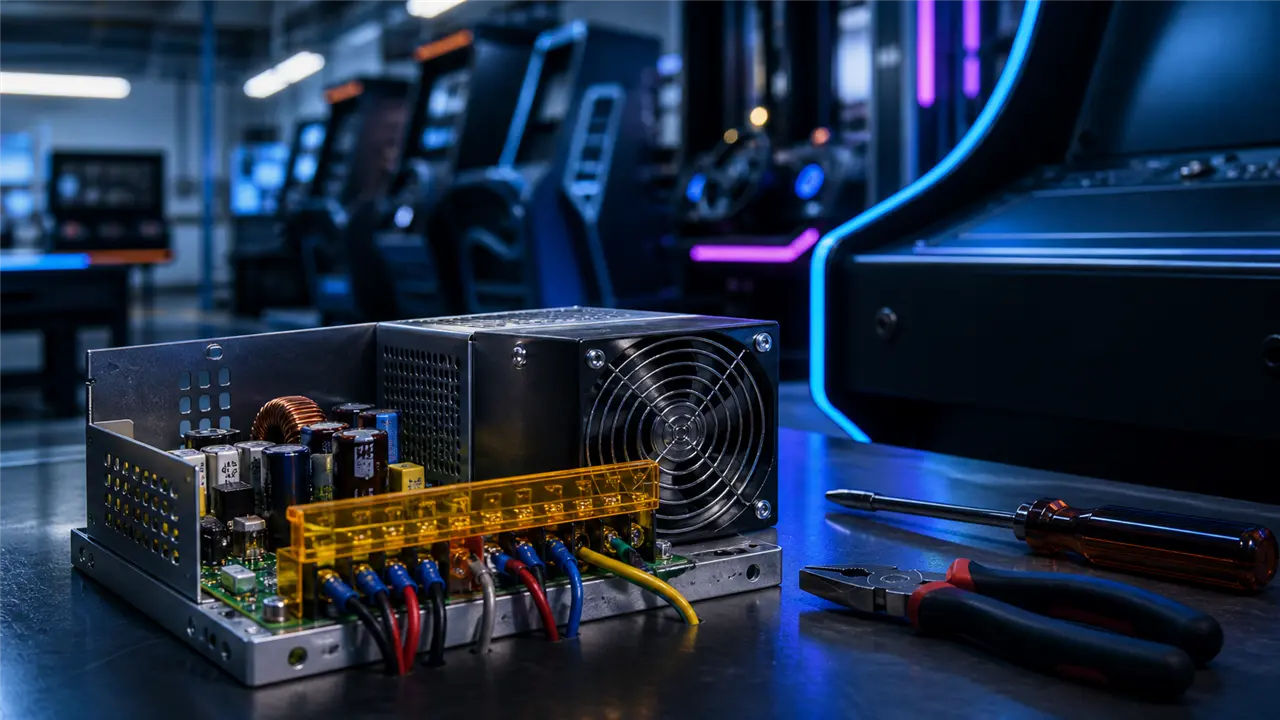
A mathematically perfect software model is entirely useless if the physical hardware executing it can be compromised by external actors. Our manufacturing approach at Guangzhou Miba Animation Technology treats software and hardware as a unified, impenetrable security perimeter designed to protect operator capital.
Defeating EMP and High-Frequency Jammer Devices
Arcade venues worldwide are frequently targeted by organized groups utilizing electromagnetic pulse devices, RF jammers, or piezoelectric sparkers to force hopper payouts or artificially inflate credits without inserting currency. Our customized JAMMA boards, IoT controllers, and proprietary logic circuits feature military-grade EMP shielding and hyper-fast transient voltage suppressors. If a high-frequency voltage spike or RF anomaly is detected, the hardware triggers an immediate non-maskable interrupt. This instantly freezes the current game state, physically cuts power to all payout mechanisms via solid-state relays, triggers a localized alarm, and irreversibly records the event in the non-volatile security ledger. Your money stays securely inside the machine.
Secure Communication Protocols and Data Encryption
The communication link between the game logic board and vulnerable peripherals like bill validators, coin mechs, and payout hoppers is a critical attack vector. We completely discard standard, unencrypted serial connections or pulse-line inputs in favor of proprietary, encrypted RS-485 or CAN bus protocols. The math model engine mathematically signs every single payout command with a dynamic, time-sensitive cryptographic hash. The intelligent hopper controller must verify this hash before dispensing even a single coin or ticket. This sophisticated handshake prevents bypass tools from injecting counterfeit payout commands or spoofing credit inputs.
Watchdog Timers and Absolute State Recovery
Power fluctuations, intentional brownouts, or malicious power cycling can corrupt game states, leading to disputed payouts, angry customers, or lost operator revenue. Our systems utilize independent, hardware-level watchdog timers completely separate from the main CPU clock. If the main processor hangs, loops, or is glitched by an external attack, the watchdog instantly resets the system safely. Crucially, the math model continuously writes its precise state, credit balance, and RNG seed to redundant EEPROM every few milliseconds. Upon reboot from a power failure, the machine resumes the exact state prior to the interruption down to the frame, protecting both the operator profit and the player legitimate credits, ensuring zero downtime disputes.
Optical Isolation for Pulse Interfaces
For legacy venues that require standard pulse-based bill acceptors or coin mechs, we implement absolute optical isolation. The pulse signal from the peripheral is separated from the main logic board by a physical air gap inside an optocoupler. High voltage injected into the coin door cannot cross this gap to fry the logic board or trigger false credits. The excessive voltage simply destroys the inexpensive input stage while leaving the expensive logic board and your vital math model completely untouched and secure, minimizing replacement costs and repair time.
The Factory RTP Calibration Process
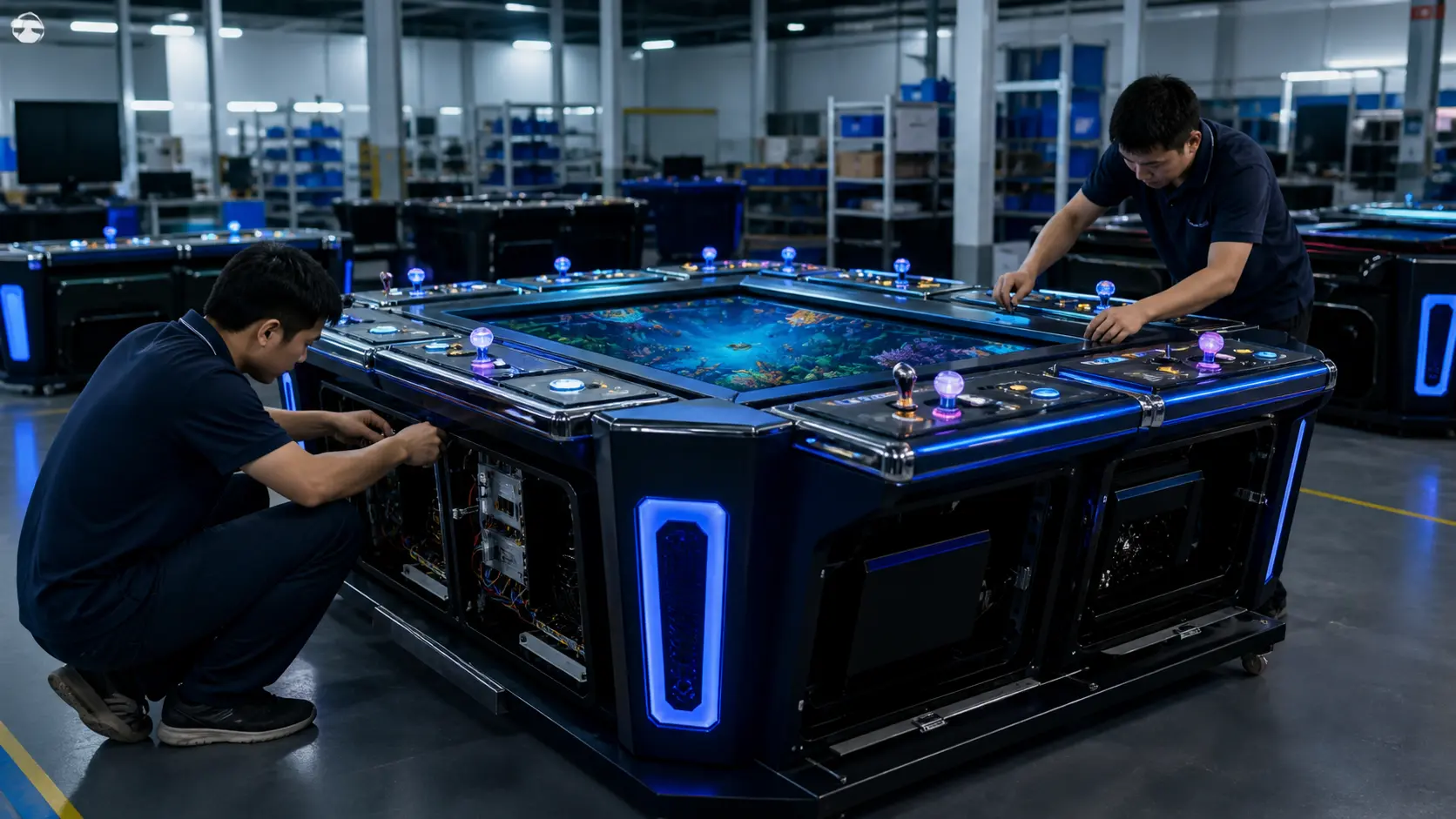
Calibration at our Panyu factory is not a guessing game. It is a rigorous, data-driven factory procedure designed to mathematically guarantee your revenue before the arcade machine ever leaves the shipping port and arrives at your venue.
Extensive Monte Carlo Simulations
Before any custom game code is burned to ROM or flashed to production storage, our engineering team runs hundreds of millions of automated Monte Carlo simulations on massive server clusters. We simulate varying bet sizes, chaotic player strategies, multiplayer interactions, and extended session durations to map the exact RTP curve and variance over time. This exhaustive process allows us to identify and completely eliminate edge-case exploits where a specific, highly improbable combination of actions might mathematically force a payout exceeding operator limits. We mathematically break the game in the lab so players cannot break it on your floor.
Physical Burn-In and Hardware Integrity Testing
Mathematical simulations are only the first step. They must be validated by physical burn-in testing on the actual production line. We subject fully assembled cabinets to continuous operation under extreme load conditions. Automated pneumatic actuators simulate rapid coin drops and button presses, while precision electronic load cells verify the exact weight of coin payouts against the software digital ledger. This ensures the physical dispensing mechanisms are perfectly synchronized with the digital math model, guaranteeing that mechanical fatigue does not alter the payout ratio or disrupt the player experience.
Configurable Operator DIP Switches and Software Dashboards
Different global regions have vastly different regulatory requirements, competitive landscapes, and player demographics. We provide operators with granular control over the final RTP and volatility settings via secure internal physical DIP switches or a highly encrypted, password-protected operator administration panel. Operators can confidently shift a machine from a 92 percent tight configuration for casual locations to a 96 percent loose configuration for highly competitive halls, knowing the underlying math model has been factory-certified to remain stable at both extremes without breaking or malfunctioning.
Specialized Math Models for Different Arcade Genres
The application of mathematical models varies significantly across different styles of arcade games. Our factory customizes the mathematical engine to perfectly suit the physical mechanics and psychological appeal of the specific cabinet type.
Fish Hunter Game Mathematical Dynamics
In multiplayer fish shooting games, the math model must account for simultaneous, high-frequency inputs from up to eight players. Our algorithms track the cumulative coin-in from all stations and dynamically adjust the vulnerability of high-value boss characters in real-time. This ensures that the global machine RTP remains strictly controlled, while individual players still experience the thrill of capturing major targets. The math model balances the visual chaos of the screen with a rigidly structured underlying financial ledger, ensuring the operator never loses control of the payout ratio.
Coin Pusher and Redemption Logic
For physical coin pushers and redemption games, the math model must integrate directly with the mechanical realities of the cabinet. We calibrate the timing of the pusher shelf, the frequency of bonus drops, and the probability of triggering secondary digital mini-games to align perfectly with the target RTP. The math model calculates the exact physical volume of coins required to push a prize over the edge, ensuring the payout matches the theoretical probability curve mapped during our Monte Carlo simulations. This creates a seamless fusion of physical physics and digital mathematics.
Slot Hybrid and Skill-Based Models
In markets requiring an element of skill to comply with local regulations, we engineer math models that incorporate genuine player input while still maintaining a defined operator edge. We achieve this by mapping a portion of the RTP to physical timing or aiming mechanics, while the remainder is governed by our secure TRNG. This dual-layered mathematical approach provides the legal compliance of a skill game with the financial predictability and profitability of a traditional high-retention arcade cabinet.
Independent Auditing and Regulatory Certification
To provide operators with absolute peace of mind and strict legal compliance in heavily regulated jurisdictions, we subject our proprietary mathematical models to intense third-party scrutiny. We do not just claim our algorithms are mathematically sound; we prove it through independent certification.
Source Code Reviews and GLI Compliance
Our mathematics team actively collaborates with leading independent testing laboratories such as Gaming Laboratories International (GLI) and BMM Testlabs. We provide these auditors with full access to our source code, RNG logic, and paytable architecture. They mathematically verify that our claims regarding statistical randomness, non-predictability, and overall Return to Player percentages are absolutely accurate and devoid of hidden developer backdoors. When you purchase a certified custom math model from our Panyu factory, you receive a mathematically verified asset.
Verifying Paytable Accuracy and Claimed Volatility
Auditors execute millions of automated spins and game cycles using our exact production hardware boards. They meticulously map the empirical payout data against our stated theoretical paytable to ensure there are no deviations or calculation errors in the live environment. This rigorous verification process ensures that the 94 percent RTP we promise in the manual is the exact 94 percent RTP your physical machine will yield on your floor, eliminating any discrepancy between software design and hardware execution.
Secure Supply Chain and Firmware Hashing
Certification is meaningless if the code can be altered after the audit. To prevent unauthorized modifications in transit or deployment, we implement strict firmware hashing. Before a logic board is sealed inside a cabinet, the final certified firmware is cryptographically hashed, and the unique signature is permanently recorded. Venue operators and field technicians can independently verify this hash using a secure boot process. If a malicious actor attempts to flash a compromised ROM to alter the payout ratio, the hash mismatch immediately triggers a system halt, ensuring the certified math model remains completely untouched.
Maximizing Operator Return on Investment
Every technical specification, every line of code, and every circuit pathway we implement is designed to serve one primary goal, which is accelerating your capital payback period and driving long-term, stress-free profit for your arcade business.
The True Cost of Poor Mathematical Design
An improperly balanced math model is a silent, invisible revenue killer. If the game is too tight, players abandon the machine permanently, resulting in dead floor space and zero coin-in. If the game is too loose or mathematically exploitable, the machine operates at a net loss, actively draining your business. Furthermore, hardware vulnerabilities that allow credit stuffing or forced payouts destroy your margins instantly and demoralize your staff. Partnering with a legitimate arcade manufacturer that owns the math model ensures you are investing in a secure profit center, not buying a massive liability.
Example Revenue and ROI Projection
To clearly illustrate the financial impact of a mathematically sound game and secure hardware, consider the following baseline projection for a custom high-visibility arcade cabinet operating in a moderate traffic venue versus a high traffic venue.
| Financial Metric | Moderate Traffic Scenario | High Traffic Scenario |
|---|---|---|
| Average Daily Coin-In | $400.00 | $950.00 |
| Target RTP Calibration | 94.00% | 94.00% |
| Effective House Edge | 6.00% | 6.00% |
| Average Daily Gross Profit | $24.00 | $57.00 |
| Monthly Gross Profit (30 Days) | $720.00 | $1,710.00 |
| Estimated Cabinet Capex | $2,800.00 | $2,800.00 |
| Projected Payback Period | ~3.8 Months | ~1.6 Months |
| Annual ROI | ~308% | ~732% |
These numbers rely entirely on the absolute stability of the game math model and the physical security of the cabinet. A single EMP exploit, a software RNG glitch, or a mechanical hopper over-pay could easily wipe out an entire month of profit in an hour. Our engineering guarantees that your daily gross profit is mathematically protected against both player luck and malicious attacks, ensuring fast CAPEX payback and sustained profitability.
The Factory Acceptance Test and Quality Assurance Checklist
We actively invite our B2B clients to verify our engineering firsthand. Our Factory Acceptance Test protocols are transparent, rigorous, and specifically designed to prove the resilience of our machines before you accept delivery.
- RNG Entropy Verification We provide tools to review the statistical output of the hardware random number generator, proving a uniform distribution free from predictable patterns or seeding biases.
- EMP Resilience Stress Test We subject the active, powered-on cabinet to direct high-frequency localized EMP interference from commercial jammers and verify immediate system lockout, state retention, and failure to dispense unauthorized credits.
- Power Cycling State Recovery We aggressively disconnect main AC power during an active jackpot payout sequence. We then reboot the system to verify the precise resumption of the payout, ensuring neither the operator nor the player loses a single credit.
- Ledger Synchronization Audit We rigorously compare the internal digital coin-in and coin-out logs stored in the encrypted software against the physical, non-resettable mechanical meter counts for absolute parity down to the final coin.
- Peripheral Communication Integrity We attempt to trigger hopper payouts using unauthorized serial injection tools and pulse generators, verifying the cryptographic handshake rejection and immediate system alarm state.
- Thermal Stress Testing We operate the logic boards in extreme environmental chambers to ensure the TRNG and CPU do not experience thermal drift that could subtly alter probability calculations.
Advanced Troubleshooting for Arcade Math Models and Payouts
Even with pristine factory calibration and robust hardware, venue operators may occasionally encounter operational anomalies due to extreme environmental factors or mechanical wear. This guide provides immediate, engineering-level diagnostic steps for common revenue-impacting issues.
| Observed Symptom | Probable Engineering Cause | Recommended Operator Action |
|---|---|---|
| Coin-out exceeds theoretical RTP limit over a continuous 7-day period. | Anomalous player strategy exploit, subtle hopper over-dispense mechanical issue, or incorrect base denomination setting. | Audit internal software ledger for payout spikes. Clean hopper optic sensors with isopropyl alcohol. Verify RTP DIP switch configuration matches expected setting. |
| Machine enters hardware lockout state during peak operation without warning. | Anti-cheat sensors detected transient voltage spike, unauthorized access attempt, or severe grounding fault. | Inspect cabinet exterior for physical tamper marks. Verify wall outlet grounding continuity with a multimeter. Clear security log via master operator key and monitor. |
| Player reports missing credits after a brief power sag or building brownout. | EEPROM write failure due to failing backup capacitor, or corrupted watchdog state recovery sequence. | Verify site AC voltage stability. Check power supply 5V and 12V rails with multimeter under load. Replace logic board lithium backup battery if voltage is under 2.8V. |
| Digital software meters do not match physical non-resettable mechanical meters. | Desynchronization in the pulse counting circuit, noisy input lines, or a failing mechanical relay coil. | Inspect wiring harness for loose ground connections. Test mechanical meter pulse response with an oscilloscope. Recalibrate software multiplier settings in the admin panel. |
| Frequent hopper coin jams constantly interrupting payout pacing and angering players. | Worn dispensing disc, bent coin routing chute, accumulation of metallic dust, or incorrect coin denomination loaded. | Clear physical jam entirely. Verify coin diameter and thickness strictly match hopper specifications. Clean and lightly lubricate moving mechanisms with dry PTFE spray. |
Related Engineering References and Floor Operational Guides
- For our comprehensive factory production standards, review our China arcade machine manufacturer sourcing framework.
- To inspect our physical facility, see our Guangzhou arcade game factory sourcing guide.
- Analyze component BOM pricing with our arcade machine manufacturing cost breakdown.
- Compare direct cabinet pricing in our fish table wholesale manufacturer pricing guide.
Frequently Asked Questions
Can I dynamically adjust the RTP after the machine is deployed to my venue?
Yes. Our proprietary operator control panel allows authorized venue managers to securely adjust the RTP within a pre-certified mathematical range. These adjustments instantly recalculate the internal volatility matrix without requiring a physical ROM replacement, allowing you to react dynamically to your floor traffic, local competition, and weekly revenue targets while maintaining absolute mathematical integrity.
How do you completely prevent players from finding mathematical exploits in custom games?
We rely on massive-scale Monte Carlo simulations during the software development and QA phase. By running billions of simulated game cycles through heuristic analysis algorithms on our server farms, we map out every conceivable betting strategy and input combination. If a mathematical exploit exists that breaks the operator margin, we identify it and patch the logic before the code is ever finalized for production, ensuring your machine is bulletproof from day one.
Is the hardware random number generator truly secure against physical tampering?
Absolutely. We implement physical TRNG hardware that generates entropy from quantum-level thermal noise. This module is physically shielded and actively monitored by the main processor. If the system detects any attempt to cool the chip with refrigerant, bombard it with radiation, or manipulate the entropy source, the game enters an immediate, irreversible fail-safe lock state to protect your revenue, requiring a physical master key reset to restore operation.
What actually happens when an EMP device triggers a fake coin-in signal on your boards?
Our custom JAMMA interface boards utilize strict optical isolation circuits and massive transient voltage suppressors on all input lines. An EMP pulse or piezoelectric spark cannot bridge the physical gap in the optocoupler to inject a signal into the main processor. The high voltage is instantly shunted to earth ground, the logic board completely ignores the noise, and the machine logs an attack attempt in the security ledger while continuing normal, uninterrupted operation.
Can your custom math models support multi-site progressive jackpots across different cities?
Yes. We engineer advanced networked game solutions featuring low-latency, encrypted WebRTC and WebSocket communication. This architecture allows multiple cabinets across different physical venues or even different countries to contribute to a synchronized, mathematically sound progressive jackpot pool. This drives massive player engagement and marketing potential while maintaining strict, centralized global RTP controls on our secure backend servers, ensuring the house always retains its mathematical edge.
Accelerate Your Venue Profitability Today
Do not gamble your capital on generic, unverified arcade cabinets with black-box mathematical models and weak, exploitable hardware security. You need a dedicated engineering partner that fundamentally understands the intricate link between statistical probability, hardware resilience, and operator ROI. When Friday night arrives and your floor is packed, you need absolute certainty that every machine is generating profit, not bleeding capital to exploits or mechanical failures.
Whether you need a custom-developed fish hunting game precisely tailored to your local demographic, a fleet of ultra-secure coin pushers, or a complete white-label arcade management system, our Panyu manufacturing base is ready to deliver. We provide full source code delivery options for enterprise clients, comprehensive white-label branding, and relentless technical support from the engineers who actually designed the mathematics and built the hardware.
Stop losing revenue to street exploits, mechanical downtime, and poorly optimized game logic. Secure your floor and guarantee your margins today. Contact Engineer Wang directly to discuss your custom math model requirements, request our latest technical whitepapers and RTP certification reports, or schedule a live video tour of our manufacturing and QA facilities in Guangzhou.
- Direct WhatsApp for Technical Consultation +86 17620842078
- Telegram Engineering Channel https://t.me/JLwyc
- Email Specifications and RFQs miba515527@gmail.com