- The Economics of Fish Table Arcade Operations and ROI Variables
- Core Hardware Architecture for Commercial Environments
- Mathematical Models and Profit Retention Algorithms
- Security Hardware and Advanced Anti-Cheat Mechanisms
- Factory Acceptance Test Protocol and Quality Assurance
- Troubleshooting Framework and IO Pinout Reference
- Frequently Asked Questions Regarding Fish Table Sourcing
When arcade operators first contact our factory, they are rarely concerned with the raw specifications of a sheet metal cabinet, the exact chemical composition of the wiring insulation, or the theoretical electrical output of a generic power supply. Instead, the questions I hear every single day are focused strictly on survival, risk mitigation, and profitability on the venue floor. Venue owners want to know if a crowded, high-stakes Friday night peak session will cause a system crash that wipes out player credits and triggers a near-riot. They ask how they can prevent sophisticated players from using electromagnetic pulse devices (EMP) to steal points from vulnerable coin acceptors. They worry about bill validators jamming during crucial operating hours, leading to angry front-desk disputes, poor online reviews, and irretrievable lost revenue. Ultimately, every operator needs to know exactly how fast the machine will pay for itself and whether the underlying math model genuinely protects the house edge without driving players away in frustration.
I am Engineer Wang, Lead Hardware and Game System Architect at Guangzhou Miba Animation Technology Co., Ltd. Over the past twelve years, I have seen every possible way a venue can lose money due to inferior hardware, sloppy assembly, or weak security logic. I have spent my entire career designing solutions to stop those specific revenue leaks. Operating out of our 15,000-square-meter manufacturing base in Panyu, Guangzhou, our dedicated team of fifty engineers builds industrial-grade arcade equipment meant for relentless, continuous, and high-intensity operation. In this comprehensive framework, we will bridge the gap between factory-level hardware design and your bottom-line venue profit, revealing exactly what makes a premier fish table wholesale manufacturer a critical partner for your business. For factory-direct procurement and comprehensive engineering specs, consult our master guide on commercial arcade game machines manufacturing factory.
Ready to see how our engineering protects your revenue? Request our latest technical whitepaper on arcade hardware security today, and let us start the conversation.
The Economics of Fish Table Arcade Operations and ROI Variables
Running a profitable fish game venue requires a ruthless calculation of capital expenditure versus operational revenue. A high-quality fish table is not a mere toy or casual amusement device; it is an industrial revenue-generating asset that must perform flawlessly under the stress of aggressive multi-player action. To fully understand why premium manufacturing matters in this space, we must deeply analyze the revenue flow of a typical arcade setup.
Many operators make the fatal mistake of sourcing cheap, unbranded machines from secondary assembly workshops simply to save on initial capital costs. However, the true cost of a machine is quickly revealed in its downtime. If an eight-player or ten-player fish table goes offline due to a blown power supply or a burnt-out input/output board during peak weekend hours, the lost revenue can instantly eclipse whatever money was saved on the purchase price. Furthermore, players who experience game freezes, lag spikes, or lost credits will often abandon the venue entirely. In the highly competitive arcade market, player trust is paramount, and losing it results in permanent customer attrition.
Our engineering philosophy at Guangzhou Miba Animation Technology Co., Ltd. is built fundamentally around maximizing your uptime. We engineer our cabinets to run 24 hours a day, seven days a week, in environments characterized by high humidity, fluctuating grid voltage, poor ventilation, and intense physical abuse. When you invest in a machine built for true commercial use, the return on investment (ROI) accelerates rapidly. A well-placed, mathematically balanced fish table can often return its initial capital cost within three to four months, provided the hardware remains flawlessly stable and the math model correctly retains the designated profit margin.
Capital Expenditure and Operational Expenditure Analysis
The initial purchase price of a fish table encompasses the physical cabinet, the heavy-duty monitor, the central game board (such as IGS platforms or custom software logic), the complex wiring harness, the power supply unit, and the payment systems. This capital expenditure (CAPEX) is a fixed upfront cost. The operational expenditures (OPEX) include venue electricity, commercial rent, staff wages, insurance, and most importantly, ongoing maintenance and spare parts.
By utilizing industrial-grade components—such as pure copper wiring harnesses that prevent voltage drop and branded Meanwell power supplies that ensure clean electrical delivery—we drastically reduce your operational expenditure on maintenance. You stop paying expensive local technicians for emergency weekend repairs because the hardware simply does not fail. This hardware reliability translates directly into higher daily net profit margins and a dramatically more predictable cash flow for the venue owner, allowing for faster expansion and scale.
Core Hardware Architecture for Commercial Environments
To understand how we achieve zero-downtime reliability, we must look inside the cabinet. The internal architecture of a commercial fish table is a carefully orchestrated system of power distribution, signal processing, and robust physical security.
Industrial Power Supply Units and Voltage Regulation
The heartbeat of any arcade machine is its power supply unit (PSU). Many budget manufacturers use generic, uncertified power supplies that output highly unstable voltage with massive ripple interference. This electrical instability silently degrades the logic boards over time, causing mysterious game resets, micro-stutters, and eventual permanent component failure.
In our Panyu QA lab, our internal protocol mandates the exclusive use of high-tier power supplies, such as genuine Meanwell units or specialized industrial equivalents that meet strict international electrical standards. These premium units feature active power factor correction (PFC) and robust transient voltage surge suppression. If the electrical grid in your venue experiences a sudden spike from heavy machinery turning on nearby, our power supplies clamp the surge within picoseconds. This massive transient energy is safely dissipated, protecting the sensitive CPU and expensive game boards. This means your players never experience a mid-game crash that requires refunds, and your hardware investment is heavily insulated from bad grid power.
Precision Input Devices and Anti-Vandalism Features
The joysticks and action buttons are the primary physical interface between the player and the machine. In a gambling or high-stakes competitive environment, adrenaline runs high, and players often strike the controls with significant physical force. Standard consumer-grade microswitches will bend or fail within weeks under such sustained abuse.
To combat this, we utilize reinforced arcade-grade microswitches specifically rated for over ten million actuations. The joysticks feature hardened steel shafts and heavy-duty centering springs that resist bending, fatigue, and deliberate snapping. Furthermore, the control panel itself is constructed from thickened, cold-rolled sheet metal, coated in scratch-resistant poly-carbonate overlays that withstand cigarette burns, spilled high-sugar drinks, and heavy blunt impacts. By completely eliminating control interface failures, we eliminate the need for frequent, tedious replacement parts and keep the machines on the floor earning money continuously.
High Definition Visuals and Display Panel Durability
The immersive visual appeal of a fish game is its primary draw; players are captivated by the vibrant ocean environments and exploding visual effects. We integrate A-grade commercial LCD and LED panels offering true 4K resolution, deep contrast ratios, and high refresh rates to ensure no motion blur during fast gameplay.
However, a beautiful screen is entirely useless if it is shattered by an angry player throwing a heavy object. To prevent this, every monitor we install is heavily shielded by a thick layer of tempered, explosion-proof glass. This optical-grade protective barrier is rigorously drop-tested and impact-tested to withstand direct hits from heavy objects, ensuring that a momentary outburst from a player does not result in a catastrophic, multi-thousand dollar equipment loss.
Looking for custom cabinet designs that fit your venue aesthetic? Send a message to Engineer Wang via WhatsApp at +86 17620842078 for our current catalog of modular and custom enclosures.
Mathematical Models and Profit Retention Algorithms
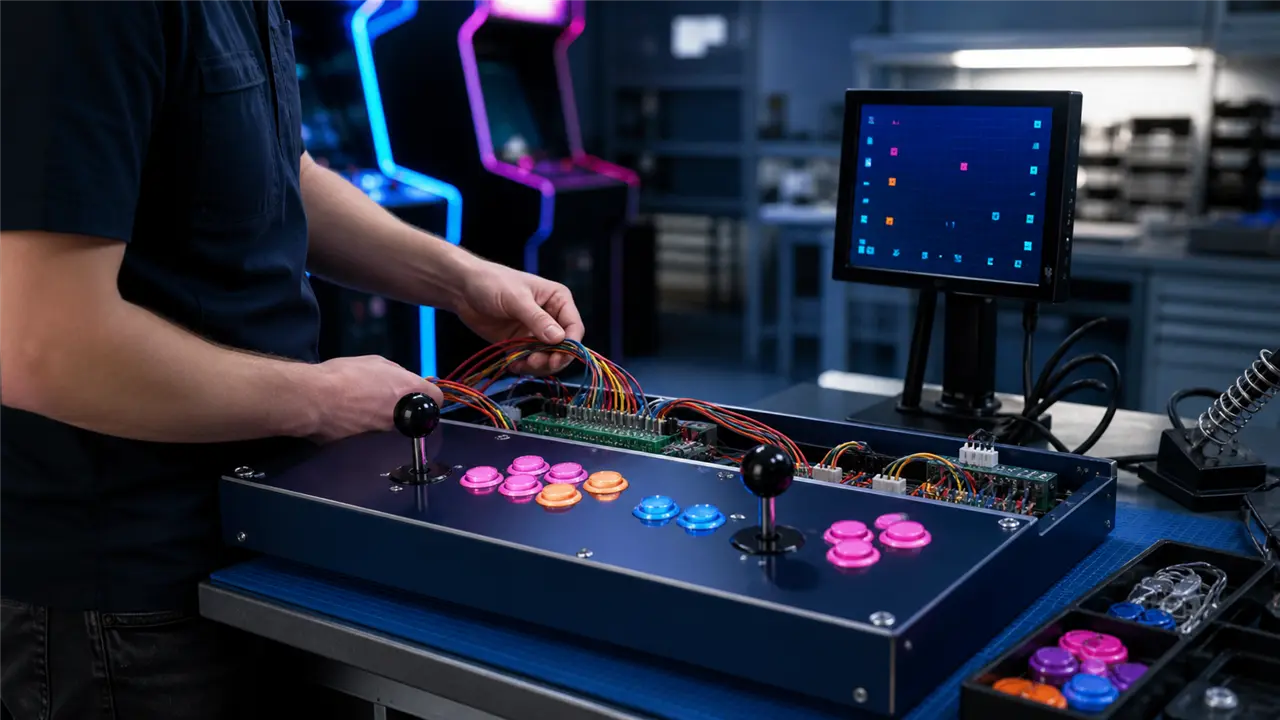
No matter how physically robust the hardware is, a fish table is only profitable if its internal mathematics are correctly balanced and strictly enforced. The Return to Player (RTP) percentage mathematically determines the long-term profitability of the machine. Venue operators need a system that absolutely ensures consistent profit while delivering enough exciting, visually spectacular wins to keep players deeply engaged and continuously spending money.
Balancing Volatility and Player Engagement
Our game software development team at Guangzhou Miba Animation Technology Co., Ltd. spends months fine-tuning the complex math models of our proprietary fish games. A standard commercial fish table usually operates with an RTP strategically set between 92 and 96 percent. This means the venue retains a mathematical edge of 4 to 8 percent over the long term, acting as the consistent house profit.
However, RTP alone is not enough to guarantee a successful game. The volatility of the game—the frequency, timing, and size of payouts—must be meticulously engineered. If a game absorbs money too quickly without offering occasional, substantial wins, players will feel blatantly cheated and walk away permanently. If it pays out too frequently or predictably, the operator risks negative daily cashflow and cash-box depletion.
Our math models use dynamic algorithmic adjustments that constantly monitor the current pool of credits and the historical payout ratio. The system mathematically creates periods of high tension and high reward, simulating the natural ebb and flow of chance while strictly protecting the venue’s overall profit margin. It recognizes patterns of high-stakes betting and scales the random number generation appropriately to ensure the house edge is never compromised, even against highly coordinated groups of players.
Server-Side Calculations versus Local Logic
For operators seeking the absolute highest level of security and scale, we offer advanced systems where the core random number generation (RNG) and payout calculations are handled on a secure, encrypted remote server rather than locally on the physical game board.
This modern architecture completely prevents any localized tampering. Even if a bad actor gains physical access to the cabinet, hacks the internal network, or attempts to flash the local storage, they cannot alter the payout logic because the critical mathematical decisions are being made on a remote, secure node. This setup is particularly popular and highly recommended in our Remote Live Arcade solutions, effectively bridging the gap between physical hardware resilience and enterprise-grade digital security.
Security Hardware and Advanced Anti-Cheat Mechanisms
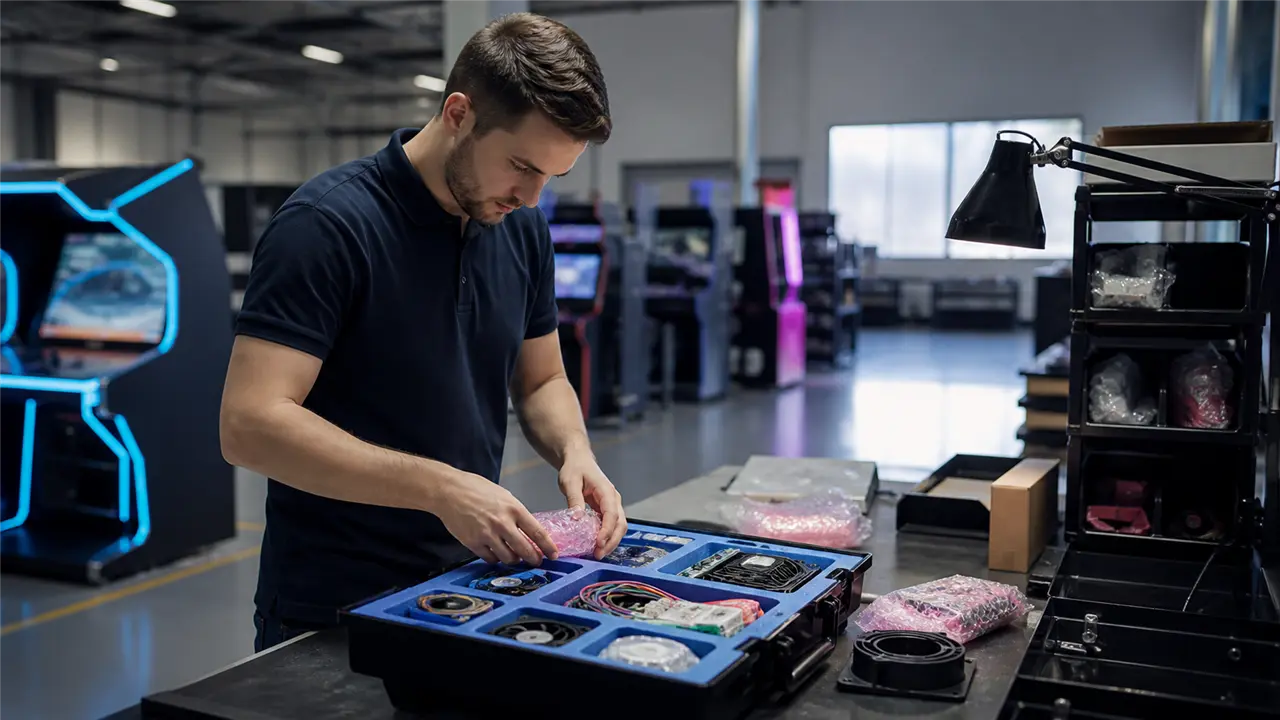
Arcade security is an ongoing, aggressive arms race. As an operator, you are constantly up against organized, professional players utilizing specialized electronic equipment to drain credits illegally. As a manufacturer, it is our core responsibility to build impenetrable countermeasures directly into the hardware architecture.
Defeating Electromagnetic Pulse Devices
One of the most common and devastating threats to unshielded arcade machines is the electromagnetic pulse (EMP) jammer. Malicious players use these covert handheld devices to emit high-frequency electromagnetic bursts directly near the coin acceptor or bill validator. In poorly designed machines, this pulse induces a false electrical signal on the wiring harness, tricking the motherboard into registering hundreds of deposited credits without any actual money changing hands. This can empty a cash box digitally in minutes.
We eliminate this threat entirely through multi-layered hardware isolation. First, we utilize high-speed optocouplers on the input/output (I/O) boards. An optocoupler transmits the sensitive credit signal using a beam of light inside a sealed chip rather than a direct electrical connection. When an EMP hits the machine, the electrical surge cannot cross the optical gap, and the fake signal is completely blocked.
Second, we integrate physical anti-interference shielding around the payment components. Our proprietary V5/K8 multi-band anti-theft modules actively monitor the localized environment for abnormal radio frequency activity across a wide spectrum (from 300 to 1200MHz). If an EMP attempt is detected, the system will immediately lock the machine, reject all inputs, and trigger a silent alarm to the venue management system.
Encrypted Communication and Dynamic Key Exchange
Another sophisticated attack vector involves physically splicing into the wires and intercepting the communication between the bill validator and the main processing board. To counter this, we implement AI intelligent trojan terminators and dynamic key exchange protocols across all critical communication buses.
Every time a bill is accepted and verified by the validator, the pulse signal is heavily encrypted using a dynamic cryptographic key that scrambles the data stream. If a cheat device attempts to record and replay an old signal, the system rejects it immediately because the key has already changed. This military-grade encryption ensures that absolutely every credit registered on the screen corresponds definitively to verified currency sitting securely in the locked cash box.
Require assistance upgrading your current venue security or auditing your floor for vulnerabilities? Connect with our engineering team on Telegram at https://t.me/JLwyc for a free, confidential technical consultation.
Factory Acceptance Test Protocol and Quality Assurance
Before any machine is permitted to leave our 15,000-square-meter facility, it must strictly pass our stringent Factory Acceptance Test (FAT). This protocol is the final gatekeeper, ensuring that the equipment will perform flawlessly the moment it is powered on at your venue.
We absolutely do not believe in spot-checking or batch sampling; every single unit undergoes a grueling, individualized inspection process.
The 48-Hour Continuous Burn-In Phase
Electronic components, regardless of quality, are most likely to fail during their initial hours of operation (the “infant mortality” phase of the bathtub curve). To prevent these early-life failures from happening on your arcade floor, every completed machine is powered on and subjected to a 48-hour continuous burn-in test.
During this intensive period, the machines run maximum graphics rendering loads while environmental variables such as temperature and humidity are closely monitored. We intentionally push the processors to their thermal limits. Any microchip, capacitor, logic board, or power supply that shows the slightest signs of thermal instability, voltage sag, or graphical artifacting is immediately discarded and replaced. This ensures you only receive battle-tested hardware.
Wiring Harness and Payment System Verification
Following the burn-in, our master technicians manually inspect every single crimp, connector, and solder joint in the massive wiring harness. We test the bill validators with a wide variety of global currencies, intentionally introducing severely worn, heavily wrinkled, damp, and taped bills to thoroughly verify the optical sensors’ rejection and acceptance thresholds.
The coin hoppers and ticket dispensers are cycled thousands of times to ensure they will not jam during peak continuous operation. Only when a machine scores a perfect pass across all mechanical, electrical, software, and aesthetic metrics is it signed off by our QA lead and approved for crating and international shipping.
Troubleshooting Framework and IO Pinout Reference
Even with the most robust manufacturing processes in the world, operators must be prepared for basic venue maintenance. Understanding your machine’s wiring and logic flow is the first crucial step in rapid troubleshooting and minimizing downtime.
Common Diagnostic Solutions for Venue Operators
If a specific player station suddenly loses input control (e.g., the joystick stops responding), the issue is almost never the main processor. The fastest, most effective diagnostic step is to swap the localized I/O board with an adjacent, known-working station. If the problem moves with the board, the board requires replacement. If the problem remains at the specific station, the fault lies definitively within the mechanical microswitches or a specific severed wire in the harness segment.
Furthermore, if the bill validator repeatedly rejects legitimate, clean currency, the optical lenses may be obstructed by ambient dust, cigarette smoke residue, or physical debris. We provide our operator partners with highly detailed maintenance schedules, including weekly cleaning protocols for bill validators using non-abrasive, alcohol-free optical wipes. Regular, scheduled preventive maintenance is always exponentially cheaper and less stressful than emergency weekend repairs.
Related Engineering References and Floor Operational Guides
- To secure your floor against transient spark attacks, see our breakdown on EMP jammer detectors for fish game arcades.
- Compare footprint and power demands with our commercial Ocean King hardware specifications.
- For pulse harness isolation schematics, inspect our fish table bill validator wiring guide.
- Calculate venue launch economics with our commercial fish table arcade setup and ROI model.
Frequently Asked Questions Regarding Fish Table Sourcing
How long does it take for a standard commercial fish table to achieve profitability in a typical venue? Assuming proper venue placement, adequate foot traffic, and a mathematically sound RTP model set between 92 and 96 percent, a high-traffic location can often see the machine fully pay for its capital cost within three to four months. Variables influencing this timeline include local demographics, marketing efforts, competition, and crucially, the flawless hardware uptime guaranteed by our industrial manufacturing standards.
Can I customize the game math, RTP, and visual assets for my specific local market? Yes. Guangzhou Miba Animation Technology Co., Ltd. provides full white-label hardware and software customization. We can adjust the volatility index, modify 3D visual elements to better suit local cultural tastes, and integrate specific payment gateway protocols or currency acceptors required by your strict regional gaming regulations.
What specific hardware prevents malicious players from using EMP cheating devices to steal credits? Our machines utilize multi-layered, redundancy-based defenses. This includes optical isolation (optocouplers) on all pulse input lines, heavy-duty physical electromagnetic shielding around the logic boards and cash box, and active V5/K8 anti-theft modules that detect high-frequency surges and neutralize the input instantly before a fake credit can register.
Do you supply replacement parts for ongoing maintenance and how fast can I get them? Absolutely. We maintain a massive, dedicated inventory of standardized components at our Panyu facility. Because we utilize universally recognized commercial standards like JAMMA harnesses and standardized modular IO boards, parts are easily swappable without soldering. We can air-freight emergency replacement parts worldwide via DHL or FedEx within a matter of days.
How do you handle crating and international shipping for large multi-player cabinets to prevent transit damage? We never cut corners on packaging. We use heavy-duty, heat-treated export-grade wooden crating specifically designed to withstand extreme maritime and air freight physical stresses. The cabinets are moisture-sealed in specialized anti-static wrapping and heavily shock-mounted on industrial pallets, ensuring they arrive at your facility in pristine condition, ready for immediate, profitable deployment on your floor.
Ready to optimize your arcade operations with factory-direct industrial hardware that guarantees security and maximizes ROI? Skip the middlemen, brokers, and trading companies, and speak directly to the engineers who design and build your machines from the ground up. Contact Engineer Wang via WhatsApp at +86 17620842078, reach out on Telegram at https://t.me/JLwyc, or email miba515527@gmail.com to schedule a live video tour of our manufacturing facility, discuss your venue requirements, and secure your custom technical quote today.